Books like Verity: five unsettling reads, ranked by fit

Best overall: Rebecca by Daphne du Maurier. Best for fast-moving domestic deception: The Wife Upstairs by Rachel Hawkins. Best for a psychological puzzle: The Silent Patient by Alex Michaelides. This 2026 guide ranks five books like Verity by the qualities that matter: attraction tangled with suspicion, secrets inside a household, and uncertainty about whose account deserves your trust.
- Rebecca is the strongest overall match for Verity’s unsettling household, romantic insecurity, and competing accounts of another woman.
- The Wife Upstairs suits readers seeking domestic suspense with attraction, social ambition, and concealed histories.
- The Last Mrs Parrish emphasizes manipulation; Behind Closed Doors emphasizes danger rather than romantic uncertainty.
- The Silent Patient suits readers who preferred Verity’s interpretive puzzle to its romance.
For a list shaped around your favorite part of Verity, GetSimilarBooks gives you five hand-curated read-alike suggestions. You can also request a free personalized list of 20–30 titles by email.
Why this matters
Verity combines several reading pleasures that do not always travel together. There is the uneasy attraction, the intimidating household, the disturbing written account, and the question of what a reader should believe. A thriller can match one of those qualities and miss the others completely.
The useful question is not simply whether another book contains a twist. It is whether you want to feel seduced, trapped, suspicious, or forced to reconsider an explanation. These five recommendations move from the closest emotional match toward more specialized alternatives. None requires revealing a major twist to explain the connection.
What makes the best books like Verity?
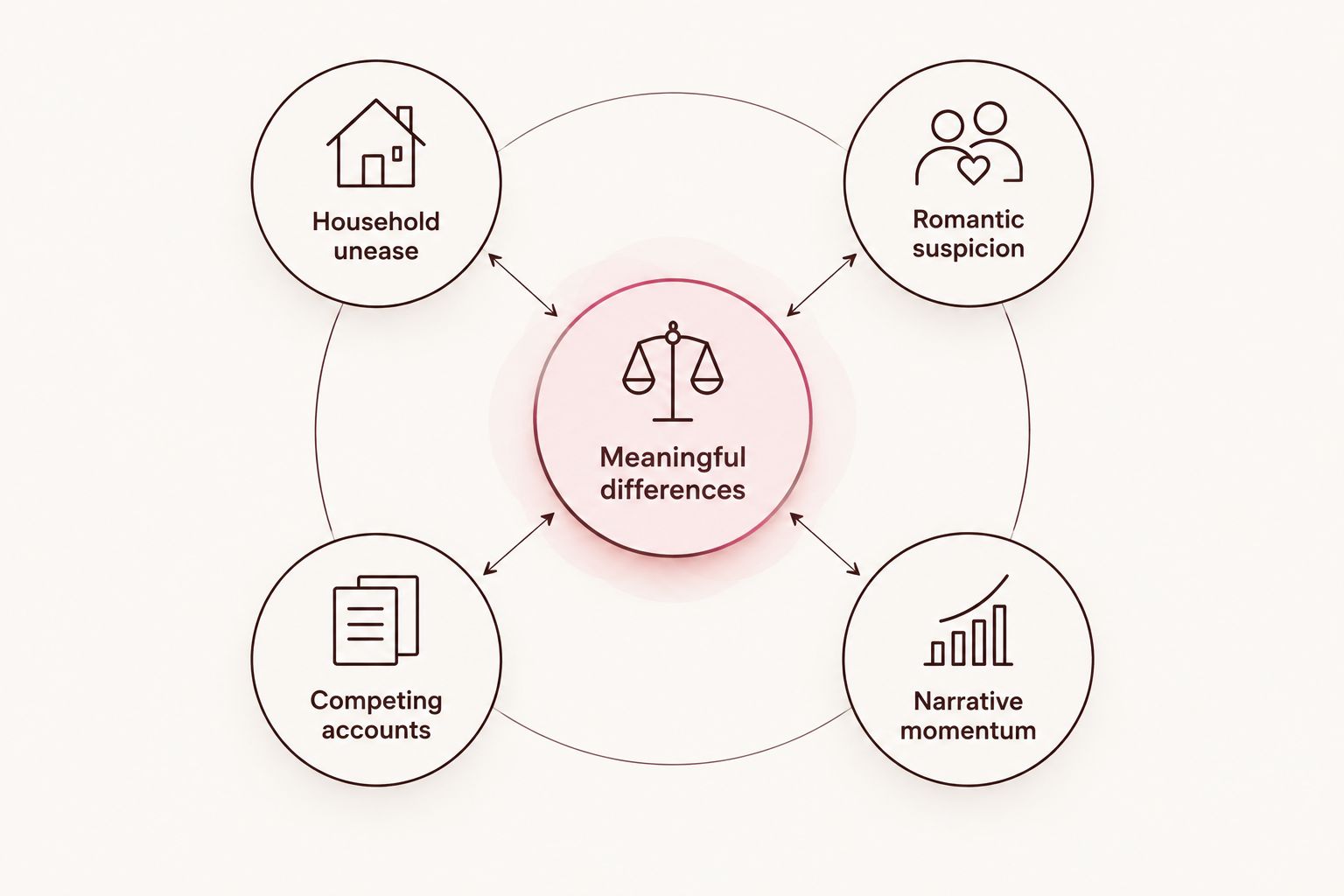
For this 2026 shortlist, the matching criteria are specific:
- Household unease: A home should feel like a place where access, knowledge, or control is unevenly distributed.
- Romantic suspicion: Attraction should complicate judgment, not sit beside the suspense as an unrelated subplot.
- Competing accounts: Different versions of a person or relationship should make belief an active part of reading.
- Narrative momentum: The book should give you reasons to keep investigating, whether through urgent scenes or accumulating discomfort.
- Meaningful differences: The recommendation should explain what changes, especially pace, sexual explicitness, and the kind of danger involved.
A shared genre label is not enough. A domestic thriller about a marriage can still feel very different from Verity if the danger is obvious and the romance offers no uncertainty. Likewise, a slower gothic novel can be a close match if its household and emotional tensions create the right unease.
Books like Verity at a glance
| Rank and book | Best for | Standout matching quality | Key limitation |
|---|---|---|---|
| 1. Rebecca — Daphne du Maurier | An unsettling household and romantic insecurity | Another woman’s presence shapes a marriage and a home | Slower gothic suspense; not an explicit romantic thriller |
| 2. The Wife Upstairs — Rachel Hawkins | Fast-moving domestic deception | Attraction, ambition, and concealed histories collide | More focused on reinvention than a disturbing manuscript |
| 3. The Last Mrs Parrish — Liv Constantine | Calculated manipulation | A desirable marriage becomes a contest over appearances | Social ambition takes more space than gothic atmosphere |
| 4. Behind Closed Doors — B. A. Paris | Claustrophobic relationship danger | A polished marriage conceals private control | Less romantic ambiguity; more sustained threat |
| 5. The Silent Patient — Alex Michaelides | Interpreting an elusive account | A psychotherapist tries to understand a woman who will not speak | The central pursuit is clinical, not romantic |
1. Rebecca: best Verity read-alike for household unease
Daphne du Maurier’s Rebecca follows an unnamed young woman who marries Maxim de Winter and enters Manderley, his country estate. His first wife, Rebecca, remains a powerful presence in the house and in other people’s accounts. The new wife has access to the rooms but not to an explanation she can comfortably trust.
That imbalance makes Rebecca the strongest overall recommendation here. Like Verity, it places romantic insecurity inside a household shaped by another woman. The tension comes from wondering whether the relationship offers belonging or whether the narrator has misunderstood the situation she entered.
Rebecca pros:
- The home itself carries emotional pressure rather than functioning as scenery.
- Accounts of another woman shape the narrator’s understanding of her marriage.
- Attraction and insecurity remain connected to the suspense.
Rebecca cons:
- The pacing is more gradual than Verity’s immediate shocks.
- The sexual tension is less explicit, and the gothic style requires more patience.
The specific match is not a manuscript, an identical plot, or a promise of the same ending. It is the experience of entering an intimate arrangement whose history belongs to everyone except you. That makes Rebecca especially useful if you finished Verity still thinking about the household and the competing images of its central woman.
Best for: Readers who want romantic unease, a charged setting, and uncertainty about another woman’s story.
Verdict: Read Rebecca first. Choose it for the closest emotional architecture, not for an identical pace.
2. The Wife Upstairs: best for fast-moving domestic deception
Rachel Hawkins’s The Wife Upstairs follows Jane, a dog walker in a wealthy Alabama neighborhood, as she becomes involved with widower Eddie Rochester. His late wife’s history complicates the appeal of the life Jane wants. The novel reworks elements of Jane Eyre within a contemporary domestic thriller.
The Verity connection is the mixture of attraction and incomplete information. Jane’s interest in Eddie is entangled with ambition, while the apparent promise of his household gives you something to distrust. You are watching a relationship develop without treating its surface explanation as settled.
The Wife Upstairs pros:
- Romantic interest creates access to the central mystery.
- Concealed histories keep the household from feeling secure.
- Social ambition gives the protagonist motives beyond simple curiosity.
The Wife Upstairs cons:
- The emphasis falls on reinvention and deception rather than disturbing written testimony.
- The contemporary social setting creates a different atmosphere from Verity’s enclosed household.
Choose this over Rebecca if you want the next read to feel more like a contemporary thriller. The attraction remains part of the problem, but the novel spends more attention on who wants a particular life and what they conceal to obtain it.
That distinction matters. Wanting access to someone’s world is not the same as knowing the person who controls it. The Wife Upstairs makes that gap central to its appeal.
Best for: Readers who want attraction, domestic secrets, and a more immediate thriller rhythm.
Verdict: Read The Wife Upstairs if Rebecca sounds too slow. It is the stronger alternative for contemporary relationship suspense.
3. The Last Mrs Parrish: best for calculated manipulation
Liv Constantine’s The Last Mrs Parrish centers on Amber Patterson, who envies Daphne Parrish’s affluent life and sets out to get close to her family. The attraction is not only to a person. It is to a marriage, a social position, and an image of having everything.
This is a good Verity follow-up when manipulation mattered more to you than atmosphere. The connection lies in the gap between a relationship’s outward presentation and the motives operating inside it. The novel asks you to examine the picture of a desirable household rather than accept it.
The Last Mrs Parrish pros:
- Deliberate manipulation drives the story rather than appearing only at the end.
- Envy and social ambition give the household an outsider’s perspective.
- The contrast between public appearance and private experience supports the suspense.
The Last Mrs Parrish cons:
- Status and wealth occupy more of the story than in a purely gothic read-alike.
- It is not the closest choice for readers seeking a manuscript-centered puzzle or intimate romantic tension.
The meaningful difference is the direction of desire. Rather than simply becoming attracted to a mysterious partner, Amber wants entry into another woman’s life. That makes the reading experience more strategic: you are tracking an effort to gain position, not only an effort to uncover truth.
Content note: the novel includes abuse and sexual violence. Those elements belong to its relationship dynamics, so choose another recommendation if that is not what you want next.
Best for: Readers who liked Verity’s manipulation, distrust, and competing impressions of a marriage.
Verdict: Read The Last Mrs Parrish for the contest over appearances. Skip it if romantic chemistry is your main requirement.
4. Behind Closed Doors: best for claustrophobic relationship danger
B. A. Paris’s Behind Closed Doors presents Jack and Grace Angel as a couple whose marriage looks enviable from outside. The suspense depends on the difference between that appearance and Grace’s private circumstances. The household becomes a place of control rather than reassurance.
It matches Verity’s domestic discomfort, but not the same kind of romantic uncertainty. The important question is less whether attraction has distorted your judgment and more how a threatening relationship operates beyond other people’s view. That change makes the book a narrower recommendation, not a weaker one.
Behind Closed Doors pros:
- The household is central to the danger.
- The contrast between public charm and private control is clear and sustained.
- The relationship creates pressure without requiring an elaborate external mystery.
Behind Closed Doors cons:
- The emphasis is sustained threat rather than seductive ambiguity.
- Coercive control and abuse make it a poor choice for a lighter follow-up.
Choose this book if the isolation in Verity unsettled you most. Do not choose it because you want a romance with a suspicious edge. Its strength is the experience of a private reality that outsiders do not recognize.
The difference also changes how you read. Instead of mainly weighing rival explanations, you follow the constraints placed on someone inside a dangerous arrangement. That is a more direct form of tension.
Best for: Readers who want a threatening household and the contrast between a polished marriage and private fear.
Verdict: Read Behind Closed Doors for domestic dread. Skip it if you want romantic attraction to remain the central pull.
5. The Silent Patient: best for a psychological puzzle
Alex Michaelides’s The Silent Patient follows psychotherapist Theo Faber’s interest in Alicia Berenson, an artist who stops speaking after killing her husband. His effort to understand her silence drives the novel. Written material also plays a role in how her story reaches the reader.
The connection to Verity is interpretive rather than romantic. You are asked to examine an account, consider what it leaves out, and decide how much confidence to place in the person pursuing an explanation. The professional setting changes the emotional balance substantially.
The Silent Patient pros:
- Understanding an elusive account is the central reading task.
- Written material offers a useful connection to Verity’s interest in testimony.
- The search for an explanation gives the narrative a clear direction.
The Silent Patient cons:
- Romantic chemistry is not the main reason to read it.
- The clinical investigation creates a different atmosphere from domestic intimacy.
This is the furthest recommendation from Verity’s relationship dynamics. It belongs on the list because some readers want another story that makes interpretation feel consequential, not another unsettling romance.
Best for: Readers who preferred the question of what happened to the attraction between characters.
Verdict: Read The Silent Patient for the puzzle. Skip it if romance is essential to your next book.
How this ranking works
This 2026 ranking prioritizes matching qualities over surprise endings. Rebecca comes first because household pressure, romantic insecurity, and another woman’s story work together. The Wife Upstairs follows because attraction and concealed domestic history remain closely connected.
The remaining books each isolate a different need: manipulation, private danger, or interpretation. Their lower placement reflects a narrower match, not a judgment that they are worse novels. This is a comparison of reading experiences, not a claim that every title has been personally tested by a curator.
Which book should you choose?
Start with Rebecca unless you specifically want faster contemporary suspense. In that case, choose The Wife Upstairs. Those are the clearest defaults for a reader who wants more than a thriller containing a dramatic revelation.
For a narrower preference, choose The Last Mrs Parrish for calculated manipulation, Behind Closed Doors for domestic danger, or The Silent Patient for an interpretive puzzle. Your answer should follow what you want to feel while reading, not just what you want the ending to do.
GetSimilarBooks is best for readers seeking book recommendations built around a title they already enjoyed. Its five suggestions are the preview; the email-gated personalized list contains 20–30 titles. That gives you a separate route when this 2026 shortlist matches only part of your taste.
Find your next read
Get five hand-curated suggestions, then request a free personalized list of 20–30 titles by email.
FAQ
What is the best book like Verity to read in 2026?
Rebecca by Daphne du Maurier is the best overall choice on this list. Its unsettling household, romantic insecurity, and competing accounts of another woman make it a close emotional match, though its pace is slower.
Which book like Verity has the strongest contemporary domestic suspense?
The Wife Upstairs by Rachel Hawkins is the clearest choice for contemporary domestic suspense. Attraction, ambition, and concealed histories shape its central relationship, without duplicating Verity’s manuscript premise.
Is Rebecca too different from Verity?
Rebecca differs in pace and sexual explicitness, but closely matches Verity’s household unease. Choose it for romantic insecurity and another woman’s influence over a marriage, not for the same style of immediate shocks.
What should I read if I liked Verity’s manipulation most?
Read The Last Mrs Parrish by Liv Constantine. Its focus on envy, access to an affluent household, and calculated deception makes it a stronger choice for manipulation than for gothic atmosphere.
Which recommendation is best if I do not need romance?
The Silent Patient by Alex Michaelides is best if you want an interpretive puzzle rather than romantic chemistry. Behind Closed Doors is the alternative if you prefer relationship danger and domestic confinement.
Do these Verity read-alikes include disturbing content?
Yes, these recommendations involve disturbing relationship dynamics or violence. The Last Mrs Parrish includes abuse and sexual violence, while Behind Closed Doors centers coercive control and abuse; check detailed content guidance before choosing if those subjects are a concern.
How can I get personalized books like Verity?
GetSimilarBooks lets you enter a title you enjoyed and receive five hand-curated read-alike suggestions. You can then request a free personalized list of 20–30 titles by email.
One last thing
Before choosing your next book in 2026, finish this sentence: I want another Verity because of the household, the attraction, the manipulation, or the uncertainty. Pick one. It tells you more than asking for another twist.
A close read-alike does not need the same plot device. Rebecca earns its place through the pressure surrounding a marriage and a home. That is the distinction to keep when requesting your next GetSimilarBooks list: name the reading experience you want repeated, not just the book you finished.
Related guides
Leave a Reply