
GetSimilarBooks Editor
How much spice is in Fourth Wing?

Fourth Wing contains explicit, on-page sex, sustained sexual tension, and strong language; it is not a closed-door fantasy romance. The sex is only part of its mature content: Rebecca Yarros also writes about lethal training, combat, injury, and death, so a 2026 reading decision needs more than a spice score.
- How much spice is in Fourth Wing? Explicit sex appears on the page, alongside sustained attraction and romantic tension.
- Fourth Wing combines dragon-rider training with adult romance; it is not a closed-door or romance-free fantasy.
- Skipping sex scenes does not remove the novel’s violence, strong language, or sexual references.
- GetSimilarBooks suits fiction readers who want read-alikes matched to their preferences, including a different balance of romance and fantasy.
How much spice is in Fourth Wing?
Fourth Wing is sexually explicit, but it is not a book made entirely of sex scenes. Attraction and romantic tension extend beyond the explicit encounters. Dragon-rider training, friendships, danger, and the wider fantasy conflict remain substantial parts of the story.
The useful distinction is between how often sex appears and how directly it is described. Fourth Wing does not keep every encounter behind a closed door. When the narrative becomes sexual, it includes detail rather than stopping at a kiss or cutting immediately to the aftermath.
| Content | What to expect | What that means for your choice |
|---|---|---|
| Sexual tension | Recurring attraction, desire, and charged interactions | Avoiding explicit scenes does not remove the sexual tone |
| On-page sex | Explicit encounters rather than exclusively implied intimacy | Not suitable for a strict closed-door preference |
| Romance | A central relationship alongside the fantasy plot | A poor fit if you want dragon fantasy without a major romance |
| Violence | Dangerous training, combat, injury, and death | Low tolerance for violence matters separately from spice |
| Language | Strong language | Not a clean-language reading choice |
If you already know explicit scenes are a deal-breaker, start with books like Fourth Wing with less spice. You do not need to abandon dragon bonds, dangerous training, or romantic tension just because you want a different level of sexual detail.
Why this matters
A spice label answers only part of the question. A book can contain relatively concentrated explicit content while maintaining a sexual atmosphere across much of the story. Another can devote more space to a relationship without describing sex directly.
For a useful 2026 reading choice, separate explicitness, frequency, and romantic emphasis. Fourth Wing has on-page sexual detail and a prominent romantic relationship, but it also asks you to invest in a dangerous fantasy setting.
That distinction matters whether you are choosing for yourself, buying a gift, or assessing a book for a teenager. You can enjoy an enemies-to-lovers relationship and still dislike explicit description. You can also be comfortable with sex scenes but not with the book’s violence.
On-page sex: explicit rather than closed-door
Fourth Wing crosses the line from attraction into explicitly described sexual activity. That is the clearest answer for readers who use “spicy” to mean sex shown directly on the page.
Choose a different book if your boundary is no explicit sex. Calling Fourth Wing a fantasy novel does not make its sexual content incidental or automatically easy to overlook.
There is also a difference between accepting sexual content and wanting it to dominate your reading experience. Fourth Wing retains an external plot built around training, survival, dragons, and conflict. Readers looking for constant erotic content should not mistake “explicit” for “sex in every chapter.”
No numerical score is necessary to make that distinction. An unexplained rating can obscure the exact boundary you need to assess: whether the book describes sex rather than merely acknowledging that it happens.
Romantic tension: present beyond the explicit scenes
Sexual tension is not limited to the encounters themselves. Violet’s attraction and the developing relationship shape her attention, expectations, and interactions.
That makes Fourth Wing different from a fantasy novel with a small romantic subplot. The relationship is part of the reading experience, not a detachable extra that appears briefly between battles.
The benefit is emotional investment for readers who want danger and desire to develop together. The drawback is equally clear: if you mainly want military training or dragon lore, the attention given to the romance can feel like time away from those interests.
Slow burn does not mean low spice. The phrase describes how a relationship develops, not how explicitly the eventual intimacy is written. Use those as separate filters when choosing your next book.
Violence and language: separate content decisions
Fourth Wing’s mature content extends beyond sex. The training environment is dangerous, and the story includes injury, death, combat, and strong language.
Skipping an intimate passage does not turn it into a gentle academy adventure. The threat of harm belongs to the premise and continues outside the romance.
For a sensitive reader, ask what specifically causes difficulty. Sexual description, bodily injury, character death, and sustained danger are different concerns. A recommendation that fixes one of them can leave the others unchanged.
This also explains why a “less spicy” replacement is not automatically a younger-reader recommendation. Removing explicit sex tells you nothing by itself about a book’s violence, emotional intensity, or language.
Why Fourth Wing spice ratings vary
Reader-assigned ratings describe different things. For a 2026 comparison, ask what a reviewer means before treating a score as a reliable match for your preferences.
- Explicitness: Some readers rate the detail of the sexual writing, regardless of how much space it occupies.
- Frequency: Others judge how often explicit encounters appear across the whole novel.
- Anticipation: A reader who counts desire, flirting, and sexual thoughts will describe more sustained heat.
- Romantic emphasis: A central relationship can make a book feel more romance-led even outside intimate scenes.
- Personal boundaries: Readers distinguish between implied sex, on-page sex, and specific kinds of description differently.
- Comparison point: Someone coming from closed-door fantasy is using a different baseline from someone reading explicit romance regularly.
Ask for a description, not just a score. “Explicit sex with sustained tension and a substantial fantasy plot” gives you a more useful decision than a number without an explanation.
Can you skip the spicy scenes in Fourth Wing?
You can skip explicit passages, but you will still encounter sexual tension and references elsewhere. You also risk missing dialogue or emotional developments connected to the relationship.
If your aim is simply to avoid detailed description, selective skipping is an option. If your aim is to avoid sexual content altogether, it is a poor solution because attraction remains part of the narration.
Use a spoiler-light content guide if you need help identifying passages. Avoid assuming that a page number from someone else’s edition will match your copy, and do not treat a scene list as a guarantee that every sexual reference is covered.
Is Fourth Wing appropriate for a younger teenager?
Fourth Wing contains explicit sex, strong language, and violence, so it should not be treated as a default younger-teen recommendation. Its academy setting does not make it equivalent to a young-adult school fantasy.
For a parent or caregiver, the useful question is not whether a teenager can follow the plot. It is whether the particular sexual and violent content fits the reader’s boundaries and your household’s expectations.
Assess sexual content and violence separately. A reader comfortable with fantasy combat is not automatically comfortable with explicit intimacy, and the reverse is also true. Familiarity with other dragon books does not settle either question.
Is Fourth Wing mostly romance or mostly fantasy?
Fourth Wing gives substantial attention to both its romance and its fantasy conflict. The dragon-rider setting is not merely background decoration, but the central relationship is not a minor subplot either.
Choose it when you want those interests intertwined. Skip it when you want either an almost romance-free military fantasy or a story focused almost exclusively on erotic encounters.
This distinction is useful after you finish, too. Identify what you kept reading for: the relationship, the rider bonds, the training pressure, or the wider conflict. Those answers lead to different read-alikes.
What should you read if you want less explicit romance?
For a 2026 next-read list, keep the feature you loved and change the feature that did not work. These recommendations move from the closer dragon-rider connection toward the broader appeal of dangerous magical education.
| Book | Best for | Specific match | Meaningful difference |
|---|---|---|---|
| Fireborne by Rosaria Munda | Dragon riders with less emphasis on explicit romance | Competitive rider training, close relationships, and political pressure | More attention to governance, class, and competing loyalties |
| A Deadly Education by Naomi Novik | A dangerous school with romance kept secondary | A capable heroine navigating lethal magical education | No dragon-rider bond; a more acerbic voice and a different kind of school |
Neither recommendation is a promise of zero mature content. They change the balance of the reading experience. Check individual content concerns rather than treating the absence of Fourth Wing’s sexual emphasis as an all-purpose suitability label.
Fireborne by Rosaria Munda
Best for: readers who want to keep the dragons and competitive training. Fireborne follows Annie and Lee in a society shaped by revolution, with dragon riding tied to status, leadership, and political responsibility.
The match is specific: young riders face pressure that affects both personal loyalties and public roles. It gives you a reason to care about who becomes powerful, not just who succeeds in training.
The difference is its political center of gravity. Choose Fireborne for dragon riders and complicated loyalties; do not choose it expecting Fourth Wing’s particular pattern of sexual tension and explicit payoff. Recommendation: start here if the rider world mattered most.
A Deadly Education by Naomi Novik
Best for: readers who want the dangerous-school pressure more than the dragons. A Deadly Education follows El through a magical school where survival shapes daily decisions and relationships.
The useful match is the hostile educational environment and the need to judge whom to trust. Romance exists, but the book’s appeal also depends on El’s voice, magical danger, and the social bargains of staying alive.
The difference is substantial: there are no dragon-rider bonds, and the narration has a sharply acerbic character. Recommendation: choose it for survival, magic, and school politics rather than a direct replacement for the romance.
Find the right match without starting over
When you request another recommendation, describe your boundary in plain language. “Keep the dragon bonds, but remove explicit sex” is more useful than “something similar, only cleaner.” It names both the attraction and the limit.
GetSimilarBooks is a free book recommendation tool for readers who want title-based read-alikes. Enter a book you enjoyed to receive 5 hand-curated suggestions; an email-gated personalized list expands that to 20–30 titles.
The advantage is a focused starting point. The trade-off is that the longer list requires your email, and a recommendation does not replace checking a specific content boundary. For your 2026 reading list, use GetSimilarBooks to find candidates, then check the details that matter to you.
Frequently Asked Questions About Audiobooks Like Verity
How much spice is in Fourth Wing?
Fourth Wing contains explicit, on-page sex and sustained sexual tension. It also has a substantial fantasy plot, so explicit content is not the entirety of the book.
Is Fourth Wing closed-door romance?
Fourth Wing is not closed-door romance. Sexual activity is described on the page rather than kept entirely implied or off-page.
Does Fourth Wing have spice throughout the whole book?
Fourth Wing has recurring attraction and sexual tension, but explicit sex does not occupy the whole book. Training, dragons, relationships, and conflict also receive substantial attention.
Can I skip the explicit scenes in Fourth Wing?
You can skip explicit passages, but sexual tension and references remain elsewhere. Skipping also risks removing relationship dialogue or emotional context.
Is Fourth Wing suitable if I only read clean romance?
Fourth Wing is not a match for a strict no-explicit-sex preference. It also includes strong language and violence, which need separate consideration.
What should I read instead of Fourth Wing if I want less spice?
Fireborne by Rosaria Munda is a useful starting point for dragon riders and political pressure with less emphasis on explicit romance. A Deadly Education by Naomi Novik fits the dangerous-school interest, but it does not include dragon-rider bonds.
Can GetSimilarBooks help me find a Fourth Wing read-alike?
GetSimilarBooks provides five hand-curated read-alike suggestions after you enter a title you enjoyed. Its longer personalized list contains 20–30 titles and requires an email address.
One last thing
The opposite of explicit is not emotionless. You can ask for closed-door intimacy while keeping rivalry, longing, difficult trust, and a central love story. Make that distinction before choosing your next book; otherwise, you risk removing the romance you enjoyed instead of only the detail you did not.
Related guides
- Books like Fourth Wing with slow-burn romance
- Books like Fourth Wing with dragons and rider bonds
- Books like Fourth Wing for young-adult readers
Is Project Hail Mary hard science fiction?

Yes. Project Hail Mary is hard science fiction with an accessible, conversational voice. Andy Weir makes experiments, engineering constraints, and scientific reasoning central to the story, but its speculative biology is fiction—not established science, and not a promise that every premise is physically possible.
- Is Project Hail Mary hard science fiction? Yes: scientific problem-solving drives the plot, despite speculative biological premises.
- Project Hail Mary explains its science through problems and experiments; you do not need a technical background.
- The Martian is the closest next read for practical problem-solving, isolation, and humor.
- Getsimilarbooks offers hand-curated read-alikes when you want to match a specific reading experience, not just a genre.
Is Project Hail Mary hard science fiction?
Yes, because science determines what the characters can discover and do. Ryland Grace does not merely inhabit a futuristic setting. He observes unfamiliar conditions, forms explanations, tests them, and changes his approach when the evidence demands it.
That distinction matters more than the presence of spacecraft. A story can take place in space while treating technology as background scenery. In Project Hail Mary, understanding a material, a biological process, or a physical constraint changes the available choices.
| Feature | What Project Hail Mary does | What that means for you |
|---|---|---|
| Scientific method | Makes observation and experimentation part of the action | You follow the reasoning behind discoveries |
| Engineering constraints | Gives practical limits consequences | Solutions require more than a convenient invention |
| Speculative biology | Builds the central problem around imagined organisms | Scientific detail does not make every premise real |
| Explanatory narration | Lets Grace explain problems in everyday language | Technical subject matter stays approachable |
| Character and humor | Gives the scientific work emotional stakes | The book is not a textbook disguised as fiction |
For your 2026 reading list, the useful label is accessible hard science fiction. It tells you both how the story works and how it feels to read.
If you have already finished it, the guide to books like Project Hail Mary, closest match first helps separate the science appeal from the humor, isolation, and relationships.
Why this matters
The word hard describes the role of science, not a required level of reading difficulty. Confusing those meanings sends readers away from books they would enjoy—and toward books that share a shelf label but deliver a different experience.
If you loved Fourth Wing, do not expect romance to organize this story. If you loved Verity, do not expect domestic suspicion to be its main engine. Project Hail Mary creates much of its tension through incomplete information and practical problems, rather than those books' central relationship dynamics.
For someone choosing a first science-fiction novel in 2026, that is a useful distinction. You can enjoy suspense, a readable narrator, and high stakes while trying a story whose central question is often: what can the evidence tell us?
Why the hard-science label varies
Hard science fiction is a critical description, not a certification. Readers disagree about where to draw its boundaries because they give different weight to scientific plausibility, internal consistency, and the amount of explanation on the page.
These are the relevant factors for Project Hail Mary:
- Scientific method: Grace repeatedly learns through observation and testing. The method matters as much as the answer.
- Physical constraints: Movement, energy, materials, and survival impose limits. Those limits help generate the plot.
- Speculative premises: The novel invents biology essential to its story. Accepting that invention is part of reading it.
- Internal consistency: Discoveries establish rules that shape later decisions. The story asks you to remember what has been learned.
- Explanatory style: Scientific reasoning receives substantial space, but humor and plain-language explanations make it readable.
The strongest classification is therefore not everything here is real. It is science and engineering are the story's main problem-solving tools.
You do not have to defend every fictional mechanism to use that description. Equally, you should not recommend the novel as a source of verified biology just because its explanations sound persuasive.
Does hard science fiction mean difficult to read?
No. Project Hail Mary is technically focused without requiring you to solve its problems yourself. Grace explains what he notices, why it matters, and what he intends to try. You can follow the consequences even when you do not retain every technical detail.
The real reading preference is whether you enjoy explanations interrupting forward motion. For some readers, the explanation is the action. For others, it slows the moment they wanted to reach.
Ask yourself whether you like watching a character work through a problem before seeing the result. If the process interests you, the scientific passages belong to the attraction. If you only want the outcome, the same passages will feel longer.
You can also lose track of a technical explanation without losing the whole story. Focus on the immediate question, the constraint preventing an easy solution, and what the experiment changes. That keeps the causal thread intact.
Is the science in Project Hail Mary real?
Project Hail Mary combines real scientific concepts with invented biological premises. Its use of scientific reasoning does not turn its fictional organisms or all their properties into established discoveries.
A useful distinction is between a method and a premise. Measuring something, testing an explanation, and revising a conclusion are recognizable scientific practices. The thing being measured can still be entirely fictional.
That is also why hard science fiction and scientifically flawless are not interchangeable. The first describes a literary approach. The second is a much stronger claim about accuracy, and it is not necessary to make that claim to recommend the book.
For a 2026 book-club discussion, ask where the novel earns your trust through explanation and where it asks you to accept an invention. That question produces a better conversation than trying to classify the entire book as either fact or fantasy.
What should you read next for the same scientific appeal?
The closest match depends on what you want repeated. Practical troubleshooting, the search for extraterrestrial intelligence, and a large speculative biological idea lead to different books.
The order below moves from the closest match in reading experience toward a more substantial change. None duplicates every part of Project Hail Mary.
| Book | Best for | Specific match | Meaningful difference |
|---|---|---|---|
| The Martian by Andy Weir | Practical problem-solving and humor | A resourceful narrator works through survival problems using science | More grounded survival logistics; less emphasis on unfamiliar biology |
| Contact by Carl Sagan | Evidence and the search for extraterrestrial intelligence | Scientific discovery raises questions about communication and understanding | More attention to institutions, belief, and public disagreement |
| Children of Time by Adrian Tchaikovsky | Speculative biology and unfamiliar intelligence | Biological ideas shape how intelligence and civilization develop | A broader historical scale and less of a single-person troubleshooting voice |
The Martian: best for practical problem-solving
The Martian is the closest next read if you want another funny, technically minded survival story. Andy Weir again makes practical reasoning central to the tension. The pleasure lies in watching a character identify a problem, account for constraints, and attempt a workable response.
Its main difference is the kind of uncertainty involved. The Martian concentrates on survival in a recognizable planetary environment rather than making unfamiliar biology the central mystery. That gives its problems a more logistical character.
The limitation is equally clear: the shared author and problem-solving style mean this is not a radical change of reading experience. If the explanations were your least favorite part of Project Hail Mary, choosing more of that approach will not fix the mismatch.
Verdict: Read The Martian for the closest match in scientific troubleshooting and humor.
Contact: best for evidence and communication
Contact is the next choice if scientific discovery interested you more than survival logistics. Carl Sagan makes the search for extraterrestrial intelligence a question of evidence, interpretation, and human response.
The match is not simply that both books involve space. Both give scientific inquiry narrative weight and ask what understanding something unfamiliar demands of people. That is the connection to follow.
The difference is pace and emphasis. Contact gives more room to institutions, competing beliefs, and the consequences of discovery beyond an individual problem-solver. Readers seeking a steady sequence of practical fixes should expect a different rhythm.
Verdict: Read Contact for scientific inquiry; skip it as a substitute for Weir's comic survival voice.
Children of Time: best for speculative biology
Children of Time is the more adventurous choice if unfamiliar intelligence was the draw. Adrian Tchaikovsky uses evolution and biological difference to shape a story about civilization and survival.
Its strongest connection to Project Hail Mary is curiosity about minds that do not share human assumptions. The biological idea changes how the story works rather than serving as decoration.
The difference is substantial. Children of Time works across a much broader timescale and does not offer the same close, conversational relationship with a single scientific problem-solver. Its darker survival pressures also change the mood.
Verdict: Read Children of Time for biological imagination, not for another version of Grace.
Choose the quality you want repeated
Before adding another title to your 2026 reading list, finish this sentence: I want another book that makes me feel… Then identify what produced that feeling.
- Problem-solving: You enjoyed watching an apparently impossible situation become understandable through patient work. Start with The Martian.
- Communication: You cared about how people establish meaning when their assumptions do not line up. Consider Contact, with its wider social focus.
- Unfamiliar intelligence: You wanted the story to challenge what a mind or civilization looks like. Consider Children of Time.
A genre label cannot make this choice for you. Two hard-science-fiction novels can differ sharply in warmth, narrative scale, humor, and the amount of time spent explaining an idea.
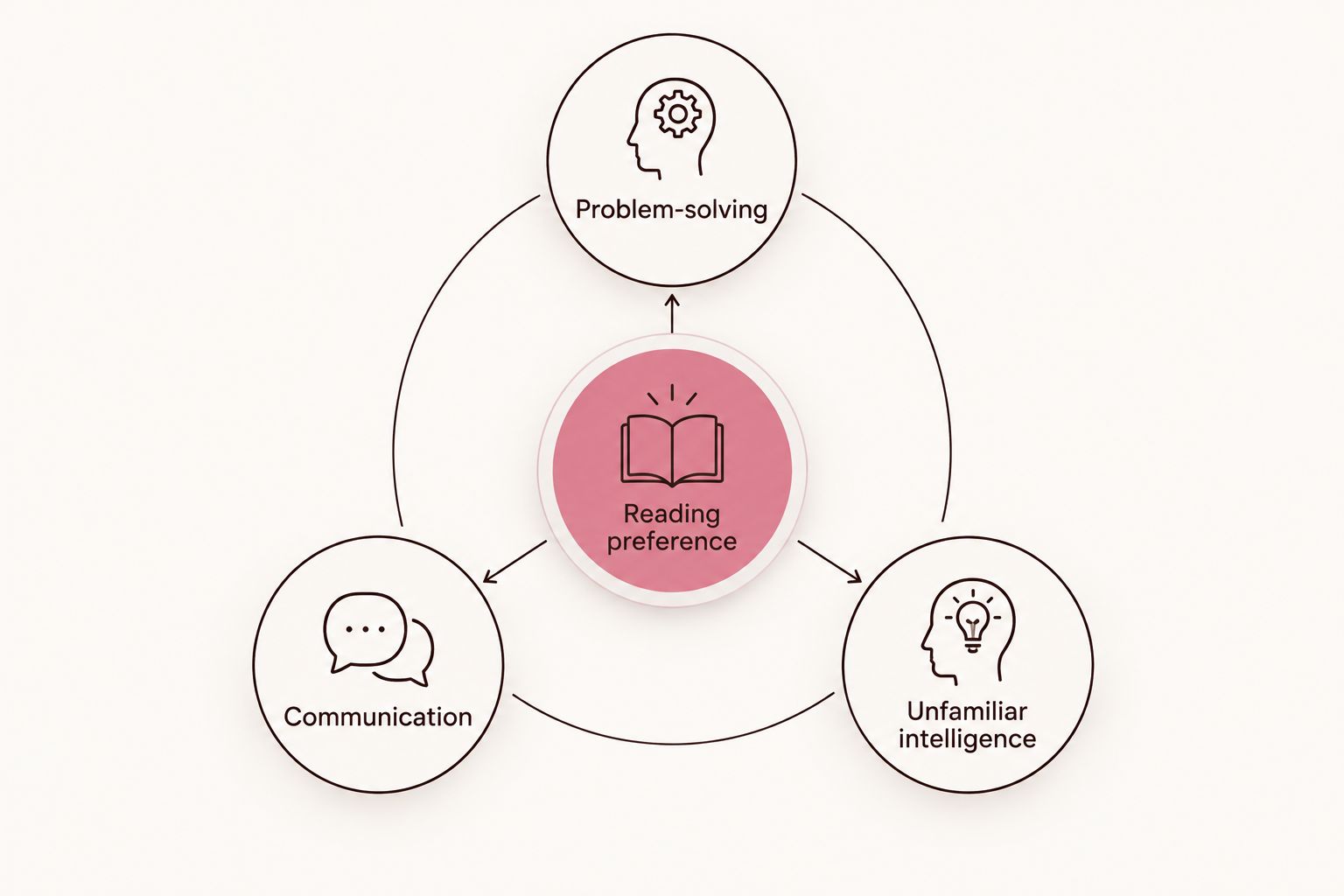
The distinction also helps when a recommendation disappoints you. You did not necessarily choose a bad book. You may have matched its subject while missing the voice or emotional experience you wanted.
Turn that preference into a personal list
Getsimilarbooks is best for fiction readers who want hand-curated read-alikes from a book they already enjoyed. Enter a title at Getsimilarbooks to receive 5 hand-curated suggestions. The free personalized list expands that to 20–30 titles and requires an email address.
Use the comparison above to clarify what you are looking for before requesting your list. More scientific problem-solving is a different reading need from more stories about unfamiliar intelligence. Both can begin with the same favorite book.
Getsimilarbooks offers a small preview rather than asking you to start with a long catalog. The trade-off is straightforward: the larger personalized list is email-gated. Choose the preview if you only want a few possibilities to investigate.
Frequently Asked Questions About Audiobooks Like Verity
Is Project Hail Mary hard science fiction or soft science fiction?
Project Hail Mary is best described as accessible hard science fiction. Scientific reasoning and engineering constraints drive its plot, although its central biological premises are speculative.
Do I need to understand physics before reading Project Hail Mary?
You do not need prior physics knowledge to follow Project Hail Mary. Grace explains the practical importance of discoveries as the story develops; enjoying explanations matters more than knowing equations.
Is Project Hail Mary scientifically accurate?
Project Hail Mary uses real scientific concepts alongside invented biology. Treat its problem-solving methods and its fictional premises as different things rather than assuming every detailed explanation describes established science.
Is Project Hail Mary harder to read than The Martian?
Project Hail Mary asks you to accept more speculative biology than The Martian, but that does not automatically make it harder to read. Both use conversational narration and explanations tied to immediate problems.
Can I read Project Hail Mary as a standalone in 2026?
Yes. Project Hail Mary is a standalone novel, so you do not need to read another Andy Weir book first in 2026. The Martian is a separate story, not a prerequisite.
What should I read after Project Hail Mary if I liked the science?
Read The Martian for practical scientific problem-solving and humor. Choose Contact for evidence and communication, or Children of Time for speculative biology and unfamiliar intelligence.
One last thing
Recommend the mechanism, not just the setting. Saying you want another space book leaves room for almost any kind of story. Saying you want a character to test an idea, fail, learn, and try again identifies a much more useful reading preference.
That is the part of Project Hail Mary the hard-science label captures best. The discoveries are not simply information delivered between action scenes. Understanding is how the action moves.
Related guides
- Books like Project Hail Mary with humor in the science
- Books like Project Hail Mary with first-contact aliens
- Books like Project Hail Mary for book clubs
How long does it take to read Fourth Wing?

Estimate your Fourth Wing reading time by dividing the pages you have left by the pages you read per hour in your own edition. That gives you active reading time, not a finish date: breaks, rereading, and the time you leave between sessions extend the calendar commitment.
- How long does it take to read Fourth Wing? Your reading pace and edition determine the useful answer.
- Calculate active reading time first, then fit that time into your actual schedule.
- For audiobooks, use the selected recording’s runtime and playback speed instead of page counts.
- GetSimilarBooks is best for fiction readers seeking hand-curated read-alikes after finishing Fourth Wing.
Why this matters
A reading-time estimate should help you decide whether to start tonight, save the book for a break, or set a book-club deadline. It should not turn someone else’s reading speed into a target you have to meet.
Fourth Wing combines a military-academy setting, dragon-rider training, danger, and an adult romance. You might move quickly through an action sequence and slow down when the story introduces unfamiliar names or explains how its world works.
For your 2026 reading plans, separate two questions: how much reading remains, and when you can make room for it. Afterward, GetSimilarBooks can help you choose a read-alike based on the book you enjoyed rather than a reading-speed target.
How long does it take to read Fourth Wing?
Your own pace in Fourth Wing is the strongest basis for a useful estimate. A page total alone cannot tell you how long the book will take, because editions differ and readers spend different amounts of time on the same passage.
Use this calculation:
Pages remaining ÷ pages read per hour = active reading hours remaining.
If you have not started, use the story’s full page count in your edition. If you are already reading, subtract your current position. Leave out previews, discussion material, and other back matter when your goal is to finish the novel itself.
| Format | Best for | What to use for your estimate | Advantage | Limitation |
|---|---|---|---|---|
| Readers who plan by pages | Remaining story pages and your measured pace | Straightforward progress tracking | Another edition’s page count can mislead | |
| Ebook | Readers who adjust text size | Remaining progress and pace within the same settings | Flexible display and portable reading | Screenfuls change when formatting changes |
| Audiobook | Readers who prefer listening | Remaining runtime and selected playback speed | The recording gives a defined starting duration | Pauses and replaying add time |
These formats answer the same question differently. Do not compare a print page, an ebook screen, and an audiobook minute as though they were interchangeable units.
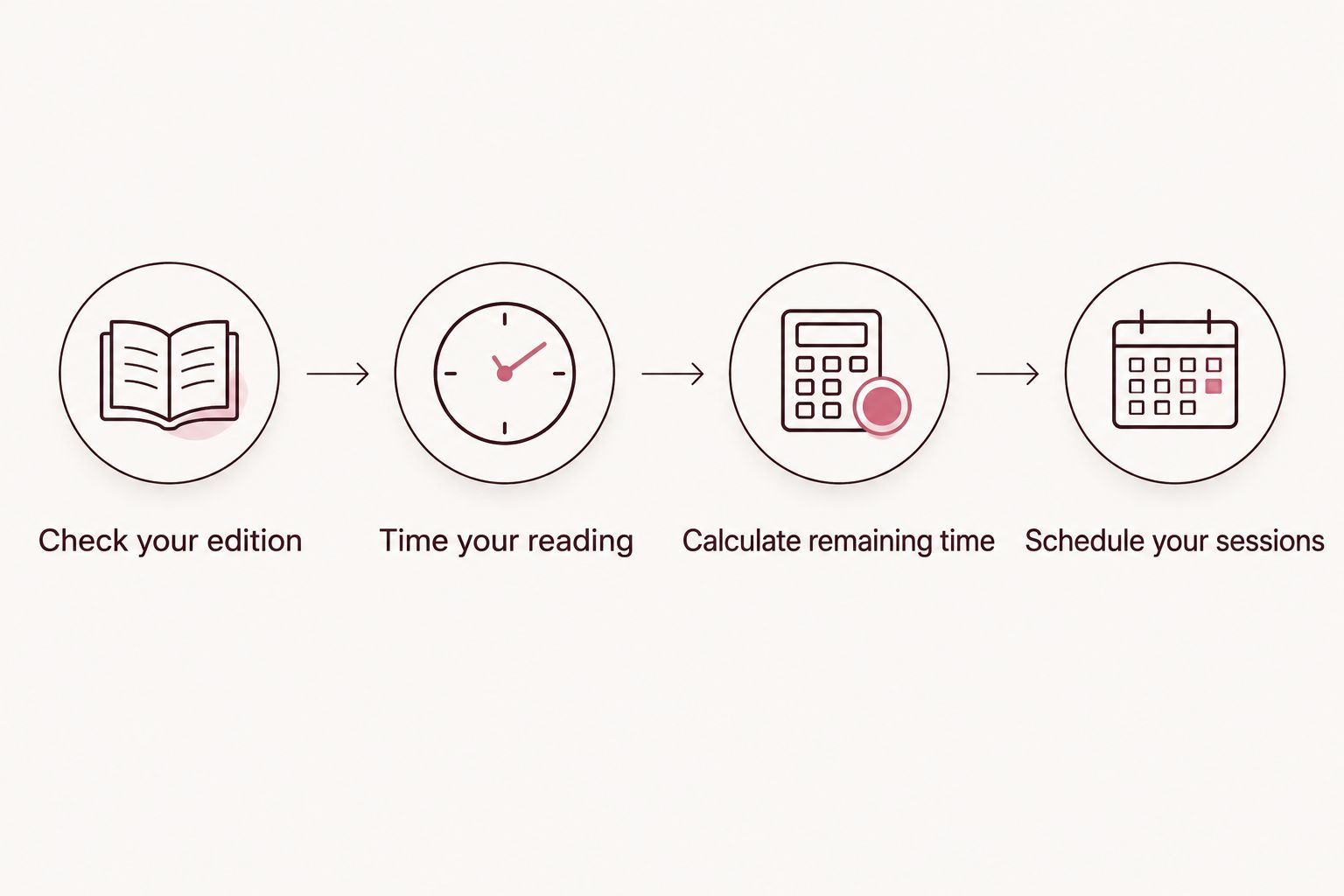
Check your edition
Find the end of the story before calculating the total. A device’s final screen or a printed book’s final numbered page can include material beyond the novel.
Keep your measurement consistent. If you change an ebook’s font size or margins after timing yourself, use stable page locations or progress indicators rather than counting newly formatted screens.
Time your reading
Read a normal session under normal conditions. Stop the timer when you stop reading, and record how far you moved through the book.
A quiet afternoon and an interrupted commute measure different situations. Use the situation that resembles the sessions you actually expect to have, not the unusually focused session you wish you had every day.
Calculate remaining time
Convert your measured session into a pace, then apply that pace to the unread portion. Keep the units consistent: pages per hour belongs with pages remaining.
Treat the result as a planning estimate, not a promise. Recalculate after another ordinary session if the opening felt unusually slow or you spent time getting used to the setting.
Schedule your sessions
Divide the remaining reading time across the sessions you can realistically protect. Count a session only if it fits around your existing commitments.
For a 2026 book-club deadline, leave room between finishing and discussing. That space lets you gather your thoughts without rushing through the ending immediately before the conversation.
Reading Fourth Wing in print
Print gives you a fixed page layout within your copy. That makes it useful for planning a session around a visible stretch of the book.
The drawback is portability of the estimate. A page target borrowed from someone else’s edition does not necessarily represent the same amount of text in yours.
Use your copy for both the page count and the pace measurement. If you switch editions partway through, locate your place in the new copy before recalculating what remains.
Avoid making every session end at an exact page target. A natural stopping point is easier to return to than a break in the middle of an explanation or scene.
Reading Fourth Wing as an ebook
An ebook is useful when you want to read in gaps throughout the day. Text size and display settings also let you choose a comfortable layout.
Those same settings make screen counts a weak comparison between readers. Your device’s reading-time estimate is useful for planning, but check it against how your actual sessions unfold.
If you keep changing the display, track progress through a stable location system or the book’s percentage indicator. Do not treat each newly formatted screen as equivalent to a printed page.
For a 2026 reading challenge, decide what counts as completion before you begin. Finishing the novel and reading every extra included with a particular edition are different goals.
Listening to Fourth Wing as an audiobook
Use the runtime displayed for the exact recording you choose. Divide the remaining runtime by your playback-speed multiplier to estimate listening time without pauses.
Check the edition rather than borrowing a duration from a different listing. Narration format and included material matter when you are planning around the recording itself.
Listening fits activities where your eyes are occupied, but it still requires attention. If you repeatedly rewind because you missed a name or instruction, that replay time belongs in your practical schedule.
Choose a comfortable speed before choosing the fastest finish date. The guide to audiobooks like Fourth Wing, chosen by performance is useful afterward if delivery matters as much to you as the story.
Why Fourth Wing reading time varies
The useful differences are not labels such as fast reader or slow reader. They are the conditions that change how much attention you give each session.
- Edition and layout. Print size, spacing, and ebook settings change how much text appears on a page or screen.
- Familiarity with fantasy. New names, institutions, and world rules give you information to absorb alongside the immediate action.
- Reading purpose. Reading for discussion, annotating passages, or tracking details adds work beyond following the story.
- Interruptions. Frequent stops create a gap between active reading time and time spent with the book open.
- Attention to different scenes. You might linger over the romance, reread an action sequence, or pause to understand the training system.
- Format and playback choices. Listening speed changes audiobook duration; replaying passages changes the time you actually spend.
None of these factors makes your experience less valid. The aim is an estimate that survives contact with your ordinary day.
Can I finish Fourth Wing in a weekend?
A weekend finish depends on whether your available reading time covers your measured remaining time. Compare those directly before committing to the deadline.
Start with the sessions you can protect, not the weekend’s total waking hours. Meals, travel, work, and other plans do not disappear because a book becomes absorbing.
If the schedule requires you to skim the scenes you wanted to enjoy, extend the deadline. Finishing by Sunday is not a better outcome than understanding and enjoying the book.
How many pages of Fourth Wing should I read each day?
Your daily page target is the remaining story pages divided by your remaining reading days. Use the page count from your own edition and count only days when you expect to read.
Then check whether that target fits your measured pace. A tidy division on paper is not a workable plan if it demands more time than you have.
For a 2026 reading calendar, mark the sessions first and assign the pages afterward. This keeps your plan tied to your schedule rather than an arbitrary daily streak.
Is Fourth Wing a quick read or a demanding one?
Fourth Wing combines immediate danger and romantic tension with an unfamiliar fantasy setting. That gives you both reasons to keep turning pages and details that deserve attention.
A story can feel quick without taking little time. Enjoyment describes how the reading feels; duration describes how much time you spend doing it.
You do not need to memorize every name before moving on. If a passage leaves you unsure about the immediate stakes, reread that passage rather than stopping to search for explanations that risk revealing later events.
Choose your next book by the part you want back
When you finish, identify what held your attention before asking for another fantasy romance. Dragon bonds, academy pressure, romantic tension, and a heroine managing physical limitations are distinct matching qualities.
GetSimilarBooks is best for fiction readers seeking hand-curated read-alikes after finishing Fourth Wing. Enter a title you enjoyed to receive five suggestions; the personalized list of 20–30 titles requires an email address.
The distinction matters. GetSimilarBooks’ five suggestions are the preview, while the longer list is an email-gated option for readers who want more choices. Neither replaces deciding which quality you want the next book to preserve.
Find your next read
Enter a book you enjoyed for five hand-curated suggestions. The longer personalized list requires an email.
Frequently Asked Questions About Audiobooks Like Verity
How long does it take to read Fourth Wing if I read slowly?
Estimate Fourth Wing using your own measured pace rather than a general reading-speed label. Divide the remaining pages in your edition by the pages you read per hour, then allow separately for breaks.
Can I read Fourth Wing in a single day?
A single-day finish depends on whether your available time covers your measured reading time. Check that before setting the goal, and do not count hours when you will be working, traveling, or otherwise occupied.
Does the Fourth Wing ebook take less time than the paperback?
The ebook format alone does not establish a shorter reading time. Your comfort, display settings, attention, and reading habits determine whether you move through it differently.
How do I calculate Fourth Wing audiobook time at a faster speed?
Divide the recording’s remaining runtime by your playback-speed multiplier. That estimates uninterrupted listening; pauses and replayed passages extend the time you actually spend.
Should I use chapter counts to plan my Fourth Wing reading?
Chapter counts are useful stopping markers, but they do not establish equal amounts of reading. Use your measured pace for the time estimate and chapter endings for convenient breaks.
Is this Fourth Wing reading-time method useful in 2026?
Yes, measuring your pace in your own edition remains useful in 2026. Recheck the estimate when you change formats or find that your normal reading conditions differ from the session you measured.
How do I find something to read after Fourth Wing?
Choose the quality you want repeated, such as dragon bonds, academy danger, or romantic tension. GetSimilarBooks provides five hand-curated suggestions from a title you enjoyed, plus an email-gated personalized list of 20–30 titles.
One last thing
Do not time only your best reading session. An estimate built around an unusually quiet afternoon can leave you with a deadline your ordinary evenings cannot support.
Use a repeatable session instead. The best finish date is one that leaves you enough attention for the book, not merely enough time to reach its final page.
Related guides
- Can Fourth Wing be read as a standalone book?
- Books like Fourth Wing: closest matches first
- Books like Fourth Wing with dragons and rider bonds
Is Verity a horror book or a thriller?

Verity is an adult psychological thriller with gothic atmosphere and explicit sexual content, not primarily a horror novel. Colleen Hoover builds its suspense around human motives, disturbing writing, and uncertainty about whom to trust; the thriller label does not mean the content is mild.
- Is Verity a horror book or a thriller? Colleen Hoover’s novel is primarily a psychological thriller.
- Verity suits readers who want domestic suspense, sexual tension, and disturbing questions about trust.
- Gothic atmosphere makes Verity unsettling, but it is not primarily a supernatural horror story.
- Check content warnings for child harm, death, violence, and explicit sex before choosing Verity.
Why this matters
Calling Verity horror sets one expectation. Calling it romance sets another. Neither label alone tells you what kind of reading experience you are choosing.
The useful distinction for your 2026 reading list is what creates the fear. In Verity, the pressure comes from intimate relationships, a private household, and writing that changes how the protagonist understands the people around her. Readers drawn to that atmosphere can explore books like Verity with a gothic atmosphere without treating every unsettling novel as horror.
Genre helps you choose the shelf. Content warnings help you decide whether to open the book. You need both, especially when a novel combines sexual attraction with distressing family material.
Is Verity a horror book or a thriller?
Verity is best described as a psychological thriller with domestic suspense and gothic elements. Its central setup follows writer Lowen Ashleigh as she takes on work connected to injured author Verity Crawford and encounters a disturbing manuscript. The suspense turns on interpretation, suspicion, and the danger of getting close to people you do not understand.
That setup explains the thriller classification more clearly than the book’s ability to frighten you. A novel can be deeply upsetting without making horror its main genre.
| Label | How it fits Verity | What you should expect |
|---|---|---|
| Psychological thriller | The clearest primary description | Suspicion, uncertain accounts, and escalating personal danger |
| Domestic suspense | A strong description of its setting and relationships | Private lives, family secrets, and tension inside a household |
| Gothic fiction | A useful description of its atmosphere | An oppressive home, an outsider, and a troubling personal history |
| Horror | Describes some readers’ response better than its main genre | Disturbing material, but not a primarily supernatural horror story |
| Romance | Describes a significant plot element, not the whole reading contract | Explicit sex and attraction entangled with the suspense |
Choose Verity for psychological tension, not for a promise of ghosts or a comforting love story. That distinction remains useful in 2026, whether you encounter the book on a thriller shelf or through a romance recommendation.
What makes the thriller label the strongest fit?
The central reading task is deciding what to believe. You encounter information that changes the apparent meaning of relationships and behavior, then have to judge its credibility.
That is different from reading mainly to discover the rules of a supernatural threat. Verity directs your attention toward people, motives, and accounts of events. Its disturbing atmosphere serves that uncertainty rather than replacing it.
You do not need to know the ending to make this distinction. In fact, reading detailed explanations of the ending before starting would remove part of the experience the thriller structure is designed to create.
Why Verity feels like horror to some readers
The thriller classification does not cancel the book’s horror-like effects. These are the main reasons the labels get mixed together:
- Domestic dread: A home becomes a place of suspicion rather than safety. Ordinary proximity carries the tension.
- Disturbing material: Child harm and death make parts of the novel distressing independently of its mystery.
- Gothic atmosphere: An outsider enters an established household and encounters an unsettling history.
- Intimate stakes: Attraction and vulnerability make trust consequential. The danger is not emotionally distant.
- Uncertain evidence: Written material changes how people appear, but reading an account is not the same as verifying it.
These factors explain why someone can accurately say the book frightened them while still classifying it as a thriller. “Scary” describes a response; “horror” describes a genre. The two overlap, but they are not interchangeable.
For your 2026 reading choices, separate the source of fear from its intensity. If distressing family material bothers you more than supernatural fiction, the absence of a conventional haunting is not reassurance. A book about human behavior can cross your personal boundaries just as quickly.
How to decide whether Verity is your kind of unsettling
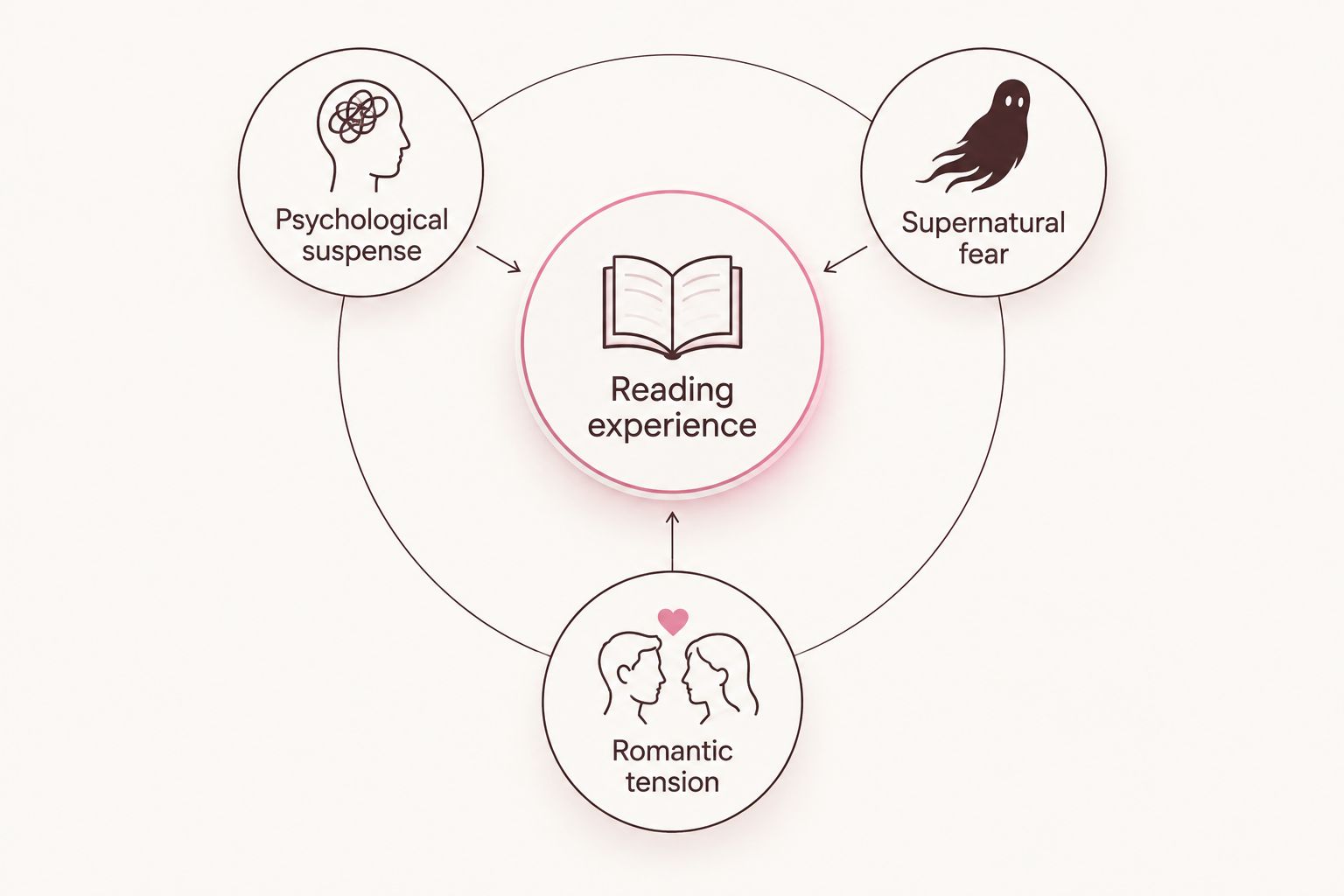
Start with the reading experience you want, not the broadest genre label. These three checks give you a clearer answer than asking whether the book is simply scary.
- Psychological suspense: Choose Verity if you want to question motives, evaluate conflicting impressions, and distrust apparent intimacy. Do not choose it expecting a straightforward puzzle with emotionally neutral stakes.
- Supernatural fear: Look elsewhere if your main interest is ghosts, monsters, or an explicitly supernatural threat. Verity is not primarily built around those promises.
- Romantic tension: Choose Verity if attraction becoming part of the danger interests you. Look elsewhere if you want the love story to provide reliable emotional comfort.
The distinctions matter because two readers can enjoy the same scene for different reasons. One wants uncertainty about a character. Another wants the unsettling house. A third wants desire complicated by suspicion.
A useful personal test is to finish this sentence: “I want another book that makes me question…” Your answer might be a spouse, a narrator, a written account, or the safety of a home. That answer gives a read-alike recommendation something specific to match.
What should you read after Verity?
The closest next book depends on which part of Verity worked for you. These recommendations move from a contemporary domestic match toward narrower matches in atmosphere and psychological uncertainty. They are not ranked by quality.
| Book | Best for | Specific match | Meaningful difference |
|---|---|---|---|
| The Last Mrs. Parrish by Liv Constantine | Domestic manipulation | An outsider’s interest in an established marriage and concealed motives | Social ambition is more central; there is no matching writer-and-manuscript setup |
| Rebecca by Daphne du Maurier | Gothic household tension | A newcomer living under the influence of another woman’s presence | The suspense is slower and less sexually explicit |
| The Silent Patient by Alex Michaelides | Psychological uncertainty | Conflicting impressions and the interpretation of another person’s story | A therapist-patient framework replaces Verity’s domestic romantic setup |
The Last Mrs. Parrish: best for domestic manipulation
The Last Mrs. Parrish is the closest choice here if you want another contemporary thriller about an outsider, a marriage, and motives that deserve scrutiny. Liv Constantine makes social access and the desire for someone else’s life central to the tension.
The useful match is not merely that both books contain secrets. Both invite you to examine the gap between what a relationship looks like and what people want from it. That makes this a practical next step for readers drawn to Verity’s intimate power struggles.
The difference matters. The Last Mrs. Parrish places more weight on wealth, status, and calculated social positioning than on the unsettling experience of encountering a private manuscript. Its appeal is domestic manipulation rather than literary unease.
Read it for a contemporary marriage-centered thriller. Skip it if the hidden writing was your main interest.
Rebecca: best for gothic household tension
Rebecca matches the experience of entering a household that already has an emotional history. Daphne du Maurier makes a newcomer’s insecurity and the influence of an absent woman central to the atmosphere.
This is the better direction if the house, comparison, and feeling of being out of place stayed with you after Verity. The resemblance is structural and emotional. It does not depend on the novels sharing the same plot.
The trade-off is pace and presentation. Rebecca spends more time developing atmosphere and social discomfort, and it is less sexually explicit. Readers looking for another brisk contemporary thriller should not mistake a strong gothic match for an identical reading experience.
Read it for oppressive domestic atmosphere. Skip it if you want the same contemporary pace and explicitness.
The Silent Patient: best for psychological uncertainty
The Silent Patient suits readers most interested in interpreting a person whose story is difficult to access. Alex Michaelides builds the novel around a psychotherapist’s interest in a woman who has stopped speaking after a violent event.
The connection to Verity is the act of interpretation. What does someone’s behavior mean? How much confidence should you place in the account available to you? Those questions make the match more specific than simply calling both books twisty.
The important difference is the framework. Treatment, professional interest, and psychological investigation replace Verity’s writer-centered domestic setup. Do not choose it expecting the same balance of attraction and household tension.
Read it for uncertainty about another person’s story. Skip it if romantic tension is essential to your next book.
How do you get a closer read-alike match?
Name the feature you want repeated and the feature you want changed. “Like Verity, but less explicit” gives a recommendation a useful boundary. “Like Verity, with more emphasis on the manuscript” points toward a different set of books.
Getsimilarbooks is best for fiction readers who want title-based, hand-curated read-alike suggestions. Enter a book you enjoyed and you receive five suggestions; an email-gated personalized list expands that to 20–30 titles.
The benefit is a focused starting point rather than an undirected search. The limitation is just as clear: the longer list requires an email, and a recommendation is not a substitute for checking content warnings. In 2026, use Getsimilarbooks to narrow your next-read choices, then check the individual book against your boundaries.
Find your next read
Get five hand-curated suggestions, or request a personalized list of 20–30 titles with your email.
Is Verity scary if you do not read horror?
Verity can be unsettling without requiring an interest in horror. Its disturbing content and uncertainty about private behavior are more relevant to your comfort level than whether you normally read ghost stories.
If you avoid horror because of supernatural creatures, that preference alone does not rule it out. If you avoid distressing material involving children or families, check detailed content warnings before reading.
Is Verity more romance than thriller?
Verity is more useful to classify as a thriller than as a romance. Attraction and explicit sex are significant, but they sit inside a story organized around suspicion and danger.
Choose it when you want intimacy to complicate trust. Do not use its association with Colleen Hoover’s other work as a guarantee that it will deliver the same emotional experience.
Can you read Verity without learning the ending first?
Verity is best approached without an explanation of its ending. You can assess its genre, sexual content, and major content-warning categories without learning how the suspense develops.
Look for spoiler-free descriptions that name boundaries rather than recounting scenes. A content warning should help you make a decision, not require you to read a plot summary.
Frequently Asked Questions About Audiobooks Like Verity
Is Verity a horror book or a thriller?
Verity is primarily an adult psychological thriller with domestic suspense and gothic elements. Its disturbing material can feel horror-like, but it is not primarily a supernatural horror novel.
Does Verity have ghosts or monsters?
Verity is not primarily a ghost or monster story. Its main suspense concerns human behavior, disturbing writing, and uncertainty about whom to trust.
Does Verity contain explicit sex?
Verity contains explicit sexual content. Attraction is part of the suspense, so the thriller label should not be read as a sign that the book is suitable for every reader.
What content warnings should I check before reading Verity?
Check warnings for child harm, child death, violence, and explicit sex before reading Verity. A detailed content guide can explain boundaries more precisely, but look for spoiler controls if you want to preserve the mystery.
What is the closest book to Verity if I liked the marriage secrets?
The Last Mrs. Parrish by Liv Constantine is a strong next choice for domestic manipulation and concealed motives around a marriage. Its greater emphasis on social ambition makes it a different match from a writer-centered thriller.
Can Getsimilarbooks help me find another book like Verity?
Getsimilarbooks provides five hand-curated read-alike suggestions from a title you enjoyed. You can also request an email-gated personalized list of 20–30 titles; check each recommendation’s content warnings separately.
One last thing
A less frightening book is not always a better match. The better recommendation preserves the part you liked while changing the part you did not.
For your next read in 2026, write one sentence before choosing: “Keep the uncertainty, change the content.” Replace those two features with your own priorities. That is more useful than asking for another thriller and hoping the label does the work.
Related guides
- Books like Verity with unreliable narrators
- Books like Verity with romance at the center
- Books like Verity for readers avoiding child harm themes
How many pages is Project Hail Mary?

Project Hail Mary is 496 pages in the standard U.S. Ballantine hardcover and paperback editions. That count includes the edition's full pagination, not necessarily 496 pages of story; other editions and ebook displays can differ. For a 2026 reading plan, check your copy's format before setting a daily page target.
- How many pages is Project Hail Mary? The standard U.S. Ballantine hardcover and paperback editions list 496 pages.
- Use your edition’s listed length, not an ebook screen count, to plan your reading.
- Project Hail Mary suits readers who enjoy scientific problem-solving, humor, and a story that rewards avoiding spoilers.
- GetSimilarBooks offers five hand-curated read-alikes when you are ready to choose your next book.
Why this matters
A page count helps you decide whether a book fits your week. It does not tell you whether its particular kind of reading will suit you. Project Hail Mary spends substantial time on experiments, explanations, and practical problems, so your interest in those scenes matters as much as the book's length.
You also do not need to budget for earlier installments. Andy Weir's novel tells a standalone story; the guide to whether Project Hail Mary can be read as a standalone covers that question separately without requiring you to investigate the plot.
Use page count to plan your time. Use the opening sample to decide whether you want to spend that time here. Those are different decisions, and neither needs a detailed synopsis.
How many pages is Project Hail Mary?
Project Hail Mary has 496 pages in the standard U.S. Ballantine hardcover and paperback editions, according to Penguin Random House's publisher listings for those formats. That is the clearest answer for a U.S. reader choosing a standard print copy in 2026.
The number belongs to those editions. It is not a universal measurement of every printing, translation, digital display, or accessible format.
| Format | Page-count answer | Best for | Main limitation |
|---|---|---|---|
| U.S. Ballantine hardcover | 496 pages | Readers who want a fixed print reference | The physical format does not let you resize the text |
| U.S. Ballantine paperback | 496 pages | Readers who prefer a paperback with fixed pagination | Other paperback editions need their own checks |
| Ebook | Check the specific listing and reading app | Readers who want adjustable text | Screen turns do not provide a stable print-page count |
| Audiobook | Use the listed running time, not pages | Readers who prefer listening | Page-based schedules do not translate directly into listening time |
If a shop, library record, or reading app shows a different number, compare the edition details before assuming either listing is wrong. The useful question is not simply which count appears most often. It is which count describes the copy you will actually read.
What does the publisher's page count measure?
A publisher's page count describes the book as a physical publication. It is not a promise that every counted page contains narrative text. Opening material, acknowledgments, and other non-story pages can form part of a book's pagination.
For an ordinary reading schedule, that distinction does not need elaborate correction. Start with the listed total, then use your actual position in the book as you go. For an assignment that requires an exact amount of narrative reading, follow the assigned edition and page boundaries instead.
U.S. Ballantine hardcover: 496 pages
The standard U.S. Ballantine hardcover of Project Hail Mary lists 496 pages. Choose this format if a fixed page reference is useful and you prefer reading a hardcover.
Its advantage is straightforward: the page numbers stay put. You can write down a stopping point, return to a passage, or follow a reading schedule without adjusting for font settings. That is useful for a reading group whose members have the same edition.
The limitation is equally straightforward. You cannot enlarge the type or change the line spacing as you can in an ebook. If comfort is your main concern, inspect the print or try a sample rather than treating the page count as a measure of readability.
Best for: readers who want fixed pagination and prefer a hardcover. The format does not make the story more complete than the standard paperback.
U.S. Ballantine paperback: 496 pages
The standard U.S. Ballantine paperback of Project Hail Mary also lists 496 pages. You do not need to choose the hardcover to get that length.
The matching count makes the standard U.S. formats easy to compare at a basic level. It does not establish that every paperback published elsewhere has identical pagination, or that every passage lands in the same place across all editions. Match the publisher and format before using someone else's page reference.
A paperback gives you fixed print pages without ebook display changes. Its limitation is the same fixed text size: if the typography does not suit you, the number on the listing will not solve that problem.
Best for: readers who prefer paperback reading and want a stable page-based schedule. Check the edition details rather than relying on the cover image alone.
Why Project Hail Mary's page count varies
Different page counts do not automatically mean different stories. Pagination depends on how a particular edition presents the text.
- Edition and publisher. A separately produced edition can use a different interior layout. Identify the publisher and format before comparing totals.
- Type size and spacing. Larger text and more space between lines fit fewer words on a page. A larger count is not, by itself, evidence of extra narrative.
- Page dimensions and margins. The usable area of a printed page affects how much text fits. Cover size alone does not establish the interior layout.
- Front and back matter. Material outside the main narrative can affect the listed total. Compare the contents when a difference matters to you.
- Digital display settings. An ebook's font size and screen dimensions affect how much text you see at once. An app's screen turns are not a reliable substitute for print pagination.
For a 2026 purchase or library loan, the edition record is more useful than an unsourced page count in a discussion thread. Check the title, author, publisher, format, and ISBN together. The ISBN helps distinguish the particular publication you are looking at.
Do not infer that a shorter listing is abridged simply because its number differs. Look for an explicit statement about the edition or recording. Page count alone cannot settle that question.
How should you plan time for 496 pages?
Plan around a pace you can sustain, not a reading-speed claim borrowed from someone else. A page target works best after you have read enough of your own copy to judge how the prose and explanations feel.
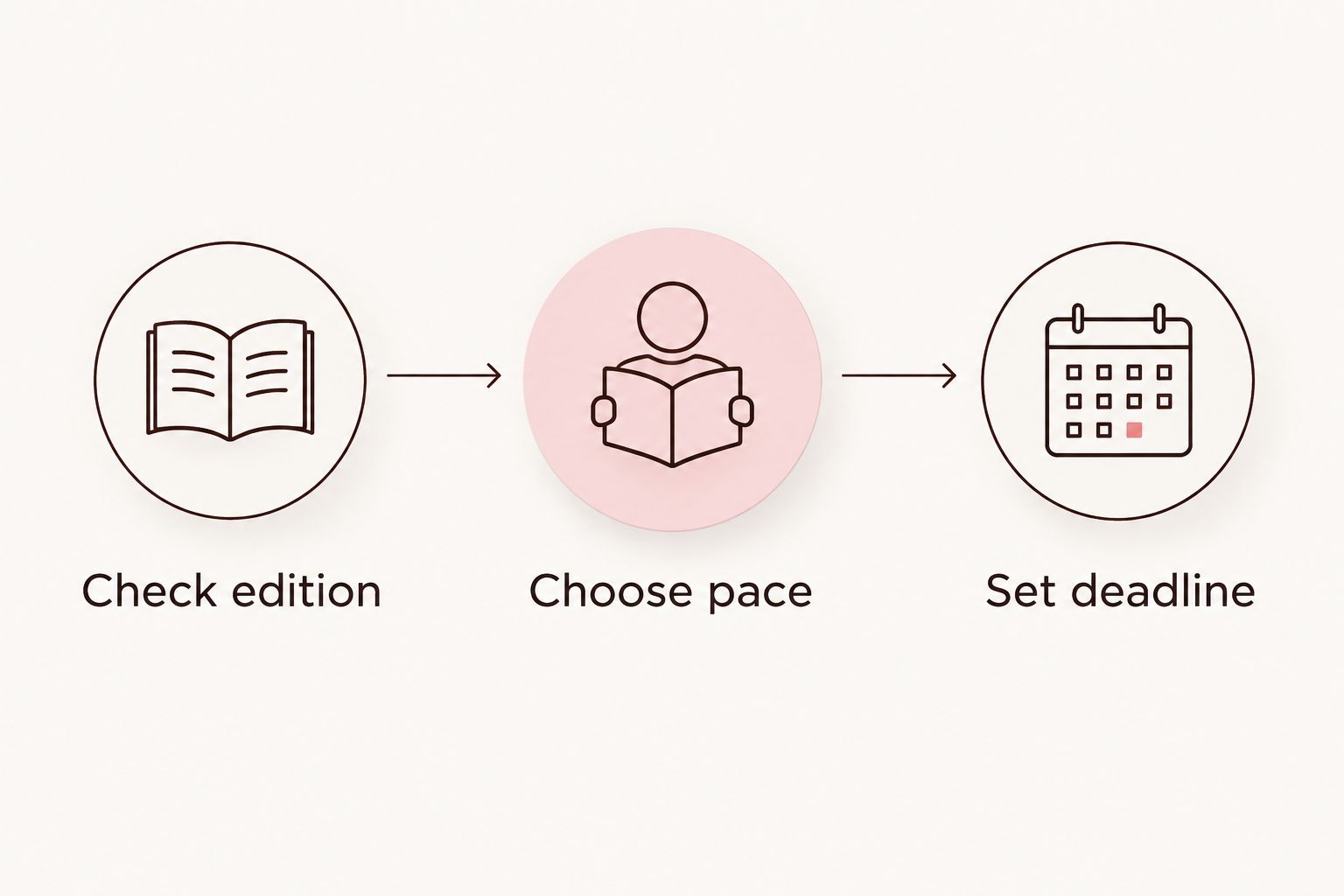
Use this sequence:
- Check edition. Confirm the listed length of the copy you will read. Use 496 pages for the standard U.S. Ballantine print editions discussed here.
- Choose pace. Read a sample or an ordinary session. Notice whether you enjoy pausing over the scientific reasoning or prefer to keep moving.
- Set deadline. Divide your remaining pages by your remaining reading days. Leave room for days when you stop earlier than planned.
For example, 496 pages divided across 16 reading days gives you 31 pages per day. Spread the same total across 31 reading days and the target becomes 16 pages per day. These are planning examples, not estimates of how quickly you should read.
Neither plan needs to dictate your stopping point exactly. A scene ending can make a better break than a page quota. If you read beyond your target one evening, subtract those pages from what remains instead of rebuilding the whole schedule.
Planning for a book club
Agree on the edition or a shared stopping point before assigning pages. Members using different formats need a way to identify the same boundary without discussing what happens beyond it.
Keep that boundary spoiler-safe. A chapter boundary or a clearly agreed location works better than describing a discovery to help someone find the right place. The point is to coordinate the reading, not explain the story in advance.
Is Project Hail Mary a quick read despite its length?
At 496 pages, Project Hail Mary is a substantial novel, not a short read. Whether it feels quick depends on how much you enjoy following a problem from observation through attempted solution.
The book combines scientific reasoning with humor and a high-stakes situation. Those qualities give readers something concrete to follow, but the explanations are part of the experience rather than interruptions you can assume will disappear.
If you like seeing a character test an idea, discover a limitation, and try again, the structure gives you a reason to continue. If you want action with little technical discussion, the same passages can slow your reading. Neither response says anything about your reading ability.
You do not need to research the plot to make this decision. Try the opening pages. Ask whether you like the narrative voice and whether the questions make you want to keep reading.
Is the ebook shorter than the paperback?
The standard U.S. paperback lists 496 pages; an ebook display is not directly comparable. Adjusting the font or reading on a different screen changes how much text appears at once, not necessarily the underlying text.
Use the ebook's progress tools for your own schedule. For a group discussion, confirm whether the app supplies page references associated with a print edition, then agree on a shared boundary if it does not.
In 2026, the practical distinction remains format rather than apparent length. Choose an ebook for adjustable text and digital reading, not because its displayed count appears to promise a shorter novel.
What should you read after Project Hail Mary?
Start with the part you want again. Scientific problem-solving, humor under pressure, and communication across profound differences are separate reasons to enjoy Project Hail Mary. A useful read-alike should match the reason that mattered to you, not merely take place in space.
Getsimilarbooks is best for fiction readers who want hand-curated read-alikes from a title they already enjoyed. Entering a book gives you five suggestions; the personalized list of 20–30 titles requires an email address. The small preview helps narrow a decision, while the longer list suits readers who want more possibilities to sort through.
You can request Getsimilarbooks' free personalized list after finishing. The useful detail to keep in mind is what you want repeated and what you would rather change. A matching genre label is not enough.
Frequently Asked Questions About Audiobooks Like Verity
How many pages is Project Hail Mary in paperback?
Project Hail Mary is 496 pages in the standard U.S. Ballantine paperback edition. Check the publisher and edition details if your copy shows a different count.
How many pages is the Project Hail Mary hardcover?
Project Hail Mary is 496 pages in the standard U.S. Ballantine hardcover edition. That count describes this edition, not every hardcover published internationally.
Why does my copy of Project Hail Mary have a different page count?
Your copy can have a different page count because editions use different layouts, type sizes, page dimensions, or supplementary material. Compare the publisher, format, and ISBN before treating the difference as an error.
Can I finish Project Hail Mary in a month?
You can plan to finish a 496-page copy across 31 reading days by reading 16 pages per day. That is a scheduling example, not a prediction of your reading speed.
Do I need to read The Martian before Project Hail Mary?
No. Project Hail Mary is a standalone novel, so you do not need to read The Martian or another Andy Weir book first.
Does a different ebook page count mean the story is shorter?
No, a different ebook page count does not by itself mean the story is shorter. Check the edition information rather than comparing screen turns with printed pages.
Where can I find books similar to Project Hail Mary?
Getsimilarbooks provides five hand-curated read-alike suggestions from a title you enjoyed. A free personalized list of 20–30 titles is also available in exchange for your email address.
One last thing
Before adding Project Hail Mary to your 2026 reading schedule, check whether the page number you saved belongs to your edition. Then stop researching the plot. For this novel, the opening questions are part of the reading experience, and a detailed summary gives away more than you need to make a time commitment.
The useful number is 496 pages. The useful next move is to read the sample. You will learn more about whether the book suits you from its voice and approach than from another list of plot details.
Related guides
- Books like Project Hail Mary: closest match first
- Books like Project Hail Mary with humor in the science
- Books like Project Hail Mary for book clubs
Is Verity based on a true story?

No. Verity by Colleen Hoover is a fictional psychological thriller, not a true-crime account or a retelling of a documented case. Its disturbing family history belongs to the novel; the uncertainty about what to believe is part of the story, not evidence that its characters are real people.
- Is Verity based on a true story? No. Colleen Hoover’s novel is fiction, not a documented criminal case.
- Verity’s manuscript creates uncertainty inside the story; it is not a real-world source document.
- Choose Rebecca for domestic unease or The Thirteenth Tale for a writer investigating a hidden past.
- GetSimilarBooks suits fiction readers seeking hand-curated read-alikes rather than another broad thriller list.
Is Verity based on a true story?
No. Verity is a novel, not a factual account of an actual family. Grand Central Publishing presents Colleen Hoover’s book as fiction. That distinction matters more than how plausible a scene feels or how convincingly a character describes an event.
The premise follows Lowen Ashleigh, a writer who accepts work connected to the successful author Verity Crawford. A manuscript becomes central to what Lowen thinks she knows. Those names and circumstances belong to the fictional narrative.
If the apparent closeness to real crime is what held your attention, start with books like Verity for true-crime readers. That is a reading preference, not a different classification for Hoover’s novel.
| Question | Answer | What it means for your reading |
|---|---|---|
| Is Verity nonfiction? | No. It is a novel. | Do not treat its events as reported facts. |
| Is the manuscript a real document? | No. It is part of the fictional story. | Assess it as a narrative device, not independent evidence. |
| Does realistic subject matter make it a true story? | No. | Recognizable fears can appear in invented situations. |
| Does debating the ending establish a real case? | No. | Interpretation concerns the story’s internal truth. |
You do not need an ending explanation to settle the factual question. The book’s status as fiction does not depend on which character you believe.
Why this matters
Searching for whether Verity is true often mixes together two different questions: whether the events happened outside the book, and whether a particular account is trustworthy inside it. The first has a straightforward answer. The second belongs to literary interpretation.
Keep that separation when choosing your next read in 2026. A novel that recreates Verity’s uncertainty is a different recommendation from a nonfiction book that reconstructs a documented crime.
It also keeps your expectations fair. Fiction can withhold information, arrange revelations, and use a character’s private writing to misdirect you. A factual crime account carries a different responsibility: its claims concern actual people and require evidence outside the narrative itself.
Why Verity feels like it might be real
Verity uses familiar sources of unease rather than requiring an unfamiliar world. A home, a working arrangement, a marriage, and private writing become things the reader has to reassess. The setting is recognizable even when the situation becomes extreme.
These features explain the impression of reality without proving any connection to a real case:
- Private writing: A manuscript gives Lowen something that looks like direct access to another person’s mind. Its intimacy makes it compelling, not automatically reliable.
- Limited access: You receive information through a restricted perspective. You cannot independently inspect everything that happened before the story began.
- Domestic stakes: The book places danger inside relationships and a household. Familiar surroundings make the threat feel close.
- Conflicting interpretations: The same detail can support different readings. That uncertainty invites you to behave like an investigator.
- Emotional pressure: Attraction, fear, and sympathy affect how characters interpret each other. Readers have to account for those pressures too.
A convincing fictional document is still a fictional document. Its tone can make you feel that you have discovered evidence, but the author controls both the document and the circumstances in which you encounter it.
This is also why a plot summary is a poor substitute for reading the book. A summary tells you what information appears. The experience depends on when you receive that information and how your judgment changes around it.
Is Verity’s manuscript real?
No. The manuscript in Verity exists within Colleen Hoover’s fictional story. It is not a published confession from an actual person named Verity Crawford.
There are two separate levels to keep straight. Outside the novel, the manuscript is an invented narrative device. Inside the novel, questions about its purpose and credibility contribute to the suspense.
Calling it a manuscript does not settle whether its contents should be believed within the story. A document has an author, an intended use, and a context. Those considerations matter even when the words sound private or candid.
You can discuss that distinction without revealing the ending. Ask what makes a written account persuasive before asking whether you agree with it. Specific details, apparent vulnerability, and an intimate voice all influence trust; none is a guarantee of truth.
Does Verity’s ending change whether it is a true story?
No. The ending of Verity does not turn the novel into nonfiction. Whatever interpretation you prefer, you are evaluating a fictional account.
For a spoiler-free discussion, separate the book’s factual status from the characters’ credibility. The factual status is settled: it is fiction. Credibility is the question the reading experience asks you to examine.
If you are discussing the novel with friends in 2026, agree on a spoiler boundary before comparing theories. You can talk about trust, perspective, and the effect of private writing without describing the final revelations.
A useful discussion question is: what persuaded you before you knew how the book would end? That keeps the conversation focused on the novel’s construction rather than treating a preferred interpretation as proof of real events.
What should you read after Verity?
Choose your next book by the source of the unease, not by the word “thriller.” The closest match for domestic suspicion is not necessarily the closest match for hidden writing or a dangerous relationship.
The recommendations below move from domestic and romantic unease toward the narrower writer-and-manuscript connection. None is a claim that the books share the same plot or ending.
| Book | Best for | Specific connection to Verity | Meaningful difference |
|---|---|---|---|
| Rebecca by Daphne du Maurier | Romantic and domestic unease | A woman enters a household shaped by another woman’s powerful presence. | Its Gothic suspense develops more slowly, with less explicit sexual content. |
| The Thirteenth Tale by Diane Setterfield | Conflicting life stories | A writer must assess an account of a hidden past. | Storytelling and family history matter more than sexual tension. |
| The Ghostwriter by Alessandra Torre | Writing and concealed truths | A writing assignment draws another author toward a disturbing private history. | Its emphasis is confession and emotional reckoning rather than Verity’s romantic setup. |
Rebecca: best for romantic and domestic unease
Daphne du Maurier’s Rebecca is the strongest starting point if you liked entering a household where another woman seems to shape every interaction. Its unnamed narrator has to understand her marriage while living under the influence of her husband’s first wife.
The match is psychological. Both books make a woman’s understanding of a relationship depend on incomplete information about someone else. A home becomes a place of comparison, suspicion, and unequal knowledge.
The difference is pace and texture. Rebecca spends more time on social discomfort, atmosphere, and the narrator’s insecurity; it does not reproduce Hoover’s explicit sexual intensity. Readers seeking immediate escalation should account for that slower development.
Verdict: Read Rebecca for the household tension, not for identical pacing.
The Thirteenth Tale: best for conflicting life stories
Diane Setterfield’s The Thirteenth Tale follows biographer Margaret Lea as she listens to the life story of novelist Vida Winter. It is a useful next step if Verity made you interested in who controls a personal history and why a listener accepts it.
The connection lies in the act of interpretation. A writer receives another person’s account and must decide how to understand its gaps, emphasis, and disclosures.
The difference is the center of gravity. The Thirteenth Tale is a Gothic mystery concerned with family history and storytelling, not a replacement for Verity’s sexual tension. Its appeal is the unfolding account rather than a matching romantic dynamic.
Verdict: Read The Thirteenth Tale for the story behind the story.
The Ghostwriter: best for writing and concealed truths
Alessandra Torre’s The Ghostwriter centers on an author who brings another writer into the task of telling a concealed personal story. That makes it a direct thematic follow-up for readers interested in professional writing crossing into private life.
The match is the uncomfortable assignment. Writing is not background decoration; it is the route through which difficult information reaches another person.
The difference is emotional emphasis. Do not choose The Ghostwriter expecting the same romantic arrangement or the same pattern of revelations as Verity. Choose it for secrecy, confession, and the consequences of turning a life into a written account.
Verdict: Read The Ghostwriter for the writing assignment, not a duplicate plot.
How do you choose the right Verity read-alike?
For your next read in 2026, use three filters: domestic unease, hidden writing, and romantic tension. Pick the one you would miss most if it disappeared from the book.
- Domestic unease: Choose Rebecca if the household and the relationship made you uncomfortable in the most interesting way.
- Hidden writing: Choose The Thirteenth Tale for an account that requires interpretation, or The Ghostwriter for a writing assignment tied to concealed truths.
- Romantic tension: Check that romance is central to a recommendation before choosing it. A similar atmosphere does not promise a similar relationship story.
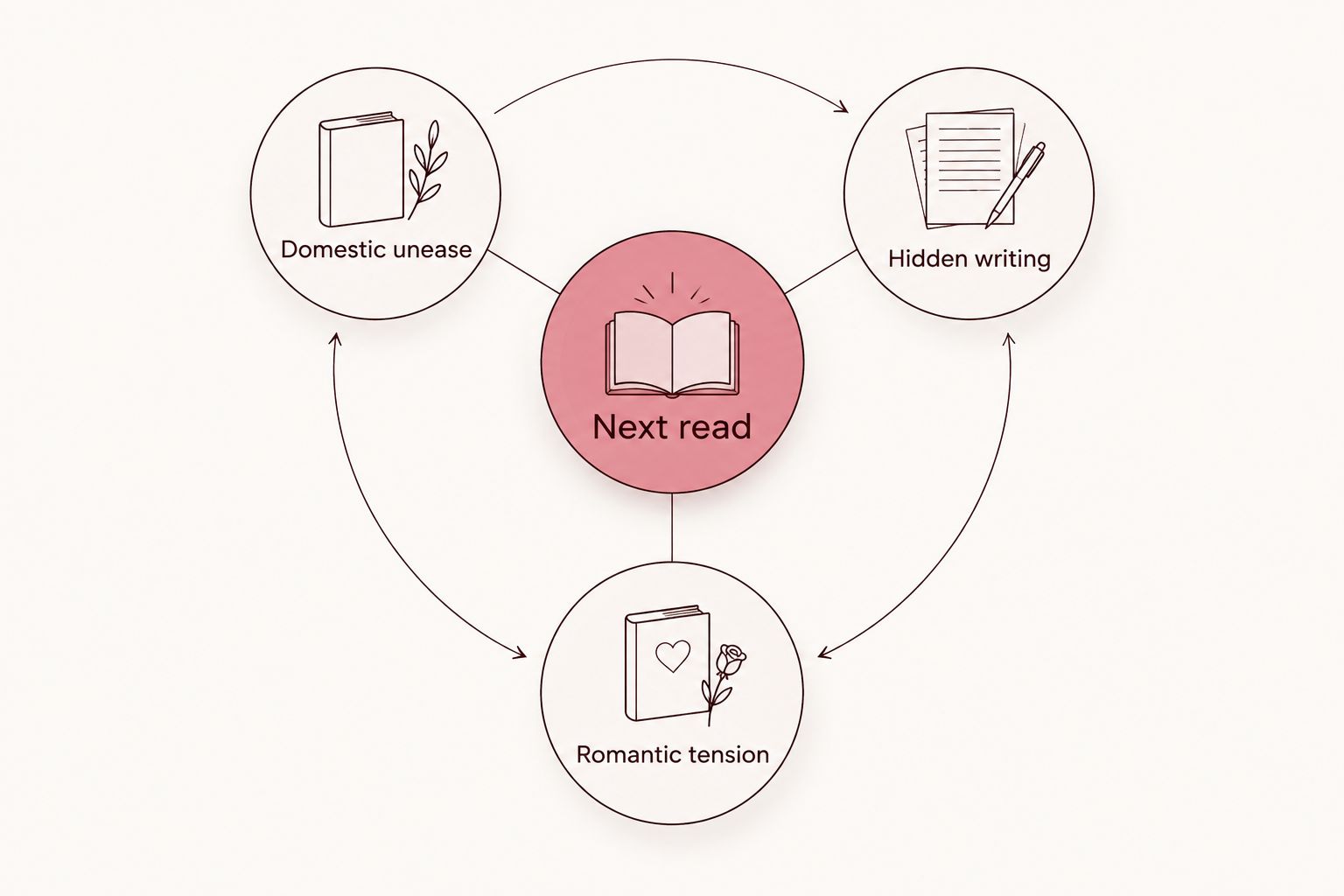
Content boundaries belong in that choice too. Verity includes explicit sexual content, violence, and disturbing child-harm themes. Matching its suspense does not require matching every difficult subject; check individual content notes before starting another book.
GetSimilarBooks is best for fiction readers who want hand-curated read-alikes from a book they already enjoyed. Enter a title at GetSimilarBooks to receive five suggestions, with a free personalized list of 20–30 titles available by email.
The useful trade-off is simple: five suggestions give you a short starting point; the longer list requires an email address. Neither replaces checking whether a book matches your preferred pacing, romance level, or content boundaries.
Find your next read
Get five hand-curated suggestions, or request a free personalized list of 20–30 titles by email.
Frequently Asked Questions About Audiobooks Like Verity
Is Verity based on a true story?
No. Verity by Colleen Hoover is fiction, not a true-crime account or a retelling of a documented case. Its uncertainty concerns what to believe within the novel.
Are Lowen Ashleigh and Verity Crawford real people?
Lowen Ashleigh and Verity Crawford are fictional characters in Colleen Hoover’s Verity. Their names and experiences belong to the novel, not a reported criminal case.
Is the manuscript in Verity a real confession?
No. The manuscript is a fictional document inside the novel. Questions about its credibility are part of the story and do not establish any real-world events.
Can I find out whether Verity is true without spoiling the ending?
Yes. Verity is fiction, and you do not need to know its ending to establish that. Avoid ending explanations if you want to preserve the book’s uncertainty.
Is Verity suitable if I avoid child-harm themes?
Verity contains disturbing child-harm themes, so it is not a suitable choice if you want to avoid that material. It also includes explicit sexual content and violence.
What should I read after Verity in 2026?
Choose Rebecca for domestic and romantic unease, The Thirteenth Tale for conflicting life stories, or The Ghostwriter for writing and concealed truths. Each matches a specific feature rather than reproducing Verity’s whole plot.
How does GetSimilarBooks help me find books like Verity?
GetSimilarBooks provides five hand-curated read-alike suggestions after you enter a title you enjoyed. You can also request a free personalized list of 20–30 titles by email.
One last thing
For your 2026 reading list, write down the part of Verity you wanted more of before reading another recommendation. “A document I could not confidently trust” is a more useful request than “a shocking thriller.”
The detail that stayed with you is the best place to start. You do not need another book to be true—or to repeat the same twist—to recreate that feeling of doubt.
Related guides
- Books like Verity with unreliable narrators
- Books like Verity about writers and hidden manuscripts
- Books like Verity with romance at the center
How many ACOTAR books are there?

There are 5 published ACOTAR books to read in 2026: 4 full-length novels and 1 novella. The novella, A Court of Frost and Starlight, counts toward the five-book reading order, which is why a list of novels alone gives you a different total.
- How many ACOTAR books are there? Five published volumes: four novels and one novella.
- Read A Court of Frost and Starlight between A Court of Wings and Ruin and A Court of Silver Flames.
- The opening three novels follow Feyre’s central story; A Court of Silver Flames shifts focus to Nesta and Cassian.
- GetSimilarBooks suits ACOTAR readers seeking title-based, hand-curated recommendations after the series.
Why this matters
Five books does not mean five equally long installments. ACOTAR includes a shorter bridge book between its opening trilogy and its next full-length novel. If you count only novels, you leave out part of the published sequence.
That distinction matters when you plan your reading. You need the titles in order, but you also need to know where the pace, perspective, and central relationship change. The ACOTAR reading-order guide covers the sequence separately; below is the count and what each installment contributes.
How many ACOTAR books are there?
The ACOTAR reading list contains 5 published volumes in 2026. Four are novels. One is a novella. ACOTAR is short for A Court of Thorns and Roses, the fantasy romance series by Sarah J. Maas.
The table follows publication order, which is also the straightforward order for a first read. It compares each book's role without revealing major plot developments.
| Reading position | Book | Format | Best for | Main difference or limitation |
|---|---|---|---|---|
| First | A Court of Thorns and Roses | Novel | Starting Feyre's story and learning the setting | Establishes the series rather than delivering the later books' broader scope |
| Second | A Court of Mist and Fury | Novel | Expanding the relationships and court politics | Depends heavily on the first book's events |
| Third | A Court of Wings and Ruin | Novel | Following the opening arc into a larger conflict | Gives more space to war and alliances |
| Fourth | A Court of Frost and Starlight | Novella | Spending quieter time with the characters after the opening arc | Offers less external action than the surrounding novels |
| Fifth | A Court of Silver Flames | Novel | Following Nesta and Cassian's central story | Changes the lead characters and narrative perspective |
The count refers to these distinct works, not to their editions. A paperback, hardcover, ebook, and audiobook of the same title remain one book in the series. A collection containing several titles does not create an additional installment.
For your reading list, count five. For a count of full-length novels, count four. Both totals describe the same bibliography; they answer different questions.
The full-length novels: 4 books
The four ACOTAR novels are A Court of Thorns and Roses, A Court of Mist and Fury, A Court of Wings and Ruin, and A Court of Silver Flames. These are the longer installments that carry the main story arcs.
The first three form the opening sequence centered on Feyre. The fourth full-length novel shifts its central focus to Nesta and Cassian. That change does not make it a separate series or a fresh starting point.
A Court of Thorns and Roses
Best for: starting the series properly. This is the entry point for Feyre, the faerie setting, and the relationships that later books develop. Its fairy-tale elements give the opening a different shape from the wider political and romantic story that follows.
The trade-off is setup. If your interest comes from discussions of later relationships, you still need this foundation rather than treating those discussions as a guide to where to begin.
A Court of Mist and Fury
Best for: a larger emotional and political scope. The second novel expands the world beyond the first book's immediate setting and gives its relationships more room. It builds on consequences rather than restarting the story.
That dependence is also its limitation as an entry point. Starting here means encountering information that assumes you already know what happened in A Court of Thorns and Roses.
A Court of Wings and Ruin
Best for: the opening arc's larger conflict. The third novel brings war, competing interests, and alliances further into the foreground. Readers who want the romantic story to sit inside a broader struggle get more of that here.
The difference is emphasis. Its larger cast and conflict mean the reading experience is not simply another version of the second novel's relationship-focused development.
A Court of Silver Flames
Best for: continuing through a different central character. This novel centers Nesta and Cassian and uses third-person narration, unlike Feyre's first-person narration in the opening novels. Its focus includes recovery, training, and relationships.
The shift asks you to adjust your expectations. It is not another Feyre-led installment with a different title, and its more explicit sexual content deserves a separate content check if that affects your reading choices.
The bridge novella: 1 book
A Court of Frost and Starlight is the novella in the ACOTAR sequence. Read it after A Court of Wings and Ruin and before A Court of Silver Flames. Its place in the sequence explains much of the confusion around the total.
Best for: character aftermath rather than a new large-scale conflict. The book spends time with the characters after the opening trilogy and helps establish their circumstances before the next novel. Its quieter, seasonal focus is the point.
The limitation is equally clear. If you expect the momentum and external stakes of A Court of Wings and Ruin, this shorter installment offers a different experience. Do not approach it as another full-length war novel.
You will also see A Court of Frost and Starlight labeled book 3.5. That label places it between the third novel and the next one; it does not mean you have found an extra title beyond the five listed above.
For a first read, keep the novella in your sequence. You can decide whether its quieter pace appeals to you without mistaking it for a duplicate, an alternate edition, or an unrelated side story.
Why the ACOTAR book count varies
The different totals usually come from different counting rules. Before comparing two lists in 2026, check what each list includes.
- Full-length novels: A novels-only list counts four and leaves out the novella.
- Bridge novella: A complete published reading list includes A Court of Frost and Starlight, bringing the total to five.
- Published volumes: Counting every distinct story installment gives you the reading-list total, regardless of length.
- Edition format: Hardcovers, paperbacks, ebooks, and audio editions are versions of a work, not separate story installments.
- Story arc: The opening trilogy is a smaller group within the series, not the entire published reading list.
The useful distinction is between a work and its packaging. A different cover does not add a story. A shorter work still counts as a distinct installment when it has its own place in the sequence.
Are there 3 ACOTAR books or 5?
There are 5 published ACOTAR volumes; 3 refers to the opening trilogy. That trilogy consists of A Court of Thorns and Roses, A Court of Mist and Fury, and A Court of Wings and Ruin. The novella and A Court of Silver Flames extend the reading list beyond that opening arc.
Are there 4 ACOTAR books or 5?
There are 4 full-length ACOTAR novels and 5 published volumes altogether. The difference is A Court of Frost and Starlight, which is a novella. Use the five-title list when planning a first read rather than dropping the shorter installment without realizing it.
Is A Court of Silver Flames the fourth or fifth book?
A Court of Silver Flames is the fourth full-length novel and the fifth published volume in reading order. The novella sits immediately before it. Numbering systems that call the novella book 3.5 explain why Silver Flames also appears as book four.
What the count tells you about the reading commitment
The five-volume total gives you a sequence, not a reliable estimate of reading time. The novella is shorter than the novels, and the later shift in central characters changes the experience as much as the format does.
For your 2026 reading plan, separate these decisions:
- Starting point: Begin with A Court of Thorns and Roses. The later novels assume knowledge of earlier events.
- Pacing: Expect the novella to slow down and spend time on the characters between larger story arcs.
- Perspective: Expect A Court of Silver Flames to change both the central focus and the narration.
- Content: Check individual titles if explicit sex, violence, or trauma affects your choice. One series label does not describe every installment equally well.
There is no need to turn the series into a reading deadline. Finish the first book, decide whether the setting and relationships work for you, and continue in order. Knowing there are five volumes should help you plan, not make the choice for you.
Find your next read by what you want to keep
Once you finish the published sequence, “more fantasy romance” is a broad request. A useful read-alike should preserve something specific: slow-building trust, court politics, a difficult recovery, or a central relationship under pressure. A shared genre label alone does not explain the match.
GetSimilarBooks is best for ACOTAR readers who want hand-curated, title-based book recommendations. Enter a title you enjoyed to receive five suggestions. The free personalized list expands to 20–30 titles and requires an email address.
That distinction matters before you request it. The preview is short; the expanded list asks for an additional step. GetSimilarBooks is a recommendation tool, not another ACOTAR installment or a substitute for checking a recommended book's content.
You can start with GetSimilarBooks when you know which title you want to use as your reference. Choosing the installment you most enjoyed makes the request more specific than using the series name alone.
Frequently Asked Questions About Audiobooks Like Verity
How many ACOTAR books are there in 2026?
There are 5 published ACOTAR volumes in the reading list: 4 full-length novels and 1 novella. The novella is A Court of Frost and Starlight.
What are all the ACOTAR books in order?
Read A Court of Thorns and Roses, A Court of Mist and Fury, A Court of Wings and Ruin, A Court of Frost and Starlight, then A Court of Silver Flames. This sequence keeps the bridge novella before the novel it precedes.
Does A Court of Frost and Starlight count as a book?
Yes. A Court of Frost and Starlight counts as a distinct published ACOTAR volume, although it is a novella rather than a full-length novel. Include it when counting the complete published reading list.
Can I skip A Court of Frost and Starlight?
Keep A Court of Frost and Starlight in your first-read sequence. It provides character aftermath and a bridge into A Court of Silver Flames, although its quieter focus differs from the surrounding novels.
Is A Court of Silver Flames about Feyre?
A Court of Silver Flames centers Nesta and Cassian rather than continuing with Feyre as the lead. It also changes to third-person narration and assumes familiarity with the earlier books.
Do I need to read Throne of Glass before ACOTAR?
No. Throne of Glass is a separate Sarah J. Maas series, not an earlier ACOTAR installment. Start ACOTAR with A Court of Thorns and Roses.
Do different ACOTAR covers or audiobooks change the count?
No. Different covers and audio editions do not add distinct story installments. Count the underlying titles rather than each format or edition.
One last thing
The number printed beside a title is less useful than the title itself. Book 3.5 and the fourth volume can describe the same novella. Before starting your next ACOTAR book in 2026, check that Frost and Starlight comes before Silver Flames on your list.
After that, let your favorite installment guide your next recommendation. Wanting another book like Nesta's story is a more precise request than wanting another series with five books.
Related guides
- Books like ACOTAR: closest matches first
- Books like ACOTAR with slow-burn romance
- Audiobooks like ACOTAR worth the listen
Is Fourth Wing young adult or adult fantasy?

Fourth Wing is adult fantasy, not young adult fiction. In 2026, the clearest description is adult romantic fantasy, or romantasy: its military-academy setting has YA-like features, but its explicit sexual content and adult publishing category distinguish it from YA.
- Is Fourth Wing young adult or adult fantasy? Adult fantasy, with a central romance and explicit sexual content.
- Fourth Wing’s academy setting does not make it YA; protagonist Violet Sorrengail is 20 years old.
- New adult describes Fourth Wing’s life stage, but it is not a reason to shelve it as young adult.
- Choose your next read by the feature you want: dragon bonds, dangerous training, romance, or lower sexual explicitness.
Why this matters
A category label helps you choose a book. It does not replace a content check. Someone seeking dragon training and friendships wants something different from someone seeking explicit romance, even when both readers enjoyed the same novel.
That distinction matters when buying a gift, choosing a book-club read, or looking for a less explicit follow-up. If your real question concerns a particular teenager, the guide to whether Fourth Wing is appropriate for 16-year-olds addresses that decision separately.
Adult is the publishing category. Suitability is a reader-specific judgment. Keep those questions separate and the recommendation becomes much more useful.
Is Fourth Wing young adult or adult fantasy?
Fourth Wing by Rebecca Yarros is adult fantasy with a central romantic storyline. Entangled Publishing publishes it through Red Tower Books, its adult fantasy imprint. The novel follows 20-year-old Violet Sorrengail as she enters a dangerous military training environment for dragon riders.
The confusion comes from its familiar story structure. You get a young protagonist, a competitive academy, new friendships, hostile classmates, and a developing romance. Those elements also appear in YA fantasy. None is exclusive to it.
Here is how the labels differ when you encounter them in a 2026 reading list:
| Label | What it tells you | How it applies to Fourth Wing | What it does not establish |
|---|---|---|---|
| Adult fantasy | The intended publishing market is adult readers | This is the clearest category | That every adult reader will enjoy its voice or content |
| Young adult fantasy | The intended publishing market is teen readers | This is not Fourth Wing’s publishing category | That a book is free of violence, romance, or difficult themes |
| New adult | The story concerns early adulthood and related transitions | A useful description of Violet’s life stage | A universal shelving category or formal content rating |
| Romantasy | Romance and fantasy are both central attractions | A useful description of the reading experience | A specific age category or level of sexual detail |
The practical answer is simple: look in adult fantasy or romantasy, then check the content that matters to you. Do not rely on the academy setting to make the decision.
Fourth Wing as adult fantasy
The adult classification is not just a comment on how violent the book is. It reflects the publishing audience, alongside a story that includes explicit on-page sex, strong language, and lethal training.
The appeal is equally specific. Dragon bonds, physical vulnerability, institutional pressure, and romantic tension shape Violet’s experience. Readers who want those elements together have a clear reason to choose Fourth Wing.
The limitation is that the romance is not incidental. If you want military training with only a background romantic thread, this is a different balance. Likewise, an adult label does not promise dense prose or a slow, extensively explained magic system.
Best for: adult readers who want dragon-rider fantasy with a prominent, sexually explicit romance. Choose it for that combination, not simply because it contains dragons.
Fourth Wing as new adult fantasy
New adult is a useful descriptive term for Fourth Wing because Violet is 20 years old and faces transitions associated with early adulthood. Independence, desire, responsibility, and separation from family expectations all matter to the story.
But new adult and young adult are not interchangeable. The word young in a description of the characters does not move a novel into the YA market. Nor does new adult mean a book sits halfway between explicit and non-explicit content.
The advantage of the label is precision about life stage. Its drawback is inconsistency: readers and retailers do not always use it in the same way. For a 2026 recommendation, pair it with the clearer description: adult romantasy featuring a young adult protagonist.
That wording tells you more than either label alone. It identifies the audience without pretending the protagonist is older than she is.
Why Fourth Wing’s age classification gets confused
Several recognizable features make Fourth Wing resemble books readers encountered on YA shelves. These explain the overlap without changing its category:
- Academy setting: training, assessments, and rivalries resemble school-centered fantasy. A school setting does not determine the intended audience.
- Young protagonist: Violet is entering adulthood. Her age helps describe the story but does not classify it by itself.
- Immediate voice: the first-person narration keeps you close to Violet’s reactions. An accessible voice is not exclusive to YA.
- Friendship and belonging: learning whom to trust is central to many coming-of-age stories, including adult novels.
- Romantic tension: attraction and conflict appear in both YA and adult fantasy. The degree of on-page sexual detail is a separate consideration.
Think of the decision as three questions: Publishing audience, Content boundaries, and Reading appeal. The first identifies the shelf, the second checks suitability, and the third helps you find the next book.
Does adult fantasy always mean explicit romance?
No. Adult fantasy includes books with explicit sex, books with off-page sex, and books with no sexual storyline. Fourth Wing contains explicit romance, but its category alone would not tell you that.
This distinction prevents a common recommendation mistake. Asking for less spice does not necessarily mean asking for YA, and asking for adult fantasy does not necessarily mean asking for more spice.
When choosing an edition or reading a description in 2026, look for a direct statement about sexual content rather than treating a retailer’s category as a content advisory. Use the same approach for violence and other subjects you prefer to avoid.
Is Fourth Wing automatically suitable for older teens?
No. Fourth Wing’s popularity with teen readers does not change its adult category or remove its explicit content. A particular teenager’s suitability depends on their reading boundaries and the decision of the reader or responsible adult.
Keep the check brief and concrete: explicit sexual scenes, strong language, violence, and death. Avoid vague descriptions such as mature themes when a specific content description would answer the question.
If you are selecting a book for someone else, ask what they want to read and what they want to avoid. Familiarity with YA fantasy is not enough information to assume comfort with adult romantasy.
What should you read next if you liked Fourth Wing?
Choose the feature you want to repeat before choosing another category. The following books move from a close match for dangerous competition and adult romance toward more specific matches for the school setting or dragon-rider relationships.
These are not interchangeable substitutes. Each preserves something important and changes something else.
| Book and author | Best for | Specific match | Meaningful difference | Main caution |
|---|---|---|---|---|
| The Serpent and the Wings of Night by Carissa Broadbent | Adult romance and deadly trials | A vulnerable human protagonist faces a lethal contest among more powerful opponents | Vampire-centered rather than dragon-rider fantasy | Explicit sexual content and graphic violence |
| A Deadly Education by Naomi Novik | A hostile magical school | Survival pressure, difficult alliances, and a heroine resisting others’ expectations | Sharper social commentary; romance is less central | Frequent danger and death despite less sexual explicitness |
| Fireborne by Rosaria Munda | Dragon riders and political loyalties | Rider training, competition, and relationships tested by institutions | YA fantasy with stronger emphasis on class and political conflict | War, violence, and traumatic histories |
The Serpent and the Wings of Night: adult romance and deadly trials
Best for readers who want Fourth Wing’s attraction-under-pressure dynamic. Carissa Broadbent places a human protagonist in a deadly vampire competition, giving you a clear mismatch of power and a romance entwined with survival.
The resemblance is structural rather than decorative. Danger makes trust consequential, and attraction does not remove the reasons for caution. That is a more useful match than simply calling both books romantasy.
The difference is equally important: there are no dragon-rider bonds or military academy to replace Violet’s training experience. This is also not a lower-spice alternative. Choose it for adult romance and lethal competition; skip it if reducing explicit content is the priority.
A Deadly Education: a dangerous school without the same romance balance
Best for readers who want an institution that makes survival difficult. Naomi Novik’s adult fantasy follows a teenage heroine at a magical school where danger shapes daily choices and relationships.
Its strongest connection to Fourth Wing is the pressure to survive a system that does not protect everyone equally. Difficult alliances matter. So does the gap between how a heroine is perceived and what she chooses to do.
The voice is more sardonic, and explanation takes a different shape. Romance does not carry the same weight as it does in Fourth Wing. Choose it for the hostile-school premise; skip it if a prominent explicit romance is essential.
Fireborne: dragon bonds with a YA audience
Best for readers who want dragon riders without treating explicit romance as the main attraction. Rosaria Munda’s YA fantasy connects rider training and competition to class, power, and divided loyalties.
This is the most direct match here for the dragon-rider interest. It also gives you relationships shaped by political structures rather than relying on a shared fantasy label to establish similarity.
The difference is emphasis. Political loyalties and the consequences of a changed social order deserve your attention alongside the characters’ bonds. YA does not mean gentle: violence and traumatic histories remain relevant. Choose it for dragons and political tension; skip it if you mainly want Fourth Wing’s adult romance.
Turn the category question into a useful reading request
For your next read in 2026, describe both the attraction and the boundary. “Dragon bonds and dangerous training, but less explicit sex” gives a recommendation service more direction than “another adult fantasy.”
GetSimilarBooks is a free book recommendation tool for readers who want read-alikes from a title they already enjoyed. You enter a title and receive 5 hand-curated suggestions; the personalized list contains 20–30 titles and requires an email address.
GetSimilarBooks is best for fiction readers who want title-based read-alikes rather than a broad genre list. Its initial suggestions give you a short starting point. The email requirement for the longer list is the trade-off.
Use GetSimilarBooks after deciding what you want to keep from Fourth Wing. A recommendation still needs to meet your content boundaries; similarity alone does not establish suitability.
Find your next read-alike
Get five hand-curated suggestions, or request a personalized list of 20–30 titles with your email.
Frequently Asked Questions About Audiobooks Like Verity
Is Fourth Wing YA or adult fantasy?
Fourth Wing is adult fantasy, commonly described as adult romantasy. Its academy setting and young protagonist do not change its publishing category.
How old is Violet in Fourth Wing?
Violet Sorrengail is 20 years old in Fourth Wing. Her age supports describing the story as new adult, but character age alone does not establish a publishing category.
Does Fourth Wing have explicit sexual scenes?
Yes, Fourth Wing contains explicit on-page sexual scenes. It also includes strong language, violence, and death.
Does new adult mean the same thing as young adult?
No, new adult and young adult are different labels. New adult describes early-adult life stages, while YA identifies a publishing market aimed at teen readers.
Can an adult fantasy book have a teenage protagonist?
Yes, an adult fantasy book can have a teenage protagonist. A Deadly Education is one example; intended audience is not determined by the protagonist’s age alone.
What should I read if I want Fourth Wing with less explicit romance?
Fireborne is a useful option if dragon riders and political loyalties matter most. A Deadly Education is another option for the dangerous-school setting, though neither is free of violence or disturbing material.
Can GetSimilarBooks help me find another book like Fourth Wing?
GetSimilarBooks offers five hand-curated read-alike suggestions when you enter a title you enjoyed. Its longer personalized list contains 20–30 titles and requires an email address.
One last thing
A younger protagonist does not necessarily mean a younger intended audience. A Deadly Education makes that distinction especially clear: its teenage school setting belongs to an adult fantasy novel.
For your 2026 reading list, keep two notes beside each candidate: what you want repeated and what you want changed. “More dragon bonds, less explicit romance” is a better instruction than “something like Fourth Wing.”
Related guides
- Books like Fourth Wing for young adult readers
- Books like Fourth Wing with less spice
- Books like Fourth Wing with dragons and rider bonds
- Books like Fourth Wing set in a military academy
How many books are in the Fourth Wing series?

There are 3 published books in the Fourth Wing series in 2026, out of 5 planned books. Read them in this order: Fourth Wing, Iron Flame, then Onyx Storm. The series is officially called The Empyrean, and the published books do not yet form a completed series.
- How many books are in the Fourth Wing series? There are 3 published books and 5 planned books.
- Read Rebecca Yarros’s Empyrean series in publication order: Fourth Wing, Iron Flame, then Onyx Storm.
- Special editions and alternate audiobook performances do not add new novels to the series count.
- GetSimilarBooks is best for readers seeking curated fiction recommendations after Fourth Wing.
Why this matters
Three books to read is not the same commitment as a finished trilogy. If you want a complete story before you start, the planned series length matters more than the number of titles you can currently name.
If you have already finished the first novel, the next step is Iron Flame, not a companion book or a prequel. If you are deciding whether to stop after the opening installment, read the guide to whether Fourth Wing can be read as a standalone.
The useful distinction is simple: count the published novels to plan your immediate reading, and count the planned novels to understand the longer commitment. Do not treat those totals as interchangeable.
How many books are in the Fourth Wing series?
The 2026 count is 3 published novels in a planned 5-book series. Rebecca Yarros is the author; The Empyrean is the series name. Fourth Wing is the opening novel, although readers also use its title to refer to the whole series.
The author’s official Empyrean series information and Red Tower Books’ listings are the reference points for the series plan and the named novels. The reading sequence is:
| Reading order | Book | Place in the story | Best for | Main limitation |
|---|---|---|---|---|
| First | Fourth Wing | Introduces Violet Sorrengail and the dragon-rider setting | Starting the series | Does not complete the wider story |
| Second | Iron Flame | Continues the story after Fourth Wing | Readers who have finished the opening novel | Assumes knowledge of the first book |
| Third | Onyx Storm | Continues the story after Iron Flame | Readers caught up through the second novel | Is not the planned series finale |
Read in publication order. These are connected installments, not separate adventures you can rearrange around a favorite character or setting.
The difference between the published count and the planned total is 2 books. That describes the remaining space in the announced series plan; it is not a publication timetable. A planned installment and a published novel belong in different columns of your reading list.
Fourth Wing: book 1
Fourth Wing is the starting point. It introduces Violet Sorrengail, the pressures of training at Basgiath War College, and the relationship between riders and dragons.
Best for: readers beginning The Empyrean. The novel establishes the relationships, rules, and conflicts that the later books build on. Starting here lets you encounter those discoveries in the intended sequence rather than reconstructing them from references in a sequel.
Its appeal is the combination of dangerous training, dragon bonds, and a central romance. Its limitation for readers seeking a single-book commitment is equally clear: it opens a continuing story rather than delivering the conclusion to the entire series.
Keep that distinction in mind when someone recommends it as a quick introduction to fantasy romance. An accessible entry point is not necessarily a self-contained one. You can try the first book before committing to the others, but that is a reading decision, not evidence that the series ends there.
Recommendation: start here; do not skip ahead. You do not need a different entry novel to understand the opening setup.
Iron Flame: book 2
Iron Flame is the direct sequel to Fourth Wing. It continues Violet’s story and builds on relationships and conflicts established in the opening novel.
Best for: readers who want to continue immediately after Fourth Wing. This is the next main installment, not an optional side story. Reading it before the first book would expose developments whose meaning depends on what came earlier.
The meaningful difference is scope. Fourth Wing introduces the training environment and its immediate dangers; Iron Flame develops the wider conflict around that foundation. Expect continuation rather than a fresh cast and an unrelated romantic premise.
That continuity is also its limitation as an entry point. A short summary of the first book can remind a returning reader what happened, but it does not replace the relationships and discoveries established there.
If you took a long break after Fourth Wing, review a recap that stops at the first book’s ending. Avoid a general series summary: it can include events from later installments without warning.
Recommendation: read second, after finishing Fourth Wing.
Onyx Storm: book 3
Onyx Storm follows Iron Flame. It is the third published novel in The Empyrean, not the start of a separate series.
Best for: readers who have completed both earlier books. Its place in the sequence matters because it continues an existing story. The familiar author and dragon imagery are not the only connections; the narrative itself carries forward.
The main distinction for a new reader is that Onyx Storm is not a shortcut into the series. For a returning reader, the important distinction is that reaching this book does not mean reaching the planned ending.
In 2026, book 3 is the latest published installment in a planned 5-book sequence. That makes it the end of the current published reading order, not the conclusion of the full series.
Avoid reviews, character searches, and detailed synopses until you have finished Iron Flame. Even a discussion about a later book’s opening can reveal the outcome of an earlier conflict.
Recommendation: read third; do not approach it as a standalone or a finale.
Why the Fourth Wing book count varies
Different answers often count different things. Before accepting a total, check what the list includes and whether it distinguishes a plan from a publication.
- Published novels. This count includes the main books that have been published: Fourth Wing, Iron Flame, and Onyx Storm.
- Planned novels. The announced series plan contains 5 books. That total includes installments beyond the published sequence.
- Special editions. A different cover, sprayed edges, or additional material does not by itself turn an edition into another main novel.
- Audio formats. A standard narration and a dramatized adaptation can represent the same underlying book. Count the story, not each recording.
- Series naming. A list headed The Empyrean and a list headed Fourth Wing series can refer to the same sequence, not two separate collections.
The practical rule is one main novel, one place in the reading order. A retailer’s results page can contain several listings for that single place.
When you compare lists, look for titles rather than counting thumbnails. A paperback, an ebook, and an audiobook of Iron Flame remain the second novel. Format choice changes how you read or listen, not which installment comes next.
Should you start now or wait for the series to finish?
Start now if you enjoy following an unfinished story. Wait if a completed ending is part of what you need from your next read. Neither choice changes the order: Fourth Wing still comes first.
Use the decision that matches your reading habits, not someone else’s enthusiasm for the series.
Start now
Best for: readers comfortable with an ongoing series. You can read the published novels in sequence and join discussions once you are caught up.
The trade-off is incomplete closure. Reaching the end of the published books is not the same as reaching the planned ending, and you will need to remember the story when you return.
Wait for completion
Best for: readers who prefer one continuous, finished story. Waiting lets you make your reading commitment around the completed sequence rather than the current published count.
The trade-off is postponing a series you want to try. You also need to avoid spoilers while browsing recommendations and discussions. Waiting is a preference, not a guarantee that the eventual story will suit you.
Read something self-contained first
Best for: readers who want fantasy romance without an ongoing-series commitment. Choose a standalone or a completed series while keeping The Empyrean on your reading list.
The trade-off is difference. Another book can match the dangerous trials, romantic tension, or dragon bonds without reproducing all of them. Decide which quality matters most before choosing a substitute.
For your 2026 reading list, separate two questions: do you want Fourth Wing specifically, or do you want the reading experience that drew you to it? The second question gives you more room to choose.
Is Fourth Wing a trilogy or a five-book series?
Five books are planned for The Empyrean, so it is not a planned trilogy. The presence of 3 published novels does not change the intended total.
A trilogy describes a three-book sequence. It should not be used as shorthand for an unfinished longer series simply because the current published count happens to be three.
This matters when you see a collection containing the opening books. A collection’s contents tell you what that collection includes, not whether the whole story is complete.
Do special editions count as extra Fourth Wing books?
Three published main novels remain three main novels, regardless of edition. Count a special edition under the title it contains rather than adding it as another installment.
Additional material can be interesting to an existing reader, but it does not automatically create a new numbered book. Check the contents before choosing an edition; do not assume a different cover means a different story.
What should you read after the published Fourth Wing books?
Three published books take you through Onyx Storm. After that, choose your next read by the part of the series you most want to keep: dragon bonds, dangerous training, romantic tension, or a continuing cast.
Do not settle for “also fantasy romance” as the entire reason for a recommendation. A useful match explains both the similarity and the difference. A book with a comparable romance can still feel very different if it removes the academy setting or gives dragons a smaller role.
GetSimilarBooks is best for readers seeking curated fiction recommendations after Fourth Wing. Enter a title you enjoyed to receive 5 hand-curated read-alike suggestions; the personalized list of 20–30 titles requires an email address.
The benefit is a focused set of books to consider. The limitation is that recommendations help you choose another read; they do not continue Violet’s story or replace an unpublished installment.
Find your next read
GetSimilarBooks offers five hand-curated suggestions, plus an email-gated personalized list of 20–30 titles.
Frequently Asked Questions About Audiobooks Like Verity
How many Fourth Wing books are published in 2026?
There are 3 published Fourth Wing books in 2026: Fourth Wing, Iron Flame, and Onyx Storm. The official series name is The Empyrean.
How many books will be in the Fourth Wing series altogether?
Five books are planned for The Empyrean. The planned total is different from the count of 3 published novels.
What order should I read the Fourth Wing books in?
Read Fourth Wing first, Iron Flame second, and Onyx Storm third. The books continue the same story, so publication order is the reading order.
Is Onyx Storm the last book in the Fourth Wing series?
Onyx Storm is book 3, not the planned final book. The Empyrean is planned as a 5-book series.
Can I read Iron Flame without reading Fourth Wing?
Read Fourth Wing before Iron Flame. The second novel assumes you know the characters, relationships, and events established in the first.
Do different audiobook versions count as separate books?
Different recordings of the same novel do not count as separate main books. Match the underlying title to its place in the reading order.
Can GetSimilarBooks help me choose a book after Fourth Wing?
GetSimilarBooks provides 5 hand-curated read-alike suggestions when you enter a title you enjoyed. An email-gated personalized list offers 20–30 titles for readers who want more options.
One last thing
Keep a spoiler-free return note when you finish each installment. Write down the character relationships and unanswered questions you want to remember, then label the note with the last book you completed.
That boundary matters more than a long summary. When you return to the series, you can refresh your memory without searching a character name and encountering a later development. Your own stopping point is the safest place to restart.
Related guides
- Completed series for readers who loved Fourth Wing
- Standalone books like Fourth Wing
- Books like Fourth Wing with dragons and rider bonds
Books Like a Court of Thorns and Roses
Readers who enjoyed Sarah J. Maas’s A Court of Thorns and Roses find five hand-picked read-alikes on GetSimilarBooks. Each recommendation is chosen by a reader, not an algorithm. The platform offers free, instant results without requiring an account, ordered by closeness to the original title.
What makes ACOTAR so hard to follow?
A Court of Thorns and Roses grips readers with a rare combination of elements that most series never blend successfully. The series delivers sizzling romance alongside intricate Fae politics, creating a world where characters look at the stars and wish while navigating deadly court intrigue. Epic Reads notes that thousands of readers discover Feyre’s tale daily, drawn by this exact fusion of emotional depth and political complexity.
The difficulty in moving on stems from several intertwined factors:
World building that feels lived-in and expansive, making other fictional realms seem shallow by comparison
Morally ambiguous characters who defy simple categorization as hero or villain
Forbidden romance tropes executed with genuine tension rather than predictable formulas
High-stakes Fae politics that ripple through every personal relationship
Dipsea Stories observes that finishing the ACOTAR series leaves many readers desperate for more. The hangover hits hard because the series refuses to compromise on any single element. Romance readers find the political maneuvering surprisingly gripping. Fantasy purists discover the relationships carry genuine emotional weight. Neither camp walks away unsatisfied, and both struggle to locate that same alchemy elsewhere.
Why do standard recommendation tools fail ACOTAR fans?
Algorithm-driven book suggestions typically match on genre tags or purchase patterns. A reader who loved the romantic tension and court intrigue receives recommendations based on surface-level fantasy labels. The emotional texture that made ACOTAR resonate goes entirely unaccounted for.
How does reader-curated matching solve the problem?
GetSimilarBooks provides hand-picked recommendations curated by actual readers who understand what makes a book feel similar. Rather than analyzing purchase history, the service identifies titles that replicate the specific emotional and narrative experience. This approach catches the nuances that automated systems miss entirely.

Which romantasy books like ACOTAR deliver similar tension?
Romantasy books like ACOTAR succeed when they replicate the series’ signature blend of enchanting fae romance, morally ambiguous characters, and captivating plot twists. The series leaves no reader indifferent because these elements work together to create sustained emotional stakes. Without that combination, a recommendation falls flat.
What makes the romantic tension in ACOTAR so effective?
The romantic tension in ACOTAR stems from characters who operate in ethical gray zones. A love interest who is purely heroic lacks the unpredictability that keeps pages turning. Morally ambiguous figures create friction because their loyalties remain uncertain, and that uncertainty mirrors the political instability of the fae courts themselves. Plot twists then weaponize that ambiguity, forcing protagonists and readers alike to reassess every prior interaction.
How do curated recommendations preserve that tension?
Algorithm-driven suggestions often miss the feel of a book because they rely on purchase history and shared genre tags. Books like ACOTAR require a different approach. GetSimilarBooks provides a service where readers enter a book title they loved and receive a list of five similar books selected for their feel, not for overlapping metadata. Each pick is chosen by an actual reader who understands that tension depends on pacing, character complexity, and the specific cadence of romantic payoff.
For readers seeking fantasy romance books like ACOTAR, the platform also offers a free, personalized list containing twenty to thirty book recommendations. Accessing that extended list requires answering several questions about reading habits and preferences. The process accounts for mood, pace, and specific literary tropes, ensuring the recommendations match the emotional architecture of the original series rather than surface-level similarities. A curated selection of books like a court of thorns and roses ordered from closest match outward helps readers avoid the disappointment of a poorly matched follow-up.

What to read after A Court of Thorns and Roses for fae lore?
Fae lore enthusiasts who finished books like a court of thorns and roses often crave more intricate faerie politics and ancient magic systems. The right follow-up deepens immersion in fae courts without sacrificing the romantic tension that defines the genre. GetSimilarBooks addresses this need by curating read-alikes based on feel rather than algorithmic purchase patterns.
How does GetSimilarBooks match fae-focused readers with the right book?
The platform orders every recommendation list by closeness. The closest match appears first, ensuring the most tonally aligned title sits at the top. Each entry includes a sentence explaining why that specific book earned its place on the list. This transparency helps readers understand the selection rationale before committing to a new series.
Which fae-heavy series do ACOTAR fans gravitate toward?
Readers who enjoyed the original series also gravitate toward other romantasy titles featuring high-stakes magical trials and complex court dynamics. For those seeking fantasy romance books like acotar with a younger protagonist lens, the platform offers a dedicated young adult fantasy guide that ranks titles by specific preferences including fae courts and romantic dynamics.
The broader romantasy books like acotar landscape rewards readers who prioritize worldbuilding depth over surface-level similarity. Books like acotar succeed when they replicate the emotional architecture of Maas’s fae realms rather than merely borrowing aesthetic trappings. GetSimilarBooks builds its recommendations around that principle, filtering for mood, pace, and the specific tropes that made the original series resonate.
How can fantasy romance books like ACOTAR match your mood?
Mood matching transforms a scattered search into a focused discovery. Fantasy romance books like ACOTAR succeed when they align with a reader’s emotional state, not just a genre label. A reader craving political intrigue needs a different recommendation than one seeking slow-burn romance. Without this alignment, even highly rated titles fall flat. The wrong match wastes reading time and deepens the post-series slump.
GetSimilarBooks builds every recommendation list around three core dimensions: mood, pace, and specific literary tropes. The service moves beyond surface-level genre matching. A reader who loved the tension of Under the Mountain receives titles that replicate that claustrophobic intensity. Someone drawn to the found-family dynamic in the Night Court gets recommendations centered on loyal, ride-or-die character bonds.
How does trope filtering improve book recommendations?
Trope filtering lets readers exclude elements they dislike and highlight what they crave. The platform offers an option to filter out particular tropes when building a personalized list. A reader tired of love triangles removes them entirely. Another reader specifically seeking enemies-to-lovers dynamics amplifies that preference. Each recommended title arrives with a sentence explaining why it earned its place on the list.
What makes mood-based matching different from algorithm suggestions?
Algorithm-driven platforms rely on purchase history and shared genre tags. GetSimilarBooks uses hand-picked recommendations curated by actual readers who understand narrative texture. The service values emotional authenticity and the joy of literary discovery over sales data. A curated list captures the feel of a book: its atmosphere, its emotional weight, its pacing rhythm. This approach surfaces titles that algorithms overlook, including lesser-known works that match a reader’s specific mood with precision.
Where to find books like ACOTAR curated by real readers?
Finding books like a court of thorns and roses that capture the same emotional resonance requires more than algorithmic matching. Most recommendation engines analyze purchase histories and genre tags, producing lists that feel generic and miss the nuanced elements readers actually crave. The fae politics, the slow-burn tension, the morally complex characters: these qualities resist simple categorization.
GetSimilarBooks solves this problem through human curation. Every recommendation comes from actual readers who understand what made the original book impactful. The platform delivers an experience that truly resembles the book a reader loved, not a statistically probable next purchase.
How does human curation differ from algorithmic recommendations?
Algorithm-driven suggestions rely on shared genre labels and buying patterns. Human curators evaluate mood, pacing, and specific literary tropes. A reader who loved the enemies-to-lovers arc in ACOTAR receives recommendations that replicate that dynamic, not just other fae-themed titles.
The service also supports serendipitous discovery through themed lists that encourage exploration across genres. Readers searching for books like acotar often discover compelling titles they would never encounter through conventional search tools.
Are the recommendations influenced by affiliate partnerships?
No recommendation receives influence from third parties or affiliate incentives. The platform maintains complete editorial independence. Where affiliate links appear, they carry clear disclosure. This transparency ensures readers searching for romantasy books like acotar can trust every suggestion as genuine.
For book clubs exploring what to read after a court of thorns and roses, the platform offers ranked recommendations by matching qualities and discussion value. The extended reader profile generates twenty to thirty personalized titles after answering several questions about reading habits and preferences.
Readers seeking fantasy romance books like acotar benefit from a system built on reader expertise rather than commercial optimization. Each title arrives with a sentence explaining its selection rationale, connecting the recommendation directly to what made the original story resonate.
Conclusion
For readers seeking books like ACOTAR, the path forward requires a recommendation system that evaluates emotional architecture rather than surface-level genre tags. GetSimilarBooks delivers this precision through human curation, mood-based matching, and trope filtering, ensuring every suggested title replicates the specific narrative qualities that made the original series resonate.