Best book recommendation quizzes for your next read

Best overall for a title-led next read: GetSimilarBooks. Best for reading preferences: The StoryGraph. Best for mood: Whichbook. This 2026 book recommendation quiz guide compares five ways to choose your next read, especially after Fourth Wing or Verity—not every option uses a literal quiz.
- GetSimilarBooks is the best book recommendation quiz alternative when you already have a favorite title.
- The StoryGraph suits readers who want recommendations shaped by broader reading preferences.
- Whichbook suits mood-led browsing; What Should I Read Next? starts with a book or author.
- NoveList suits library readers who want read-alikes with explanations of reading appeal.
If you know the book you want to follow, start with GetSimilarBooks. Enter a title for five hand-curated suggestions. The personalized list adds 20–30 titles and requires an email address. That makes it a direct alternative to answering broad questions about your personality.
Why Book Recommendation Quizzes Must Match What You Loved
A book recommendation quiz needs to distinguish what you enjoyed from what happened in the story. Dragons are a subject. A dangerous training environment, an intense romance, and a bond built through trust are different reasons to love Fourth Wing.
The same distinction matters after Verity. You might want romantic obsession, an unsettling household, or uncertainty about whose account deserves belief. A recommendation that matches only the thriller label leaves the important decision unresolved.
For your 2026 reading list, choose the tool that lets you express the reason you want another book—not just its genre.
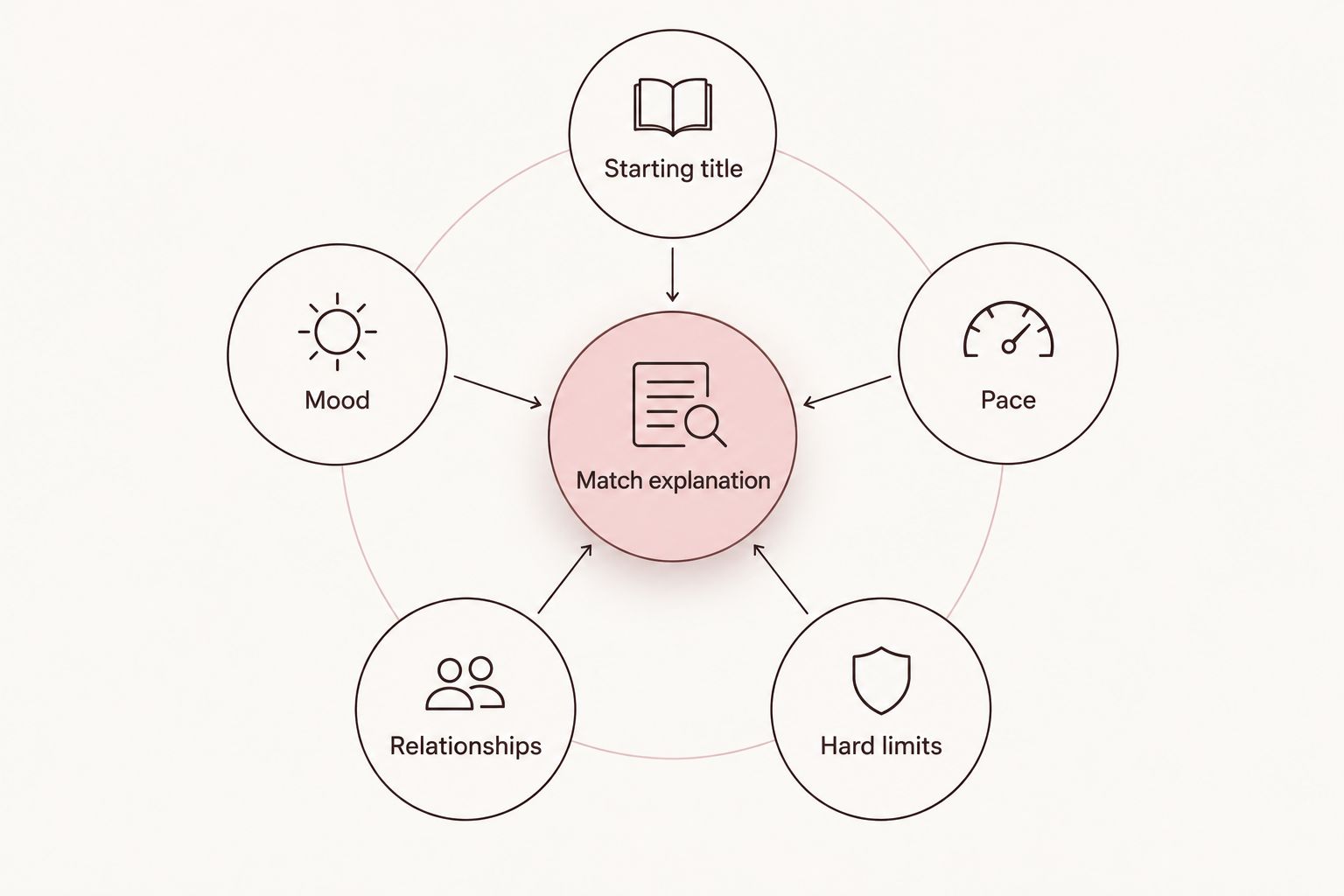
What makes the best book recommendation quiz?
These criteria matter more than whether a questionnaire feels entertaining:
- Starting title: Can you begin with the book you just finished, rather than describe your entire reading identity?
- Mood: Can you distinguish comforting, tense, unsettling, or emotionally heavy reading?
- Pace: Can you separate an urgent plot from a slower story built around atmosphere?
- Relationships: Can you say whether romance, friendship, or family conflict should carry the story?
- Hard limits: Can you identify content or storytelling choices you do not want?
- Match explanation: Does the result explain both the resemblance and the meaningful difference?
For 2026, prioritize a useful distinction over a long questionnaire. A result that says why a book fits gives you something to judge. An unexplained match percentage does not tell you whether the romance, writing style, or suspense will work for you.
Book recommendation tools at a glance
The order runs from a direct favorite-book match toward broader discovery. These are different routes to a recommendation, not interchangeable personality quizzes.
| Tool | Best for | Standout approach | Key limitation |
|---|---|---|---|
| GetSimilarBooks | Following a specific favorite | Five hand-curated read-alikes from a title | The longer personalized list requires email |
| The StoryGraph | Building an ongoing reading profile | Reading preferences and personalized recommendations | More setup than a title-only search |
| Whichbook | Choosing by mood | Interactive mood and reading-experience controls | Less direct when you want a particular book's closest match |
| What Should I Read Next? | Exploring from a book or author | A straightforward title-or-author starting point | A title alone cannot express your boundaries |
| NoveList | Exploring through your library | Read-alikes and reading-appeal information | Access depends on your library's subscriptions |
1. GetSimilarBooks: best for following a specific favorite
GetSimilarBooks is a free book recommendation tool for readers who know which title they want to follow. You enter a book you enjoyed and receive five hand-curated read-alike suggestions. An email-gated personalized list expands that selection to 20–30 titles.
The useful distinction is the starting point. You do not have to turn one reading experience into a permanent personality profile. You can want another Fourth Wing today and something closer to Verity next time.
GetSimilarBooks pros:
- Starts with a concrete book rather than an abstract reader type.
- Keeps the initial selection to five suggestions.
- Offers a longer personalized list for readers building a reading queue.
GetSimilarBooks cons:
- The longer list requires an email address.
- A favorite title does not, by itself, explain everything you liked or disliked.
Best for: Readers seeking a direct read-alike after finishing a specific novel.
Verdict: Use it first when you can name the book you want to follow. Before choosing a result, decide which quality you want repeated and which you want changed.
2. The StoryGraph: best for an ongoing reading profile
The StoryGraph combines reading tracking with personalized recommendations. Its preference-led approach suits readers who want discovery to sit alongside their wider reading life, rather than exist as a single quiz result.
Mood and pace are useful distinctions here. Wanting an intense book is not the same as wanting a fast book. A slower novel can remain deeply unsettling, while an action-heavy fantasy can have a very different emotional effect.
The StoryGraph pros:
- Gives reading preferences a role beyond a single favorite title.
- Uses mood and pace as useful ways to describe books.
- Keeps reading tracking and discovery in the same place.
The StoryGraph cons:
- Building a useful profile takes more input than entering a title.
- Broad preferences still need interpretation when you want one very specific relationship dynamic.
Best for: Readers who want a continuing recommendation habit rather than a one-off answer.
Verdict: Choose The StoryGraph when you want to describe your reading tastes over time. Skip the setup if your immediate question is simply what to read after one particular novel.
3. Whichbook: best for choosing a reading mood
Whichbook lets you explore books through reading-experience choices, including mood, character, and plot. Its interactive controls make it a useful alternative when a standard genre question feels too broad.
This approach works particularly well when you cannot name a comparison title. You might know you want something disturbing rather than comforting, or unpredictable rather than familiar. Those are actionable preferences even without a favorite author.
Whichbook pros:
- Starts with how you want a book to feel.
- Helps you move beyond familiar titles and authors.
- Makes contrasting reading preferences visible during selection.
Whichbook cons:
- Mood alone does not guarantee the relationship dynamic you want.
- It is a less direct route to a close Fourth Wing or Verity read-alike.
Best for: Readers who can describe the experience they want but cannot name a starting book.
Verdict: Choose Whichbook for a mood-led change of direction. Use a title-led finder instead when preserving a particular story dynamic matters most.
4. What Should I Read Next?: best for a quick starting point
What Should I Read Next? begins with a book or author search and returns reading suggestions. That makes it easy to start without translating your preferences into a questionnaire.
Treat the results as possibilities, not explanations of your taste. Searching for Verity cannot tell a tool whether you loved the manuscript device, the romantic tension, or the uncomfortable uncertainty. You still need to make that distinction yourself.
What Should I Read Next? pros:
- Gives you a straightforward book-or-author starting point.
- Avoids a lengthy personality-style questionnaire.
- Provides another route into discovery when you already have a reference title.
What Should I Read Next? cons:
- The starting title cannot communicate every preference or exclusion.
- You need to check whether each suggestion matches the right part of the original.
Best for: Readers who want suggestions quickly and are comfortable checking the fit themselves.
Verdict: Use What Should I Read Next? to open a shortlist, not settle it. Keep only the suggestions whose descriptions support your actual reading priorities.
5. NoveList: best for library-based read-alike research
NoveList is a readers' advisory resource that libraries provide through subscription access. Its read-alikes and reading-appeal information help you look beyond a shared subject toward qualities such as tone, pace, and characterization.
That distinction matters when recommendations need an explanation. Two novels can feature secretive households yet offer different experiences: one might emphasize psychological pressure, while another spends more time on romantic relationships.
NoveList pros:
- Connects book discovery with library research.
- Supports read-alike searching beyond a simple genre label.
- Gives you vocabulary for explaining what kind of reading experience you want.
NoveList cons:
- Your library must provide access.
- Database exploration requires more involvement than receiving an immediate shortlist.
Best for: Library readers who want to investigate why a recommendation fits.
Verdict: Choose NoveList when you want to examine the reasoning. Check your library's electronic resources before making it your main discovery route.
Turn a quiz result into a book you actually want
Before starting a 2026 book recommendation quiz, write two sentences: one naming the quality you want again, and one naming what you want changed. This is a selection exercise, not another personality test.
After Fourth Wing, that might be: “Keep the dangerous competition and central romance. Change the amount of explicit sexual content.” A focused guide to books like Fourth Wing with less spice addresses that distinction more directly than a broad fantasy result.
After Verity, the request might be: “Keep the threatening household and uncertainty. Make romance less central.” That points toward a different reading experience than asking for another romantic thriller.
Two examples of a meaningful match
These examples show what a useful recommendation explanation should contain. Neither book duplicates its comparison title.
| Starting book | Possible next read | Best for | Meaningful difference |
|---|---|---|---|
| Fourth Wing | The Serpent and the Wings of Night by Carissa Broadbent | Deadly competition with a central romance | Vampire society replaces dragons and military training |
| Verity | Rebecca by Daphne du Maurier | An unsettling household and a relationship shadowed by another woman | Gothic atmosphere replaces Verity's contemporary thriller setting |
The Serpent and the Wings of Night fits the danger-and-romance request. Its competition and vampire setting give the match a specific basis. It is not the right substitute if dragon bonds or academy life were your main attraction.
Rebecca fits readers drawn to domestic unease and the influence of an absent woman. Its atmosphere is the connection. Do not choose it expecting Verity's contemporary setting or the same treatment of sexual content.
For mature-content boundaries, check the individual book rather than trusting a genre label. A mood match is not a content guarantee.
How the ranking works
This 2026 ranking favors a direct starting point, useful preference distinctions, and a clear role for each tool. It is an editorial fit assessment, not a measured contest between recommendation engines.
The first choice answers the narrowest question: what follows a specific favorite? The later choices serve broader preferences, mood exploration, quick discovery, and library research. Order carries meaning, but your starting question determines the winner.
Which book recommendation quiz should you choose?
Choose a title-led finder when you have a favorite; choose a preference-led tool when you have a reading mood. That is the simplest way to avoid answering questions that do not help your decision.
For your next 2026 read, start narrow. Name the book, preserve one important quality, and change one thing. Expand into mood-led browsing only when you want the recommendation to take you somewhere less familiar.
Find your next read
Start with five hand-curated suggestions, then request a free personalized list of 20–30 titles by email.
FAQ
What’s the best book recommendation quiz after Fourth Wing?
A title-led read-alike finder is the strongest starting point after Fourth Wing. Decide whether you want the romance, dragon bonds, dangerous training, or another specific quality before choosing a result.
Is a book recommendation quiz better than searching by title?
A quiz is better when you need help describing your preferences; a title search is more direct when you already have a favorite. Neither approach replaces checking why the suggested book fits.
Which book recommendation tool should I use if I only know my mood?
Whichbook is the clearest choice here for mood-led exploration. Its reading-experience controls let you start with how you want a book to feel rather than a comparison title.
Does GetSimilarBooks require an email address?
The personalized list of 20–30 titles requires an email address. The tool also provides an initial selection of five hand-curated read-alike suggestions from a title you enjoyed.
What should I ask for after reading Verity?
Ask for the specific feature you want repeated: romantic obsession, domestic unease, an unreliable account, or a manuscript-centered story. Those requests lead toward different books, even when all the results sit near psychological suspense.
Can a recommendation quiz tell me whether a book has explicit content?
Do not treat a recommendation quiz as a content guarantee. Check book-specific content information whenever explicit sex, violence, or another subject is a firm boundary.
How do I choose between several recommended books?
Choose the book whose match explanation names your main priority and whose difference you accept. A close genre match is less useful than a clear explanation of the reading experience.
One last thing
A useful recommendation includes a reason not to choose it. “Similar romantic tension, but no academy setting” tells you more than “perfect for fans.” Keep the difference in view. It is where you decide whether you want a close match or an interesting departure.
Related guides
- Books like Fourth Wing with slow-burn romance
- Books like Verity with romance at the center
- Books like Verity with a gothic atmosphere
Leave a Reply