Books like Verity with a gothic atmosphere

Best overall: Rebecca by Daphne du Maurier. Best for a writer drawn into family secrets: The Thirteenth Tale by Diane Setterfield. Best for contemporary domestic dread: The Turn of the Key by Ruth Ware. These are the closest starting points for books like Verity with gothic atmosphere in 2026, followed by two picks that move further into horror and uncertainty.
- Rebecca leads these books like Verity with gothic atmosphere: an unsettling marriage, an imposing house, and an absent woman’s influence.
- The Thirteenth Tale fits readers who want a writer, conflicting accounts, and buried family history.
- The Turn of the Key brings gothic isolation into a contemporary nanny thriller.
- Mexican Gothic emphasizes bodily horror; The Little Stranger emphasizes slow, unresolved unease.
What Makes a Gothic Read-Alike for Verity Effective?
Verity makes a private household feel dangerous. An outsider enters, becomes emotionally involved, and has to decide whose account deserves belief. A useful gothic read-alike preserves some of that pressure, rather than simply adding an old house.
The difference matters when you choose. You can want the oppressive setting without wanting supernatural horror, or want narrative doubt without another romance-driven thriller. GetSimilarBooks offers five hand-curated read-alikes from a title you enjoyed, with a free personalized list of 20–30 titles available by email.
What makes the best gothic Verity read-alikes
These 2026 recommendations prioritize the source of the tension, not a shared genre label:
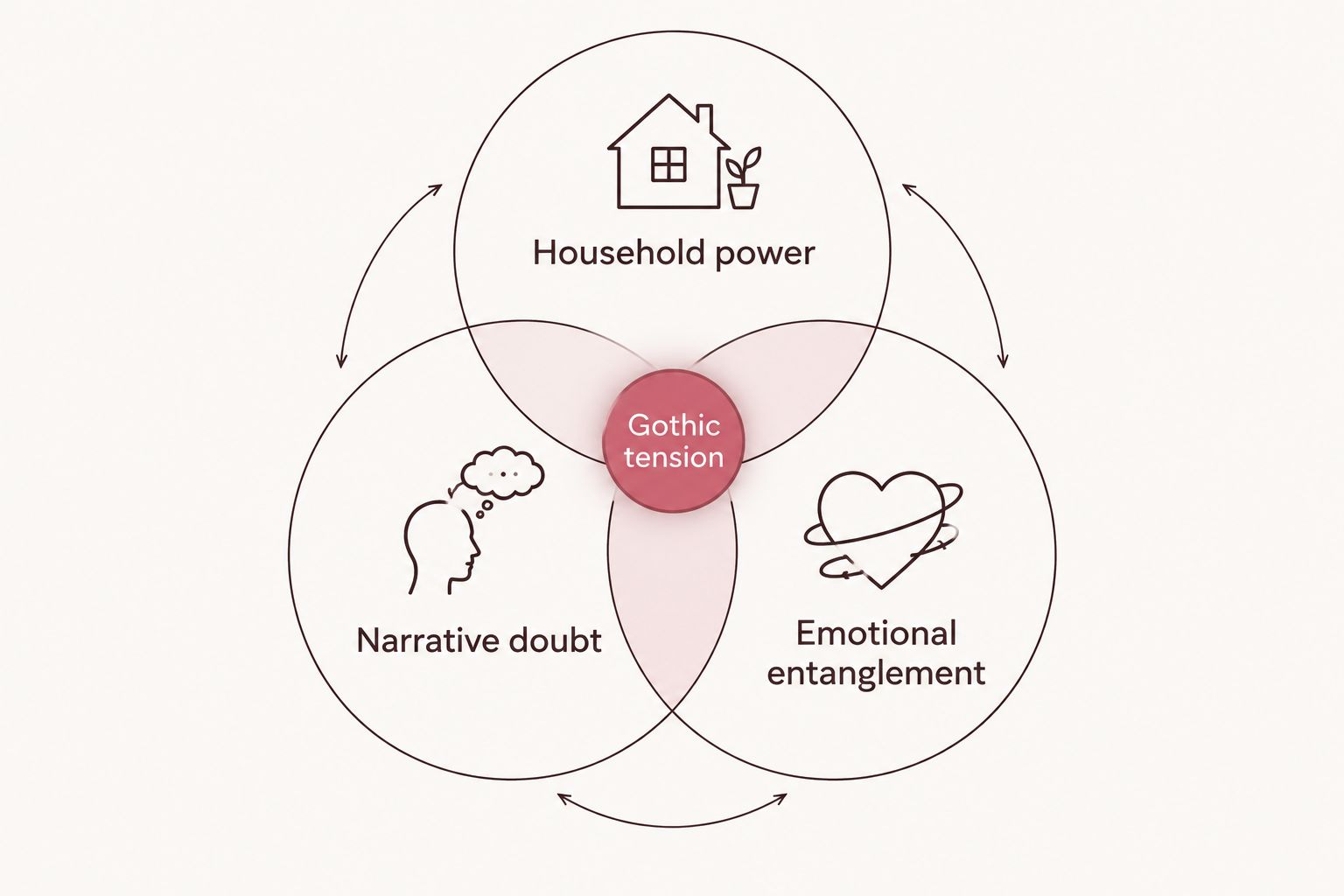
- Household power: Someone controls the home, the information, or the conditions under which an outsider stays.
- Narrative doubt: Accounts conflict, evidence needs interpretation, or the narrator's judgment deserves scrutiny.
- Emotional entanglement: Affection, desire, dependence, or fascination makes leaving harder than recognizing danger.
- Gothic atmosphere: Rooms, routines, inherited status, and the past shape the threat. The house does more than provide scenery.
- Meaningful difference: Every recommendation identifies what you lose as well as what you keep from Verity.
Household power, narrative doubt, and emotional entanglement create gothic tension together. A locked room alone is not enough; the reader needs a reason to care about what it contains.
Gothic read-alikes at a glance
The order moves from the closest overall match toward more specialized choices. A lower position means a greater change in reading experience, not a weaker novel.
| Book | Best for | Standout connection to Verity | Key limitation |
|---|---|---|---|
| Rebecca — Daphne du Maurier | Marriage and an absent woman's influence | An outsider enters a household still shaped by a previous wife | More restrained and slower than Verity |
| The Thirteenth Tale — Diane Setterfield | Writers and contested family history | A writer must interpret another person's account | Storytelling matters more than romantic suspense |
| The Turn of the Key — Ruth Ware | Contemporary domestic confinement | A paid outsider becomes entangled in a troubled household | Child endangerment is central; romance is not |
| Mexican Gothic — Silvia Moreno-Garcia | A threatening family estate | An outsider challenges a household's control | Moves into overt bodily horror |
| The Little Stranger — Sarah Waters | Slow, interpretive unease | Class, desire, and a decaying house complicate perception | Deliberate pacing rather than rapid reversals |
1. Rebecca: best for marriage under an absent woman's shadow
Daphne du Maurier's Rebecca follows an unnamed young woman who marries Maxim de Winter and arrives at Manderley. His first wife, Rebecca, remains a powerful presence in the household despite her absence.
The connection to Verity is specific: a newcomer tries to understand a marriage while another woman's story shapes everything around her. Attraction does not provide reliable access to the truth. Domestic details become evidence, and the narrator's insecurity affects what she notices.
Rebecca pros:
- The previous wife's influence gives the household a sustained emotional threat.
- Manderley makes belonging, exclusion, and status tangible.
- The marriage keeps personal desire tied to uncertainty.
Rebecca cons:
- The narration spends more time on social discomfort and inward anxiety than Verity does.
- Sexual content is more restrained; do not choose it for comparable explicitness.
Best for: Readers who want the dangerous intimacy of Verity with a stronger emphasis on the house and its history.
Difference that decides it: Rebecca builds pressure through what the narrator believes about herself as much as through what she suspects about others. Give that insecurity room to work.
Verdict: Buy if the marriage and the absent woman's influence mattered more than Verity's speed.
2. The Thirteenth Tale: best for a writer confronting family secrets
Diane Setterfield's The Thirteenth Tale brings biographer Margaret Lea into the orbit of novelist Vida Winter. Winter wants to tell her life story, but her reputation for invented accounts makes straightforward belief difficult.
This is the recommendation for readers who liked the act of reading and interpreting another person's story in Verity. Margaret's work becomes an encounter with concealed history, family damage, and the question of what a storyteller chooses to reveal.
The Thirteenth Tale pros:
- The writer-and-listener relationship makes credibility central.
- Angelfield provides a decaying estate with a consequential past.
- Family history supplies the mystery rather than functioning as background.
The Thirteenth Tale cons:
- The atmosphere is more literary and retrospective than Verity's immediate domestic suspense.
- Romance is not the main reason to keep reading.
Best for: Readers who want storytelling itself to become part of the mystery.
Difference that decides it: The Thirteenth Tale asks you to listen closely to a life being reconstructed. It offers less of the charged romantic triangle that drives Verity.
Verdict: Buy if an uncertain account and a damaged family are your strongest points of interest.
For that particular connection, the guide to books like Verity about writers and hidden manuscripts keeps the focus on texts, authorship, and concealed information.
3. The Turn of the Key: best for contemporary household dread
Ruth Ware's The Turn of the Key follows Rowan, a nanny who takes a position at an isolated Scottish home fitted with smart technology. Her account is framed as a letter written from prison after a child's death.
Like Verity, the novel puts a paid outsider inside a family system she does not understand. The home offers access and opportunity, then turns daily routines into sources of anxiety. Surveillance replaces some of the traditional gothic house's secrecy without removing its menace.
The Turn of the Key pros:
- The employment setup gives the outsider a concrete reason to stay.
- Modern technology makes the domestic setting intrusive rather than reassuring.
- The letter framework makes Rowan's account part of the suspense.
The Turn of the Key cons:
- Child death and endangerment are central, not incidental content notes.
- A romantic relationship does not carry the story as it does in Verity.
Best for: Readers who want gothic confinement without switching to a historical setting.
Difference that decides it: Rowan's professional responsibility shapes the danger. Choose this for household pressure and a disputed account, not for a romance-first experience.
Verdict: Buy for contemporary isolation; skip if child-harm themes are a firm boundary.
4. Mexican Gothic: best for a family estate that becomes a bodily threat
Silvia Moreno-Garcia's Mexican Gothic sends Noemí Taboada to High Place after she receives a troubling letter from her cousin. The isolated estate and its controlling family make her visit increasingly difficult.
The Verity connection is an outsider investigating what happens inside a household whose occupants control the information. Noemí's concern gives her a reason to remain involved. The difference is substantial: the threat develops into overt horror rather than remaining solely a matter of deception and interpretation.
Mexican Gothic pros:
- The estate's physical condition contributes directly to the reading experience.
- Family authority makes ordinary conversations feel coercive.
- Noemí's investigation provides a clear purpose beyond simply surviving an unsettling visit.
Mexican Gothic cons:
- Bodily horror changes the texture of the suspense.
- Sexual coercion and eugenics are part of the novel's disturbing material.
Best for: Readers who wanted Verity's house to feel more physically oppressive and its family power more threatening.
Difference that decides it: Mexican Gothic is not merely a domestic thriller in a more elaborate building. Choose it because you want the move into horror.
Verdict: Buy for an oppressive estate and bodily horror; skip if you want strictly psychological suspense.
5. The Little Stranger: best for slow dread and uncertain interpretation
Sarah Waters's The Little Stranger follows Dr. Faraday's growing involvement with the Ayres family at Hundreds Hall, a declining country house in postwar England. The family's difficulties and unsettling events resist a simple explanation.
The connection to Verity lies in the distance between an account and the reader's interpretation of it. Faraday's position matters. So do class, attachment, and the desire to belong to a household that is losing its former standing.
The Little Stranger pros:
- The decaying house carries emotional and social meaning.
- The narrator's investment in the family rewards close attention.
- Uncertainty persists beyond individual frightening incidents.
The Little Stranger cons:
- The pacing is deliberately slow compared with Verity.
- Romantic attachment does not create the same fast, sexually charged suspense.
Best for: Readers who enjoy deciding what a narrator understands, overlooks, or cannot admit.
Difference that decides it: The Little Stranger asks for patience with social observation and accumulating discomfort. It is the furthest step from Verity's momentum on this list.
Verdict: Buy for patient, interpretive reading; skip when you want an immediate page-turner.
How these books are ranked
The 2026 order puts emotional and structural resemblance ahead of the quantity of gothic scenery. Rebecca leads because marriage, an outsider's insecurity, and an absent woman's influence work together. The Thirteenth Tale follows for its contested storytelling, while The Turn of the Key preserves the contemporary outsider-in-a-house setup.
Mexican Gothic and The Little Stranger move outward in different directions: bodily horror and sustained uncertainty. This is a comparison of those reading qualities, not a claim that each book reproduces Verity's twists.
GetSimilarBooks is best for fiction readers who want title-based, hand-curated book recommendations. Use the free personalized list when the distinction is narrower than a genre: more atmosphere, less romance, or a different tolerance for horror.
Find your next read
Start with five hand-curated suggestions, then request a free personalized list of 20–30 titles by email.
Which gothic Verity read-alike should you choose?
Start with Rebecca if you are undecided. For this 2026 shortlist, it offers the clearest combination of an unsettling marriage, household power, and another woman's enduring influence. Choose The Thirteenth Tale instead if interpreting a storyteller matters more than romantic attachment.
Do not pick the darkest-sounding title automatically. The Turn of the Key emphasizes responsibility and child endangerment; Mexican Gothic takes you into bodily horror; The Little Stranger trades speed for interpretive unease. Those are different reading commitments.
FAQ
What’s the best book like Verity with a gothic atmosphere?
Rebecca by Daphne du Maurier is the strongest overall choice on this list. Its outsider narrator enters a marriage and a household still shaped by the husband’s first wife, making intimacy difficult to separate from uncertainty.
Which book should I choose after Verity in 2026?
Choose Rebecca for marriage-centered gothic suspense or The Thirteenth Tale for a writer interpreting a disputed life story. The better match depends on whether Verity’s relationship tension or its embedded account interested you more.
Is Rebecca as sexually explicit as Verity?
No. Rebecca is more restrained in its treatment of sex and develops much of its tension through insecurity, social power, and the influence of the first wife.
Which recommendation feels the most contemporary?
The Turn of the Key provides the most clearly contemporary household setup here. Smart-home technology and surveillance give its isolated setting a different form of intrusiveness from the older estates in the other recommendations.
Are all these books supernatural?
No. Gothic atmosphere does not require a supernatural explanation, and these books handle that boundary differently. Mexican Gothic moves into overt horror, while Rebecca builds its threat through people and the household’s past.
Which book is best if I liked the writing-related mystery in Verity?
The Thirteenth Tale is the best fit for that interest. A biographer listens to a novelist’s account of her life, making credibility and the reconstruction of family history central to the mystery.
Which recommendation should I avoid if child harm is a boundary?
The Turn of the Key is a clear exclusion because a child’s death frames the story. This shortlist is not a child-harm screening guide; check detailed content notes before choosing any title when that boundary is firm.
How does GetSimilarBooks help me choose my next book?
GetSimilarBooks lets you enter a title you enjoyed and receive five hand-curated read-alike suggestions. You can also request a free personalized list of 20–30 titles by email.
One last thing
Before choosing, ask what made the house in Verity frightening: the person inside it, the account you read there, or the possibility that intimacy had distorted your judgment. That answer is more useful than asking for another mansion.
For your 2026 reading list, pick the connection first. Atmosphere works best when it puts pressure on something you already care about.
Related guides
- Books like Verity with romance at the center
- Books like Verity with unreliable narrators
- Books like Verity built around family secrets
Leave a Reply