Books like Project Hail Mary with humor in the science

Best overall: The Martian. Best for an inventive, talkative narrator: We Are Legion (We Are Bob). Best for dry humor: All Systems Red. This 2026 guide ranks funny books like Project Hail Mary by how closely their humor connects to science, problem-solving, and life under pressure.
- For books like Project Hail Mary, funny scientific problem-solving makes The Martian the closest match.
- We Are Legion (We Are Bob) pairs engineering puzzles with a conversational narrator and a broader space adventure.
- All Systems Red delivers dry humor and reluctant teamwork, but less scientific explanation.
- Redshirts and The Hitchhiker’s Guide to the Galaxy favor satire over realistic science.
Want recommendations built around your own favorite title? GetSimilarBooks gives you 5 hand-curated recommendations, with an email-gated personalized list of 20–30 titles for a longer reading queue. GetSimilarBooks is best for readers seeking book recommendations from a title they already enjoyed.
Why this matters
Project Hail Mary is funny without treating its central problem as a joke. Ryland Grace observes, guesses, tests, and revises. His voice makes the explanations readable; the explanations make his small victories satisfying.
That combination is narrower than funny science fiction. A book can offer excellent jokes and almost none of the pleasure of watching someone work out how an unfamiliar system behaves.
The distinction matters here. The first recommendations preserve the problem-solving experience. The later recommendations trade scientific detail for sharper comedy. Order carries meaning.
What makes the best funny Project Hail Mary read-alike?
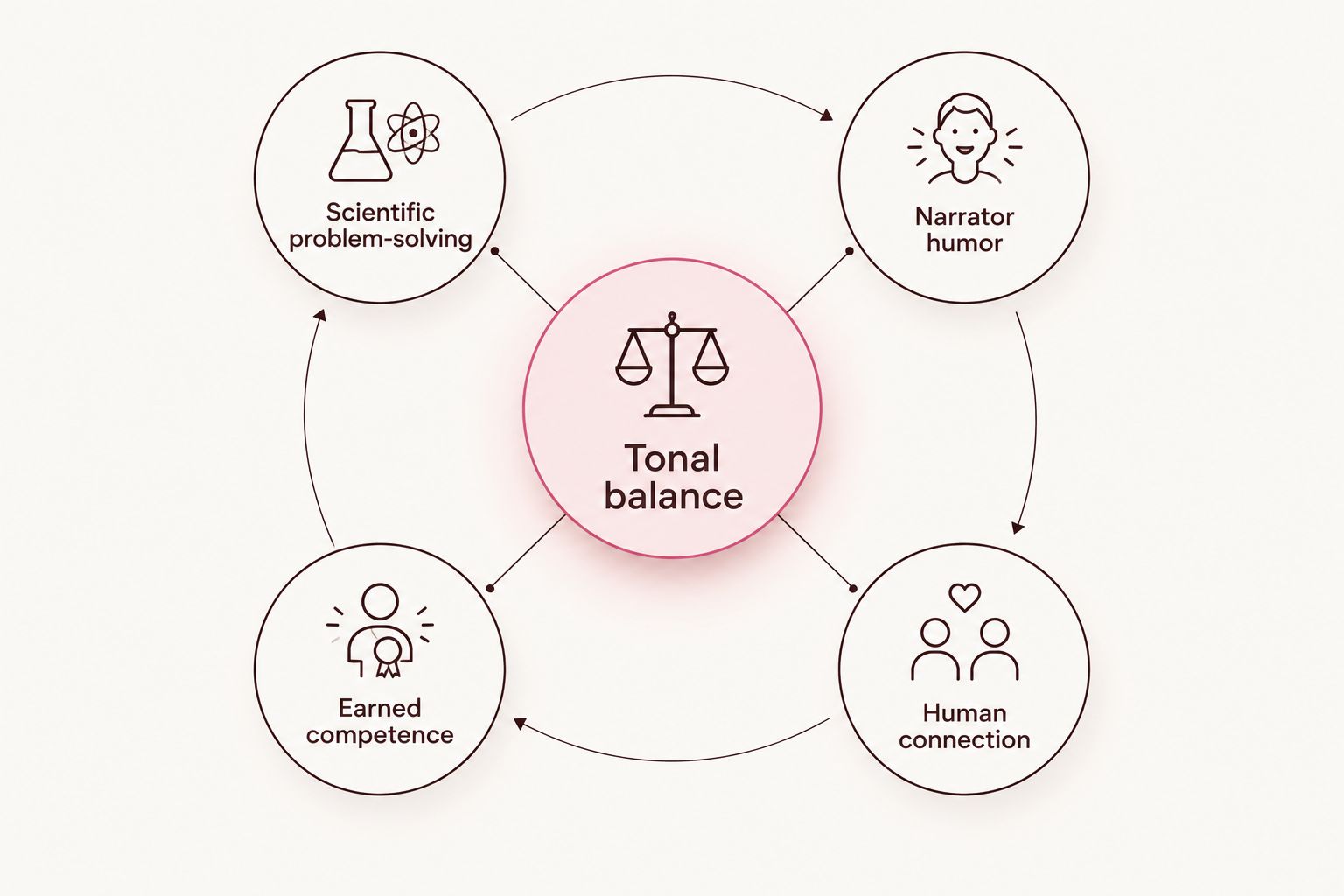
For this 2026 list, a shared spaceship setting is not enough. These are the matching qualities that determine the order:
- Scientific problem-solving: Characters make progress through observation, experiments, engineering, or practical reasoning.
- Narrator humor: The comic voice belongs to the person facing the problem, rather than sitting outside the story.
- Earned competence: Solutions require work. An explanation matters more when you understand what could go wrong.
- Human connection: Cooperation, friendship, and reluctant trust give the technical material an emotional purpose.
- Tonal balance: Humor relieves pressure without making every threat meaningless.
Decide which quality you want before choosing. If you want experiments, start at the top. If you want a funny voice more than scientific detail, the middle picks offer a different route.
Funny books like Project Hail Mary at a glance
The Martian is the closest match in method and voice. Each subsequent book moves farther from realistic scientific troubleshooting and toward another kind of comic pleasure.
| Book | Best for | Standout matching quality | Key limitation |
|---|---|---|---|
| The Martian by Andy Weir | Survival through practical science | A stranded scientist explains solutions with gallows humor | No equivalent central alien relationship |
| We Are Legion (We Are Bob) by Dennis E. Taylor | A chatty engineering-led space adventure | Technical puzzles, an informal narrator, and expanding possibilities | A more sprawling story that continues across a series |
| All Systems Red by Martha Wells | Dry humor and reluctant teamwork | A capable, anxious narrator who would rather avoid people | Less scientific explanation; more action and security work |
| Redshirts by John Scalzi | Space-adventure satire | Characters question the lethal logic of their assignments | Its puzzles concern storytelling more than physical science |
| The Hitchhiker’s Guide to the Galaxy by Douglas Adams | Absurd cosmic comedy | Comic explanations turn the universe into the joke | Little interest in realistic experimentation |
1. The Martian: best for survival through practical science
Andy Weir’s The Martian follows astronaut Mark Watney after he is stranded on Mars. Survival becomes a sequence of practical problems involving food, equipment, communication, and an environment that does not forgive mistakes.
This is the strongest recommendation if your favorite Project Hail Mary passages involved Grace working something out. Watney explains his reasoning in an informal voice. The jokes sit beside the calculations rather than replacing them.
The specific match: A scientifically capable narrator uses humor to keep an overwhelming situation manageable. Progress feels satisfying because you understand the obstacle and the proposed solution.
The meaningful difference: The Martian emphasizes isolation, survival logistics, and the effort to bring someone home. It does not recreate the discovery-led relationship at the heart of Project Hail Mary. Its narrator also uses frequent strong language.
The Martian pros:
- Scientific explanations are central to the action.
- Watney’s gallows humor keeps technical passages conversational.
- Practical constraints give each successful repair or experiment weight.
The Martian cons:
- The survival structure is less focused on discovering unfamiliar life.
- Readers who disliked extended technical explanations will encounter them again.
Best for: Readers who want another resourceful scientist talking through an apparently impossible assignment.
Verdict: Read The Martian first for the closest combination of science and humor.
2. We Are Legion (We Are Bob): best for an expansive engineering adventure
Dennis E. Taylor’s We Are Legion (We Are Bob) follows Bob Johansson, whose consciousness becomes the basis of an artificial intelligence operating a space probe. The premise opens into exploration, engineering, and questions about identity.
Bob’s informal narration supplies the main connection. He approaches extraordinary circumstances with curiosity, technical interests, and pop-culture references. Working out what he can build becomes part of the pleasure.
The specific match: Technical problem-solving remains entertaining because the narrator sounds like someone thinking aloud. New capabilities create new problems rather than ending the story’s practical challenges.
The meaningful difference: The story spreads outward. Project Hail Mary concentrates attention on a mission; We Are Legion increasingly divides attention among different developments and versions of its central character. It also starts a continuing series.
We Are Legion (We Are Bob) pros:
- Engineering decisions help drive the plot.
- An approachable voice keeps speculative ideas easy to follow.
- Exploration gives the scientific curiosity room to expand.
We Are Legion (We Are Bob) cons:
- Pop-culture references are a larger part of the comic voice.
- The widening scope reduces the tight, isolated-mission feeling.
Best for: Readers who want more technical playfulness and are happy to follow a story beyond a single novel.
Verdict: Read We Are Legion (We Are Bob) for the engineering voice, not an identical emotional arc.
3. All Systems Red: best for dry humor and reluctant teamwork
Martha Wells’s All Systems Red introduces Murderbot, a security construct that has overridden its governor module. It wants to watch entertainment rather than deal with humans. Protecting a survey team makes that preference difficult to maintain.
The humor comes from the gap between Murderbot’s abilities and its discomfort with social interaction. It can assess danger more easily than it can handle people expressing concern.
The specific match: Competence and connection share the page. A narrator who resists emotional involvement still has to decide what other people mean to it. That tension gives the dry observations more weight than a stream of detached jokes.
The meaningful difference: All Systems Red is a novella with a security-and-action plot. You get assessments, investigation, and decisive action rather than long explanations of physics or chemistry. It begins The Murderbot Diaries, so the larger character development continues elsewhere.
All Systems Red pros:
- The distinctive narrator supplies humor without stopping the action.
- Reluctant cooperation gives the danger personal stakes.
- The shorter form offers a compact change of pace after Project Hail Mary.
All Systems Red cons:
- Scientific experimentation is not the main attraction.
- Combat and bodily injury are part of the story.
Best for: Readers who miss the funny voice and growing trust more than the laboratory work.
Verdict: Read All Systems Red for character-driven humor; skip it if detailed science is essential.
4. Redshirts: best for questioning space-adventure logic
John Scalzi’s Redshirts follows low-ranking crew members aboard a starship whose away missions are disturbingly dangerous. They begin paying attention to patterns that their working lives give them good reason to question.
The book turns familiar space-television conventions into problems its characters must confront. Why does an assignment behave this way? What changes when someone notices the pattern?
The specific match: Characters observe something strange and try to understand its rules. The humor grows from recognizing a contradiction between what they are told and what they experience.
The meaningful difference: Redshirts investigates narrative logic rather than offering Project Hail Mary’s kind of scientific explanation. Its central pleasure depends on enjoying a story that examines the conventions of other stories. Familiarity with television space adventures helps the jokes land.
Redshirts pros:
- Questions and observations give the satire a plot to follow.
- Crew interactions provide a more social kind of humor.
- The premise offers a clear change from lone-scientist survival.
Redshirts cons:
- Scientific realism is not the organizing principle.
- The metafictional approach can interrupt immersion if you prefer a self-contained fictional world.
Best for: Readers who want an investigation with jokes about the rules of space adventures.
Verdict: Read Redshirts when you want satire; skip it when you want experiments.
5. The Hitchhiker’s Guide to the Galaxy: best for cosmic absurdity
Douglas Adams’s The Hitchhiker’s Guide to the Galaxy sends Arthur Dent into space after the destruction of Earth. Alien bureaucracy, improbable situations, and the Guide’s explanatory digressions shape the comedy.
Explanations are often the joke. Where Andy Weir makes an extraordinary problem understandable, Adams makes the supposedly understandable world look ridiculous.
The specific match: An ordinary-seeming viewpoint helps you enter an enormous, unfamiliar universe. Comic explanations keep the reading conversational even when the setting becomes strange.
The meaningful difference: Scientific plausibility is not the point. Arthur is not a Watney-style engineer steadily converting knowledge into control. The universe resists that kind of orderly treatment, and much of the humor depends on the mismatch.
The Hitchhiker’s Guide to the Galaxy pros:
- Narration and explanatory asides are central comic strengths.
- The cosmic scale creates room for philosophical absurdity.
- It offers a decisive tonal change without leaving science fiction.
The Hitchhiker’s Guide to the Galaxy cons:
- The episodic structure offers less sustained technical problem-solving.
- Emotional relationships are not developed in the same way as Project Hail Mary’s central bond.
Best for: Readers who want the funniest departure from the original rather than the closest reconstruction.
Verdict: Read The Hitchhiker’s Guide to the Galaxy for absurdity; skip it for realistic science.
How this ranking works
This 2026 ranking prioritizes the overlap between scientific reasoning and a funny narrative voice. Emotional connection breaks a close match ahead of a book that merely shares the setting.
These are comparisons of the books’ premises, narrative approaches, and central concerns, not claims of hands-on testing or a curator having read every title. There is no numerical similarity score behind the order.
The Martian leads because science and humor perform similar jobs in both books. We Are Legion broadens the engineering adventure. All Systems Red preserves the voice-and-connection appeal. Redshirts and The Hitchhiker’s Guide move toward satire and absurdity.
Which book should you choose?
The Martian is the default recommendation for readers seeking funny books like Project Hail Mary in 2026. Choose it when the explanation of a solution was as enjoyable as the solution itself.
Choose All Systems Red instead if your strongest memory is a funny character learning to care. Choose We Are Legion if you want technical curiosity to expand into a continuing space adventure.
For a list shaped around your own priorities, GetSimilarBooks accepts a title you enjoyed and returns read-alike recommendations. Name the book you loved; then judge each suggestion by the quality you want repeated, not merely its genre.
Find your next read-alike
Get five hand-curated suggestions, then request a personalized list of 20–30 titles by email.
FAQ
What’s the best funny book like Project Hail Mary in 2026?
The Martian by Andy Weir is the closest match for scientific problem-solving paired with a funny first-person voice. Its major difference is the focus on survival and rescue rather than discovering unfamiliar life.
Is The Martian or We Are Legion closer to Project Hail Mary?
The Martian is closer in its focused survival structure and step-by-step scientific reasoning. We Are Legion offers a similarly conversational technical voice but expands into a broader, continuing space adventure.
What should I read if I liked the humor but not all the science?
All Systems Red is the strongest choice here for dry character humor without extended scientific explanations. Redshirts is a better fit if you prefer satire about space-adventure conventions.
Is The Hitchhiker’s Guide to the Galaxy scientifically realistic?
The Hitchhiker’s Guide to the Galaxy uses science-fiction ideas for absurd comedy rather than realistic scientific problem-solving. Choose it for comic narration, not a close equivalent to Grace’s experiments.
Which recommendation is best if I liked the friendship in Project Hail Mary?
All Systems Red is the best choice on this list for reluctant trust and character connection. Its relationships develop through protection and cooperation, not through the same circumstances as Project Hail Mary.
Do I need to start a long series after Project Hail Mary?
No. The Martian gives you a standalone survival story. We Are Legion and All Systems Red begin continuing series, making them better choices when you want more time with their narrators.
Can I get personalized recommendations instead of another fixed list?
GetSimilarBooks provides five hand-curated suggestions when you enter a title you enjoyed. You can also request a personalized list of 20–30 titles through its email-gated option.
One last thing
Before opening a sample, finish this sentence: I liked Project Hail Mary because of the ______.
Write experiments, and start with The Martian. Write voice, and consider All Systems Red. Write cosmic jokes, and move toward Douglas Adams. The useful match is the thing you want to feel again, not the spaceship on the cover.
Related guides
- Books like Project Hail Mary: closest match first
- Books like Project Hail Mary with first-contact aliens
- Switch to fantasy: books like Harry Potter for adult readers
Leave a Reply