Books like ACOTAR for book clubs: complete 2026 guide

Book-club ACOTAR read-alikes are fantasy novels chosen to recreate the series’ romantic tension while giving your group something substantial to debate. Start with The Serpent and the Wings of Night for dangerous attraction and deadly trials; choose The Cruel Prince when faerie politics matter more than explicit romance.
- For books like ACOTAR for book clubs, start with Carissa Broadbent’s The Serpent and the Wings of Night.
- Choose The Cruel Prince for faerie politics, not an equally prominent or explicit romance.
- Choose Uprooted when your club wants a standalone rather than another series commitment.
- GetSimilarBooks suits fiction readers seeking hand-curated read-alikes from a title they already enjoyed.
Why ACOTAR read-alikes matter for book clubs
A useful 2026 shortlist needs more than the label romantasy. One member wants faerie courts. Another wants an absorbing relationship. Someone else wants a book that leaves room to discuss power rather than predict the next kiss.
ACOTAR means Sarah J. Maas’s A Court of Thorns and Roses series here, not just its opening novel. Ask which part your members want repeated. A match for the first book’s fairy-tale atmosphere is not automatically a match for the later books’ relationships and wider conflicts.
The closest-match ACOTAR reading guide is another starting point if your group still needs to identify its main attraction. For a club decision, add a second test: Does the book give members who disagree about the romance something else to discuss?
The recommendations below move from romance-forward danger toward more distant matches. They do not promise the same experience. Their differences are part of the choice.
How to choose books like ACOTAR for book clubs
Name the experience your members want repeated
Before collecting titles, ask everyone to finish this sentence: I want another book that makes me feel the way ACOTAR did when… Keep answers spoiler-free. The useful words are usually more specific than fantasy or romance: distrust, belonging, temptation, transformation, or divided loyalty.
For your 2026 ballot, reduce those answers to 2 matching qualities and 1 deal-breaker. That gives the group a shared brief without pretending everyone reads for the same reason. It also keeps the loudest enthusiast from choosing a whole series for everyone else.
- Pick the main attraction: relationship tension, faerie politics, or found family.
- State whether explicit sexual content is welcome, unwanted, or optional.
- Decide whether the selection must stand alone.
- Agree whether discussion can include later ACOTAR books.
Start with dangerous attraction and deadly trials
The Serpent and the Wings of Night by Carissa Broadbent is the closest opening choice here for a group that wants romance tied to survival. Oraya is a human raised within vampire society who enters a deadly tournament. Her alliance with Raihn makes trust both emotionally charged and practically necessary.
Best for: readers who want an adult romantic fantasy with dangerous tests, unequal power, and an uneasy alliance. The match is the pressure placed on intimacy: attraction does not remove the need to judge someone’s motives.
The meaningful difference is the setting. Vampires and tournament survival replace faerie courts, so do not choose it primarily for ACOTAR’s faerie atmosphere. Its violence and explicit sexual content also belong in the group’s decision, not in a surprise announcement after the vote.
Verdict: Buy for romance under pressure; skip if faeries are essential.
- Ask whether survival pressure changes what counts as a free choice.
- Discuss how Oraya’s upbringing shapes her judgments.
- Compare protective behavior with controlling behavior without revealing later developments.
Put political consequences ahead of magical spectacle
The Bridge Kingdom by Danielle L. Jensen follows Lara, a princess trained to undermine the kingdom she enters through a political marriage. The relationship is inseparable from competing national interests. Choosing whom to believe carries consequences beyond the couple.
Best for: clubs that want distrust, divided loyalty, and a romance that creates political problems. Its strongest ACOTAR connection is the collision between personal attachment and inherited assumptions about an enemy.
The difference is equally useful. This is not a faerie-court substitute, and its appeal rests on espionage, geography, and political marriage rather than the same magical atmosphere. Choose it because your group wants to argue about loyalty, not because every fantasy romance is interchangeable.
GetSimilarBooks’ book recommendation tool offers another route when these distinctions split the room: enter 1 title your group enjoyed to receive 5 hand-curated suggestions. The personalized list contains 20–30 titles and requires an email address. That expands the ballot; it does not replace your content boundaries.
Verdict: Buy for political mistrust; skip if elaborate magic is the priority.
- Ask what Lara owes her birthplace and what she owes the people she meets.
- Separate understandable motives from defensible actions.
- Decide whether secrecy strengthens the romantic tension or obstructs it.
Separate faerie intrigue from romance intensity
The Cruel Prince by Holly Black is the strongest choice here when faerie is the nonnegotiable word. Jude is a mortal trying to gain power in a dangerous faerie court. Status, humiliation, ambition, and belonging shape her decisions.
Best for: groups that want hostile attraction and court maneuvering, with less emphasis on explicit sexual content. The match lies in a human character confronting an unequal supernatural society and refusing to remain powerless.
The difference is the romance’s role. This is young adult fantasy in which political ambition takes substantial space; it is not an adult romance with equivalent on-page intimacy. Members expecting the relationship to dominate every development need that distinction before voting.
Its discussion value comes from Jude herself. Your group does not have to admire her choices to understand why she makes them. Keep content notes brief: bullying and violence matter even though the romance is less explicit.
Verdict: Buy for faerie power struggles; skip if romance must lead.
- Discuss whether belonging requires acceptance or control.
- Ask when adaptation to a cruel society becomes participation in it.
- Compare Jude’s stated goals with the choices she actually makes.
Choose a standalone when commitment is the obstacle
Uprooted by Naomi Novik offers a self-contained alternative to starting another romantic fantasy series. Agnieszka’s connection to her village, her friendship with Kasia, and the threat of a corrupted Wood give the story stakes outside its central romantic relationship.
Best for: clubs that want fairy-tale darkness, unsettling magic, and a complete story within the selected novel. Its ACOTAR connection is the combination of an initially unequal relationship, an unfamiliar magical world, and a heroine discovering her own abilities.
The difference is emphasis. Romance shares the book with friendship, community, and the struggle against corruption. The central relationship also involves a substantial power imbalance; do not present the novel as an uncomplicated comfort read. It includes violence and sexual content.
This is the better choice when finishing a story matters more than finding another long series to inhabit. You can discuss the ending without asking members to continue into another installment.
Verdict: Buy for a complete fairy-tale fantasy; skip if romance must dominate.
- Ask which relationship most strongly shapes Agnieszka’s choices.
- Discuss whether the magic feels intuitive, controlled, or contested.
- Examine how the story distinguishes protecting a place from possessing it.
Change the pace without abandoning faerie danger
Emily Wilde’s Encyclopaedia of Faeries by Heather Fawcett moves furthest from ACOTAR’s romance-forward experience. Emily is a scholar studying faeries, and the journal format makes her observations part of the story’s appeal. Her research brings questions of interpretation, expertise, and social understanding into the discussion.
Best for: groups that want folklore, an academic viewpoint, and a more restrained romantic thread. The connection is the encounter with faeries who do not simply follow human expectations.
The difference is tone and structure. Field research and journal entries replace the sustained romantic intensity some ACOTAR readers want. Do not call it an equivalent just because both books contain faeries. Its quieter presentation also does not mean its supernatural world is harmless.
Choose this when the group wants a change of pace rather than another version of the same emotional arc. It is a series opener, not the standalone alternative offered by Uprooted.
Verdict: Buy for scholarly folklore; skip if you want high-intensity romance.
- Ask what Emily understands better through scholarship than through conversation.
- Discuss where observation becomes interference.
- Compare the faeries’ rules with the assumptions human characters bring.
Run a short ballot and a spoiler-bounded discussion
Choose 3 candidates from the shortlist rather than asking everyone to assess every possible read-alike. Give each candidate a matching quality, a meaningful difference, and a brief content note. Let members rule out a genuine boundary before ranking their preferences.
For your 2026 meetings, keep the first discussion focused on the selected book. Later-series revelations can make a new reader’s contribution impossible, even when everyone technically finished the assigned title.
Use these decision labels to keep the ballot concrete:
- Closest match: choose The Serpent and the Wings of Night for romantic danger.
- Court politics: choose The Cruel Prince for faerie ambition.
- Standalone: choose Uprooted for a complete story.
- Change of pace: choose Emily Wilde’s Encyclopaedia of Faeries for scholarly folklore.
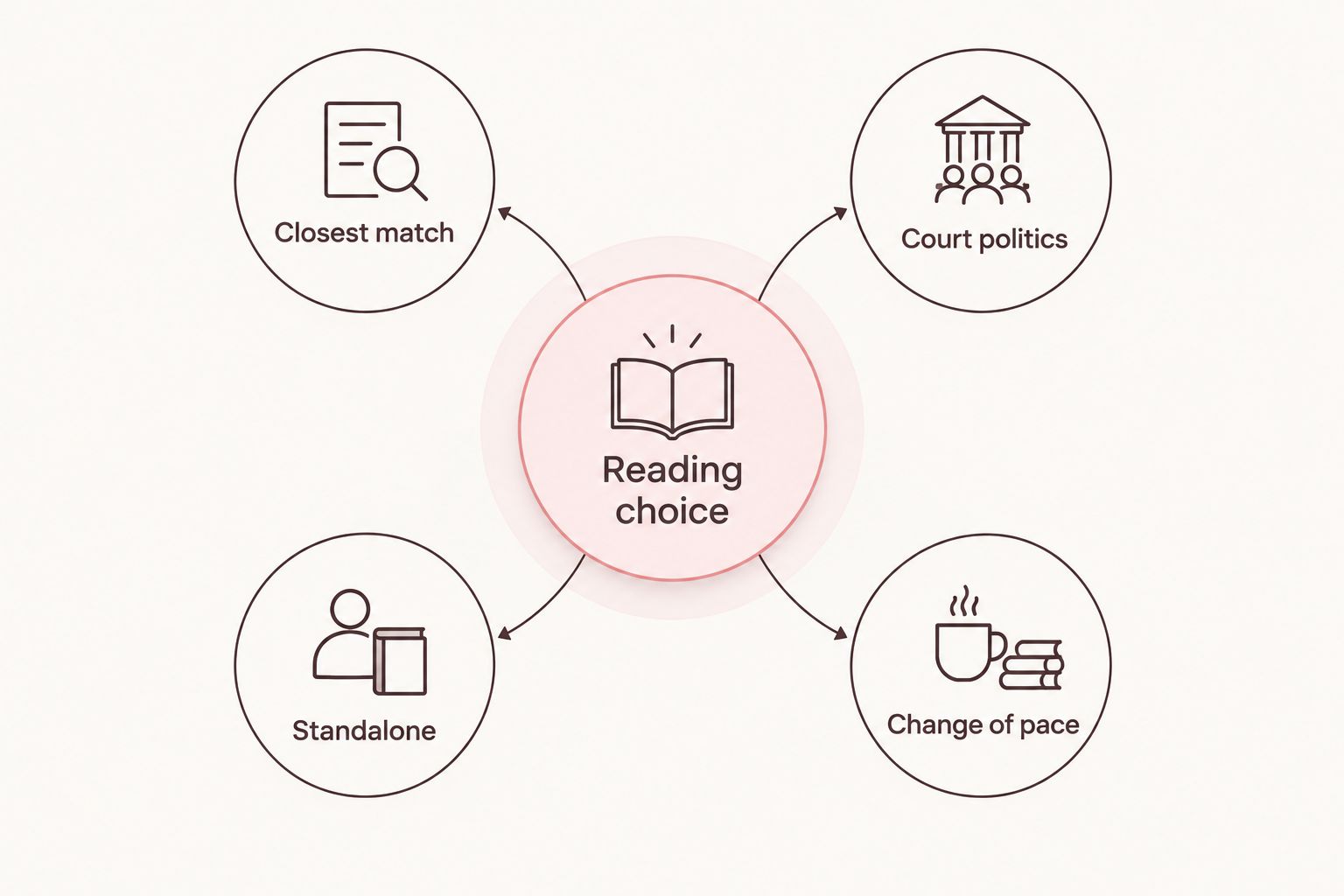
The reading choice should reflect the group’s shared interest, not just its favorite cover description. If the ballot stalls, GetSimilarBooks can supply a wider hand-curated shortlist from a title members already agree on; the email requirement applies to the longer personalized list.
Find your next shared read
Enter a title for five suggestions, or request the email-gated personalized list of 20–30 titles.
Compare the book-club options
These are reading-fit comparisons, not interchangeable recommendations. The limitation column matters as much as the match.
| Book | Best for | Strongest matching quality | Key limitation |
|---|---|---|---|
| The Serpent and the Wings of Night | Adult romance under pressure | Dangerous attraction and survival tests | Vampire setting rather than faerie courts; explicit content |
| The Bridge Kingdom | Arguments about loyalty | Political marriage and distrust | Not a substitute for faerie magic |
| The Cruel Prince | Faerie-court debate | Mortal ambition within an unequal court | Romance is less central and less explicit |
| Uprooted | A standalone selection | Dark fairy-tale magic and personal transformation | Friendship and community compete with romance for attention |
| Emily Wilde’s Encyclopaedia of Faeries | A quieter change of pace | Dangerous folklore and an outsider’s perspective | Journal format and restrained romance change the experience |
Common mistakes in a 2026 ACOTAR book club
- Treating all ACOTAR fans as one audience. Someone seeking explicit romance and someone seeking faerie politics need different recommendations. Name the attraction before the vote.
- Assigning a series without discussing continuation. Selecting an opening novel does not commit the club to its sequels. Make that boundary explicit.
- Calling a YA book an equivalent adult romance. The Cruel Prince matches court danger better than romantic explicitness. Describe the actual fit.
- Using future romantic developments as the sales pitch. Explain the initial tension and setup. Do not reveal relationship changes to prove that a recommendation works.
- Assuming less explicit means emotionally gentle. Bullying, coercion, violence, and power imbalances require their own brief content notes.
FAQ
What’s the best book like ACOTAR for a book club?
The Serpent and the Wings of Night is the first choice here for clubs seeking adult romance, dangerous attraction, and deadly trials. Choose The Cruel Prince instead when faerie politics matter more than explicit romance.
Which ACOTAR read-alike gives a book club the most political material?
The Bridge Kingdom is the clearest choice here for discussing political loyalty within a romance. The Cruel Prince is a better fit when the group specifically wants faerie-court ambition and status.
Is The Cruel Prince as romance-focused as ACOTAR?
No. The Cruel Prince gives substantial attention to Jude’s ambition and court politics, with a less explicit romantic thread. Recommend it for faerie intrigue rather than equivalent romantic intensity.
What’s a standalone alternative to ACOTAR for a book club?
Uprooted is the standalone selection in this guide. Its dark magic, friendship, and community stakes support discussion beyond the romance.
Which choice works for readers who want less explicit romance?
The Cruel Prince and Emily Wilde’s Encyclopaedia of Faeries are better fits for that preference than the adult romance-forward choices here. Less explicit romance does not mean an absence of violence or disturbing situations.
Does everyone need to finish the ACOTAR series first?
No. Agree on the ACOTAR spoiler boundary before the meeting and discuss the selected novel on its own terms. Do not use later-series revelations as required background.
How can GetSimilarBooks help our book club choose?
GetSimilarBooks’ book recommendation tool returns five hand-curated suggestions from a title you enjoyed. Its longer personalized list contains 20–30 titles and requires an email address; your club still needs to agree on content boundaries and series commitment.
One last thing
For your next 2026 meeting, ask every member to bring one moment when the book made them change their judgment of a character. Keep the explanation within the selected novel’s spoiler boundary.
That question connects romance, politics, and character without requiring everyone to love the same couple. A useful read-alike gives your club familiar pleasures and a new disagreement.
Related guides
- ACOTAR read-alikes with slow-burn romance
- ACOTAR read-alikes without a love triangle
- Audiobooks like ACOTAR worth the listen
Leave a Reply