Does Fourth Wing have a love triangle?

Fourth Wing has early love-triangle tension, but not a sustained, evenly balanced choice between two love interests. Violet’s relationships with Dain and Xaden create jealousy and competing loyalties, while the central romance becomes clear. This spoiler-light 2026 guide covers the first novel only, without revealing its ending or making promises about later books.
- Does Fourth Wing have a love triangle? Early tension, yes; a sustained, evenly balanced romantic choice, no.
- Rebecca Yarros gives Dain and Xaden different roles in Violet’s story, rather than equal romantic weight.
- Fourth Wing suits readers who enjoy enemies-to-lovers tension, but not readers who require absolutely no romantic rivalry.
- GetSimilarBooks offers five hand-curated read-alikes, with an email-gated personalized list of 20–30 titles.
Does Fourth Wing have a love triangle?
Yes in the broad sense of competing romantic possibilities; no in the sense of a prolonged choice between equally developed relationships. Rebecca Yarros introduces Violet’s existing attachment to Dain alongside her attraction to Xaden. Those connections overlap enough to create tension, especially early in the book.
The useful distinction is between a triangle-shaped setup and a triangle-driven story. Fourth Wing has the setup. Its main romantic arc does not give both possibilities equal space or equal momentum.
| What you mean by a love triangle | Does Fourth Wing fit? | What to expect |
|---|---|---|
| Two people have romantic significance for the protagonist | Yes | Dain and Xaden both matter to Violet |
| Jealousy or competing attention | Yes | Some uncomfortable romantic tension |
| Two equally developed romantic relationships | No | The central pairing receives clearer emphasis |
| A prolonged question of which person Violet wants | Not the main structure | Trust and danger carry more weight than partner selection |
| Absolutely no romantic rivalry | No | That is a stricter boundary than this book meets |
If your real concern is how long the attraction takes to develop, the guide to books like Fourth Wing with slow-burn romance separates romantic pacing from romantic rivalry. They are different preferences. A book can delay a relationship without introducing another serious contender.
Why this matters
A simple yes or no gives the wrong expectation here. Calling Fourth Wing a love-triangle romance overstates the competition; calling it completely triangle-free erases the early tension that some readers specifically want to avoid.
Your tolerance for rivalry matters more than the trope label. If you dislike hundreds of pages of indecision between equally appealing partners, Fourth Wing is not primarily built around that experience. If even brief competing attraction bothers you, take the warning seriously.
For a reader choosing Fourth Wing in 2026, the practical question is not whether someone has attached a trope tag to it. Ask whether jealousy, an existing crush, or an alternative romantic possibility crosses your own line.
Dain: familiarity and an existing attachment
Dain represents someone Violet already knows. Their shared history gives his presence emotional significance before the newer relationship has had time to develop.
That familiarity explains why readers identify a triangle at all. Dain is not simply an unrelated friend standing near the romance. However, his importance to Violet’s history does not make his romantic role equivalent to Xaden’s.
Best for understanding: why the opening feels more triangular than the central romance. Naming his eventual role more precisely would reveal developments you do not need before reading.
Xaden: attraction complicated by danger
Xaden’s connection with Violet carries attraction, suspicion, and reasons for caution. Their relationship belongs to the book’s enemies-to-lovers appeal, where wanting someone does not immediately make trusting that person easy.
This is the romance that receives the clearer narrative emphasis. That statement describes the book’s focus, not its ending. You can know which relationship matters most without knowing how its conflicts unfold.
Best for understanding: why readers often describe Fourth Wing through enemies-to-lovers rather than through love-triangle indecision.
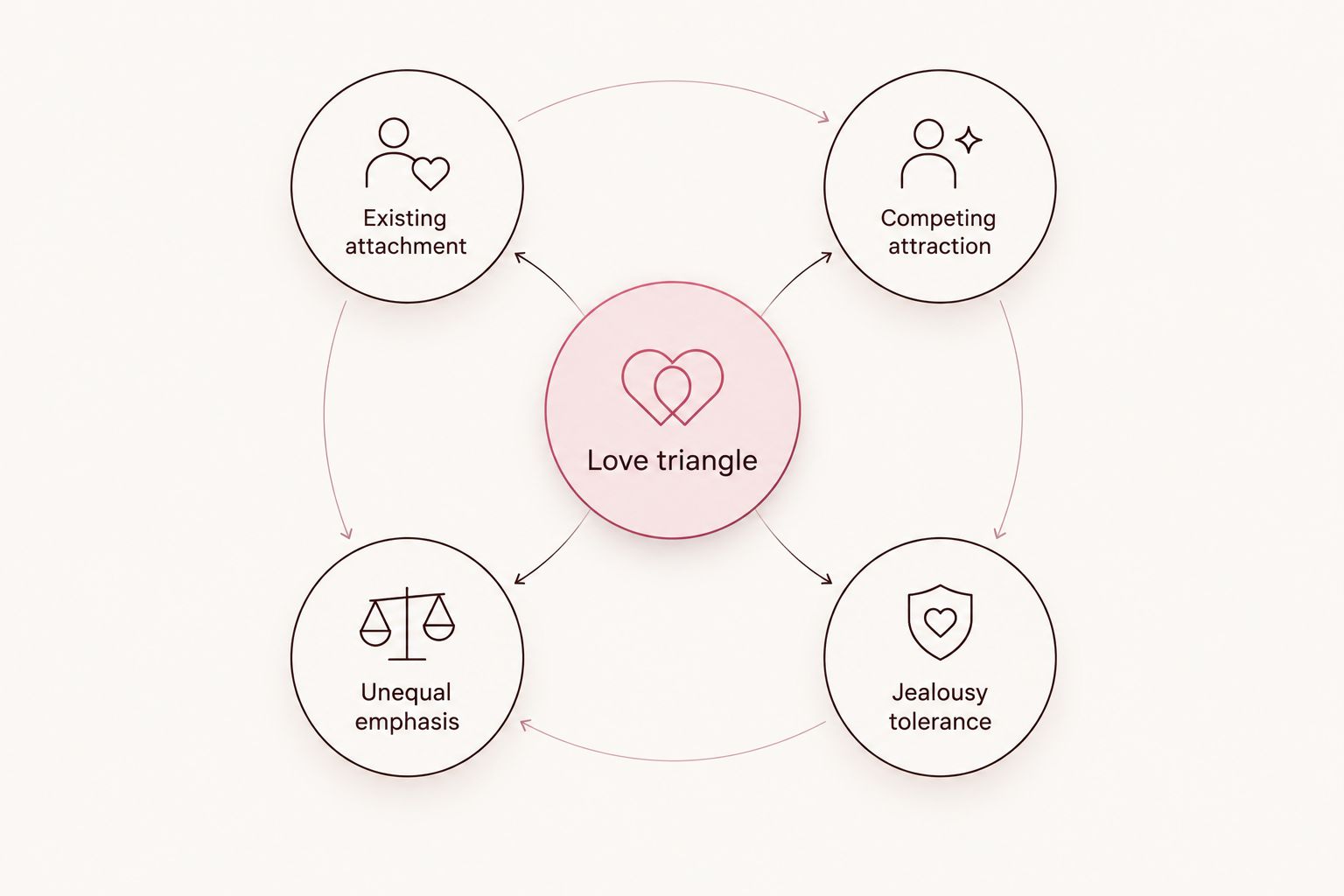
Why readers describe the romance differently
Readers use “love triangle” for different experiences. The disagreement usually comes from the definition, not from a disagreement about which characters appear in the book.
- Existing attachment: Violet’s history with Dain gives him significance that a newly introduced acquaintance would not have.
- Competing attraction: The presence of another romantic possibility is enough for some readers to count a triangle.
- Unequal emphasis: Other readers reserve the label for two relationships that receive comparable development. Fourth Wing does not fit that narrower definition well.
- Jealousy tolerance: A reader avoiding jealousy entirely needs a stronger warning than someone avoiding drawn-out indecision.
- Series scope: An answer about Fourth Wing should describe that novel, not silently include later installments.
Those distinctions make trope warnings more useful in 2026. Instead of asking only whether a triangle exists, ask what kind of competition appears and how much of the romance depends on it.
Will I like Fourth Wing if I hate love triangles?
Fourth Wing is a reasonable choice if you dislike prolonged romantic indecision, but a poor choice if you require zero rivalry. Its romantic tension is not limited to deciding between two people. Trust, conflicting loyalties, and the dangerous setting also shape the relationship.
Separate your hard boundary from your preference. “I prefer one obvious central couple” leaves more room than “I never want another character to be a romantic possibility.” Fourth Wing fits the former more comfortably than the latter.
You should also separate triangle avoidance from content level. Fourth Wing is adult fantasy with explicit sexual content and violence. A clearer central pairing does not make it a low-spice or gentle read.
Can you explain the romance without spoiling who Violet chooses?
Yes: Fourth Wing gives Violet an established emotional connection and a newer, more dangerous attraction. The contrast lets the book explore familiarity, independence, and trust without giving both relationships equal romantic development.
A spoiler-light explanation can name Dain and Xaden because that answers the actual question. It does not need to disclose relationship milestones, later revelations, or the ending. Avoid character relationship timelines if you want to preserve those discoveries.
Does this answer cover the whole Empyrean series?
No: this answer covers Fourth Wing, not the whole Empyrean series. A first-book trope description is not a guarantee about every later installment.
When checking a discussion in 2026, look for the book title before reading further. A thread labeled with the series name can discuss later relationship developments even when its opening question sounds suitable for a new reader.
What should you read next if you want less romantic competition?
Start with the part of Fourth Wing you want to keep. Deadly trials, distrustful attraction, and emotionally important romance are separate qualities; no recommendation below reproduces all of them.
These books move from the closest match for danger and romantic tension toward quieter or structurally different alternatives. The differences matter as much as the similarities. None should be treated as a substitute for checking your other content boundaries.
| Book | Best for | Specific connection to Fourth Wing | Meaningful difference |
|---|---|---|---|
| The Serpent and the Wings of Night by Carissa Broadbent | Deadly trials and distrustful attraction | A vulnerable heroine faces lethal competition while attraction complicates trust | Vampires and a tournament replace dragons and military training |
| Radiance by Grace Draven | A clearly centered couple | A fantasy relationship develops across social and cultural divisions | An arranged marriage and growing friendship replace academy rivalry |
| Divine Rivals by Rebecca Ross | Emotional intimacy through writing | Romance develops alongside a dangerous wider conflict | Rival journalists and letters replace rider training and dragons |
The Serpent and the Wings of Night: best for deadly trials
Choose Carissa Broadbent’s The Serpent and the Wings of Night if the strongest part of Fourth Wing was attraction developing under lethal pressure. Oraya is a human in a vampire-dominated world, and the tournament setting makes survival central rather than decorative.
The match is specific: a comparatively vulnerable heroine must assess danger while deciding whom to trust. Romantic tension grows inside that problem, not outside it. That connection is stronger than simply shelving both books under fantasy romance.
The difference is equally clear. You get vampires and a structured competition, not dragon bonds or the rhythms of a military academy. Expect adult sexual content and violence; this is not the gentler alternative.
Verdict: Buy for dangerous competition and distrustful attraction; skip if dragons are the essential ingredient.
Radiance: best for a clearly centered couple
Choose Grace Draven’s Radiance if you want the relationship to feel like a developing alliance rather than a contest between romantic candidates. Brishen and Ildiko enter a political marriage across cultural and physical differences.
The strongest connection is learning to understand someone your own society treats as fundamentally different. The attraction grows through respect and companionship. That makes it useful for readers who enjoyed intimacy developing across divisions but want less romantic competition.
The trade-off is pace and setting. Radiance does not reproduce Fourth Wing’s academy structure, dragon relationships, or succession of training dangers. It also contains adult sexual content, so “less rivalry” should not be mistaken for “less explicit.”
Verdict: Buy for companionship becoming desire; skip if you want another lethal-school story.
Divine Rivals: best for emotional intimacy through writing
Choose Rebecca Ross’s Divine Rivals if you want to keep romantic tension while changing how intimacy develops. Iris and Roman are rival journalists whose connection involves letters against the backdrop of a war between gods.
The match is the contrast between public friction and private vulnerability. Readers who liked seeing guarded characters become emotionally legible have something concrete to follow here. The romance does not depend on recreating Fourth Wing’s physical setting.
The difference is substantial: writing, work, and wartime separation shape the relationship. There are no dragon-rider classes. Its sexual content is less explicit than Fourth Wing’s, but war and danger remain part of the reading experience.
Verdict: Buy for letters and emotional closeness; skip if training trials matter more than the romance.
Ask for the relationship dynamic you actually want
“Something like Fourth Wing” leaves too much unsaid. A useful request names both the attraction and the exclusion: deadly trials with a central couple, enemies-to-lovers without prolonged indecision, or fantasy romance without competing love interests.
GetSimilarBooks is best for fiction readers who want hand-curated read-alikes from a book they already enjoyed. Enter 1 title to receive 5 suggestions. The free personalized list expands that to 20–30 titles and requires your email address.
The trade-off is straightforward: the short preview asks less of you, while the longer list adds an email step. A recommendation list also does not replace checking a specific content boundary before reading.
Use GetSimilarBooks to start with the book you liked. For your 2026 reading list, keep the preference precise: one central romance is not the same request as no jealousy at all.
FAQ
Does Fourth Wing have a love triangle or not?
Fourth Wing has early love-triangle tension, but not a sustained, evenly balanced choice between two love interests. Dain and Xaden have romantic significance without receiving equal romantic development.
Is Dain a love interest in Fourth Wing?
Dain has romantic significance for Violet, especially through their existing history and her attachment to him. Describing him as only an unrelated friend would understate the early setup.
Is Xaden the main romantic focus in Fourth Wing?
Xaden is the main romantic focus in Fourth Wing. Identifying that emphasis does not reveal the ending or explain how the relationship’s conflicts develop.
Should I avoid Fourth Wing if I cannot stand jealousy?
Avoid Fourth Wing if absolutely no romantic jealousy or rivalry is a firm requirement. Its central romance is clearer than a balanced triangle, but the book is not free of competing romantic tension.
Does no love triangle mean Fourth Wing is low spice?
No. Fourth Wing contains explicit sexual content, regardless of how you classify its romantic structure. Triangle intensity and sexual explicitness are separate content questions.
Can I read this answer without getting spoilers for later books?
Yes. This page limits its relationship discussion to Fourth Wing and does not reveal later-book developments. It also avoids explaining the first novel’s ending.
Can GetSimilarBooks help me find my next fantasy romance?
GetSimilarBooks provides five hand-curated read-alike suggestions from a title you enjoyed. Its free personalized list contains 20–30 titles and requires an email address.
One last thing
Ask what makes the romance difficult, not just how many people are involved. A book with one central couple can contain distrust, jealousy, and painful conflict. A triangle label alone tells you surprisingly little about whether that experience suits you.
For your next read, finish this sentence: “I want Fourth Wing’s ___, without its ___.” That gives you a clearer selection rule than another broad fantasy-romance list.
Related guides
- Books like Fourth Wing with enemies-to-lovers romance
- Books like Fourth Wing with less spice
- How to find similar books without spoilers
Leave a Reply