How accurate are book recommendation quizzes?

Book recommendation quizzes are useful for building a shortlist, not for predicting whether you will love a book. Their accuracy depends on whether they capture why you liked a title, respect your dealbreakers, and explain the differences between the match and your next read. In 2026, judge a quiz by the reasoning behind its results—not by a confidence score without an explanation.
- How accurate are book recommendation quizzes? Judge the fit explanation, not an unexplained score.
- Fourth Wing read-alikes should distinguish dragon bonds, romantic tension, and deadly competition.
- Verity read-alikes should distinguish relationship suspense, unsettling atmosphere, and narrative uncertainty.
- GetSimilarBooks offers five hand-curated suggestions from a title you enjoyed; your content limits still need separate checking.
Why this matters
Finishing Fourth Wing does not tell a quiz what you want next. You might want the dragons but less explicit romance. Another reader might want the romantic tension without another military academy.
Those are different requests. A result can share the genre and still miss the experience you wanted to repeat.
A useful recommendation names both the connection and the compromise. If you want a repeatable way to assess results, the book recommendation quiz to personalized list workflow keeps the focus on turning a broad match into a reading decision.
How accurate are book recommendation quizzes?
Book recommendation quizzes are accurate only in relation to a defined goal. Identifying a book in your preferred genre is a different task from finding one with the same emotional tension, narrative voice, and content boundaries as your last favorite.
For your 2026 reading list, separate these jobs before deciding whether a result is good.
| Recommendation approach | Best for | What it helps you identify | Main limitation |
|---|---|---|---|
| Broad preference quiz | Exploring a genre | A starting direction based on answers such as mood or setting | Broad answers leave room for very different books |
| Title-based read-alike search | Following a particular favorite | Books connected to an identifiable reference title | The title alone does not explain which qualities mattered to you |
| Annotated recommendation list | Comparing specific candidates | Reasons a book matches, plus meaningful differences | You still need to decide which differences are acceptable |
These are ways to organize your search, not accuracy rankings. A short quiz with a clear explanation gives you something you can assess. A longer quiz that returns unexplained titles leaves you guessing.
Look for a statement such as: this matches the dangerous competition, but the romance has a different balance. That explanation lets you accept or reject the recommendation for a reason.
A list of covers does not do that work. Neither does a matching percentage that leaves the meaning of a match undefined.
Why book recommendation accuracy varies
The quality of a match depends on the request and the explanation attached to the result. Use these factors to identify where a recommendation fits—or breaks down.
- Matching priority. Dragons, romantic tension, and academy rivalry are distinct reasons to enjoy Fourth Wing. Decide which one comes first.
- Pacing preference. Wanting suspense does not necessarily mean wanting a slow accumulation of unease. State whether you want urgency or atmosphere.
- Romance balance. A central love story and a background romantic subplot offer different reading experiences.
- Content limits. A thematic match still fails your request if it includes material you want to avoid.
- Tolerance for difference. A close read-alike and an interesting departure serve different purposes. Choose which you want before judging the list.
- Explanation quality. A result becomes easier to evaluate when it identifies a shared feature and an important departure.
Treat a dealbreaker as a requirement, not a preference to average away. If you want less explicit romance, a strong setting match does not cancel that condition.
The same applies to format. Wanting a standalone is a practical constraint, not a minor variation in taste.
How can you check a quiz result before committing?
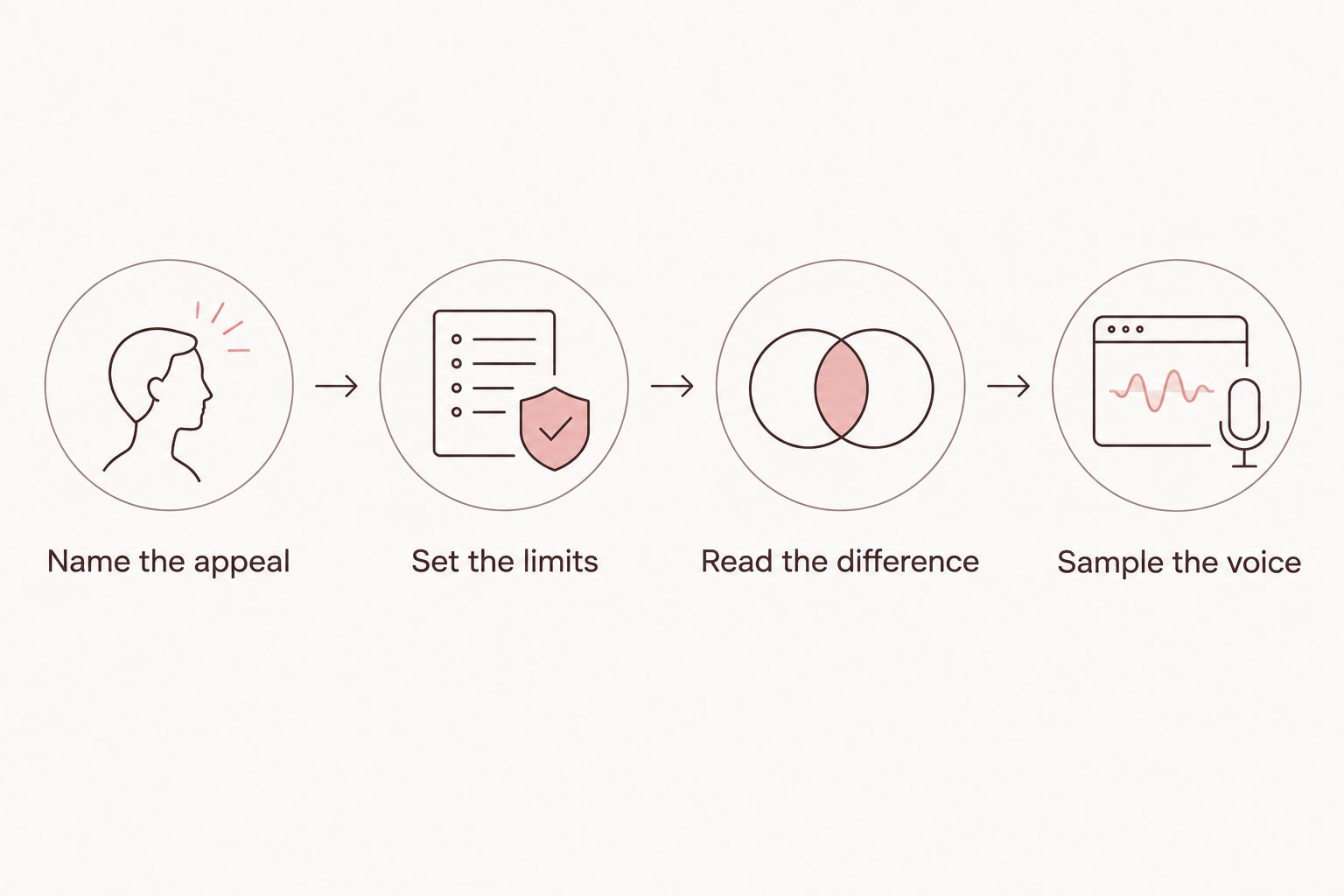
Use this four-step check on your next 2026 shortlist. It is a decision process, not a scoring system or a promise of enjoyment.
1. Name the appeal
Finish this sentence: I want another book that makes me feel the way this part did. Keep the answer specific enough to distinguish your favorite from other books in its genre.
For Fourth Wing, that might mean a vulnerable protagonist surviving dangerous training. For Verity, it might mean the discomfort of not knowing whose account to trust.
2. Set the limits
Name what you do not want before inspecting the recommendations. Examples include explicit sexual content, child-harm themes, a love triangle, or a series commitment.
You do not need to justify a boundary. You need enough information to check whether the suggested book respects it.
3. Read the difference
Look for the part of the recommendation that tells you what will change. Is the pace slower? Does politics replace training? Is the romance less central?
An honest difference is not a defect in the recommendation. It is the information that makes the recommendation usable.
4. Sample the voice
Read an opening sample when one is accessible to you. Notice the narration, sentence rhythm, dialogue, and distance from the protagonist.
A plot description cannot reproduce those qualities. If the premise fits but the voice does not, move to another candidate rather than treating the match as an obligation.
What does an accurate Fourth Wing or Verity match look like?
An accurate explanation does not need to promise another favorite. It needs to make the reading choice clear without revealing major twists.
The examples below show the difference between a specific connection and a shared genre label. They are starting points for evaluating fit, not claims about measured quiz performance.
| Starting point | Candidate | Best for | Specific connection | Honest difference |
|---|---|---|---|---|
| Fourth Wing | Fireborne by Rosaria Munda | Readers prioritizing dragon riders and institutional rivalry | Dragon-rider training and competition connect personal ambition with political power | Political aftermath and competing loyalties shape the story; do not choose it expecting the same romance balance |
| Fourth Wing | The Serpent and the Wings of Night by Carissa Broadbent | Readers prioritizing dangerous competition and romantic tension | A human heroine faces lethal stakes in a vampire-dominated setting | Vampires and a deadly tournament replace dragon bonds and a military academy |
| Verity | Rebecca by Daphne du Maurier | Readers prioritizing marital unease and an unsettling home | An uneasy marriage and the influence of another woman create psychological tension | Its gothic atmosphere and measured pace differ from a contemporary romantic thriller |
For the Fourth Wing examples, the order starts with the dragon-rider connection and moves outward to the competition-and-romance connection. Reverse that order if romantic tension matters more to you than dragons.
Rebecca answers a separate Verity need: unease inside an intimate relationship. It is not a substitute for every aspect of Verity, and it should not be presented as one.
If explicit content is your deciding factor, start with books like Fourth Wing with less spice rather than accepting a broad fantasy-romance match. Then check each candidate's content notes separately.
Does a longer quiz mean a better recommendation?
More questions help only when the answers change something relevant about the result. Questions about pace, romance balance, and content boundaries address different parts of the reading experience.
Rephrasing the same broad preference does not tell you more about the final match. Before finishing a long quiz, ask whether its questions distinguish the books you would accept from the books you would reject.
A useful test is to imagine two readers choosing the same genre. One wants an atmospheric standalone; the other wants a fast-moving series with a central romance.
If the questions cannot separate those requests, the result needs more explanation. Length alone is not evidence of accuracy.
Are recommendation quizzes useful for choosing a gift?
A gift recommendation has an extra problem: you are describing someone else's preferences. Keep your 2026 gift shortlist anchored to books the recipient has actually enjoyed, not just facts you know about their life.
Occupation gives you a topic to consider, not a complete reading profile. When choosing books by profession, distinguish professional interest from leisure reading: a job tells you what someone does, not whether they want that subject in a novel.
The same distinction applies to hobbies. Someone who enjoys solving puzzles does not automatically want a puzzle-driven mystery, and someone who works in healthcare does not automatically want a hospital setting.
Use a known favorite as the starting point. Then identify what the recipient enjoyed about it, whether they already own the proposed book, and whether the content fits their preferences.
For gifts, familiarity with the reader matters more than an elaborate personality label. If you cannot explain why the specific book suits the person, keep looking.
What should you do when the recommendations miss?
Change the request before repeating it. Asking for another book like Verity still leaves open whether you mean romantic tension, domestic unease, an unreliable account, or an ending that invites discussion.
Keep the part that worked and name the part that did not. A useful revision is: keep the unsettling relationship, but choose a faster pace. Another is: keep the dangerous training, but reduce the emphasis on romance.
Avoid adding every preference at once. Start with the defining appeal and the firm boundaries, then decide which remaining differences you can accept.
For a fresh 2026 search, a concise preference statement gives you a clearer basis for judging any list. You are not trying to describe your entire reading identity. You are choosing your next book.
When should you use a title-based read-alike finder?
Use a title-based finder when you have a clear starting book but do not want to complete a broad personality quiz. GetSimilarBooks lets you enter a title you enjoyed and receive five hand-curated read-alike suggestions.
GetSimilarBooks is best for fiction readers who want a title-based starting point for their next read. The advantage is a concrete reference book; the limitation is that a title alone does not communicate every preference or content boundary.
Five is the preview. You can also request a free personalized list of 20–30 titles by providing your email.
Treat the longer list as more candidates to assess, not as proof of greater accuracy. Apply the same check to each result: the reason it matches, the meaningful difference, and any condition you need to verify.
Find your next read-alike
Start with a title you enjoyed and get five hand-curated suggestions.
FAQ
Can a book recommendation quiz tell whether I will love a book?
A book recommendation quiz gives you candidates, not certainty about your reaction. Judge whether the explanation matches your priorities, then sample the writing before committing.
What makes a book recommendation quiz accurate for me?
A useful match connects your specific reading preferences to identifiable qualities in the suggested book. It should also explain a meaningful difference and leave you able to check your dealbreakers.
Are longer book quizzes more accurate than short ones?
Length alone does not establish accuracy. Additional questions matter when they distinguish relevant preferences such as pacing, romance balance, and content limits.
Why do I dislike books recommended from a favorite title?
A title-based recommendation can match a feature that was not your reason for enjoying the original. Specify what you want to repeat and what you want to change.
How do I get better recommendations after Fourth Wing?
Choose whether dragon bonds, dangerous training, romantic tension, or another quality matters most. Add any firm content limits so a shared fantasy setting does not become the whole basis for the match.
Can a quiz help me find books like Verity without spoilers?
A quiz can describe matching qualities without explaining plot revelations. Look for language about atmosphere, relationship tension, narrative uncertainty, and pace rather than descriptions of the ending.
How many recommendations does GetSimilarBooks provide?
GetSimilarBooks provides five hand-curated read-alike suggestions from a title you enjoyed. You can also request a free personalized list of 20–30 titles by providing your email.
One last thing
The most revealing part of a recommendation is sometimes its warning. A sentence explaining that the politics matter more than the romance tells you more than an unsupported promise of a perfect match.
For your 2026 reading list, ask one final question: What will I miss from the original? A recommendation that answers honestly gives you a choice rather than a sales pitch.
Related guides
- How does a book recommendation quiz actually work?
- How to find your next book after finishing a series you loved
Leave a Reply