Is Verity based on a true story?

No. Verity by Colleen Hoover is a fictional psychological thriller, not a true-crime account or a retelling of a documented case. Its disturbing family history belongs to the novel; the uncertainty about what to believe is part of the story, not evidence that its characters are real people.
- Is Verity based on a true story? No. Colleen Hoover’s novel is fiction, not a documented criminal case.
- Verity’s manuscript creates uncertainty inside the story; it is not a real-world source document.
- Choose Rebecca for domestic unease or The Thirteenth Tale for a writer investigating a hidden past.
- GetSimilarBooks suits fiction readers seeking hand-curated read-alikes rather than another broad thriller list.
Is Verity based on a true story?
No. Verity is a novel, not a factual account of an actual family. Grand Central Publishing presents Colleen Hoover’s book as fiction. That distinction matters more than how plausible a scene feels or how convincingly a character describes an event.
The premise follows Lowen Ashleigh, a writer who accepts work connected to the successful author Verity Crawford. A manuscript becomes central to what Lowen thinks she knows. Those names and circumstances belong to the fictional narrative.
If the apparent closeness to real crime is what held your attention, start with books like Verity for true-crime readers. That is a reading preference, not a different classification for Hoover’s novel.
| Question | Answer | What it means for your reading |
|---|---|---|
| Is Verity nonfiction? | No. It is a novel. | Do not treat its events as reported facts. |
| Is the manuscript a real document? | No. It is part of the fictional story. | Assess it as a narrative device, not independent evidence. |
| Does realistic subject matter make it a true story? | No. | Recognizable fears can appear in invented situations. |
| Does debating the ending establish a real case? | No. | Interpretation concerns the story’s internal truth. |
You do not need an ending explanation to settle the factual question. The book’s status as fiction does not depend on which character you believe.
Why this matters
Searching for whether Verity is true often mixes together two different questions: whether the events happened outside the book, and whether a particular account is trustworthy inside it. The first has a straightforward answer. The second belongs to literary interpretation.
Keep that separation when choosing your next read in 2026. A novel that recreates Verity’s uncertainty is a different recommendation from a nonfiction book that reconstructs a documented crime.
It also keeps your expectations fair. Fiction can withhold information, arrange revelations, and use a character’s private writing to misdirect you. A factual crime account carries a different responsibility: its claims concern actual people and require evidence outside the narrative itself.
Why Verity feels like it might be real
Verity uses familiar sources of unease rather than requiring an unfamiliar world. A home, a working arrangement, a marriage, and private writing become things the reader has to reassess. The setting is recognizable even when the situation becomes extreme.
These features explain the impression of reality without proving any connection to a real case:
- Private writing: A manuscript gives Lowen something that looks like direct access to another person’s mind. Its intimacy makes it compelling, not automatically reliable.
- Limited access: You receive information through a restricted perspective. You cannot independently inspect everything that happened before the story began.
- Domestic stakes: The book places danger inside relationships and a household. Familiar surroundings make the threat feel close.
- Conflicting interpretations: The same detail can support different readings. That uncertainty invites you to behave like an investigator.
- Emotional pressure: Attraction, fear, and sympathy affect how characters interpret each other. Readers have to account for those pressures too.
A convincing fictional document is still a fictional document. Its tone can make you feel that you have discovered evidence, but the author controls both the document and the circumstances in which you encounter it.
This is also why a plot summary is a poor substitute for reading the book. A summary tells you what information appears. The experience depends on when you receive that information and how your judgment changes around it.
Is Verity’s manuscript real?
No. The manuscript in Verity exists within Colleen Hoover’s fictional story. It is not a published confession from an actual person named Verity Crawford.
There are two separate levels to keep straight. Outside the novel, the manuscript is an invented narrative device. Inside the novel, questions about its purpose and credibility contribute to the suspense.
Calling it a manuscript does not settle whether its contents should be believed within the story. A document has an author, an intended use, and a context. Those considerations matter even when the words sound private or candid.
You can discuss that distinction without revealing the ending. Ask what makes a written account persuasive before asking whether you agree with it. Specific details, apparent vulnerability, and an intimate voice all influence trust; none is a guarantee of truth.
Does Verity’s ending change whether it is a true story?
No. The ending of Verity does not turn the novel into nonfiction. Whatever interpretation you prefer, you are evaluating a fictional account.
For a spoiler-free discussion, separate the book’s factual status from the characters’ credibility. The factual status is settled: it is fiction. Credibility is the question the reading experience asks you to examine.
If you are discussing the novel with friends in 2026, agree on a spoiler boundary before comparing theories. You can talk about trust, perspective, and the effect of private writing without describing the final revelations.
A useful discussion question is: what persuaded you before you knew how the book would end? That keeps the conversation focused on the novel’s construction rather than treating a preferred interpretation as proof of real events.
What should you read after Verity?
Choose your next book by the source of the unease, not by the word “thriller.” The closest match for domestic suspicion is not necessarily the closest match for hidden writing or a dangerous relationship.
The recommendations below move from domestic and romantic unease toward the narrower writer-and-manuscript connection. None is a claim that the books share the same plot or ending.
| Book | Best for | Specific connection to Verity | Meaningful difference |
|---|---|---|---|
| Rebecca by Daphne du Maurier | Romantic and domestic unease | A woman enters a household shaped by another woman’s powerful presence. | Its Gothic suspense develops more slowly, with less explicit sexual content. |
| The Thirteenth Tale by Diane Setterfield | Conflicting life stories | A writer must assess an account of a hidden past. | Storytelling and family history matter more than sexual tension. |
| The Ghostwriter by Alessandra Torre | Writing and concealed truths | A writing assignment draws another author toward a disturbing private history. | Its emphasis is confession and emotional reckoning rather than Verity’s romantic setup. |
Rebecca: best for romantic and domestic unease
Daphne du Maurier’s Rebecca is the strongest starting point if you liked entering a household where another woman seems to shape every interaction. Its unnamed narrator has to understand her marriage while living under the influence of her husband’s first wife.
The match is psychological. Both books make a woman’s understanding of a relationship depend on incomplete information about someone else. A home becomes a place of comparison, suspicion, and unequal knowledge.
The difference is pace and texture. Rebecca spends more time on social discomfort, atmosphere, and the narrator’s insecurity; it does not reproduce Hoover’s explicit sexual intensity. Readers seeking immediate escalation should account for that slower development.
Verdict: Read Rebecca for the household tension, not for identical pacing.
The Thirteenth Tale: best for conflicting life stories
Diane Setterfield’s The Thirteenth Tale follows biographer Margaret Lea as she listens to the life story of novelist Vida Winter. It is a useful next step if Verity made you interested in who controls a personal history and why a listener accepts it.
The connection lies in the act of interpretation. A writer receives another person’s account and must decide how to understand its gaps, emphasis, and disclosures.
The difference is the center of gravity. The Thirteenth Tale is a Gothic mystery concerned with family history and storytelling, not a replacement for Verity’s sexual tension. Its appeal is the unfolding account rather than a matching romantic dynamic.
Verdict: Read The Thirteenth Tale for the story behind the story.
The Ghostwriter: best for writing and concealed truths
Alessandra Torre’s The Ghostwriter centers on an author who brings another writer into the task of telling a concealed personal story. That makes it a direct thematic follow-up for readers interested in professional writing crossing into private life.
The match is the uncomfortable assignment. Writing is not background decoration; it is the route through which difficult information reaches another person.
The difference is emotional emphasis. Do not choose The Ghostwriter expecting the same romantic arrangement or the same pattern of revelations as Verity. Choose it for secrecy, confession, and the consequences of turning a life into a written account.
Verdict: Read The Ghostwriter for the writing assignment, not a duplicate plot.
How do you choose the right Verity read-alike?
For your next read in 2026, use three filters: domestic unease, hidden writing, and romantic tension. Pick the one you would miss most if it disappeared from the book.
- Domestic unease: Choose Rebecca if the household and the relationship made you uncomfortable in the most interesting way.
- Hidden writing: Choose The Thirteenth Tale for an account that requires interpretation, or The Ghostwriter for a writing assignment tied to concealed truths.
- Romantic tension: Check that romance is central to a recommendation before choosing it. A similar atmosphere does not promise a similar relationship story.
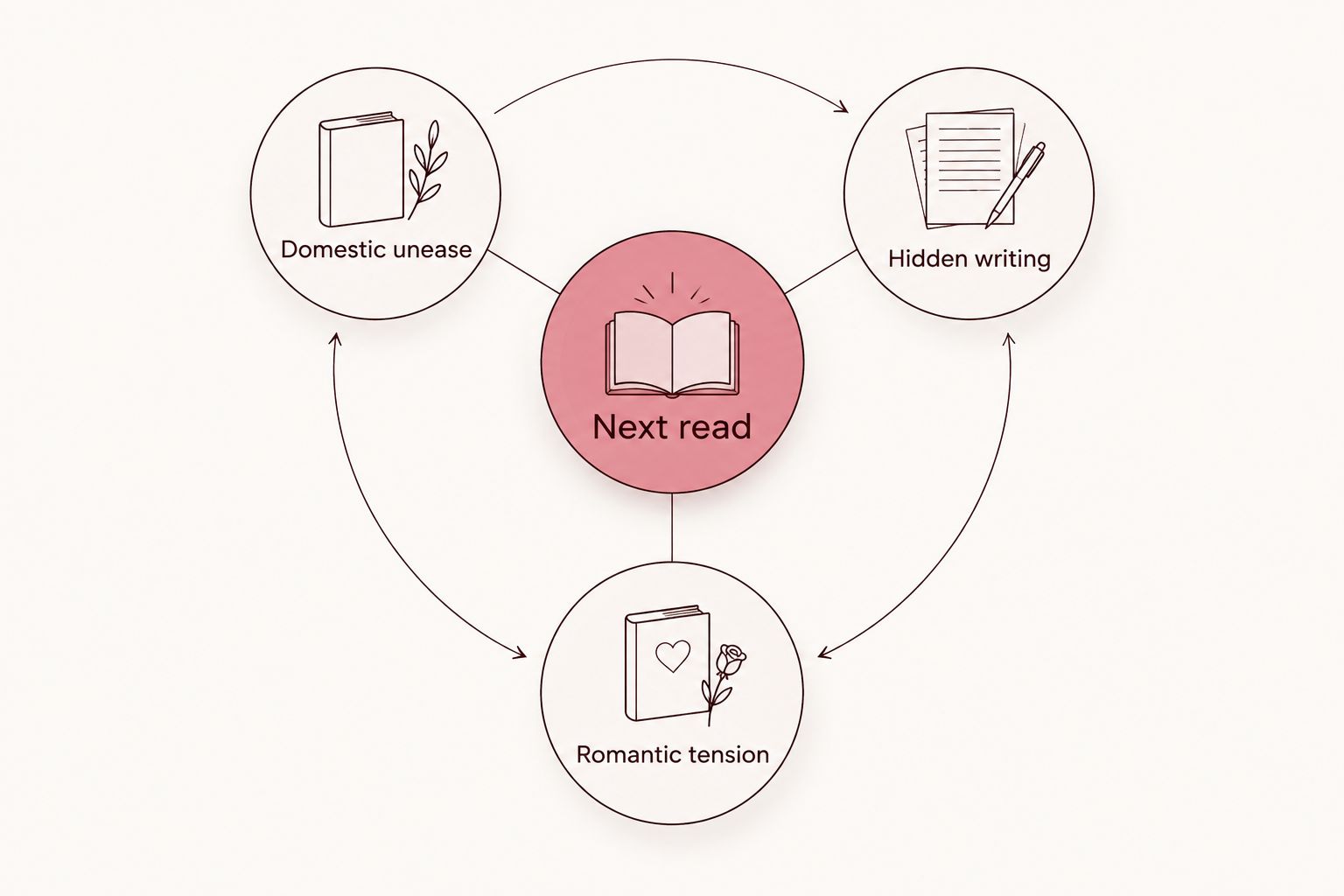
Content boundaries belong in that choice too. Verity includes explicit sexual content, violence, and disturbing child-harm themes. Matching its suspense does not require matching every difficult subject; check individual content notes before starting another book.
GetSimilarBooks is best for fiction readers who want hand-curated read-alikes from a book they already enjoyed. Enter a title at GetSimilarBooks to receive five suggestions, with a free personalized list of 20–30 titles available by email.
The useful trade-off is simple: five suggestions give you a short starting point; the longer list requires an email address. Neither replaces checking whether a book matches your preferred pacing, romance level, or content boundaries.
Find your next read
Get five hand-curated suggestions, or request a free personalized list of 20–30 titles by email.
FAQ
Is Verity based on a true story?
No. Verity by Colleen Hoover is fiction, not a true-crime account or a retelling of a documented case. Its uncertainty concerns what to believe within the novel.
Are Lowen Ashleigh and Verity Crawford real people?
Lowen Ashleigh and Verity Crawford are fictional characters in Colleen Hoover’s Verity. Their names and experiences belong to the novel, not a reported criminal case.
Is the manuscript in Verity a real confession?
No. The manuscript is a fictional document inside the novel. Questions about its credibility are part of the story and do not establish any real-world events.
Can I find out whether Verity is true without spoiling the ending?
Yes. Verity is fiction, and you do not need to know its ending to establish that. Avoid ending explanations if you want to preserve the book’s uncertainty.
Is Verity suitable if I avoid child-harm themes?
Verity contains disturbing child-harm themes, so it is not a suitable choice if you want to avoid that material. It also includes explicit sexual content and violence.
What should I read after Verity in 2026?
Choose Rebecca for domestic and romantic unease, The Thirteenth Tale for conflicting life stories, or The Ghostwriter for writing and concealed truths. Each matches a specific feature rather than reproducing Verity’s whole plot.
How does GetSimilarBooks help me find books like Verity?
GetSimilarBooks provides five hand-curated read-alike suggestions after you enter a title you enjoyed. You can also request a free personalized list of 20–30 titles by email.
One last thing
For your 2026 reading list, write down the part of Verity you wanted more of before reading another recommendation. “A document I could not confidently trust” is a more useful request than “a shocking thriller.”
The detail that stayed with you is the best place to start. You do not need another book to be true—or to repeat the same twist—to recreate that feeling of doubt.
Related guides
- Books like Verity with unreliable narrators
- Books like Verity about writers and hidden manuscripts
- Books like Verity with romance at the center
Leave a Reply