Books like Harry Potter for middle schoolers: complete 2026 guide

Books like Harry Potter for middle schoolers are fantasy read-alikes that recreate magical discovery, close friendships, and dangerous mysteries without assuming readiness for adult fantasy. Start with Nevermoor: The Trials of Morrigan Crow for hidden-world wonder, or The Iron Trial if learning magic at school matters most; this 2026 guide compares five starting points without major spoilers.
- For books like Harry Potter for middle schoolers, start with Jessica Townsend’s Nevermoor for magical discovery and belonging.
- Choose The Iron Trial for magic lessons, Amari and the Night Brothers for a hidden supernatural institution.
- Keeper of the Lost Cities emphasizes friendship and identity; The Lightning Thief emphasizes quests and humor.
- GetSimilarBooks suits readers who want title-based book recommendations rather than another broad fantasy list.
Why these read-alikes matter for middle schoolers
A reader who loved Hogwarts does not automatically want every fantasy series. The attraction might be school routines, the friendship group, a secret world beside ordinary life, or a mystery that keeps changing shape. Match that experience before matching the genre.
For your 2026 reading list, separate reading confidence from comfort with frightening material. Finishing a long novel does not mean a reader wants stronger violence or adult romance. If the setting is the deciding factor, the guide to books like Harry Potter set in boarding schools offers a narrower route.
The recommendations below move from close magical-world matches toward different structures. Each has a reason to try it and a difference that can rule it out.
How to choose the next book
Identify the part of Harry Potter you want back
Before choosing a title, finish this sentence: “I want another book where…” Make the answer about the reading experience, not just the presence of magic. “Children discover a world adults have hidden” gives you a better starting point than “fantasy.”
Also identify what you do not want repeated. A reader can love the friendships while disliking the later books’ darker atmosphere. Another can enjoy the danger but feel no attachment to classrooms. Those readers need different recommendations.
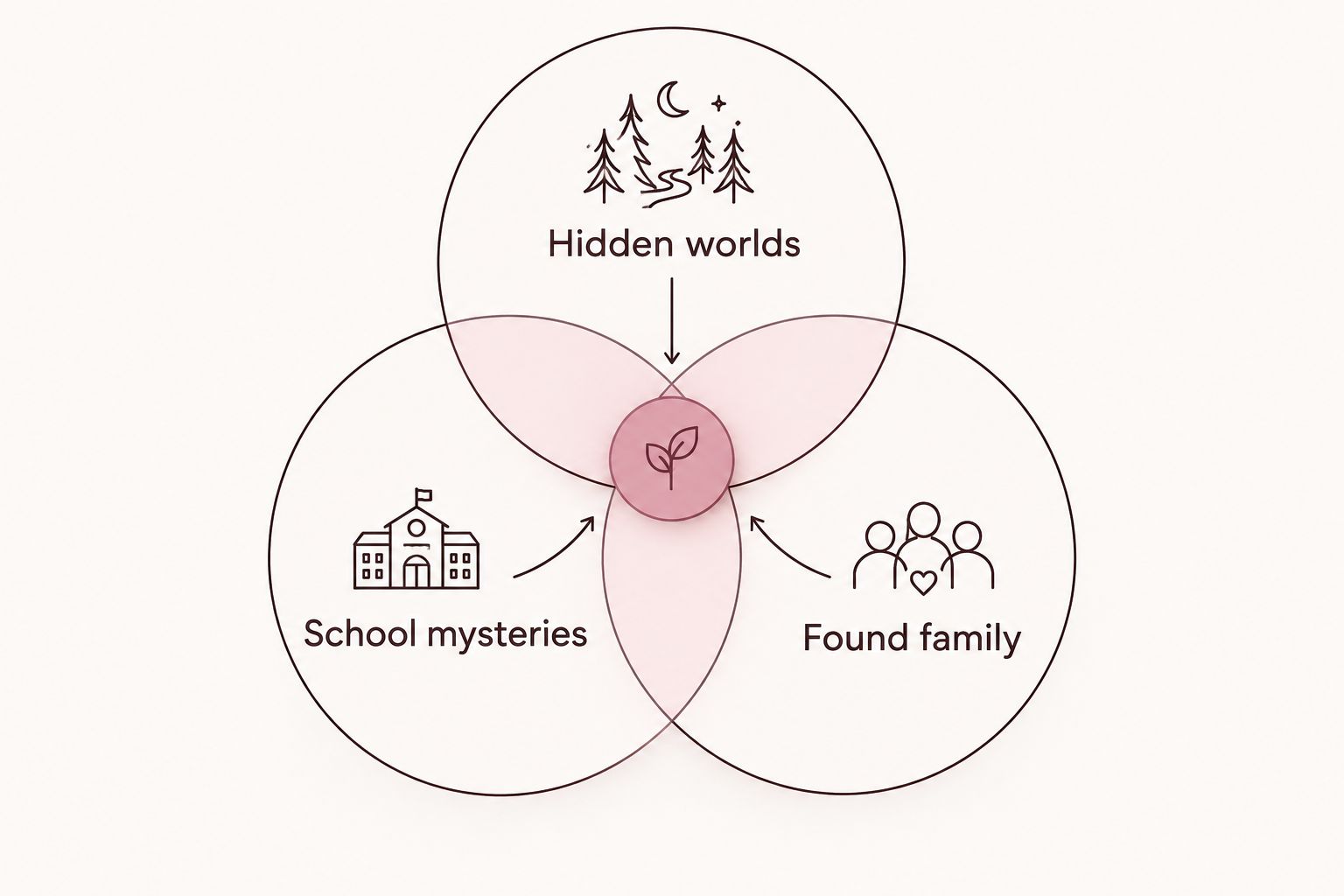
Use these three overlapping attractions as your starting point. None is a reading level or an age rating.
- Hidden worlds: ordinary surroundings conceal an extraordinary society.
- School mysteries: lessons, teachers, and institutional secrets drive discovery.
- Found family: friendship provides the belonging the protagonist lacked.
Start with Nevermoor for discovery and belonging
Best for: readers who miss entering a strange magical society. Jessica Townsend’s Nevermoor: The Trials of Morrigan Crow follows Morrigan into Nevermoor and the trials connected with joining the Wundrous Society. The strongest Harry Potter connection is emotional: a child treated as a problem discovers a place where belonging becomes possible.
The appeal is not simply that both books contain magic. Both make learning the world part of the pleasure, with unfamiliar rules, new relationships, and uncertainty about whom to trust. Nevermoor’s eccentric setting gives the discovery its own character.
The difference matters. This opening book centers on trials and entry into an institution rather than recreating a Hogwarts school year. It also includes threats and peril; its whimsical elements do not make it a danger-free choice.
Verdict: Buy for hidden-world wonder and an outsider’s search for belonging. Borrow a sample first if the reader mainly wants classroom scenes.
- Start with The Trials of Morrigan Crow.
- Choose it for magical discovery and institutional secrets.
- Expect trials rather than a direct Hogwarts substitute.
- Check comfort with threats, rejection, and danger.
Choose The Iron Trial for magical education
Best for: readers who want lessons, classmates, and uncertain teachers. Holly Black and Cassandra Clare’s The Iron Trial introduces Callum Hunt and the Magisterium, where young students learn elemental magic. Of these recommendations, it offers a particularly direct route back to the experience of entering a magical school.
The match rests on the school structure and the relationships formed inside it. Callum must work out how he fits into an institution while learning alongside other children. Adults’ expectations and warnings complicate that process.
The meaningful difference is Callum’s starting attitude. He does not arrive with a straightforward wish to embrace magical education. That resistance changes the emotional shape of the familiar school-entry setup. Choose it for the tension around learning and trust, not because you expect Hogwarts with renamed houses.
Verdict: Buy for magical-school structure and uneasy questions about trust. Skip it if you specifically want a break from school-based fantasy.
- Start with The Iron Trial, the opening Magisterium novel.
- Choose it for elemental magic and student relationships.
- Expect a reluctant approach to magical schooling.
- Check comfort with danger and threatening magical conflict.
Pick Amari for a supernatural institution and a personal mystery
Best for: readers who want discovery tied to a missing-person mystery. B. B. Alston’s Amari and the Night Brothers brings Amari Peters into the Bureau of Supernatural Affairs as she searches for answers about her missing brother. A hidden institution opens up a world she did not know existed.
The Harry Potter connection lies in discovering that ordinary life contains another society, complete with rules and prejudices. Amari has to understand that society while confronting other people’s assumptions about her. The personal mystery gives her a reason to keep pushing.
The distinction is setting and purpose. The Bureau is a supernatural organization, not a traditional boarding school, and Amari’s concern for her brother shapes the story. That makes it a stronger fit for a reader who wants an urgent investigation than one chiefly seeking cozy school routines.
Verdict: Buy for hidden-world discovery with a clear personal mystery. Hold if a missing sibling is an unwelcome subject.
- Start with Amari and the Night Brothers.
- Choose it for supernatural training and investigation.
- Expect an institutional setting rather than a Hogwarts-style school.
- Check comfort with a missing sibling, prejudice, and peril.
Try Keeper of the Lost Cities for friendship and identity
Best for: readers who want a newly discovered identity and an expanding cast. Shannon Messenger’s Keeper of the Lost Cities follows Sophie Foster as she discovers her connection to a hidden elven world. Learning where she belongs brings new relationships, unfamiliar expectations, and questions about her past.
The match is the disruption of ordinary life by a much larger magical society. Friendship and education help make that society understandable, while secrets keep it from feeling settled. Readers who enjoy discussing characters’ relationships have something specific to follow here.
The difference is emphasis. This is an elven society with its own abilities and social structures, not a wizarding-school recreation. The expanding cast and continuing questions also ask for patience. Choose it for an ongoing world to inhabit rather than a tightly contained mystery.
Verdict: Buy for friendship, identity, and a widening fantasy world. Skip it if you want a compact, self-contained reading experience.
- Start with Keeper of the Lost Cities.
- Choose it for belonging and character relationships.
- Expect an expanding cast and continuing questions.
- Check comfort with bullying, danger, and identity-related distress.
Follow The Lightning Thief for humor and a quest
Best for: readers who want friendship and danger without another school-year plot. Rick Riordan’s The Lightning Thief introduces Percy Jackson, Greek mythology in modern America, and Camp Half-Blood. It preserves the discovery of an extraordinary identity but puts a quest at the center.
The connection is strongest in the young protagonist’s voice, the importance of companions, and the sense that familiar places conceal something else. The story gives those elements a different engine: travel and encounters rather than a sustained classroom routine.
That difference makes this the outward step in the list. Camp Half-Blood is important, but you should not choose the book expecting most of the action to stay there. Greek gods, monsters, and family relationships replace wizarding traditions as the world’s organizing ideas.
Verdict: Buy for humor, mythology, and friendship under pressure. Hold if remaining inside a magical school is your main requirement.
- Start with The Lightning Thief.
- Choose it for a quest-driven story and conversational humor.
- Expect mythological encounters beyond the camp setting.
- Check comfort with monster violence and threatening situations.
Build a shortlist before requesting more recommendations
Use the manual route first: choose the strongest match above, read the opening chapter, and ask whether the voice works. A familiar premise cannot compensate for narration you do not enjoy. Library browsing and a librarian’s recommendation also let you describe the reader’s specific interests and boundaries.
For a broader 2026 shortlist, GetSimilarBooks provides title-based book recommendations: enter a book you enjoyed to receive five hand-curated read-alike suggestions. You can also request a personalized list of 20–30 titles by email.
The benefit is a smaller starting set than an unrestricted search. The limitation is equally clear: GetSimilarBooks is a recommendation tool, not an individual content assessment. Preview the books before treating a match as suitable for a particular middle schooler.
- Sample one opening chapter before committing to a series.
- Write down the matching quality you want repeated.
- Keep content boundaries separate from genre preferences.
- Request the personalized list when you want more options.
Find your next read-alikes
Enter a title for five suggestions, then request a personalized list of 20–30 titles by email.
Compare the five starting points for 2026
Choose by the matching quality, not by which series sounds biggest. This table summarizes the trade-offs; the content notes above are starting points, not exhaustive warnings.
| Starting book | Best for | Strongest matching quality | Key limitation |
|---|---|---|---|
| Nevermoor: The Trials of Morrigan Crow | Hidden-world wonder | An outsider discovers magical belonging | Trials take priority over a familiar school-year structure |
| The Iron Trial | Magical-school readers | Lessons, classmates, and uncertain authority | A reluctant student changes the emotional tone |
| Amari and the Night Brothers | Mystery-focused readers | A hidden institution and a personal investigation | A missing sibling is central to the premise |
| Keeper of the Lost Cities | Friendship-focused readers | Identity, belonging, and an expanding magical society | Continuing questions demand patience |
| The Lightning Thief | Quest and humor readers | An extraordinary identity and essential companions | The plot travels beyond its training setting |
Common mistakes when choosing for middle schoolers
Treating “less explicit” as “appropriate”
A book without explicit romance can still contain frightening violence or distressing family situations. Check the actual subjects. Adult fantasy described as having less sexual content is not automatically a middle-school recommendation.
Matching only the school setting
A magical school can host very different stories. Ask whether the reader wants lessons, friendship, mystery, or competition. The Iron Trial and Nevermoor offer institutional discovery through different structures.
Starting with a later installment
Begin with the opening book named in this guide. Continuing series build on earlier relationships and discoveries; a later volume is a poor sample of how the story introduces its world.
Ignoring the reader’s preferred tone
Do not choose solely because a reader managed Harry Potter’s length. Humor, narration, pacing, and emotional intensity affect enjoyment too. Let the reader reject a sample without treating that choice as a reading failure.
FAQ
What’s the best book like Harry Potter for middle schoolers in 2026?
Start with Nevermoor: The Trials of Morrigan Crow for magical discovery and belonging. Choose The Iron Trial instead if lessons and life inside a magical school are the main attraction.
Which recommendation feels most like going to Hogwarts?
The Iron Trial is the most direct school-based choice in this guide. Its magical education, classmates, and uncertain teachers provide the connection, though Callum’s reluctance gives it a different tone.
Is Percy Jackson a good next read after Harry Potter?
The Lightning Thief is a good next read for friendship, humor, and discovering an extraordinary identity. Choose something else if you want most of the story to remain inside a school.
Are all these books suitable for every middle schooler?
No single recommendation fits every middle schooler. These books include danger and emotionally difficult subjects, so use the brief content notes and preview your chosen title.
Which book should I pick for a reader who likes mysteries?
Choose Amari and the Night Brothers when a personal investigation is the strongest draw. The search for Amari’s missing brother gives the hidden supernatural world an immediate purpose.
Can GetSimilarBooks help me find more books after Harry Potter?
GetSimilarBooks provides five hand-curated suggestions when you enter a title you enjoyed. A personalized list of 20–30 titles is also available by email; preview recommendations for the reader’s individual needs.
Set a Clear Boundary for Your Next Harry Potter Read-Alike
For your 2026 shortlist, write a rejection rule before adding another title: “Not another school,” “No missing-family storyline,” or “More humor.” Knowing what you do not want makes the next choice clearer. Start with one book that meets both your matching quality and your boundary.
Related guides
- Similar books finder: five picks for a title you loved
- Book recommendation quizzes for your next read
Leave a Reply