Books like Harry Potter with darker themes

Best overall: A Deadly Education by Naomi Novik. Best for disillusioned adults: The Magicians by Lev Grossman. Best for unsettling magical lessons: Vita Nostra by Marina and Sergey Dyachenko. These darker Harry Potter read-alikes keep different parts of the appeal: dangerous schooling, hidden magic, close friendships, or institutions you cannot trust.
- For books like Harry Potter darker in tone, start with Naomi Novik’s A Deadly Education.
- The Magicians suits readers who want magical college and adult disillusionment rather than another chosen-one adventure.
- Vita Nostra makes magical education psychologically disturbing; Ninth House brings occult horror to a real university.
- GetSimilarBooks offers five hand-curated read-alikes, with a personalized list of 20–30 titles available by email.
What "Darker" Means in Harry Potter Read-Alikes
Darker does not mean the same thing to every reader. You might want Hogwarts with fewer protections, adult characters confronting disappointment, or magic tied to exploitation rather than wonder. A book that delivers one of those experiences can miss the others completely.
This 2026 guide orders recommendations from the closest school-and-survival match toward books that keep the institutional tension but change the reading experience. None is simply Harry Potter with more violence. Each has a different answer to the question: what does learning magic do to a person?
If your main requirement is grown-up characters rather than disturbing material, the guide to books like Harry Potter for adult readers addresses that separate need.
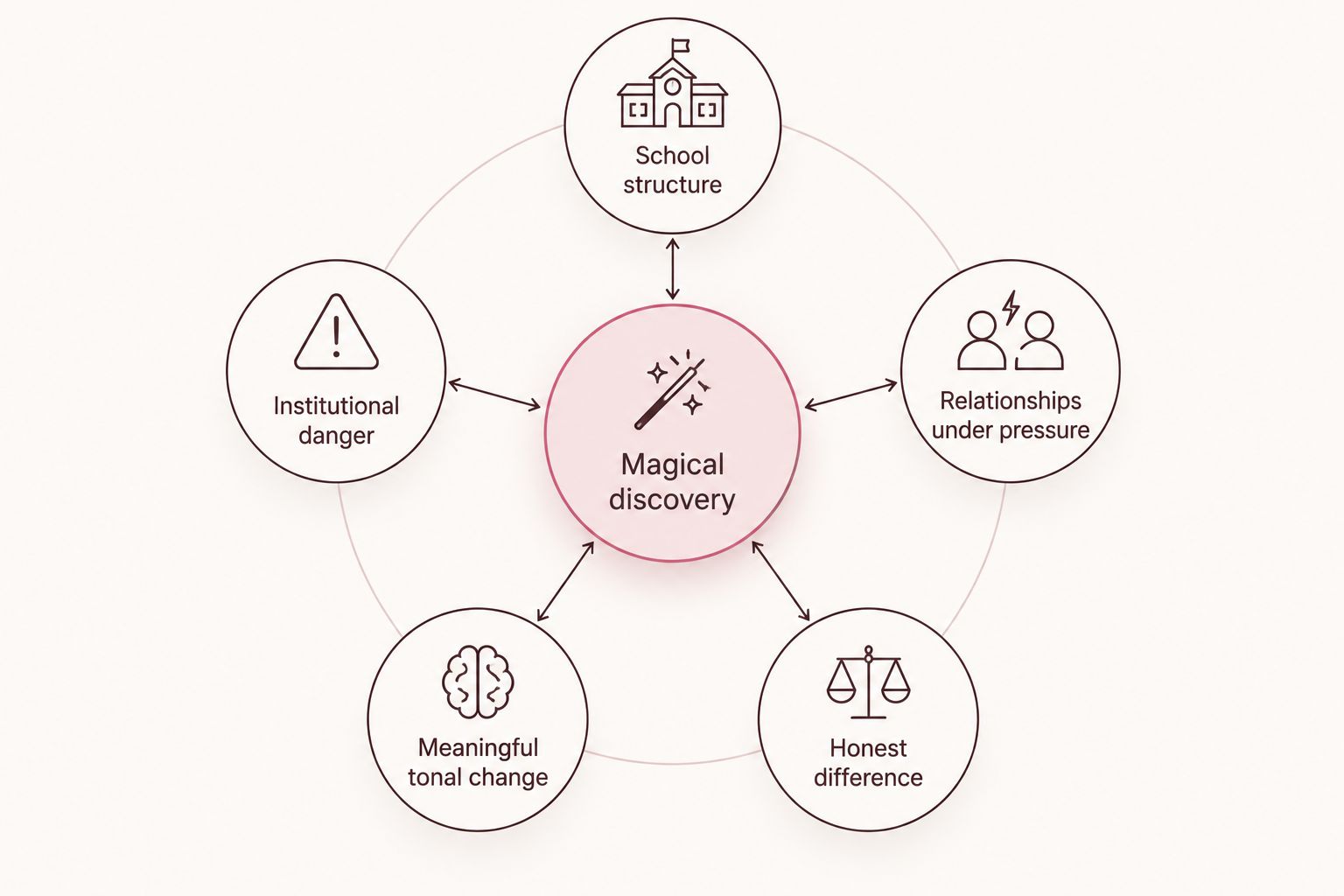
What makes the best darker Harry Potter read-alikes?
- School structure: Lessons, examinations, rivalries, and restricted spaces should shape the story, not merely decorate it.
- Magical discovery: Learning how magic works should matter to the reader’s curiosity and the character’s decisions.
- Institutional danger: The school or magical establishment should create problems, not just shelter students from an outside villain.
- Relationships under pressure: Friendship, rivalry, and dependence should have consequences beyond classroom competition.
- A meaningful tonal change: The darkness should come from something specific: predation, disillusionment, coercion, trauma, or colonial power.
- An honest difference: A close match needs a clear limit. Dense language theory and relentless psychological pressure are not substitutes for Hogwarts warmth.
For your 2026 reading list, choose the quality you want to preserve before choosing how much darkness you want to add. School routine and friendship produce a different recommendation from secret societies and occult violence.
Darker Harry Potter read-alikes at a glance
| Book | Best for | Matching quality | Key limitation |
|---|---|---|---|
| A Deadly Education — Naomi Novik | A dangerous magical school | Student alliances and magical survival | Little of Hogwarts’ everyday comfort |
| The Magicians — Lev Grossman | Adult disillusionment | Entry into an exclusive magical college | Alienation matters more than reassuring friendship |
| Vita Nostra — Marina and Sergey Dyachenko | Psychological unease | Opaque lessons at a coercive institute | Abstract, demanding, and emotionally cold |
| Ninth House — Leigh Bardugo | Occult campus horror | Hidden magical institutions and forbidden knowledge | An adult investigation, not a wizard-school progression |
| Babel — R. F. Kuang | Institutional and political darkness | A close student circle studying consequential magic | Language and empire take priority over adventure |
1. A Deadly Education: best for a dangerous magical school
Naomi Novik’s A Deadly Education is the closest starting point if you want students learning magic while a hostile school environment shapes every decision. El attends the Scholomance, where magical creatures prey on students and survival depends on preparation, resources, and alliances. There are no teachers providing a reliable safety net.
The match is structural rather than cosmetic. Schoolwork matters, other students matter, and the rules of magic affect who gets through the day. The difference is that danger is built into ordinary school life instead of arriving mainly as an interruption to it.
A Deadly Education pros:
- Magical education directly drives the survival plot.
- Student alliances make friendship materially important.
- El’s abrasive narration gives the story a distinct voice.
A Deadly Education cons:
- Explanations of magical systems interrupt the action.
- Constant threat leaves less room for comfortable school rituals.
Best for: Readers who want Harry Potter’s school setting with the protections removed.
A Deadly Education opens the three-volume Scholomance series. That makes it a useful choice if you want a continuing school story rather than a single campus mystery. Brief content note: violence and threats to young people.
Verdict: Buy A Deadly Education for the closest darker school-and-survival match.
2. The Magicians: best for adult disillusionment
Lev Grossman’s The Magicians follows Quentin Coldwater into Brakebills, an exclusive college for magical study. Admission gives him access to the extraordinary world he wanted. It does not resolve his dissatisfaction with ordinary life or with himself.
The Harry Potter connection is easy to identify: hidden magical education, talented students, difficult training, and the discovery that a larger magical world exists. The tonal break is the point. The Magicians questions the belief that entering that world will make you happy or give your life a satisfying shape.
The Magicians pros:
- Magical study feels demanding rather than automatically rewarding.
- Adult dissatisfaction changes the familiar discovery narrative.
- The story extends beyond the boundaries of its college.
The Magicians cons:
- Quentin is often self-absorbed and difficult company.
- Readers seeking loyal, comforting friendships face a colder experience.
Best for: Adults who still want hidden magic but no longer want a reassuring escape story.
Choose The Magicians for emotional disillusionment, not because you want a scarier Hogwarts mystery. Its relationship with portal fantasy is also important; the school is only part of its conversation with childhood reading. Brief content note: sexual violence, substance use, and depression.
Verdict: Buy The Magicians if the loss of wonder interests you as much as its discovery.
3. Vita Nostra: best for psychologically disturbing lessons
Vita Nostra, by Marina and Sergey Dyachenko, follows Sasha into an institute whose demands become increasingly difficult to understand. The education itself supplies the dread. Learning is not simply the acquisition of useful spells; it threatens Sasha’s understanding of herself and reality.
The connection to Harry Potter lies in a young person entering a concealed system of extraordinary education. The difference is profound. Vita Nostra gives you little reassurance that the adults, the curriculum, or even the purpose of studying can be understood in familiar moral terms.
Vita Nostra pros:
- Lessons create tension rather than serving as background.
- The atmosphere stays closely tied to Sasha’s uncertainty.
- Magical transformation reaches beyond practical spellcasting.
Vita Nostra cons:
- Abstract concepts demand patience.
- Warmth and clear explanations are deliberately scarce.
Best for: Readers who want magical education to feel coercive, strange, and destabilizing.
Vita Nostra is not the safest recommendation for someone who mainly misses the trio’s friendship. It is the stronger choice if forbidden lessons and unsettling authority figures were your favorite elements. Brief content note: coercion, psychological abuse, and sexual content.
Verdict: Buy Vita Nostra for educational dread; skip it if you need a comforting student community.
4. Ninth House: best for occult campus horror
Leigh Bardugo’s Ninth House places Alex Stern at Yale, where she monitors occult activity associated with the university’s secret societies. Her ability to see ghosts gives her access to a world where privilege and magical power reinforce each other. An investigation brings the costs of that arrangement into focus.
The Harry Potter resemblance is the concealed magical order operating behind a recognizable world. The difference is the narrative engine. Alex is not progressing through a conventional wizard-school curriculum; she is confronting dangerous practices and the people protected by them.
Ninth House pros:
- Secret societies give institutional power a concrete shape.
- Ghosts and rituals make the hidden world threatening.
- The investigation provides a clear thread through the occult setting.
Ninth House cons:
- Classroom learning is not the central attraction.
- Graphic violence and trauma make this a substantial tonal jump.
Best for: Readers who want forbidden magic, campus secrets, and adult horror.
Pick Ninth House when the restricted section interests you more than the timetable. It belongs farther down this ranking because its strongest connection is secrecy and power, not the experience of growing up through magical school years. Brief content note: sexual violence, drug use, and graphic violence.
Verdict: Buy Ninth House for occult investigation; skip it for a close Hogwarts-school experience.
5. Babel: best for political and institutional darkness
R. F. Kuang’s Babel follows Robin Swift into Oxford’s Royal Institute of Translation, where translation and silver-working connect language to imperial power. His student circle offers intellectual companionship. The institution employing their talents creates the central moral conflict.
Babel shares Harry Potter’s fascination with an elite educational world and a close group of students. Its magic, however, is inseparable from language and extraction. The darkness comes less from monsters than from understanding what a prestigious institution needs its students to support.
Babel pros:
- Language is integral to the magical system.
- Student relationships connect personal loyalties to political choices.
- Institutional belonging becomes a sustained moral problem.
Babel cons:
- Explanatory passages slow the forward movement.
- Readers seeking spell duels and magical creatures will find a distant match.
Best for: Readers who want the school’s relationship to power examined rather than a darker school adventure.
Babel is the outward edge of this list, not an interchangeable alternative to A Deadly Education. Choose it because you want language, complicity, and empire at the center. Brief content note: racism, colonial violence, and abuse.
Verdict: Buy Babel for institutional critique; skip it if adventure is your main requirement.
How the recommendations are ranked
This 2026 ranking gives priority to the reading experience you are trying to recover: magical education first, then student relationships, discovery, and institutional danger. It is not a ranking of literary merit or a claim that every reader will prefer the same book.
A Deadly Education comes first because the school’s rules organize the story. Babel comes last because its academic setting serves a different central concern. The order moves outward from the closest match rather than upward through increasingly graphic content.
Which darker Harry Potter book should you choose?
Start with A Deadly Education unless you already know you want something other than a school-survival story. It preserves the strongest combination of magical study, student alliances, and danger.
Choose The Magicians for disappointment after wish fulfillment. Choose Vita Nostra for fear of the lessons themselves. Choose Ninth House for occult investigation, or Babel for the politics of belonging to a powerful institution.
GetSimilarBooks is best for fiction readers who want title-based read-alikes rather than another broad fantasy list. Enter a book you enjoyed to receive five hand-curated suggestions. The free personalized list expands that selection to 20–30 titles and requires your email.
Find your next read-alike
Enter a title for five hand-curated suggestions, then request a free personalized list by email.
FAQ
What’s the closest book to Harry Potter but darker?
A Deadly Education by Naomi Novik is the closest match here for a darker magical-school story. Lessons, student alliances, and survival shape daily life, while reliable adult protection is absent.
What should I read after Harry Potter in 2026 if I want adult characters?
The Magicians by Lev Grossman is the strongest choice here for adult disillusionment within a hidden magical world. Choose Ninth House by Leigh Bardugo instead if you want an occult investigation rather than magical college as the main attraction.
Is A Deadly Education part of a completed series?
A Deadly Education opens Naomi Novik’s completed three-volume Scholomance series. The following books are The Last Graduate and The Golden Enclaves.
Is Ninth House a wizard-school book?
Ninth House is an adult occult campus novel, not a conventional wizard-school story. Alex Stern monitors Yale’s secret societies and becomes involved in an investigation; structured magical lessons are not the central experience.
Is Babel similar to Harry Potter?
Babel shares an elite academic setting, consequential magic, and a close student circle with Harry Potter. R. F. Kuang’s novel centers language, colonial power, and institutional complicity rather than a school-adventure structure.
Which recommendation is best if I want unsettling lessons rather than graphic horror?
Vita Nostra is the best fit here for dread rooted in learning and psychological pressure. It still includes coercion, abuse, and sexual content, so that distinction is not a promise of gentle material.
How does GetSimilarBooks help me choose another fantasy book?
GetSimilarBooks lets you enter a title you enjoyed and receive five hand-curated read-alike suggestions. You can also request a free personalized list of 20–30 titles by providing your email.
One last thing
For your 2026 shortlist, write down one thing you refuse to lose from Harry Potter. Make it specific: friendships formed under pressure, lessons that reveal a hidden world, or a school worth exploring.
Then choose the darker book that preserves it. More disturbing is not automatically a closer match. A Deadly Education is the default here because it keeps the school experience central, not because it wins a contest for the bleakest story.
Related guides
- Books like Harry Potter set in boarding schools
- Books like Fourth Wing with found family
- Books like Fourth Wing with deadly trials
Leave a Reply