Books like Project Hail Mary: five picks, closest match first

Best overall: The Martian by Andy Weir. Best for an expansive, funny space adventure: We Are Legion (We Are Bob) by Dennis E. Taylor. These five books like Project Hail Mary are ordered from the closest match outward for your 2026 reading list, with a clear reason to choose each and a difference to weigh before you start.
- The Martian leads these books like Project Hail Mary for practical science, escalating problems, and a funny narrator.
- We Are Legion (We Are Bob) trades a single survival mission for an expanding space adventure.
- Contact emphasizes first-contact science; Children of Time asks you to understand a radically different intelligence.
- The Long Way to a Small, Angry Planet prioritizes interspecies friendship over technical problem-solving.
- GetSimilarBooks suits fiction readers who want hand-curated read-alikes rather than another broad science-fiction list.
What Makes a Book Like Project Hail Mary a Good Match?
Project Hail Mary combines several pleasures that do not always travel together: practical science, an accessible voice, isolation, and connection across a profound divide. Another novel about a spaceship can miss the part you actually loved.
The useful question is not simply whether you want more science fiction. It is whether you want another problem to solve, another funny companion, or another relationship that makes the unfamiliar feel understandable. GetSimilarBooks lets you enter a title you enjoyed and receive five hand-curated suggestions; the distinctions below help you decide which part of that title to follow.
What makes the best Project Hail Mary read-alike in 2026
These are the criteria behind the order. A shared setting counts for less than a shared reading experience.
- Practical science: Discoveries change what characters can do. Explanations contribute to the action rather than sitting beside it.
- Narrative voice: Humor, clarity, and curiosity make technical material inviting. A serious scientific premise does not require a solemn narrator.
- Human connection: Cooperation matters, especially when characters cannot take shared assumptions for granted.
- Forward pressure: Each answer creates another decision. The story gives you a reason to keep reading beyond its central idea.
- Meaningful differences: A recommendation should disclose what you lose, whether that is comedy, intimacy, or a tightly bounded mission.
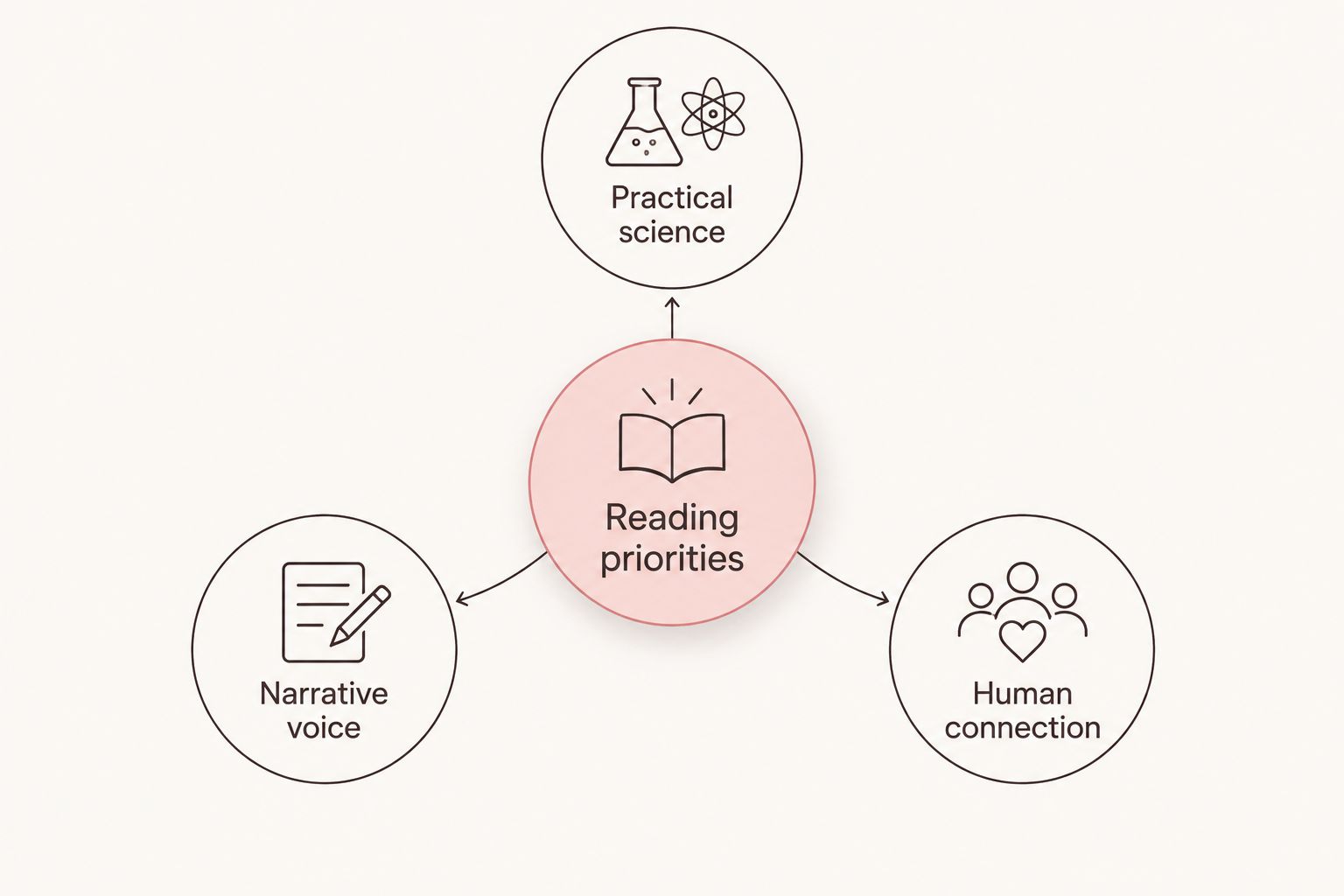
Reading priorities
Start with the quality you would miss most. Practical science points toward The Martian; narrative voice points toward We Are Legion (We Are Bob); human connection points toward The Long Way to a Small, Angry Planet. Those are different routes, not interchangeable promises.
The five picks at a glance for 2026
The order follows overall similarity, not literary importance. The lower picks move further from Andy Weir's problem-solving structure while retaining a specific reason to read them next.
| Book and author | Best for | Strongest matching quality | Key limitation |
|---|---|---|---|
| The Martian — Andy Weir | Practical survival science | A resourceful narrator works through physical problems | No equivalent to the central cross-species relationship |
| We Are Legion (We Are Bob) — Dennis E. Taylor | Funny, expanding space adventure | Technical ingenuity and a conversational voice | Branching stories replace a concentrated mission |
| Contact — Carl Sagan | First-contact investigation | Scientific inquiry into an apparent extraterrestrial signal | More institutional debate and less comic momentum |
| Children of Time — Adrian Tchaikovsky | Understanding alien intelligence | Biology and perspective challenge human assumptions | A broader, more detached narrative |
| The Long Way to a Small, Angry Planet — Becky Chambers | Interspecies friendship | Everyday cooperation across differences | Less emphasis on scientific puzzles and urgent survival |
1. The Martian: best for practical survival science
Best for: Readers who want another resourceful scientist solving immediate physical problems.
Andy Weir's The Martian follows astronaut Mark Watney after he is stranded on Mars. Survival depends on making equipment, supplies, and scientific knowledge work together under conditions that leave little room for error.
The closest match is the rhythm. A problem becomes understandable, a solution takes shape, and the consequences force another adjustment. Watney's humor keeps that process conversational rather than instructional.
The meaningful difference is emotional. The Martian includes a wider human response to Watney's situation, but it does not offer an equivalent to Project Hail Mary's central cross-species relationship. Choose it for the engineering and voice, not as a substitute for that bond.
The Martian pros:
- Practical explanations directly affect survival decisions.
- A funny, accessible narrator carries technical passages.
- Concrete constraints give the story clear forward movement.
The Martian cons:
- The shared author makes the voice familiar rather than surprising.
- The relational appeal differs sharply from Project Hail Mary.
Verdict: Buy if solving the next physical problem was your favorite part. If you have already read it, move to the next pick rather than looking for a closer copy.
2. We Are Legion (We Are Bob): best for comic space exploration
Best for: Readers who want technical ingenuity and an informal voice on a larger canvas.
Dennis E. Taylor's We Are Legion (We Are Bob) follows a human mind that becomes the intelligence operating a space probe. Exploration brings engineering decisions, unfamiliar situations, and an expanding set of responsibilities.
The match is not simply that the narrator likes science. Bob approaches strange circumstances with practical curiosity and a conversational, frequently comic perspective. That combination suits readers who enjoyed being inside a capable person's running commentary.
The difference is structure. This opens the Bobiverse series, and its narrative branches rather than staying with a single tightly contained predicament. You exchange some of Weir's concentration for a larger ongoing adventure.
We Are Legion (We Are Bob) pros:
- An approachable voice accompanies technical problem-solving.
- Exploration repeatedly turns ideas into practical decisions.
- The series format offers somewhere to continue afterward.
We Are Legion (We Are Bob) cons:
- Branching viewpoints reduce the intimacy of a single mission.
- Pop-culture references are part of the humor, not incidental decoration.
Verdict: Buy if you want more comic scientific ingenuity and welcome a series. Skip this route if your priority is another self-contained emotional arc.
3. Contact: best for science-led first contact
Best for: Readers who want scientific discovery to raise questions about communication and evidence.
Carl Sagan's Contact centers on radio astronomer Ellie Arroway and the investigation of a signal apparently originating beyond Earth. The scientific discovery becomes inseparable from arguments about what it means and how humanity should respond.
The strongest match is curiosity under uncertainty. Understanding the unfamiliar requires evidence, interpretation, and cooperation rather than an assumption that human expectations are universal. The intellectual pleasure comes from taking the question seriously.
The difference is where the pressure sits. Contact spends more time with institutions, belief, and public consequences than with improvised repairs. Its tone is more reflective, and its momentum is less dependent on comic setbacks.
Contact pros:
- Scientific inquiry drives the premise and its central questions.
- Communication matters as much as the existence of another intelligence.
- The human response gives the discovery a wider social context.
Contact cons:
- Institutional and philosophical passages slow the immediate action.
- It does not reproduce Weir's sustained comic narration.
Verdict: Buy if first contact interested you more than survival engineering. Choose The Martian instead if you chiefly want another chain of tangible problems with tangible fixes.
4. Children of Time: best for radically different intelligence
Best for: Readers who want a larger challenge to human-centered thinking.
Adrian Tchaikovsky's Children of Time follows the development of an uplifted spider civilization alongside humans searching for a future beyond Earth. Its central interests include evolution, inheritance, and the difficulty of recognizing intelligence that does not resemble your own.
The connection to Project Hail Mary is the work of understanding. Different bodies and histories produce different assumptions. The novel asks you to pay attention to those differences rather than treating them as scenery.
The major departure is scale. Children of Time follows civilizations and generations, not a small cast working through a bounded mission. Its emotional effects accumulate across that larger structure rather than relying on a consistently chatty narrator.
Children of Time pros:
- Nonhuman perspectives affect the story's logic and form.
- Biology supplies both constraints and possibilities.
- The human and nonhuman strands give comparison real substance.
Children of Time cons:
- Broad scope creates more distance from individual characters.
- Spiders are central throughout; avoid it if that is a reading barrier.
Verdict: Buy if understanding another intelligence was the lasting pleasure. Hold if you need humor and close companionship to remain the main attraction.
5. The Long Way to a Small, Angry Planet: best for interspecies friendship
Best for: Readers who miss the companionship more than the scientific puzzles.
Becky Chambers's The Long Way to a Small, Angry Planet follows Rosemary Harper as she joins the mixed-species crew of a tunneling ship. Work, personal histories, and everyday differences shape the relationships aboard it.
The match is cooperation across unfamiliar customs and needs. Characters must learn how to live and work together without assuming that their own habits are the default. That gives the novel a clear connection to Project Hail Mary's relational appeal.
The difference is the engine of the story. Relationships and episodic encounters take precedence over an escalating sequence of technical emergencies. This is the furthest recommendation from Weir's structure, but the most direct choice here for readers seeking found family.
The Long Way to a Small, Angry Planet pros:
- Interspecies relationships receive sustained attention.
- Daily work makes differences concrete rather than abstract.
- The ensemble offers several kinds of connection.
The Long Way to a Small, Angry Planet cons:
- Scientific problem-solving is not the central attraction.
- Episodic pacing provides less continuous urgency.
Verdict: Buy for the crew and their relationships. Skip if your next book needs to keep a survival clock running.
How this 2026 reading order works
The Martian leads because practical problem-solving and voice overlap most directly with Project Hail Mary. We Are Legion (We Are Bob) keeps that combination while changing the structure. Contact, Children of Time, and The Long Way to a Small, Angry Planet then separate first contact, nonhuman perspective, and companionship into distinct choices.
This is a reading-fit order, not a claim of firsthand testing or a universal quality ranking. The reasons and differences are the useful part: you can reject the highest-ranked book and still make the right choice for your reading mood.
Which book should you choose next in 2026?
Choose The Martian unless you have already read it or care more about the central relationship than the engineering. It is the clearest default, not because every element matches, but because its narrative voice and problem-solving method require the smallest adjustment.
If you have read The Martian, ask yourself two questions:
- Do you want more technical ingenuity and jokes? Choose We Are Legion (We Are Bob).
- Do you want to understand someone fundamentally unlike yourself? Choose Contact for investigation, Children of Time for perspective, or The Long Way to a Small, Angry Planet for companionship.
For a narrower match, request GetSimilarBooks' free personalized list. Enter the title you enjoyed for five hand-curated suggestions; the email-gated personalized list contains 20–30 titles. GetSimilarBooks' book recommendations suit fiction readers who want specific read-alikes rather than another broad genre list.
Find your next read-alike
Start with five hand-curated suggestions, then request a personalized list of 20–30 titles with your email.
FAQ
What’s the closest book to Project Hail Mary?
The Martian by Andy Weir is the closest match here for practical science, resourceful problem-solving, and a funny narrator. It differs most in its relationships: it has no equivalent to Project Hail Mary’s central cross-species bond.
What should I read after Project Hail Mary if I’ve read The Martian?
Read We Are Legion (We Are Bob) by Dennis E. Taylor for another conversational narrator working through technical challenges in space. Expect a branching series rather than a tightly concentrated standalone mission.
Which book is best if I loved the friendship in Project Hail Mary?
The Long Way to a Small, Angry Planet by Becky Chambers is the strongest choice here for interspecies companionship. Its crew relationships take priority over scientific puzzles, so choose it for connection rather than urgency.
Is Children of Time similar to Project Hail Mary?
Children of Time is similar in its interest in understanding nonhuman intelligence. Adrian Tchaikovsky uses a broader evolutionary and civilizational scale, with less of Andy Weir’s conversational humor.
Is Contact a good read after Project Hail Mary?
Contact is a good choice if scientific discovery and communication interested you most. Carl Sagan gives more space to institutions, evidence, and belief than to improvised survival engineering.
Which of these books starts a series?
We Are Legion (We Are Bob), Children of Time, and The Long Way to a Small, Angry Planet begin series. The Martian and Contact work as standalone choices if you want a self-contained next read.
How do I get a personalized list of books like Project Hail Mary?
GetSimilarBooks provides five hand-curated read-alike suggestions when you enter a title you enjoyed. You can also request an email-gated personalized list of 20–30 titles.
One last thing
A spaceship is a setting, not a matching reason. Before choosing, finish this sentence: “I want another book where understanding the problem changes what the characters can do.” If that sounds right, start with The Martian. If you would replace “the problem” with “each other,” start with the relationship-led picks instead.
Related guides
- Books like Fourth Wing with found family
- Books like Harry Potter for adult readers
- Books like Verity without a romance plot
Leave a Reply