Books like Hunger Games: five picks, closest match first

The Testing by Joelle Charbonneau is the closest match to The Hunger Games for readers who want deadly selection trials and a government that turns ambition into obedience. These five books like Hunger Games move from that familiar structure toward classroom horror, survival mystery, divided loyalties, and a harsher rebellion story; this 2026 guide explains what each preserves and what each changes.
- The Testing leads these books like Hunger Games: deadly trials, a resourceful heroine, and institutional distrust.
- Battle Royale is the pick for lethal classmates, but its violence is more graphic.
- The Maze Runner favors survival mystery; Legend favors opposing viewpoints; Red Rising favors caste conflict.
- Choose by the quality you miss from The Hunger Games, not the dystopian label alone.
Why this matters
The arena is only part of The Hunger Games. You might miss Katniss’s practical judgment, the threat beneath official ceremonies, or the way personal survival becomes political resistance. Those are different reading needs.
A book can reproduce a lethal competition without giving you Katniss’s emotional restraint. Another can capture the unequal society while leaving the arena behind. The strongest match preserves your favorite source of tension, not every surface detail.
GetSimilarBooks is best for fiction readers who want read-alike recommendations starting from a book they already enjoyed. Enter a title for five hand-curated suggestions, then request a personalized list by email if you want a longer reading queue.
What makes the best books like Hunger Games?
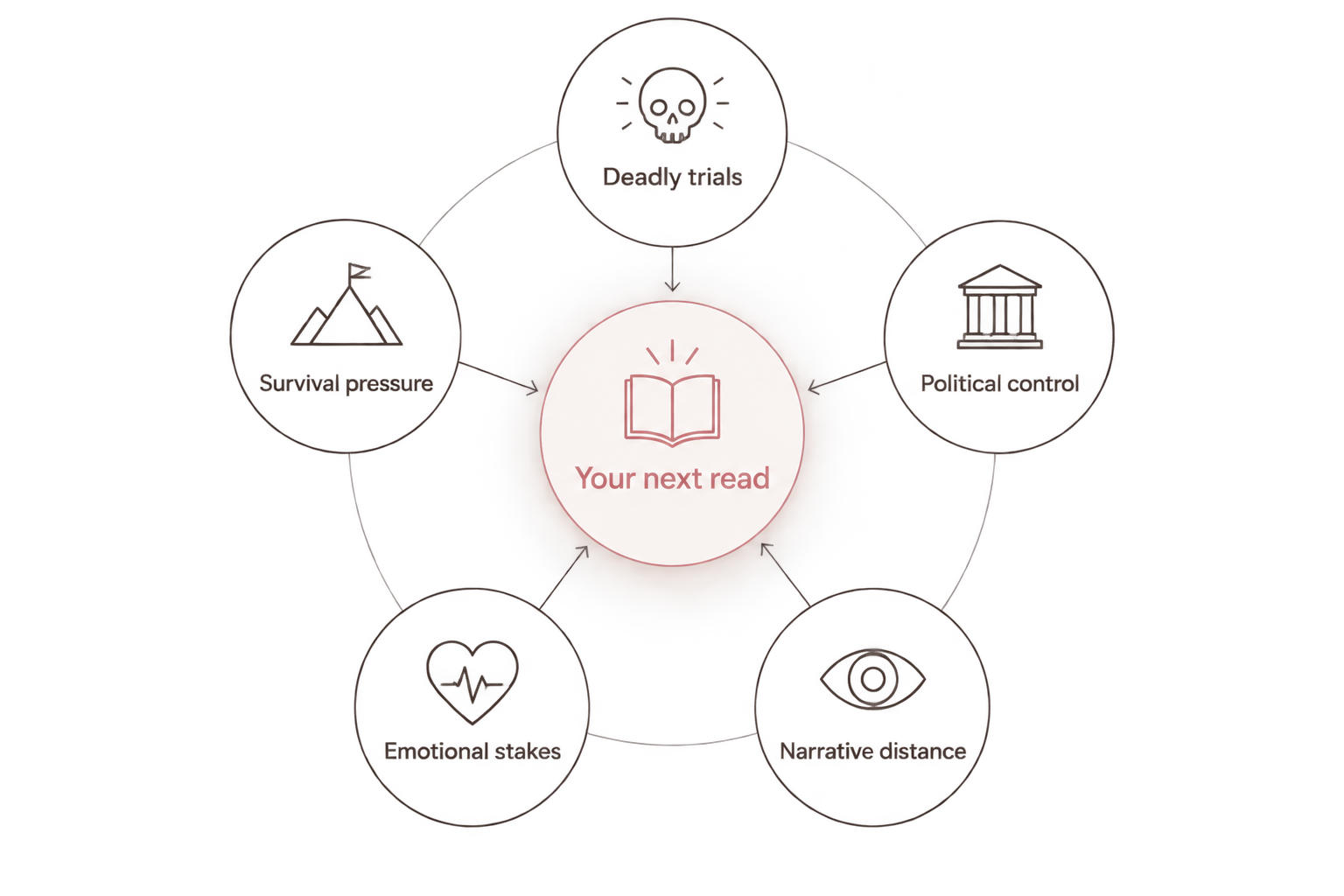
Use these criteria to choose your next read in 2026:
- Deadly trials: The rules force characters into consequential choices. A competition alone is not enough; the institution behind it should matter.
- Survival pressure: Resourcefulness, alliances, and uncertainty drive the action. The danger should affect how characters behave toward one another.
- Political control: Inequality shapes the characters’ options. Rebellion carries more weight when the system is visible in everyday life.
- Emotional stakes: Loyalty, grief, family, or attraction complicate the obvious survival decision. The characters need something to protect beyond themselves.
- Narrative distance: A close viewpoint creates a different experience from a broad ensemble. Choose according to whether you want intimacy or a wider picture.
Your next read depends on which of those qualities you want to keep. A stronger match on one dimension often means a deliberate departure on another.
Five books at a glance
The order runs from the closest overall match outward. The last book is not a weaker recommendation; it asks you to accept a larger change in audience, scale, and tone.
| Rank and book | Best for | Standout matching quality | Key limitation |
|---|---|---|---|
| 1. The Testing — Joelle Charbonneau | Deadly selection trials | A capable heroine navigating a dangerous state-run assessment | The selection structure feels particularly familiar |
| 2. Battle Royale — Koushun Takami | Classmates forced into lethal conflict | State violence turns existing relationships into survival decisions | More graphic violence and a much broader cast |
| 3. The Maze Runner — James Dashner | Enclosed survival mystery | Young people must understand a controlled environment to survive | Less immediate political context and less emphasis on romance |
| 4. Legend — Marie Lu | Opposing viewpoints within an unequal society | A privileged soldier and a wanted boy expose different sides of state power | No central arena or elimination tournament |
| 5. Red Rising — Pierce Brown | Caste conflict with an adult crossover edge | A low-status outsider enters an elite institution built around domination | Harsher content and a more aggressive central voice |
1. The Testing: best for deadly selection trials
Joelle Charbonneau’s The Testing follows Cia Vale, a young woman selected for an assessment tied to higher education and future leadership. The opportunity promises advancement. The process makes trust dangerous.
The Testing is the best next read if the selection machinery was your favorite part of The Hunger Games. Both novels place an observant heroine inside a system that presents coercion as opportunity. Preparation and judgment matter alongside physical survival.
The meaningful difference is the institutional setting. The Testing builds its threat around assessment and advancement rather than a televised punishment imposed on districts. That makes academic ambition part of the trap.
The Testing pros:
- A close female viewpoint keeps the danger personal.
- Tests make problem-solving central to survival.
- Uncertain alliances give conversations practical consequences.
- Distrust extends beyond individual competitors to the institution itself.
The Testing cons:
- The selection structure offers less novelty if you want distance from Panem.
- Its education-based premise changes the texture of the political critique.
Best for: Readers who want another capable heroine navigating deadly rules she did not write.
Content note: Violence and deaths involving young people are part of the premise. Choose it for the match, not as a gentler substitute.
Verdict: Buy The Testing if you want the closest structural match first.
2. Battle Royale: best for lethal conflict between classmates
Koushun Takami’s Battle Royale forces a class of 42 students into a government-controlled killing program. The students already know one another, so friendship, reputation, and existing grudges enter the contest with them.
The match is the state's use of young lives as an instrument of control. As in The Hunger Games, the rules push participants toward violence while making cooperation precarious. The question is not simply who can fight, but what trust means under those conditions.
Battle Royale is the sharper choice if you want the arena premise without preserving the same emotional register. Its wider cast repeatedly shifts your attention away from a single survivor.
Battle Royale pros:
- Established relationships give alliances immediate history.
- An ensemble viewpoint shows different responses to the same coercion.
- The survival setup keeps state power present in personal decisions.
Battle Royale cons:
- Violence is more graphic than in The Hunger Games.
- Frequent viewpoint changes reduce the sustained intimacy of Katniss’s narration.
- The large cast demands more attention to names and relationships.
Best for: Readers who want the lethal social experiment pushed toward horror.
Content note: Graphic violence, sexual violence, and suicide make this a substantial step up in intensity. It is not the default recommendation for a younger Hunger Games reader.
Verdict: Buy Battle Royale for the premise; skip it if graphic content is a firm boundary.
3. The Maze Runner: best for enclosed survival mystery
James Dashner’s The Maze Runner begins with Thomas arriving in a community of boys surrounded by a dangerous maze. He lacks the knowledge needed to explain his situation. Survival depends on learning the environment and understanding the group already living there.
The strongest Hunger Games connection is controlled space. Both books make geography, routines, and incomplete information part of the threat. An apparently understandable environment becomes harder to trust as its purpose comes into question.
The difference is what drives you through the chapters. The Maze Runner asks what this place is and how it works before giving you the broader political picture. Katniss enters the arena knowing much more about the society responsible for it.
The Maze Runner pros:
- Environmental danger rewards observation and practical thinking.
- Group survival gives cooperation a central role.
- Unanswered questions create a clear reason to keep reading.
The Maze Runner cons:
- Withheld information replaces much of Panem’s immediate social context.
- Romance is less central to the first book’s appeal.
Best for: Readers who remember the arena’s hazards more vividly than the Capitol’s ceremonies.
Content note: Threat, violence, and deaths involving young characters remain central. The change is toward mystery, not away from danger.
Verdict: Buy The Maze Runner when you want survival questions before political answers.
4. Legend: best for opposing viewpoints under state control
Marie Lu’s Legend follows June, an exceptional student within the Republic’s military system, and Day, a wanted boy from its poorer streets. Their paths cross through a criminal investigation that tests the official account of their society.
Legend uses 2 narrators to place privilege and deprivation beside each other. The Hunger Games shows inequality through Katniss’s movement between the districts and the Capitol; Legend builds that contrast into its viewpoint structure.
Choose Legend for divided loyalties rather than an elimination contest. Attraction matters because the characters do not begin with the same position, information, or relationship to authority. The political divide is personal from the start.
Legend pros:
- Alternating perspectives make class differences concrete.
- Investigation gives the characters reasons to question official claims.
- Romance and political distrust develop within the same conflict.
Legend cons:
- There is no central arena to reproduce the Games’ structure.
- Switching viewpoints changes the concentrated experience of following Katniss alone.
Best for: Readers who want state secrets, unequal opportunity, and a relationship shaped by opposing loyalties.
Content note: Military violence, death, and threats to family are part of the story. The romantic thread does not remove those stakes.
Verdict: Buy Legend if Panem’s inequality mattered more to you than the tournament.
5. Red Rising: best for caste conflict with an adult edge
Pierce Brown’s Red Rising follows Darrow, a low-status worker in a color-based hierarchy, as he enters the world of its ruling elite. The first novel combines infiltration with a brutal competitive institution.
The Hunger Games connection lies in the collision between organized cruelty and personal resistance. Both books make hierarchy something characters must confront physically, not just discuss. An institution teaches domination while presenting itself as necessary.
The difference is Darrow’s voice and trajectory. Red Rising is more aggressive in its ambition and harsher in its content. It is a move outward from Katniss’s guarded survival perspective, not a substitute with different scenery.
Red Rising pros:
- Caste hierarchy gives the conflict a clear structural foundation.
- Infiltration makes identity and performance part of survival.
- Competitive violence connects individual victories to a larger political goal.
Red Rising cons:
- Sexual violence and brutality make it a poor automatic teen recommendation.
- Darrow’s forceful narration differs substantially from Katniss’s restraint.
- Its speculative setting requires a different worldbuilding adjustment.
Best for: Readers ready for a harsher caste-rebellion story with an elite-training component.
Content note: Graphic violence and sexual violence warrant checking detailed warnings before starting.
Verdict: Buy Red Rising for the broader rebellion route; skip it if you want the same content level.
How the ranking works
This 2026 ranking prioritizes the first-book reading experience: immediate premise, source of tension, viewpoint, and meaningful differences from The Hunger Games. It does not rank authors by reputation or treat adaptations as substitutes for the novels.
The Testing leads because several matching qualities arrive together. Battle Royale preserves the lethal premise but changes the intensity and narrative distance. The remaining books each retain a narrower part of the experience while moving further from the original structure.
That distinction matters. Closest match and best book for you are not always the same choice. A reader avoiding an arena repeat should move down the list deliberately.
Which book should you choose?
Start with The Testing if you are undecided. It asks for the smallest adjustment in the combination of heroine, selection process, dangerous alliances, and institutional distrust.
For your 2026 reading list, choose Battle Royale for the darkest version of forced competition. Choose The Maze Runner for a place that must be understood to be survived. Choose Legend for opposing loyalties, or Red Rising for a harsher climb through an entrenched hierarchy.
Before choosing, finish one sentence: “What I want back from The Hunger Games is…” Name a reading experience, not a genre. “I want every alliance to feel risky” is more useful than “I want dystopia.”
For a longer queue, GetSimilarBooks offers five hand-curated read-alikes and an email-gated personalized list of 20–30 titles. The preview keeps the first decision small; the longer list gives avid readers more options.
Find your next read
Start with a title you enjoyed. Get five read-alikes, then request a longer personalized list by email.
FAQ
What’s the closest book to The Hunger Games?
The Testing by Joelle Charbonneau is the closest overall match on this list. It combines a resourceful heroine, dangerous selection trials, uncertain alliances, and distrust of the institution running the process.
Should I read Battle Royale if I liked The Hunger Games?
Read Battle Royale if the forced-survival premise interested you and you accept more graphic content. Its classmates already share a history, and its wider cast creates a different experience from Katniss’s close narration.
Is The Maze Runner more about romance or survival?
The Maze Runner is primarily a survival mystery, especially in its first book. Choose it for group dynamics, environmental danger, and unanswered questions rather than a romance-centered reading experience.
Which book like The Hunger Games has opposing viewpoints?
Legend by Marie Lu uses the perspectives of June and Day to show different positions within the same unequal society. It is the strongest choice here if you want attraction complicated by conflicting loyalties.
Is Red Rising suitable for every teenager who liked The Hunger Games?
No. Red Rising contains graphic violence and sexual violence, so liking The Hunger Games is not enough to establish suitability. Check detailed content warnings against the individual reader’s boundaries.
Are these recommendations connected to The Hunger Games series?
No. These five recommendations are separate works by other authors, not sequels or prequels to The Hunger Games. Their connection is the reading experience: survival pressure, coercive institutions, inequality, or rebellion.
How do I get a personalized list of books like Hunger Games?
GetSimilarBooks lets you enter a title you enjoyed and receive five hand-curated read-alike suggestions. You can also request a personalized list of 20–30 titles by email.
One last thing
For a 2026 reading reset, try choosing the difference you want rather than only the similarity. Keep the survival pressure but change the viewpoint. Keep the political anger but leave the arena behind.
The first pick is the safe one. The last is the interesting risk. Choose The Testing for recognition; choose a lower-ranked book when its difference is exactly what you need.
Related guides
- How to find books similar to one you loved without spoilers
- Books like Fourth Wing with deadly trials
- Books like Fourth Wing set in a military academy
- How to know if a book recommendation is actually a good match
Leave a Reply