How to find a book similar to a movie or show you loved?

To find a book similar to a movie or show you loved, identify the experience you want again—such as an uneasy marriage, a dangerous romance, or a fight for power—then compare books on that specific quality. Check whether the screen story has a source novel first, but choose a different book if you want familiar tension without an already familiar plot.
- How to find a book similar to a movie or show you loved: match the emotional payoff, not just genre.
- The Girl on the Train suits Gone Girl viewers seeking unreliable perspectives, but offers a different domestic mystery.
- Fourth Wing suits viewers seeking dragon-rider bonds and romance, not a royal-family political chronicle.
- GetSimilarBooks provides five hand-curated book recommendations from a book title; use a source novel as your starting point.
How to find a book similar to a movie or show you loved?
- Check for a source book. Look at the adaptation credits or the publisher’s description. A source novel gives you a clear starting point, even when you decide not to read it.
- Name the main attraction. Finish this sentence: I want another story where the tension comes from… Be specific. Distrusting a spouse is more useful than wanting a thriller.
- Choose a book that matches that attraction. Compare the relationship, conflict, and tone. Do not require the same setting unless the setting was the reason you watched.
- Check the meaningful difference. Read the publisher’s description and a sample. Confirm that the pace, narrative voice, and mature content fit what you want.
Once you have a book title that represents your taste, GetSimilarBooks offers five hand-curated suggestions. Its input is a book title, so establish that bridge before using it for a screen-inspired search.
Why this matters
A dragon does not make every fantasy story a match. Neither does a missing person make every thriller feel like Gone Girl. Those details describe what appears in the story, not how the story holds your attention.
For your 2026 reading list, separate recognition from satisfaction. You can recognize a familiar setting and still dislike the book’s central relationship. A quieter novel with no shared setting can deliver exactly the suspicion you wanted.
Match the source of tension before you match the scenery. That is the difference between a useful recommendation and a list of books sharing a genre label.
What to do when the movie or show has a source book
Start with a simple choice: do you want more of the same story, or a new story that creates a similar feeling?
Reading the source book serves the first need. Looking for read-alikes serves the second. Neither approach is automatically better, and an adaptation’s source is not always the closest match to the adaptation’s tone.
| Starting point | Best for | Advantage | Limitation |
|---|---|---|---|
| The source novel | Spending more time with familiar characters | Gives you the original narrative to compare with the adaptation | Major events can already be familiar |
| A read-alike of the source | Finding a new story with related qualities | Gives your search a specific book reference | Can reproduce qualities the adaptation changed or omitted |
| A trait-based search | Matching a particular screen experience | Focuses on the relationship or tension you actually want | Requires more detail than a genre name |
Gone Girl is adapted from Gillian Flynn’s novel. If you want the original version of that story, the novel is the direct choice. If you want another relationship built around suspicion, use Gone Girl as your reference rather than your destination.
House of the Dragon draws on George R. R. Martin’s Fire & Blood. That book uses a historical-chronicle approach. A viewer looking primarily for an intimate romance should not assume that the source will supply it simply because the show contains intense relationships.
For a 2026 search, make this distinction before collecting recommendations. Otherwise, you risk asking for the right title while describing the wrong reading experience.
Books for Gone Girl viewers who want relationship suspense
These recommendations move from contemporary domestic mystery toward different versions of intimate unease. The order follows the specific brief: unreliable perspectives, suspicion inside relationships, and uncertainty about what to believe. It is not a ranking of literary quality.
| Book | Best for | Specific match | Meaningful difference |
|---|---|---|---|
| The Girl on the Train by Paula Hawkins | Contemporary domestic mystery | Unreliable perspectives and suspicion around private lives | Observation and memory shape the mystery differently |
| Verity by Colleen Hoover | Intimate, sexually explicit suspense | An unsettling household and a manuscript that raises questions about its author | Romance and sexual content are more prominent; see these books like Verity for that branch |
| Rebecca by Daphne du Maurier | Slow-building psychological unease | A marriage shaped by secrets and an overpowering absent figure | Gothic atmosphere replaces contemporary thriller pacing |
The Girl on the Train: closest for unreliable perspectives
Best for: viewers who want to question a narrator’s interpretation. Paula Hawkins builds the novel around Rachel’s observations of other people’s lives and the uncertainty surrounding what she sees and remembers. That makes it a useful next step when your favorite part of Gone Girl was evaluating conflicting accounts.
The match is psychological rather than structural. Do not expect another version of the same marriage or the same sequence of revelations. The novel’s use of memory gives its uncertainty a different shape.
Brief content note: alcohol misuse and domestic violence. Verdict: Buy for unreliable perspectives; skip if you want a straightforward account of events.
Verity: closer to intimate, explicit suspense
Best for: readers who want relationship tension inside an unsettling home. Colleen Hoover’s Verity follows a writer taking over another author’s work and encountering a manuscript that complicates her understanding of the household. The document matters because it gives the reader something disturbing to interpret.
Choose it for suspicion, intimacy, and the discomfort of not knowing whose account deserves trust. Do not choose it expecting Gillian Flynn’s exact social focus or narrative style. The romance component is a more substantial part of the experience.
Brief content note: explicit sexual content, violence, and harm involving children. Verdict: Buy for intimate suspense; skip if sexual content is a deal-breaker.
Rebecca: the outward step into Gothic suspense
Best for: readers who want atmosphere and psychological pressure. Daphne du Maurier’s Rebecca places a new wife in a household still dominated by the memory of her husband’s first wife. The appeal lies in uncertainty, comparison, and the feeling that a relationship contains a history you cannot access.
This is the bigger change of pace. The novel builds unease through its narrator and setting rather than trying to imitate a contemporary domestic thriller’s rhythm. Choose it when you want dread to accumulate.
Brief content note: death and controlling relationships. Verdict: Buy for Gothic unease; skip if rapid plot movement is your main requirement.
Books for dragon-show viewers who want romance or court tension
Decide which part of the screen experience you want to keep. Dragon-rider relationships, romantic danger, and dynastic politics are separate attractions. A book can deliver one strongly without delivering the others.
The order below starts with dragons and rider bonds, then moves outward into dangerous courts and fantasy romance. Readers whose first priority is political maneuvering should start with The Cruel Prince instead.
| Book | Best for | Specific match | Meaningful difference |
|---|---|---|---|
| Fourth Wing by Rebecca Yarros | Dragon-rider bonds and romance | Dragons, dangerous rider training, and a central romantic relationship | A training environment rather than a royal-family chronicle; explore Fourth Wing read-alikes afterward |
| The Cruel Prince by Holly Black | Dangerous court politics | Power struggles, divided loyalties, and a hostile faerie court | No dragon-rider focus; romance shares space with political ambition |
| A Court of Thorns and Roses by Sarah J. Maas | Fantasy romance | A human protagonist entering a dangerous faerie world | Romance is the main bridge, not dragon warfare or dynastic history |
Fourth Wing: closest for dragons and rider bonds
Best for: viewers who want dragons connected to individual riders. Rebecca Yarros’s Fourth Wing centers on Violet Sorrengail entering a dangerous dragon-rider training environment. The relevant match is the relationship between riders, dragons, survival, and power—not simply the presence of flying creatures.
The difference is equally important. Training and romance organize the reading experience. If your favorite scenes involved succession disputes and rival branches of a royal family, that is a different brief.
Brief content note: explicit sexual content and violence. Verdict: Buy for rider bonds and romance; skip if dynastic politics must lead the story.
The Cruel Prince: closer for political danger
Best for: viewers who prefer maneuvering to spectacle. Holly Black’s The Cruel Prince follows Jude, a human living in a faerie world where power and belonging are contested. Its strongest connection to a court-focused screen story is the pressure to survive among people with conflicting interests.
This recommendation moves away from dragons. It also asks you to enjoy an antagonistic relationship without treating romance as the only plot. Political ambition is part of the attraction, not background decoration.
Brief content note: violence and coercion. Verdict: Buy for dangerous court politics; skip if dragons are non-negotiable.
A Court of Thorns and Roses: the outward romance choice
Best for: viewers who want a romantic relationship in a dangerous fantasy setting. Sarah J. Maas’s A Court of Thorns and Roses begins with Feyre entering the faerie world. Choose it when the emotional draw is attraction complicated by danger and unequal knowledge.
The match weakens if your main interest is military strategy or a family’s claim to a throne. This is a romance-led choice, not a substitute for a dragon-centered political story. Judge that difference before adding it to your 2026 reading list.
Brief content note: sexual content and violence. Verdict: Buy for fantasy romance; skip if you want dragons to anchor the story.
Why the closest book match varies
A recommendation changes when your reason for loving the screen story changes. Use these factors to explain what you want, rather than asking for something vaguely similar.
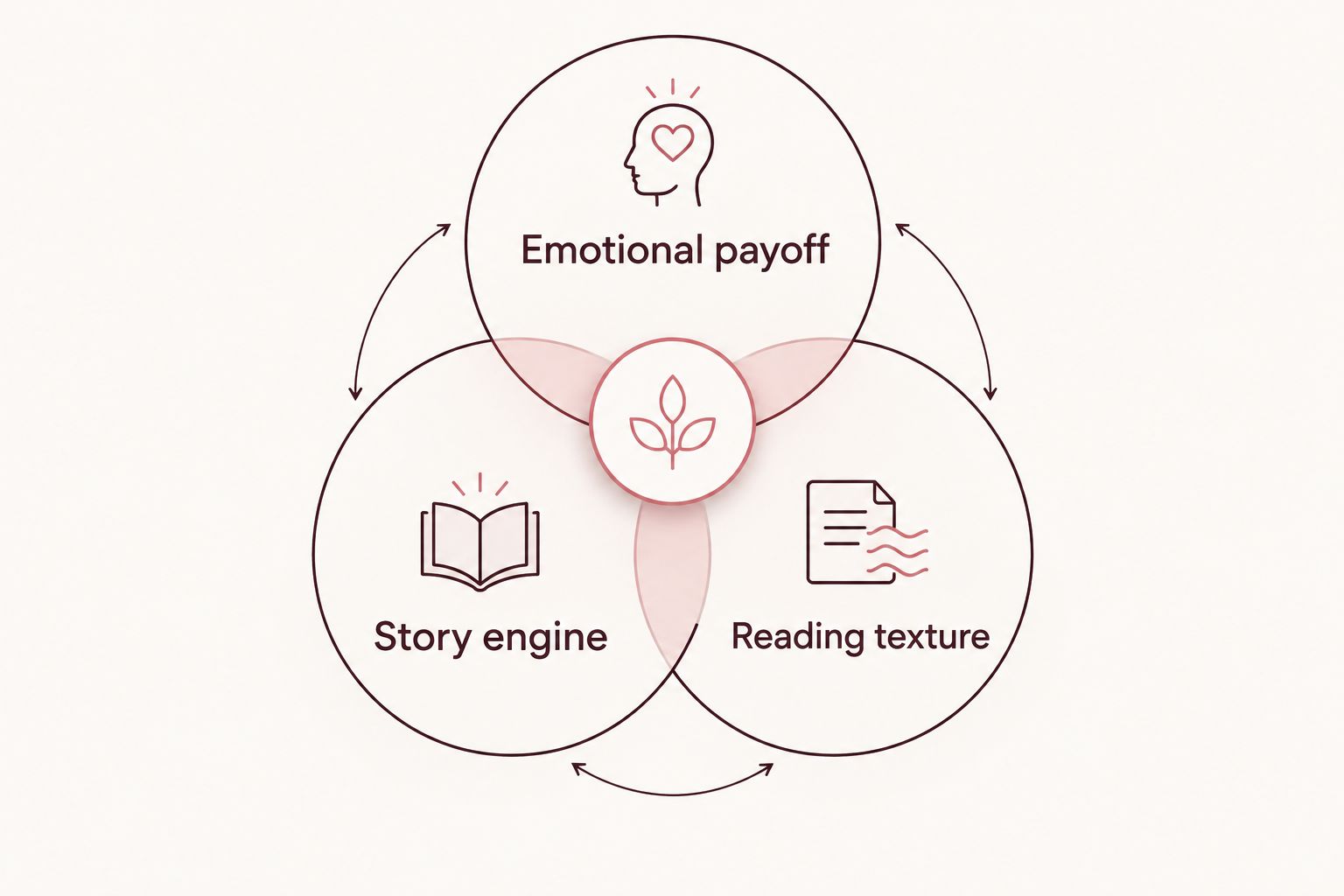
- Emotional payoff: Do you want dread, romantic anticipation, wonder, or the satisfaction of understanding a mystery?
- Story engine: Is the tension driven by a relationship, an investigation, training, or a contest for power?
- Reading texture: Do you enjoy an intimate narrative voice, shifting perspectives, or a historical-chronicle style?
- Setting: Are dragons, a particular household, or a dangerous court essential—or merely familiar scenery?
- Content limits: Would explicit sexual content, violence, or harm involving children rule out an otherwise close match?
Emotional payoff, story engine, and reading texture make a useful first filter. Setting and content limits then help you reject the wrong fit. A recommendation does not become better simply by matching more surface details.
Can I use a movie or show title in a book recommendation tool?
Use a movie or show title only when the tool explicitly supports screen titles. GetSimilarBooks accepts a book title and returns five hand-curated suggestions, so a source novel or a relevant bridge book is the appropriate starting point.
GetSimilarBooks is best for fiction readers who want book recommendations from a title they already enjoyed. The limitation matters: a relevant source novel is a search reference, not proof that you have read or liked it.
For a more personal request, explain what appealed to you on screen and what you want to avoid. The free personalized list contains 20–30 titles and requires an email address. Keep the request focused on your actual preferences rather than an assumed liking for the adaptation’s source.
Request your next reading list
Get a free personalized list of 20–30 titles. An email address is required.
What if I want the same feeling but a different genre?
Keep the emotional payoff and change the setting. A viewer who wants relationship suspicion can move from a contemporary thriller to Rebecca without preserving the same time period or plot machinery.
Use this sentence: I want the tension of this story, but not its setting. That gives your 2026 search a clear direction. It also leaves room for a recommendation that looks different while satisfying the same reader need.
FAQ
How do I find a book similar to a movie or show I loved?
Identify the relationship, conflict, or feeling you want again, then search for books that match it. Check for a source novel first, and compare each recommendation’s main difference before choosing.
Should I read the book if I already watched the adaptation?
Read the source book if you want the original version of a familiar story. Choose a read-alike instead if knowing major events would reduce your enjoyment.
What should I read after watching Gone Girl?
The Girl on the Train is a useful choice for unreliable perspectives and domestic mystery. Rebecca suits a slower Gothic mood, while Verity places more emphasis on intimate, explicit suspense.
Is Fourth Wing a good choice after House of the Dragon?
Fourth Wing is a good choice when dragon-rider bonds and romance are your priorities. It is not the same kind of story as a royal-family chronicle centered on succession.
How can I find similar books without getting spoilers?
Compare premises, narrative styles, and content notes rather than explanations of endings. A useful recommendation states why a book fits without revealing the event that resolves its mystery.
Can GetSimilarBooks recommend books from a television title?
GetSimilarBooks takes a book title as its starting point. Find the show’s source novel or a book with the qualities you want, then use that book as your reference.
What should I include in a personalized book request?
Include the screen title, the specific quality you liked, and a quality you want to avoid. Mention whether you have read the source book so your request does not imply a reading preference you have not established.
One last thing
Your strongest search detail can be something you disliked. Wanting dragons but not a training setting produces a different shortlist from wanting romantic tension but no explicit sexual content.
Before your next 2026 search, write one attraction and one exclusion. Keep both concrete. That small distinction gives you a better basis for choosing than a long list of shows you enjoyed for unrelated reasons.
Related guides
Leave a Reply