Books like Project Hail Mary with first-contact aliens

Best overall: Contact by Carl Sagan. Best for physics-driven discovery: Dragon’s Egg by Robert L. Forward. Best short read: Story of Your Life by Ted Chiang. These books like Project Hail Mary put first contact, scientific reasoning, and the difficulty of understanding another intelligence at the center of your next read in 2026.
- For books like Project Hail Mary, first contact matters most in Contact: choose it for scientific communication and discovery.
- Dragon’s Egg suits readers who want alien biology and physics more than a human-alien friendship.
- Story of Your Life makes language the central problem; Blindsight makes understanding another intelligence deeply unsettling.
- GetSimilarBooks offers five hand-curated suggestions, with a free personalized list of 20–30 titles available by email.
What Makes a Strong Project Hail Mary Read-Alike?
Project Hail Mary combines several pleasures that do not always travel together: practical science, survival pressure, humor, and a relationship built across a biological divide. Another spaceship novel can share the setting and miss the reason you cared.
Start with Contact if understanding the aliens mattered more than the mission hardware. Choose Dragon’s Egg if working through unfamiliar physical conditions was the attraction. Neither reproduces Andy Weir’s particular balance of jokes, technical explanations, and companionship.
You can also enter a book you enjoyed at GetSimilarBooks for five hand-curated suggestions. The free personalized list expands that selection to 20–30 titles after you provide an email address.
What makes the best first-contact read-alike?
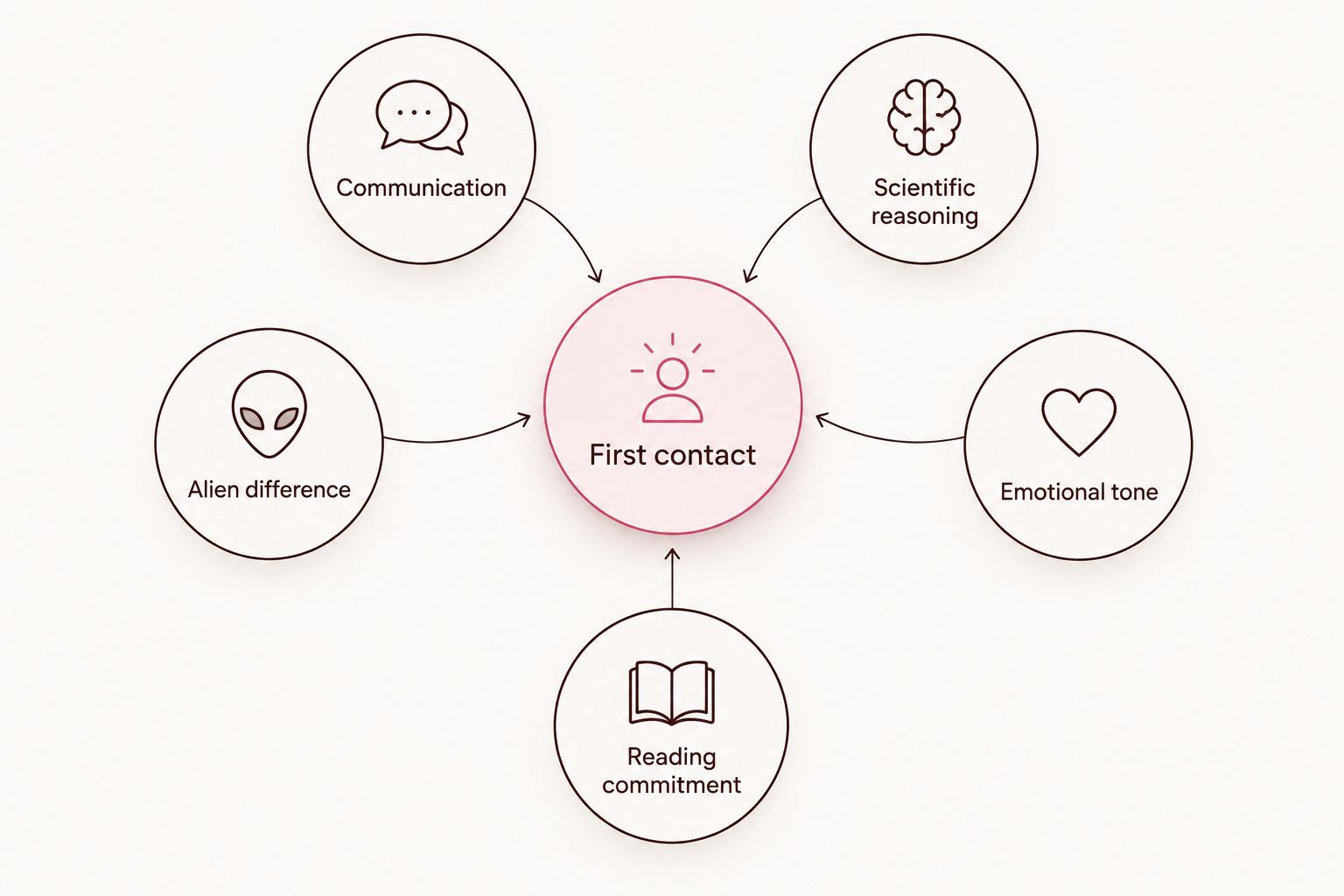
For this 2026 reading list, the match depends on what the encounter asks the characters—and you—to understand.
- Communication: Making sense of another intelligence drives the story rather than serving as background.
- Scientific reasoning: Observation, interpretation, or experimentation changes what happens next.
- Alien difference: The visitors are not simply humans with unfamiliar appearances.
- Emotional tone: Curiosity, companionship, dread, and suspicion produce very different reading experiences.
- Reading commitment: A concentrated novella and a viewpoint-heavy novel ask for different kinds of attention.
First contact is the shared subject. These criteria separate a close match in method from a close match in feeling; both matter when choosing what to read after Project Hail Mary.
First-contact books at a glance
The order moves from the closest broad match toward more specialized alternatives. The last recommendation deliberately exchanges reassurance for unease.
| Book | Best for | Standout quality | Key limitation |
|---|---|---|---|
| Contact — Carl Sagan | Scientific communication | Decoding an extraterrestrial signal connects discovery with questions of evidence | Earthbound institutions take substantial space |
| Dragon’s Egg — Robert L. Forward | Physics-driven discovery | Alien life develops under neutron-star conditions | Less emphasis on intimate human-alien companionship |
| Story of Your Life — Ted Chiang | Language and interpretation | A linguist’s encounter makes communication the central intellectual problem | Reflective rather than survival-driven |
| The Mote in God’s Eye — Larry Niven and Jerry Pournelle | Diplomatic uncertainty | An expedition must interpret an unfamiliar civilization | Military and political viewpoints replace the intimate scale |
| Blindsight — Peter Watts | Alien cognition and dread | First contact challenges assumptions about consciousness | Bleak, dense, and far from comforting |
1. Contact: best for scientific communication
Carl Sagan’s Contact follows radio astronomer Ellie Arroway as an extraterrestrial signal becomes a scientific and public event. The match with Project Hail Mary lies in treating contact as something to investigate, not merely something spectacular to witness.
The pleasure comes from asking what a signal means, what counts as evidence, and how a discovery changes when institutions become involved. You get scientific curiosity operating under pressure. You do not get the same tightly contained survival partnership.
Contact pros:
- Communication is a central scientific problem.
- Ellie provides a sustained viewpoint grounded in research.
- The story connects cosmic questions with recognizable human disagreements.
Contact cons:
- Politics, religion, and public debate interrupt the discovery thread.
- It lacks Project Hail Mary’s sustained buddy-story rhythm.
Best for: Readers who wanted more of the attempt to establish shared meaning with an extraterrestrial intelligence.
The meaningful difference is scale. Project Hail Mary makes a large problem personal through a small working relationship; Contact repeatedly asks what happens when a discovery belongs to the whole world. Choose it for the investigation, not as a promise of another Rocky.
Verdict: Read Contact first for the strongest broad match in scientific curiosity and communication.
2. Dragon’s Egg: best for physics-driven alien discovery
Robert L. Forward’s Dragon’s Egg imagines intelligent life on the surface of a neutron star. The environment is not decorative worldbuilding. Its physical conditions shape the aliens’ bodies, civilization, and relationship to human observers.
That makes Dragon’s Egg a strong next step if Project Hail Mary made you want fiction that reasons outward from an unfamiliar scientific premise. The book asks you to understand life on its own terms before expecting that life to resemble yours.
Dragon’s Egg pros:
- Physical conditions have direct consequences for alien life.
- Alien viewpoints make the civilization more than an object of human study.
- The contrast between human and alien timescales gives contact a distinctive shape.
Dragon’s Egg cons:
- Technical explanation takes priority over conversational warmth.
- Its broad civilizational scope reduces the focus on individual relationships.
Best for: Readers who enjoyed figuring out how an unfamiliar organism could function.
The difference matters: Dragon’s Egg is closer to an exercise in imagining a civilization than a survival story organized around a friendship. If your favorite passages in Project Hail Mary concerned biology and physical constraints, that trade is attractive. If your favorite passages were exchanges between companions, start elsewhere.
Verdict: Read Dragon’s Egg for alien life built from physical rules, not another buddy adventure.
3. Story of Your Life: best for language-centered first contact
Ted Chiang’s Story of Your Life follows linguist Louise Banks as she works to understand extraterrestrial language. It is a novella rather than a full-length novel, and its compact form suits a story built around interpretation.
The connection to Project Hail Mary is specific: understanding another species requires more than assigning familiar words to unfamiliar sounds. Communication changes the questions the human characters can ask. Chiang connects that intellectual problem with an intimate emotional story without relying on a sequence of survival repairs.
Story of Your Life pros:
- Linguistic work is central rather than incidental.
- The short form keeps the encounter concentrated.
- Personal experience and scientific inquiry belong to the same narrative.
Story of Your Life cons:
- It offers little of Project Hail Mary’s engineering momentum.
- Its reflective structure asks for attention rather than delivering constant action.
Best for: Readers who found the effort to understand another mind more compelling than the machinery of the mission.
Story of Your Life is the basis for the film Arrival. Familiarity with the film does not make the prose redundant, but avoid detailed explanations of the story’s structure before reading. Its method is part of the experience.
Verdict: Read Story of Your Life when you want a shorter, more reflective encounter centered on language.
4. The Mote in God’s Eye: best for diplomatic uncertainty
Larry Niven and Jerry Pournelle’s The Mote in God’s Eye places a human expedition in contact with an unfamiliar alien civilization. Understanding what the visitors see—and what their hosts mean—becomes a problem of diplomacy as much as science.
The Project Hail Mary connection is the need to reason carefully about another species. The difference is trust. Instead of centering a small cooperative relationship, the novel spreads uncertainty across an expedition, institutions, and competing interpretations.
The Mote in God’s Eye pros:
- Alien biology and social organization matter to the encounter.
- Diplomatic choices give interpretation immediate consequences.
- The wider cast supports disagreements about what contact means.
The Mote in God’s Eye cons:
- Military hierarchy and political discussion occupy substantial space.
- The broader viewpoint is less intimate than Project Hail Mary.
Best for: Readers who want to examine what a human delegation might misunderstand about an alien society.
Choose The Mote in God’s Eye if cooperation interested you because it required judgment, not just goodwill. It moves away from the warmth of a working partnership and toward the difficulty of making decisions with incomplete knowledge. That is a meaningful change of mood, not simply a larger cast.
Verdict: Read The Mote in God’s Eye for first contact shaped by diplomacy and uncertain motives.
5. Blindsight: best for unsettling alien cognition
Peter Watts’s Blindsight sends a specialized crew to investigate an extraterrestrial presence. It uses that encounter to question whether intelligence, consciousness, and recognizable personhood necessarily belong together.
This is the furthest recommendation from Project Hail Mary’s emotional tone. The connection is intellectual: both books insist that encountering alien life requires revising assumptions. Blindsight makes that revision disturbing rather than reassuring.
Blindsight pros:
- Alien cognition is a central problem, not a decorative mystery.
- The encounter challenges familiar definitions of intelligence.
- Scientific and philosophical questions remain closely connected.
Blindsight cons:
- Dense ideas and terminology make it a demanding read.
- Its bleak atmosphere offers little of Project Hail Mary’s warmth or humor.
Best for: Readers who want first contact to make human assumptions feel unsafe.
Brief content note: Blindsight includes violence, body horror, and disturbing medical material. Do not choose it merely because you liked a clever scientist solving problems. Choose it because you want the idea of understanding another intelligence placed under much harsher pressure.
Verdict: Read Blindsight for the interesting risk; skip it when you want comforting companionship.
How this 2026 list is ranked
The ranking prioritizes communication and scientific reasoning, then separates the books by emotional tone and reading commitment. It is a fit ranking, not a claim that the first book is objectively better than the last.
Contact comes first because it offers the broadest bridge from curiosity to extraterrestrial communication. Dragon’s Egg narrows toward physical speculation. Story of Your Life emphasizes language, The Mote in God’s Eye emphasizes diplomacy, and Blindsight changes the emotional contract altogether.
None is presented as a replacement for every part of Project Hail Mary. The honest recommendation names what carries over and what you leave behind.
Which first-contact book should you choose?
For your 2026 reading list, start with Contact unless a specific preference points elsewhere. It keeps the search for understanding at the center without requiring you to choose the bleakest or most technically specialized option.
Choose Dragon’s Egg for physical speculation, Story of Your Life for language, The Mote in God’s Eye for diplomacy, or Blindsight for unease. If none answers your particular reason for loving Project Hail Mary, request GetSimilarBooks’ free personalized list rather than settling for a shared genre label.
GetSimilarBooks is best for fiction readers who want hand-curated book recommendations based on a title they enjoyed. Five suggestions are the preview; the email-gated personalized list contains 20–30 titles.
Find your next read
Enter a book you enjoyed for five hand-curated suggestions, then request a personalized list by email.
FAQ
What’s the best book like Project Hail Mary for first contact?
Contact by Carl Sagan is the best starting point on this list for scientific communication and discovery. It focuses more on Earthbound institutions and public debate than Project Hail Mary’s intimate survival partnership.
Which book should I read if Rocky was my favorite part?
Start with Contact if learning to communicate was your favorite part of Rocky’s role. None of these recommendations reproduces the same warm human-alien friendship, so choose by the quality you want rather than expecting a substitute character.
What’s a short first-contact book like Project Hail Mary?
Story of Your Life by Ted Chiang is the short-form choice on this list. The novella centers on a linguist interpreting extraterrestrial language rather than an engineer solving survival problems.
Is Dragon’s Egg similar to Project Hail Mary?
Dragon’s Egg is similar in its attention to scientific constraints and unfamiliar alien biology. It differs by following a civilization shaped by neutron-star conditions rather than centering a small survival partnership.
Is Blindsight a good choice after Project Hail Mary?
Blindsight is a good choice if you want a darker examination of alien intelligence. Skip it if you primarily want humor, reassurance, or a warm working friendship.
Which first-contact book should I start with in 2026?
Start with Contact in 2026 for the broadest match on this list. Choose Story of Your Life instead if you want a shorter work focused tightly on language and interpretation.
How does GetSimilarBooks recommend my next book?
GetSimilarBooks lets you enter a title you enjoyed and receive five hand-curated read-alike suggestions. You can also request a free personalized list of 20–30 titles by providing an email address.
One last thing
Before choosing, finish this sentence: “I want another book where understanding someone changes what survival means.” If that feels right, prioritize communication and relationships over spaceship settings.
If you replace “someone” with “something,” Dragon’s Egg becomes a stronger choice. That small distinction separates wanting another connection from wanting another scientific puzzle.
Related guides
These guides address different genres but separate reader needs in the same practical way:
- Books like Fourth Wing with found family
- Books like Fourth Wing with deeper worldbuilding
- Books like Verity with unreliable narrators
Leave a Reply