Is ACOTAR worth starting in 2026?

Yes—ACOTAR is worth starting in 2026 if you want romance-led fantasy, an unfamiliar faerie world, and relationships that develop across several books. Start with A Court of Thorns and Roses by Sarah J. Maas, but expect a slower opening than Fourth Wing and a different kind of tension from Verity. The main caveat is commitment: the first novel introduces a story whose relationships and conflicts continue beyond its ending.
- Is ACOTAR worth starting in 2026? Yes for romance-led fantasy; skip it if you want a standalone thriller.
- Fourth Wing shares romantic danger with ACOTAR, but ACOTAR does not offer dragons, rider bonds, or military training.
- Start with A Court of Thorns and Roses. Do not skip directly to A Court of Mist and Fury.
- GetSimilarBooks suits fiction readers seeking read-alikes matched to a book they already enjoyed.
Is ACOTAR worth starting in 2026?
Start ACOTAR for the relationships, not because you expect another dragon academy. Its appeal rests on Feyre entering a dangerous faerie world, learning whom to trust, and forming attachments under unequal conditions. Romance and personal change carry substantial weight alongside the fantasy conflict.
ACOTAR means A Court of Thorns and Roses, both the first novel’s title and the common shorthand for the series. Follow the ACOTAR series reading order rather than choosing whichever installment appears most often in recommendations. Later books depend on earlier events.
Your previous favorite gives you a useful starting point, but not a guarantee:
| Your starting point | Best for | What ACOTAR shares | The meaningful difference |
|---|---|---|---|
| You loved Fourth Wing | Readers seeking romance under dangerous conditions | An unfamiliar power structure, romantic tension, and a heroine facing stronger opponents | No dragon-rider bond or military-academy framework; the opening gives more room to captivity, atmosphere, and attraction |
| You loved Verity | Readers who liked desire complicated by mistrust | Attraction mixed with danger and uncertainty about other people | Faerie fantasy replaces the domestic thriller; do not expect a hidden-manuscript mystery |
| You already enjoy romantic fantasy | Readers willing to follow relationships across books | Romance tied to magic, power, and personal change | The first novel establishes a narrower view of the world than later installments |
The closest fit here is the Fourth Wing reader who cared more about the romance than the training timetable. The weaker fit is the Verity reader who mainly wants a short, unsettling puzzle.
Why this matters: match the reading experience
A shared genre label does not tell you whether a book will satisfy the same need. You can love Fourth Wing for its dragons, its heroine, its danger, or its romance. Those are different reasons to choose your next read.
The useful question in 2026 is not whether ACOTAR still deserves attention. It is whether its particular balance of romance, fantasy, and pacing matches what you want now. A popular series is not an obligation.
Choose the quality you want repeated before choosing the title. If you want attraction tangled with power, ACOTAR is a sensible next read. If you want another tightly structured academy competition, the resemblance is much weaker.
The first novel: start here, not with the promise of later books
A Court of Thorns and Roses begins with Feyre, a human huntress whose actions bring her into the faerie realm. The opening draws on Beauty and the Beast: an unfamiliar household, a powerful host, and a heroine trying to understand the rules around her.
That setup creates room for observation and attraction. It also means the book does not maintain the same kind of immediate, institutional pressure as Fourth Wing. Much of the tension comes from what Feyre does not understand and what others will not explain.
Best for: readers who enjoy an outsider’s limited perspective, a threatening setting, and romance built through proximity.
The advantage is intimacy. You learn the world through Feyre’s experience rather than through a detached account of its politics. The drawback is restricted information: readers who want clear explanations early can find that frustrating.
Give the novel room to establish its central relationship, but judge the experience you are actually having. Disliking a deliberate opening is different from disliking the narrative voice, the romantic dynamic, or the fantasy setting itself.
Verdict: Start here if the premise interests you; skip the series if its basic storytelling style does not.
The second novel: a broader test of the series
A Court of Mist and Fury follows A Court of Thorns and Roses. Its relationships and emotional conflicts depend on the first novel, so reading it first trades context for confusion.
Without revealing developments, the second novel broadens the social world and gives more space to recovery, agency, and changing relationships. That makes it relevant if your favorite part of Fourth Wing was watching trust develop under pressure rather than watching characters train.
Best for: readers who want emotional consequences and a wider circle of relationships after the initial setup.
The strength is that events leave marks on the characters. The limitation is that emotional processing occupies substantial space. Readers seeking uninterrupted action should not treat a broader setting as a promise of a faster book.
You do not need to commit to 2 books before opening the first. Equally, if you finish the first novel curious about the characters but unconvinced by the scope, the second is the relevant next test—not a reason to jump ahead.
Verdict: Continue if the characters interest you; do not continue solely because someone promised a different book.
The first three novels: plan for a connected story
A Court of Thorns and Roses, A Court of Mist and Fury, and A Court of Wings and Ruin form the opening sequence. Across these 3 novels, the story expands beyond Feyre’s initial circumstances into larger relationships and conflicts.
That structure offers room for attachments to change and consequences to accumulate. It also asks for more attention than a single contained thriller. Remembering relationships and earlier choices matters more as the cast and stakes expand.
Best for: readers who enjoy staying with characters beyond the first romantic setup.
The benefit is continuity. You do not have to leave the characters as soon as their world becomes familiar. The drawback is commitment: if you prefer a new premise and a fresh cast with every book, an extended series can feel restrictive.
This is a reading plan, not a promise that every storyline ends within those novels. Avoid looking up later character pairings before you begin; even a recommendation headline can reveal developments you would rather discover yourself.
Verdict: Continue book by book; do not turn the whole series into homework.
Why ACOTAR’s fit varies by reader
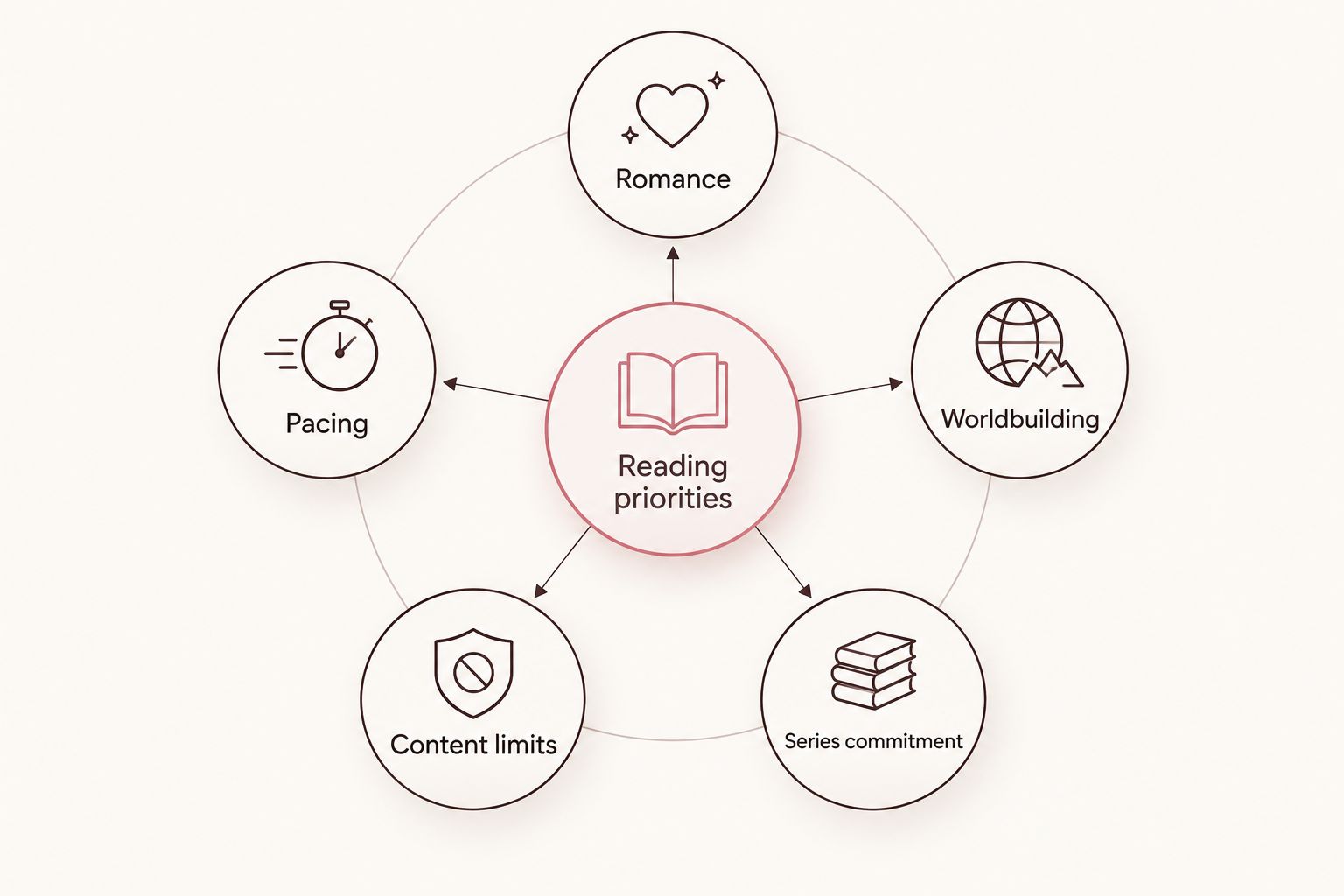
The same feature can be an advantage or a drawback. A close narrative perspective creates intimacy but limits information. A continuing romance offers development but requires patience. Use these priorities to make the decision specific.
- Romance: Choose ACOTAR if attraction, trust, and changing relationships belong near the center of your reading experience. Skip it if romance routinely interrupts what you want from fantasy.
- Pacing: Expect the opening to spend time establishing Feyre’s circumstances and the faerie setting. Do not choose it solely for the immediate danger you associate with Fourth Wing.
- Worldbuilding: Choose it for a world encountered through a character’s experience. Look elsewhere if your main pleasure is an early, systematic explanation of magic and institutions.
- Content limits: The series contains violence, abuse-related themes, and sexual content, with greater explicitness in later installments. Check individual books rather than assuming the first establishes the limit.
- Series commitment: Choose it if returning to characters appeals to you. Wait if you currently want a self-contained novel with no further reading decision attached.
Your reading priorities matter more than how closely a cover or genre label resembles your last favorite. Pick the priority you least want to compromise, then check whether ACOTAR actually supplies it.
Will I like ACOTAR if I loved Fourth Wing?
ACOTAR is a good next step if the romance and dangerous power imbalance kept you reading Fourth Wing. Both place a heroine in circumstances where understanding other people matters to survival, though their settings and story structures differ.
The match weakens if dragons and rider bonds were your main attachment. ACOTAR does not reproduce that relationship, and a faerie court is not a substitute for a military academy.
Will I like ACOTAR if I loved Verity?
ACOTAR fits the Verity reader who wants more attraction complicated by danger, not the reader seeking another domestic thriller. Both give you reasons to question what characters know and want, but they use that uncertainty differently.
Choose ACOTAR when you want to move toward fantasy and an extended relationship story. Skip it when your immediate need is a contained psychological mystery.
Should I keep reading if the first book feels slow?
Keep reading if curiosity about Feyre and the faerie world survives the slower sections. Stop if the voice, romantic focus, or central setup is what you dislike; a later change in scope does not erase those preferences.
There is no useful universal stopping page because editions differ and reading tolerance is personal. For a 2026 reading list, an honest early stop is better than committing to a series you already resent.
Find the match behind your favorite
GetSimilarBooks gives you five hand-curated read-alike suggestions from a title you enjoyed, plus an email-gated personalized list of 20–30 titles. The initial suggestions let you inspect the fit before requesting the longer list.
GetSimilarBooks is best for fiction readers who want read-alike recommendations starting from a book they already enjoyed. Its limitation is the same one behind this ACOTAR decision: a shared starting title does not make every suggested book right for every reader. Check the matching quality and the meaningful difference.
You can use GetSimilarBooks with Fourth Wing or Verity as your starting title, then request the free personalized list. Choose your next book for the experience you want, not simply its proximity to a familiar name.
Find your next read
Enter a favorite title for five read-alikes, then request a free personalized list of 20–30 titles by email.
FAQ
Is ACOTAR worth starting in 2026 if I have never read fantasy?
Yes, if a romance-centered story interests you and you are willing to learn an unfamiliar setting through Feyre’s perspective. Start with A Court of Thorns and Roses rather than a later installment.
Is ACOTAR better than Fourth Wing?
ACOTAR is the better fit when you want faerie settings and extended relationship development; Fourth Wing is the better fit when dragons and military training are central to your interest. Neither title replaces the other’s defining premise.
Can I read the first ACOTAR book and stop?
Yes, you can stop after A Court of Thorns and Roses, but its ending does not make the wider series unnecessary. Continue only if you want more of the characters and their world.
Can I skip straight to A Court of Mist and Fury?
No—start with A Court of Thorns and Roses. A Court of Mist and Fury depends on the relationships and events established in the first novel.
Is ACOTAR suitable if I want less explicit romance?
ACOTAR is not a reliable choice for avoiding explicit romance across a series. Later installments contain more explicit sexual material, so check each book’s content before continuing.
Is ACOTAR a good choice after Verity?
ACOTAR is a good choice after Verity only if you want to move from psychological suspense toward romantic fantasy. It does not offer the same domestic setting or manuscript-centered mystery.
How can I find alternatives if ACOTAR does not sound right?
GetSimilarBooks offers five hand-curated read-alikes from a title you enjoyed and an email-gated personalized list of 20–30 titles. Compare the specific reasons for each match before choosing.
One last thing
The most useful detail in an ACOTAR recommendation is the mismatch. “Like Fourth Wing, but without dragons or an academy” tells you more than “another addictive romantasy.” It makes the trade-off visible.
For your 2026 reading list, start ACOTAR because you want its actual premise: Feyre, a dangerous faerie world, and romance with consequences. Do not start because you expect your previous favorite with different names.
Related guides
- Books like Fourth Wing with dragons and rider bonds
- Books like ACOTAR with slow-burn romance
- Books like Verity with romance at the center
Leave a Reply