How does a book recommendation quiz actually work?

A book recommendation quiz turns your answers about reading preferences into a shortlist by matching them against information about books. Depending on its design, it uses fixed answer-to-book rules, scored book characteristics, or a curated selection process. The useful part is not the quiz itself: it is whether the results explain what matches your taste and what changes.
- How does a book recommendation quiz actually work? It connects your preferences to book characteristics, then selects matching titles.
- Fourth Wing readers should separate dragon bonds, romantic tension, and academy settings before choosing a read-alike.
- Verity readers should distinguish unsettling narration from romance, family secrets, and an ambiguous ending.
- GetSimilarBooks suits fiction readers who want five hand-curated read-alikes from a title they enjoyed.
Why this matters
Finishing Fourth Wing does not tell a recommendation service which part you want again. You might want another rider-and-dragon bond. Someone else wants romantic friction and would happily leave the dragons behind.
The same problem applies to Verity. Wanting another disturbing narrator is different from wanting another romance-centered thriller. A quiz becomes useful when it separates those needs instead of treating the title as a complete description of your taste.
For your next read in 2026, judge the explanation attached to each result, not just the questionnaire. The book recommendation quiz to personalized list workflow follows that distinction from your starting preference to a usable reading list.
How does a book recommendation quiz actually work?
A recommendation quiz needs an input, a way to describe candidate books, and a rule for choosing between them. Some systems make those connections explicitly through questions. Others start with a book you already like.
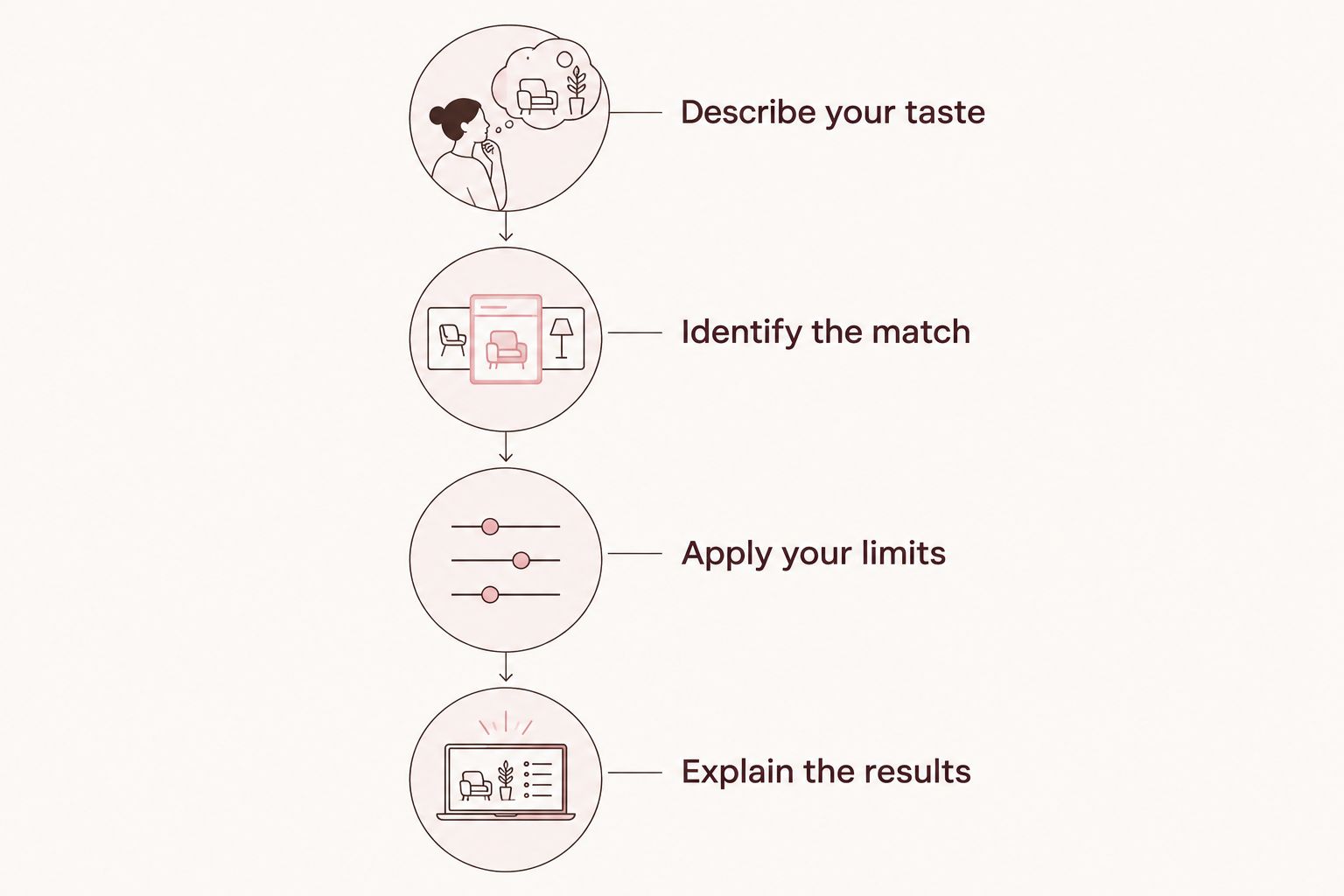
Here is the process to look for. These are general recommendation methods, not a description of every service's internal system.
- Describe your taste. You provide a favorite title or answer questions about genre, mood, pace, relationships, and reading preferences.
- Identify the match. The system connects those answers to book characteristics. A fixed-rule quiz follows predefined branches; a scoring system compares selected characteristics.
- Apply your limits. Preferences such as less explicit romance, a standalone story, or content exclusions help narrow the choices when the service supports them.
- Explain the results. A useful shortlist tells you why each book fits and names a difference that matters to your decision.
A result without an explanation leaves you doing the matching yourself. A result that says why a book fits gives you something you can accept, reject, or refine.
What information connects your answers to a book?
A quiz needs some representation of the books it recommends. That might be a manually assigned set of characteristics, a predefined result attached to an answer path, or descriptive information used by a matching system.
Those approaches are not interchangeable. A question about mood only helps if the selection process actually distinguishes the moods of the available books. Asking more questions does not, by itself, produce a more specific match.
Look for evidence in the result. If you asked for romantic tension without much explicit content, the explanation should address both parts. Merely returning another fantasy romance does not show that your preference shaped the choice.
Which recommendation method fits your starting point?
Choose the method based on what you already know about your next read. A broad quiz helps you articulate a mood; a title-based finder gives you a concrete starting reference.
| Method | Best for | What it uses | Main advantage | Main limitation |
|---|---|---|---|---|
| Preference quiz | Readers who know the feeling they want | Answers about mood, genre, pace, or relationships | Helps turn a vague preference into a direction | Broad answers can leave important differences unresolved |
| Title-based read-alike finder | Readers with a clear favorite | A book you enjoyed | Starts from a shared reference rather than a genre label | A title alone does not reveal which qualities mattered to you |
| Curated recommendation list | Readers who want reasons for each choice | Deliberately selected connections between books | Makes the reasoning available for inspection when explanations are included | The curator's chosen connection might not be yours |
These methods can overlap. A title-based finder can use curated selections, and a quiz can lead to a predefined list. The interface does not establish how the recommendations were chosen.
In 2026, do not treat the word personalized as an explanation. Ask what information changes the selection and whether the recommendations make that connection visible.
What should you tell a quiz after Fourth Wing?
Start with the part of Fourth Wing you want to preserve. Then name something you are willing to change. That produces a clearer reading brief than asking for another popular fantasy romance.
Use these distinctions to make your answer specific:
- Dragon bonds: Best for readers whose main interest is the connection between rider and dragon. The trade-off is that a creature-centered match need not reproduce the romance.
- Romantic tension: Best for readers who want attraction complicated by conflict. The trade-off is that a close relationship match can have a very different setting.
- Academy pressure: Best for readers who want training, competition, and dangerous tests. The trade-off is that an academy match does not promise the same balance of romance and fantasy.
- Found family: Best for readers who want loyalty developing under pressure. The trade-off is that the group dynamic can matter more than the central couple.
These are preference directions, not promises that every recommendation will contain all four. Decide which quality is essential before you compare results.
A useful sample brief is: Keep the dragon-and-rider connection; reduce the explicit romance. Another is: Keep the romantic friction; the academy setting is optional. Neither asks for a plot duplicate.
What should you tell a quiz after Verity?
Separate the source of your interest in Verity from its broad thriller label. You might want uncertainty about a narrator, a relationship at the center of the danger, or a setting that feels difficult to escape.
A clear sample brief is: Keep the unsettling narration; romance is optional. A different reader might say: Keep the relationship central; I do not need another manuscript plot. Those requests should lead you to evaluate different matches.
| Starting book | What you want again | What a useful explanation should address | Difference to check |
|---|---|---|---|
| Fourth Wing | Dragon-and-rider bonds | Why the creature relationship matters to the story | How central the romance is |
| Fourth Wing | Romantic tension | What creates conflict between the leads | Whether the setting offers the same appeal |
| Verity | Unreliable narration | How uncertainty shapes the reading experience, without revealing twists | Whether the ending resolves that uncertainty |
| Verity | Romance-centered suspense | How the relationship connects to the danger | How much attention the romance receives |
A shared genre is a starting filter, not a complete matching reason. Two thrillers can create very different kinds of unease. Two fantasy romances can ask you to care about entirely different things.
Why do book recommendation quiz results vary?
Results vary because quizzes can collect different inputs and use different selection rules. For your 2026 reading list, inspect these factors before deciding that an unexpected title is a bad recommendation.
- Starting information. A favorite title supplies a different kind of reference from a general preference such as dark or fast-paced.
- Priority. Romance, atmosphere, and setting can all matter, but the result needs a way to resolve competing preferences.
- Candidate selection. A quiz can only recommend from the books its selection process includes.
- Hard limits. A content boundary or standalone requirement changes what counts as an acceptable match when that filter is supported.
- Matching method. Fixed branches, characteristic-based scoring, and curated connections do not make selections in the same way.
- Explanation quality. A result that names a specific connection is easier to assess than one that provides only a cover and genre.
More questions are not automatically better. A short questionnaire that captures your decisive preference can be more useful to you than a long one that never asks what you want to avoid.
Is a title-based finder better than a quiz?
A title-based finder is the better starting point when you can name a book you loved but struggle to describe your taste. A quiz is useful when you know your desired mood or constraints and do not have a clear comparison title.
GetSimilarBooks is best for fiction readers who want hand-curated read-alikes from a book they already enjoyed. You enter a title and receive five suggestions. An email-gated personalized list expands that to 20–30 titles.
GetSimilarBooks book recommendations use a human-curated method, with no purchase history, co-view data, or automated similarity score. That gives you a different basis for discovery from behavior-based recommendations; it does not guarantee that the chosen connection is the one you personally value most.
The limitation is straightforward. A favorite title does not communicate every preference or content boundary. Start with GetSimilarBooks when you have that title, then assess each suggestion against the reason you loved it.
Find your next read-alikes
Enter a title you enjoyed for five hand-curated suggestions, with an email-gated personalized list of 20–30 titles.
Can a quiz guarantee that you will love the result?
No book recommendation quiz can guarantee your response to a novel. Matching characteristics helps narrow the field, but enjoying a premise is not the same as enjoying the writing, pacing, or characters.
Treat a recommendation as a reason to investigate a book, not an instruction to finish it. Read the description and a sample. Check whether the feature that attracted you actually appears in the explanation.
For a recommendation you plan to read in 2026, confirm content details separately when a boundary matters. A close match on atmosphere does not establish suitability on every other dimension.
How do you recognize a useful recommendation explanation?
A useful explanation names the connection and the departure. It helps you choose without revealing the plot's surprises.
Look for three things:
- A specific match: Romantic friction, rider bonds, unreliable narration, or another identifiable reading quality.
- A meaningful difference: Less romance, a slower pace, a different setting, or a different balance of story elements.
- A reader-facing verdict: Who should choose the book, and who should keep looking.
Skip explanations that only call a book gripping or perfect for fans. Those phrases do not tell you what the recommendation preserves. You need a reason you can disagree with.
FAQ
How does a book recommendation quiz actually work?
A book recommendation quiz connects your answers about reading preferences to candidate books, then selects a shortlist. Depending on the design, it uses fixed answer paths, scored characteristics, or curated selections.
Do I need to know my favorite genre before taking a book quiz?
No, you can start with a book you enjoyed or a specific reading preference. Mood, pacing, relationship dynamics, and content boundaries can describe what you want more clearly than a broad genre label.
What’s the best way to find books after Fourth Wing?
Start by identifying whether you want dragon bonds, romantic tension, academy pressure, or found family. Then check that each recommendation explains that connection and names an important difference.
How do I find something like Verity without the same plot?
Choose the reading quality you want to repeat, such as unreliable narration, romance-centered suspense, or a claustrophobic setting. Ask for that quality rather than a duplicate premise, and avoid explanations that reveal twists.
Does GetSimilarBooks use my purchase history?
GetSimilarBooks uses a human-curated method with no purchase history, co-view data, or automated similarity score. You start by entering a title you enjoyed.
How many recommendations does GetSimilarBooks provide?
GetSimilarBooks provides five hand-curated read-alike suggestions from a title you enjoyed. Its email-gated personalized list contains 20–30 titles.
Can a book quiz reliably screen out content I want to avoid?
Do not treat a general book quiz as a complete content screen. State your boundaries when the service supports them, then check content information separately before choosing a book.
One last thing
Before choosing your next book in 2026, write down what you do not need repeated. You might want Fourth Wing's romantic friction without another academy, or Verity's uncertainty without another writer-centered premise.
That distinction gives you permission to choose a book that looks less similar on the surface. Keep the quality that mattered. Let the rest change.
Related guides
- Books like Fourth Wing with slow-burn romance
- Books like Verity with unreliable narrators
- Best book recommendation quizzes for your next read
Leave a Reply