Books like Colleen Hoover: five authors, closest match first

Best overall: Mia Sheridan’s Archer’s Voice. Best for grief-centered romance: Brittainy C. Cherry’s The Air He Breathes. Best for Verity readers: Tarryn Fisher’s The Wives. These five authors offer different kinds of books like Colleen Hoover, ordered from emotional-romance matches outward rather than treated as interchangeable.
- For books like Colleen Hoover, start with Mia Sheridan’s Archer’s Voice for emotional intimacy and painful personal history.
- Brittainy C. Cherry’s The Air He Breathes suits readers seeking grief-centered romance, not domestic suspense.
- Kennedy Ryan’s Before I Let Go puts reconciliation, mental health, and shared responsibilities at the center.
- Taylor Jenkins Reid’s One True Loves focuses on competing attachments; Tarryn Fisher’s The Wives prioritizes suspicion.
- GetSimilarBooks offers five hand-curated read-alike suggestions, plus an email-gated personalized list of 20–30 titles.
Why the Hoover book you loved matters
It Ends with Us and Verity create different reading appetites. A recommendation that matches the emotional vulnerability of Hoover’s relationship fiction can miss the distrust that made Verity compelling. Choosing by author alone blurs that distinction.
Start with the feeling you want repeated, not the genre label. This 2026 guide separates wounded-character romance, relationship crossroads, and domestic suspense. You can also enter the title you enjoyed into GetSimilarBooks for five hand-curated read-alike suggestions.
GetSimilarBooks suits fiction readers who want book recommendations starting from a title they already loved. The useful starting point is specific: “I want the emotional intimacy of Archer’s Voice” tells you more than “I want another romance.”
What makes the best books like Colleen Hoover?
These are the criteria behind the order, not a claim that every Hoover novel has the same qualities:
- Emotional exposure: Characters reveal painful experiences through relationships, rather than existing only to deliver a plot surprise.
- Relationship stakes: Attraction creates difficult choices with consequences beyond whether a couple gets together.
- Readable momentum: The central emotional question gives you a reason to keep reading.
- A precise matching quality: Grief, reconciliation, competing commitments, or distrust must explain the recommendation.
- A meaningful difference: Each entry names what changes, including tone, life stage, and the balance between romance and suspense.
For this 2026 shortlist, emotional-romance similarity determines the main order. The final entry changes lanes for Verity readers. If suspense was your reason for loving Hoover, move that entry to the top of your personal list.
Five authors at a glance
| Order | Author and starting book | Best for | Matching quality | Key limitation |
|---|---|---|---|---|
| 1 | Mia Sheridan — Archer’s Voice | Emotional healing | Intimacy between people carrying painful histories | Not a domestic thriller |
| 2 | Brittainy C. Cherry — The Air He Breathes | Grief-centered intensity | Loss shapes attraction and vulnerability | Bereavement dominates the experience |
| 3 | Kennedy Ryan — Before I Let Go | Adult reconciliation | Love tested by grief and shared responsibilities | Parenting and business occupy substantial space |
| 4 | Taylor Jenkins Reid — One True Loves | Romantic crossroads | A relationship choice with incompatible futures | Less focused on threatening secrets |
| 5 | Tarryn Fisher — The Wives | Domestic suspicion | Intimacy becomes a source of uncertainty | Not a reassuring romance |
Each author has a different job here. Sheridan is the default emotional match; Fisher is the suspense detour. The middle entries help you choose which kind of relationship pressure you want next.
1. Mia Sheridan: best for emotional healing
Start with: Archer’s Voice. Bree arrives in a small Maine town carrying a painful past and forms a connection with Archer, an isolated man who does not speak. Their developing communication makes intimacy central to the story rather than a pause between dramatic events.
The Hoover connection is the movement from guardedness toward emotional exposure. You read to understand what the characters carry and whether closeness can survive that knowledge. Sheridan gives that process a small-town setting and a sustained focus on the central couple.
The meaningful difference: Archer’s Voice is a relationship-centered romance, not a puzzle built around competing accounts. Archer’s inability to speak also gives communication a particular importance that a generic “damaged characters” comparison would miss.
Mia Sheridan pros:
- A direct match for readers who value vulnerability and emotional intimacy.
- Communication matters to how the relationship develops.
- The central couple provides a clear emotional focus.
Mia Sheridan cons:
- Trauma remains part of the reading experience.
- It does not supply the domestic suspicion of Verity.
Best for: Readers seeking a painful but relationship-centered story about trust.
Content note: Violence, trauma, and explicit sexual content.
Verdict: Buy for emotional intimacy; skip if you want a psychological thriller.
2. Brittainy C. Cherry: best for grief-centered intensity
Start with: The Air He Breathes. Elizabeth and Tristan are both living with devastating losses. Their connection develops through grief, loneliness, and the difficult question of what it means to become close to someone while still attached to the past.
The Hoover match is emotional pressure. Attraction does not arrive in an uncomplicated space; it collides with experiences the characters cannot simply leave behind. Cherry makes bereavement the organizing force of the relationship rather than background information.
The meaningful difference: This is a narrower recommendation than “another emotional romance.” Choose it because you want loss and attachment examined together. If grief is the element you would rather avoid, the matching quality becomes the reason to pass.
Brittainy C. Cherry pros:
- Grief directly shapes the romantic relationship.
- Both central characters carry emotional stakes.
- The story suits readers who want sustained emotional intensity.
Brittainy C. Cherry cons:
- Bereavement makes this a demanding choice for a difficult week.
- The heightened emotional register is not a quiet, restrained alternative.
Best for: Readers who want romance shaped by mourning and the possibility of loving again.
Content note: Bereavement, trauma, and explicit sexual content.
Verdict: Buy for grief-centered romance; skip when you need a lighter emotional load.
3. Kennedy Ryan: best for adult reconciliation
Start with: Before I Let Go. Yasmen and Josiah are divorced, share children, and remain connected through their restaurant business. Their history makes renewed attraction complicated: wanting each other does not resolve the losses and difficulties that affected their marriage.
The Hoover connection is the gap between powerful feelings and a workable relationship. Ryan gives that conflict practical weight. Parenting, work, grief, and mental health belong to the central problem rather than sitting outside the romance.
The meaningful difference: These characters have already built and lost a marriage. This is not primarily about discovering a mysterious new partner; it is about whether people who know each other deeply can build a different relationship.
Kennedy Ryan pros:
- Reconciliation involves accountability, not attraction alone.
- Shared parenting and work give the relationship concrete stakes.
- Mental health receives sustained attention.
Kennedy Ryan cons:
- Grief and depression make the story emotionally heavy.
- Readers seeking a narrow focus on courtship get a wider adult life instead.
Best for: Readers who want a second-chance romance involving established lives and responsibilities.
Content note: Pregnancy loss, depression, grief, and explicit sexual content.
Verdict: Buy for adult reconciliation; skip if you want to leave parenting and marriage behind.
4. Taylor Jenkins Reid: best for romantic crossroads
Start with: One True Loves. Emma has rebuilt her life after her husband, Jesse, disappeared and was presumed dead. When Jesse returns, she is engaged to Sam, and the future she has chosen meets the past she thought she had lost.
That premise is the starting point, not an ending spoiler. The Hoover connection lies in incompatible emotional commitments: the relationship question cannot be answered by deciding which person is simply good or bad.
The meaningful difference: Reid puts identity and change at the center of the choice. The question is not only whom Emma loves, but how the person she has become relates to the life she once wanted. Choose this for emotional conflict, not an expectation of sinister revelations.
Taylor Jenkins Reid pros:
- The central dilemma is clear and consequential.
- Love connects to identity and the passage of time.
- The relationship conflict gives readers a strong discussion question.
Taylor Jenkins Reid cons:
- A love triangle is fundamental to the premise.
- Domestic menace is not the main attraction.
Best for: Readers who want to debate a romantic decision rather than solve a mystery.
Content note: Presumed death, grief, and sexual content.
Verdict: Buy for a difficult romantic choice; skip if love triangles frustrate you.
5. Tarryn Fisher: best for domestic suspicion
Start with: The Wives. Thursday believes she shares her husband with other women under an arrangement that keeps their lives separate. Questions about that arrangement turn intimacy into an investigation.
The Verity connection is distrust inside an intimate relationship. Information changes how you understand the people involved, and apparent closeness offers no reliable protection. Fisher belongs here for readers who want uncertainty more than emotional repair.
The meaningful difference: The Wives is a psychological thriller, not a romance recommendation with a darker atmosphere. Do not choose it expecting the same relationship-centered satisfaction as Sheridan or Ryan. If that distinction matters most, use the narrower guide to books like Verity, ranked by fit.
Tarryn Fisher pros:
- A direct option for domestic distrust.
- The marriage premise makes secrecy personal.
- Suspense, rather than courtship, drives the reading experience.
Tarryn Fisher cons:
- Psychological distress is central to the story.
- It is the wrong choice for a comforting romantic resolution.
Best for: Verity readers who want to question what an intimate partner has told them.
Content note: Abuse, psychological distress, and reproductive themes.
Verdict: Buy for domestic suspense; skip if you want romance to provide reassurance.
How this shortlist is ordered
The ranking follows the criteria above: emotional exposure, relationship stakes, momentum, and a specific reason for the match. It is an editorial comparison of premises and reading experiences, not a testing score or a claim that every book reproduces Hoover’s style.
The 2026 order starts with relationship-centered fiction and moves outward. That makes Sheridan the default, Cherry the grief-focused choice, Ryan the reconciliation choice, Reid the romantic dilemma, and Fisher the thriller branch.
Which author should you choose?
Choose Mia Sheridan’s Archer’s Voice if you want one default recommendation. It keeps the focus on intimacy, painful history, and the difficulty of trusting another person.
Before adding the whole shortlist to your reading queue, choose your main need:
- Emotional healing: Start with Sheridan; choose Cherry when grief is the specific attraction.
- Romantic crossroads: Choose Ryan for rebuilding a marriage or Reid for competing futures.
- Domestic suspicion: Choose Fisher when Verity is the actual reference point.
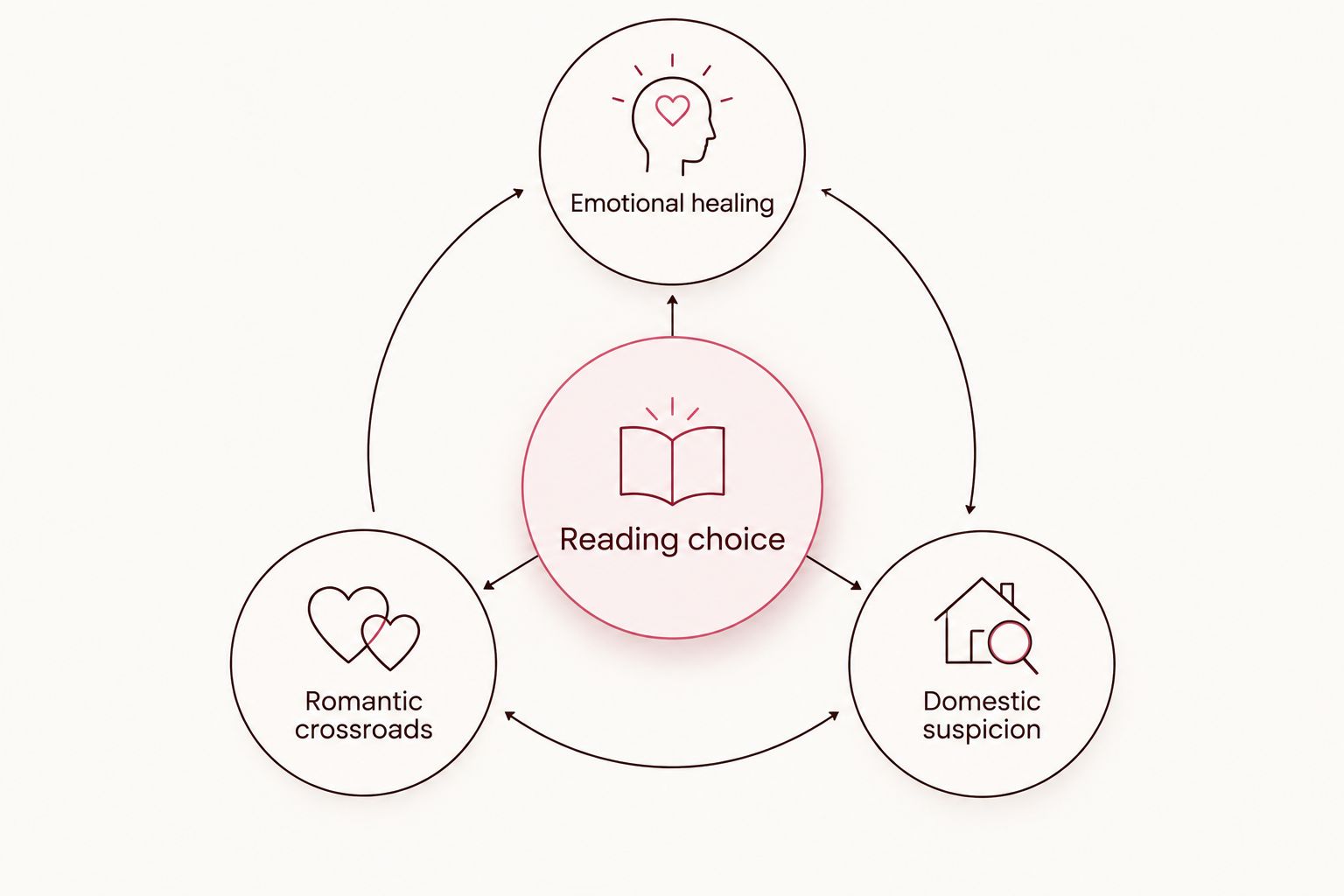
For your 2026 reading list, GetSimilarBooks offers a title-based alternative to collecting more author names. Enter a book you enjoyed for five hand-curated suggestions, then request the email-gated personalized list of 20–30 titles if you want a longer reading queue.
The advantage: You start from a specific book. The limitation: An author’s different novels can satisfy different needs, so the title you enter matters. GetSimilarBooks book recommendations are most useful here when you name the Hoover novel you want matched, not just Hoover herself.
Find your next read
Enter a title for five hand-curated suggestions, then request a personalized list of 20–30 books.
FAQ
What are the best books like Colleen Hoover?
Start with Archer’s Voice by Mia Sheridan for emotional intimacy, The Air He Breathes by Brittainy C. Cherry for grief-centered romance, or The Wives by Tarryn Fisher for domestic suspense. The right choice depends on which Hoover novel you want matched.
Which author should I read first after Colleen Hoover?
Mia Sheridan is the default choice on this shortlist for relationship-centered fiction. Start with Archer’s Voice if vulnerability and painful personal history matter more to you than thriller twists.
What should I read after Verity if I want another thriller?
Read The Wives by Tarryn Fisher for domestic suspicion and uncertainty inside a marriage. It is a psychological thriller, not a promise of a reassuring romance.
Which recommendation is best if I dislike love triangles?
Choose Archer’s Voice rather than One True Loves from this shortlist. One True Loves makes competing romantic attachments the central dilemma, so avoiding that element would mean avoiding its premise.
Are these Colleen Hoover read-alikes suitable for younger teens?
This shortlist is intended for adult readers, not as a younger-teen reading list. The recommendations include subjects such as abuse, bereavement, depression, and sexual content; check the individual book before choosing for a teen.
Is Before I Let Go a good choice for a second-chance romance?
Yes. Before I Let Go centers divorced parents whose shared family and business keep them connected. Choose it for reconciliation involving grief, mental health, and responsibilities beyond attraction.
How can I get a personalized reading list in 2026?
Enter a title you enjoyed into GetSimilarBooks for five hand-curated read-alike suggestions. You can also request an email-gated personalized list of 20–30 titles.
One last thing
A weak match often starts with an accurate but incomplete label: “emotional romance.” Before choosing your next book in 2026, finish this sentence: “I want another book that makes me feel ___, but without ___.”
“Attached to vulnerable characters, but without a love triangle” points toward Sheridan. “Suspicious of everyone, but without expecting a romance ending” points toward Fisher. That distinction does more work than adding another author to a list.
Related guides
- Books like Verity with romance at the center
- Books like Verity with unreliable narrators
- From a book recommendation quiz to a personalized list
Leave a Reply