How to find a book when you only remember the plot?

To find a book when you only remember the plot, search for its most distinctive scene, character role, and setting together, then check possible titles against a second detail. If that fails, take the same clues to a librarian or a book-identification community. Keep uncertain memories separate from facts so one mistaken detail does not rule out the right book.
- How to find a book when you only remember the plot: search distinctive events, then verify another detail.
- Google Books is useful for searching remembered wording; quotation marks belong around exact phrases only.
- A librarian or book-identification community needs concrete scenes, not just genre labels.
- GetSimilarBooks finds read-alikes from a known title; identify the forgotten book before requesting recommendations.
How to find a book when you only remember the plot?
Start with what happens, not what the book feels like. A character's unusual job, a specific object, or an unexpected event gives you a more useful search than a broad description such as an emotional thriller.
Identification and recommendation are different jobs. A similar books finder helps after you know a title; the steps below help recover the title itself.
- Write down one distinctive event. Describe an action: someone hides a manuscript, receives a message, or discovers a locked room. Use your actual memory, not these example events.
- Add a character role and setting. A translator on an island is more specific than a woman with a secret. Names help only when you remember them reliably.
- Run a plain-language search. Combine those clues with
novelorbook. Leave out uncertain details at first. - Change one clue at a time. Replace a doubtful occupation or setting rather than rewriting everything. This makes each result easier to assess.
- Verify a second independent detail. Check a publisher's description, a preview, or a library record before deciding you have found it.
Treat search results as candidates, not answers. A familiar cover or matching genre is a reason to investigate, not proof.
Why this matters
Plot memories are useful even when names disappear. The problem is turning a remembered reading experience into details that someone else can search.
If you finished Fourth Wing or Verity and want a similar feeling, you need recommendations. If you remember a different book with dragons or a hidden manuscript but cannot name it, you need identification. Searching for read-alikes too early mixes those tasks and leaves the original question unanswered.
For a 2026 search, record when you encountered the book separately from when you think it was published. Reading something recently does not mean it is a recent release.
Which search method fits the clues you remember?
Choose the method that matches your evidence. Use remembered wording for text searches and remembered events for plot searches. Neither method guarantees identification, so keep the verification step.
| Method | Best for | Useful feature | Main limitation |
|---|---|---|---|
| General web search | A distinctive event plus a character or place | Searches across descriptions, reviews, and discussions | Broad clues produce loosely related results |
| Google Books | A remembered phrase or unusual term | Searches book text where it is indexed | Searchable text does not cover every book or edition |
| Library catalog | A possible author, title fragment, or subject | Helps check bibliographic details | A vague scene is not a dependable catalog query |
| Librarian | Several clues that need sorting | Lets you explain uncertainty and answer follow-up questions | Identification still depends on finding a matching record or source |
| Book-identification community | An unusual scene you can describe clearly | Other readers can suggest titles from memory | Suggestions require independent checking |
| Personal reading records | A book you borrowed, bought, or saved | Narrows the search to your own activity | Records help only if they exist and remain accessible |
Do not use every method at once. Start with the strongest clue, then change methods when the clue calls for it. A remembered sentence deserves a text search; an uncertain cover color does not.
Build a clue sheet before you search again
Separate your notes into three groups. This keeps a guess from quietly becoming a requirement.
- Certain facts: events, objects, relationships, or settings you clearly remember.
- Possible details: names, occupations, ages, or locations you might have mixed up.
- Reading context: where you found the book, its format, and roughly when you encountered it.
Put an unusual action under certain facts only if you actually remember it. Put a guessed character name under possible details, even if the name feels familiar.
For your 2026 search notes, write down the edition or format if you know it. An audiobook memory gives you different clues from a paperback cover. Neither establishes the publication date.
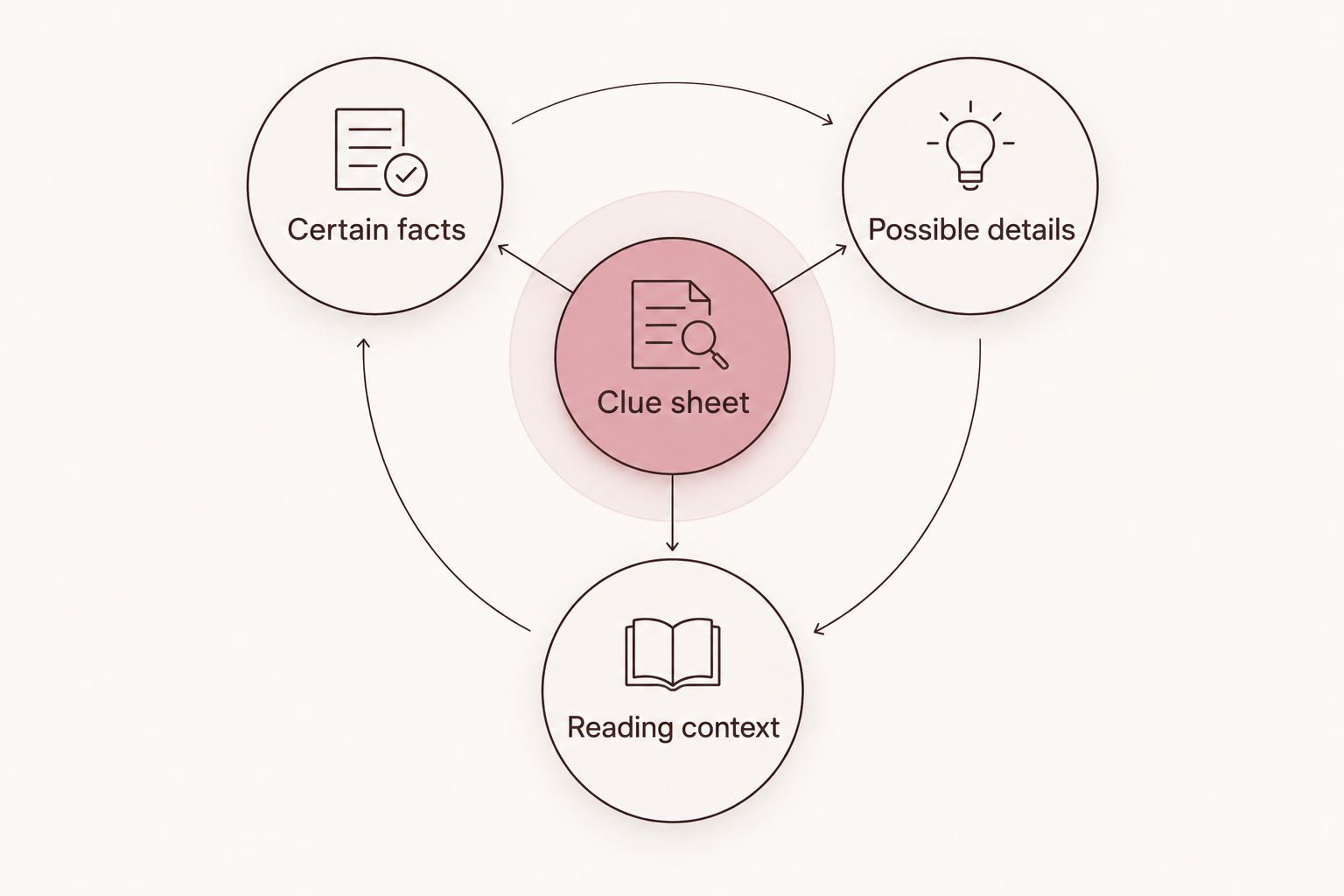
Your clue sheet should remain short enough to scan. Keep a separate space for rejected titles and the detail that ruled each one out. That prevents you from repeatedly investigating the same near-match.
Search the scene, then change the wording
Start with a compact combination: character role, unusual action, setting, and novel. You do not need a polished synopsis. You need searchable nouns and verbs.
For example, novel translator finds letters island is an illustrative query, not a claim about a particular book. Replace every element with something you remember. If the first search fails, remove the weakest detail before adding more.
Try these adjustments:
- Change a synonym. Search
boarding schoolafteracademy, ordiaryafterjournal, if both fit your memory. - Remove the genre. A book you remember as romance might be described elsewhere as suspense.
- Drop an uncertain name. A wrong name can distract from a distinctive scene.
- Search another scene. A secondary incident might be easier to distinguish than the premise.
- Try remembered wording separately. Do not bury a phrase inside a long plot description.
Quotation marks ask for exact wording. Use them when you remember the words themselves, not merely their meaning. If an exact-phrase search fails, remove the quotation marks and try the key terms.
Avoid adding 2026 unless you have a reason to restrict the results to that year. The date of your search is not evidence about the book.
How do you check whether a suggested title is right?
Confirm the plot, not just the atmosphere. Two books can share a remote house, a difficult marriage, and an unsettling tone without being the same story.
Start with the publisher's description or a library summary. Then check an available preview for an opening situation, character relationship, or scene you remember. Keep ending explanations out of the search unless the ending is your only useful clue.
Use a simple candidate record:
- Matching clue: the specific event or relationship that fits.
- Unresolved clue: the detail you still need to check.
- Contradiction: something that conflicts with a memory you consider certain.
A contradiction to a doubtful memory is not an automatic rejection. A contradiction to the central event deserves more attention. Return to the clue sheet before accepting or rejecting the title.
If another reader suggests a book, ask which part matches. A title without an explanation gives you little to verify.
Why finding a forgotten book varies
The useful search route depends on what survived in your memory. These factors determine which clues deserve attention:
- Distinctiveness: a specific event separates candidates better than a shared theme such as grief or betrayal.
- Confidence: a certain relationship is a stronger starting point than a guessed surname.
- Searchable wording: an exact phrase supports text searching; a general impression does not.
- Format: an audiobook, excerpt, or collected story can change where you need to look.
- Reading records: borrowing history or saved lists can provide a bounded set of candidates.
- Memory overlap: scenes from different books can end up in the same description, so test clues separately.
There is no useful fixed deadline for this process. For a 2026 search, keep a dated note of what you tried rather than repeating unsuccessful queries from memory.
What should you post when asking readers to identify a book?
Give readers a compact description with uncertainty clearly marked. Lead with the unusual scene, not a long explanation of how much you enjoyed the book.
Use this structure:
- Plot: describe the event or central problem you remember.
- Characters: give roles and relationships; mark uncertain names as uncertain.
- Setting: include place, time period, or an unusual location if known.
- Reading context: explain whether it was a print book, ebook, audiobook, or excerpt.
- Already checked: list rejected titles and why they did not fit.
Follow the community's posting rules. If the remembered scene contains a major twist, use its spoiler controls rather than putting the revelation in the heading. Return with the confirmed title when you find it.
Can you find a book if you remember only the cover?
A cover gives you a starting point, not a reliable identifier. Describe the objects and composition before the color: a person facing away on a bridge is more informative than a blue cover.
Combine the cover memory with a reading location or plot fragment. Different editions can use different artwork, so do not reject a strong plot match solely because the first cover you see looks unfamiliar.
What if you remember two books as one?
Search the strongest scenes separately. If different titles explain different parts of the memory, compare their descriptions before forcing every clue into a single candidate.
Check whether you read an anthology, an excerpt, or several books close together. Keep those possibilities separate from confirmed facts. They are ways to test the memory, not reasons to dismiss it.
Once you have the title, find the next book
Identification ends when the remembered details match. Recommendation begins with a different question: which part of that book do you want again?
GetSimilarBooks is best for fiction readers who know a title they enjoyed and want curated read-alikes. Enter a known title to receive five hand-curated suggestions. You can also request a free personalized list of 20–30 titles by providing an email address.
The limitation matters: GetSimilarBooks starts with a title, not an unidentified plot. Find the missing book first. Then decide whether you want its pacing, relationship dynamic, atmosphere, or setting repeated in your next read.
Find your next read
Start with a known title for five curated suggestions, then request a personalized list by email.
FAQ
How do I find a book when I only remember one scene?
Search the scene’s unusual action together with a character role and setting. Change one uncertain detail at a time, then check any suggested title against another remembered detail.
Can Google find a book from a plot description?
Google can return book descriptions, reviews, and discussions that match a plot description. Use concrete events rather than broad genre labels, and verify the suggested title separately.
Should I put my remembered plot in quotation marks?
Use quotation marks only for wording you remember exactly. A paraphrased plot belongs in a plain-language search because the same event can be described in different words.
Where can I ask someone to identify a forgotten book?
Ask a librarian or a book-identification community with a clear account of the scenes you remember. Include the format, reading context, uncertain details, and titles you have already ruled out.
Can I find a book without knowing the author or any character names?
You can search for a book using events, relationships, and setting without knowing names. Start with the detail that makes the story different from other books in its genre.
What if the suggested book has a different cover?
Check the plot before rejecting a book with a different cover. Editions can use different artwork, so cover appearance alone does not settle the identification.
Can GetSimilarBooks identify a book from its plot?
GetSimilarBooks is a title-based recommendation tool, not a plot-identification service. Once you know a title you enjoyed, it provides five hand-curated read-alike suggestions and an email-gated personalized list of 20–30 titles.
One last thing
Before another broad search, check your own trail. A library account, an old message, a saved sample, or a reading list might contain the title in plain sight.
For your next 2026 reading note, save the title beside one sentence about what made the book memorable. Record the detail you would search for later. A distinctive scene is easier to use than a star rating.
Related guides
- Book recommendation quiz to personalized list workflow
- How does a book recommendation quiz actually work?
- Books like Verity about writers and hidden manuscripts
Leave a Reply