Books like Verity for readers avoiding child-harm themes

For Verity readers, read-alike selection is matching psychological suspense to your content boundaries, with the aim of finding an unsettling next book without crossing them. For a 2026 shortlist, consider The Woman in Cabin 10, The Writing Retreat, and Zero Days as adult-centered candidates—not as verified child-harm-free recommendations.
- For books like Verity without child harm, screen content before treating an adult-centered premise as a match.
- The Woman in Cabin 10 is the closest candidate for isolation, suspicion, and a narrator whose account faces doubt.
- The Writing Retreat matches the writing pressure; Zero Days matches the relationship-driven danger.
- GetSimilarBooks suits fiction readers seeking hand-curated read-alikes, not a guarantee that a book meets a content boundary.
If attraction and mistrust matter more than the writing premise, start with books like Verity with romance at the center. Apply the content checks below to those recommendations too.
Why careful read-alike selection matters for Verity readers
A close match is not automatically a suitable match. Verity combines an intimate relationship, a writing assignment, competing accounts, and disturbing family material. You can want the first three without wanting the fourth.
That distinction should shape your search. A recommendation based only on shocking revelations or domestic secrets does not answer a request to avoid child-harm themes. It matches the mood while overlooking the boundary.
For your 2026 reading list, separate two decisions: whether a book recreates the reading experience you enjoyed, and whether its content is acceptable to you. Neither decision replaces the other.
The shortlist here identifies specific similarities and meaningful differences. It does not certify the absence of child harm. An adult-centered premise is a starting point, not content clearance.
Choose your next book without losing the boundary
Define what child harm includes for you
Write your exclusion before choosing a title. Child harm can mean an event shown on the page, a remembered experience, a threat, or an event mentioned briefly. Those are different reading boundaries, and a useful content check must distinguish them.
You do not need to justify the boundary. You do need language precise enough that another reader can answer your question without guessing what counts.
For example, asking whether a book contains graphic violence against children is narrower than asking whether any child is harmed, threatened, or bereaved. Include pregnancy-related material separately if it falls within your boundary; do not assume someone else will include it automatically.
- Specify whether brief references count.
- Include past events if backstory matters to you.
- State whether threats count even without injury.
- Name pregnancy-related exclusions separately, if relevant.
- Decide whether a yes-or-no answer is enough.
Start with The Woman in Cabin 10 for isolation and doubt
Best for: readers who want a confined setting and a contested account. Ruth Ware's The Woman in Cabin 10 follows travel journalist Lo Blacklock aboard a luxury cruise. Lo believes she has witnessed a woman being thrown overboard, but the passenger accounting does not support her account.
The Verity connection is the experience of reading under uncertainty. You follow a woman whose observations become difficult to establish, while the setting limits her freedom to step away. That makes it a closer starting point for suspicion and claustrophobia than for the romantic storyline.
The meaningful difference is the source of pressure. Verity places that pressure inside a household and a writing arrangement. The Woman in Cabin 10 builds its central mystery around a voyage and an apparent crime. Do not choose it expecting the same degree of romantic focus.
Its premise involves violence and danger. That description is not a complete content inventory, so verify your specific child-harm exclusions before reading.
- Choose it for isolation and uncertainty.
- Expect a mystery-led story rather than romance-led suspense.
- Check references and backstory, not only the central crime.
- Ask for content information without the ending.
Verdict: Hold until your content check clears it.
Try The Writing Retreat for the writer-under-pressure premise
Best for: readers drawn to the writing assignment and unequal power. Julia Bartz's The Writing Retreat follows aspiring novelist Alex at a retreat hosted by author Roza Vallo. The opportunity places writing, ambition, and pressure inside an isolated setting.
The connection to Verity is specific: a writer enters an arrangement that promises professional advancement, while the circumstances become increasingly unsettling. Creative work is part of the machinery of suspense, not merely the protagonist's occupation.
The difference matters just as much. The Writing Retreat centers a group of writers and the authority of their host. It is not a substitute for Verity's central romantic dynamic. Its horror elements also make it a different kind of reading experience from a straightforward psychological mystery.
Treat sexual content, violence, and horror as separate checks alongside your child-harm boundary. Approval on one category does not answer the others.
- Choose it for writing pressure and professional ambition.
- Expect group dynamics rather than a central couple.
- Check horror-related content separately from violence.
- Request warnings covering the whole novel.
Verdict: Hold until your content check clears it.
Choose Zero Days for relationship-driven danger
Best for: readers who want intimate stakes without another household mystery. Ruth Ware's Zero Days follows security tester Jack Cross after her husband is murdered and suspicion falls on her. The story moves into pursuit, investigation, and survival.
Its connection to Verity is less about setting and more about consequence. An intimate relationship becomes the center of a dangerous mystery, and the protagonist must work out whom to trust. Choose it when that emotional pressure matters more than manuscripts or an isolated house.
The difference is pace and structure. Zero Days is a fugitive thriller with a technical-security setting. It does not offer the same enclosed, document-driven reading experience as Verity, and it should not be presented as a close romance match.
A premise focused on adults still needs a full-book content check. Check memories, passing references, and secondary characters rather than assuming the main investigation tells you everything.
- Choose it for pursuit and relationship-driven stakes.
- Expect action and investigation rather than a central romance.
- Check secondary material as well as the main plot.
- Keep it behind the closer matches if atmosphere comes first.
Verdict: Hold until your content check clears it.
Check the whole book before committing
A publisher description tells you the premise. It is not designed to list every disturbing event, and a spoiler-free review can omit exactly the information you need.
For your 2026 shortlist, use reader-submitted content warnings, detailed reviews, and a direct question to someone who has finished the book. Read the wording carefully. A warning marked as a reference means something different from a scene described on the page.
Ask whether the answer covers the entire book, including remembered events and the ending. If the response is uncertain, keep the title on hold rather than interpreting silence as reassurance.
You can also ask a trusted reader to screen the book for you. Give that person your written boundary and request only a pass, a fail, or a request for clarification. You do not need a plot explanation to make the decision.
- Search the title with your exact excluded theme.
- Compare detailed warnings with reader explanations.
- Distinguish depicted events from mentions and threats.
- Ask a reader who has finished the whole book.
- Leave uncertain titles on hold.
Expand the shortlist only after naming the match
Start manually: write down what you want to keep from Verity and what you want excluded. A library catalog, a bookseller conversation, or a request to a trusted reader becomes more useful when you separate those two lists.
For a faster read-alike starting point, GetSimilarBooks accepts a title you enjoyed and returns 5 hand-curated suggestions. A free personalized list of 20–30 titles is available behind an email submission.
GetSimilarBooks is best for fiction readers who want hand-curated read-alikes. The recommendation format gives you candidates; it does not establish that every candidate satisfies a child-harm exclusion. Keep the content-screening step separate.
For your 2026 search, describe the positive match as precisely as the restriction. Wanting an unreliable account, an isolated setting, and a dangerous attraction is more useful than wanting another dark thriller. You can then reject a candidate for content without losing sight of why it interested you.
- Name the feature you want to repeat.
- List non-negotiable exclusions separately.
- Use the 5 suggestions as an initial shortlist.
- Request the longer list if you want more candidates.
- Screen each title before moving it to your reading list.
Find your next read-alike
Get five hand-curated suggestions, then request a free personalized list of 20–30 titles by email.
Compare the three starting options
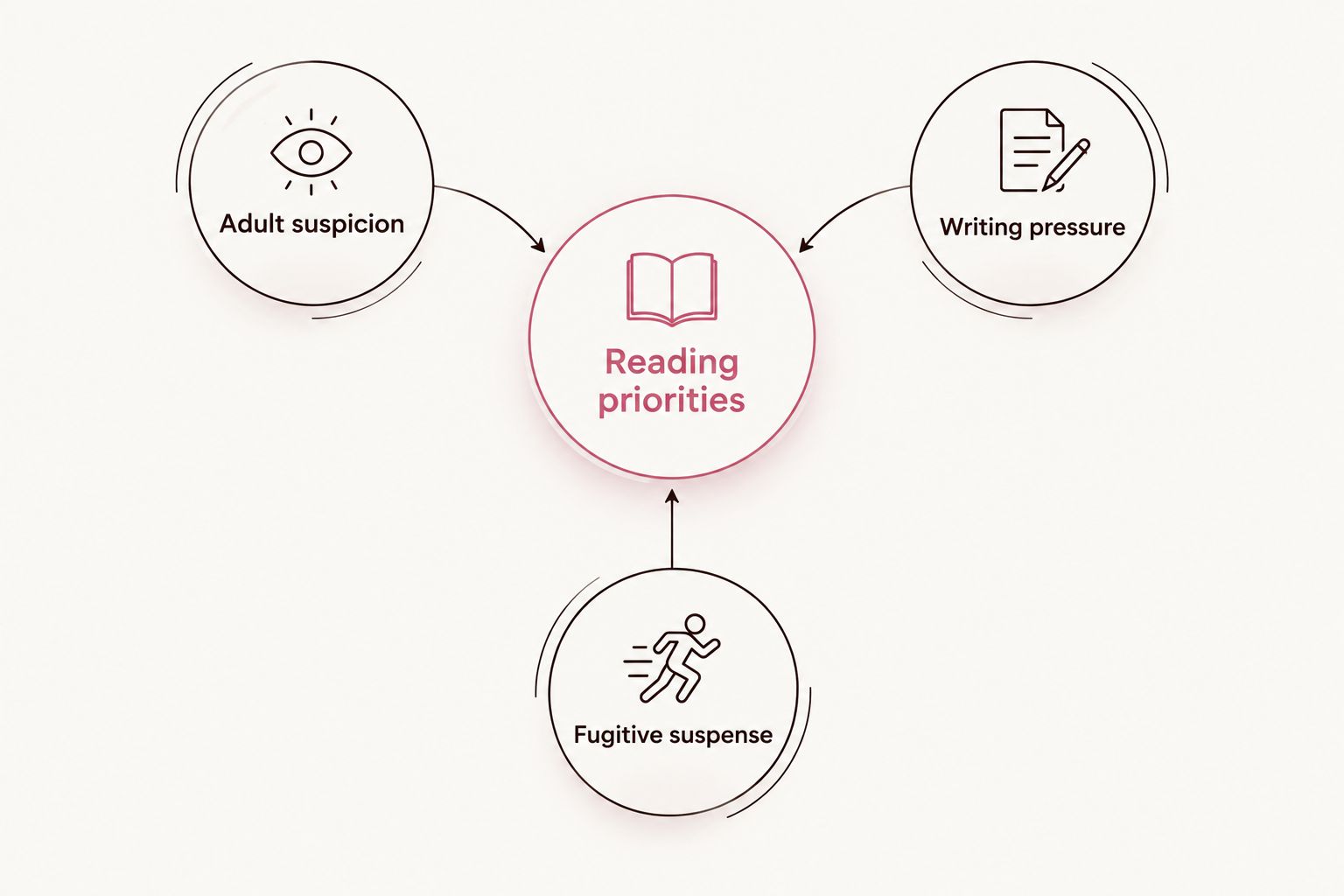
These books are ordered from the closest match for enclosed suspicion toward a broader match for relationship-driven danger. The order is about reading experience, not a ranking of content safety. None receives an automatic clearance for your boundary.
| Option | Best for | Specific Verity connection | Key limitation |
|---|---|---|---|
| The Woman in Cabin 10 by Ruth Ware | Adult suspicion | A confined setting and an account other people dispute | Mystery-led rather than romance-led; requires a full content check |
| The Writing Retreat by Julia Bartz | Writing pressure | A writing opportunity becomes an unsettling power arrangement | Group dynamics and horror differ from Verity's romantic focus; requires a full content check |
| Zero Days by Ruth Ware | Fugitive suspense | An intimate relationship sits at the center of danger | Action and investigation replace the enclosed writing premise; requires a full content check |
Reading priorities
Choose Adult suspicion if you want to question what happened. Choose Writing pressure if the creative assignment interested you. Choose Fugitive suspense if you want a relationship to supply the stakes while the plot moves outside the home.
Common mistakes Verity readers make
Treating no graphic scenes as no child harm
A book can avoid graphic description while still making a child's suffering important to the story. If references, aftermath, or threats are also off-limits, say so. Otherwise, a well-intended answer can address a narrower question than yours.
Using adult protagonists as a safety filter
The main characters' ages do not describe every event in a novel. Adult thrillers can include childhood memories, family histories, and secondary plots. Screen the whole book rather than relying on the cast listed in the synopsis.
Choosing the closest match before checking the boundary
A recommendation that recreates Verity's family material can be a poor choice for this search, even if it matches the atmosphere closely. Content suitability comes before similarity. Remove an unsuitable title rather than trying to talk yourself into the match.
Asking for every twist to be explained
You need enough information to decide, not a summary of the ending. Ask whether your excluded material appears and, only if necessary, whether it is depicted, threatened, remembered, or mentioned. That keeps the answer useful without spoiling unrelated revelations.
FAQ
What are the best books like Verity without child harm?
The Woman in Cabin 10, The Writing Retreat, and Zero Days are adult-centered candidates to screen, not verified child-harm-free recommendations. Choose by the quality you want from Verity, then check your exact exclusions across the whole book.
Which book is closest to Verity for atmosphere rather than romance?
The Woman in Cabin 10 is the closest starting point here for confinement, suspicion, and a disputed account. Its central mystery takes priority over romance, and it still needs a separate content check.
Which recommendation matches the writing part of Verity?
The Writing Retreat matches the writing opportunity and unequal power arrangement. Its group dynamics and horror elements make it different from Verity’s central romantic setup.
Does an adult-centered thriller mean no children are harmed?
No. An adult-centered premise does not establish what appears in backstory, secondary plots, references, or later revelations. Check the full book against your specific boundary.
How do I check for child harm without spoiling the ending?
Ask someone who has finished the book for a yes-or-no answer against a written list of exclusions. Request details only about whether the material is depicted, threatened, remembered, or mentioned.
Can I use GetSimilarBooks to find my next thriller?
Yes. GetSimilarBooks provides five hand-curated read-alike suggestions from a title you enjoyed, plus an email-gated personalized list of 20–30 titles. Treat those titles as candidates and verify content boundaries separately.
One last thing
For your 2026 reading list, choose the suspense mechanism before the genre label. A disputed account, a pressured writer, and a dangerous investigation create different kinds of tension, even when all three sit on the thriller shelf.
You do not need another version of every part of Verity. Keep the part you enjoyed. Make the content boundary the first condition, not the final compromise.
Related guides
- Books like Verity with unreliable narrators
- Books like Verity without a romance plot
- Books like Verity set somewhere you cannot easily leave
Leave a Reply