Books like Verity with endings open to interpretation

Best overall: My Cousin Rachel by Daphne du Maurier. Best for competing accounts: A Head Full of Ghosts by Paul Tremblay. Best for supernatural uncertainty: The Turn of the Screw by Henry James. These books like Verity with ambiguous endings leave you weighing evidence rather than simply waiting for a final twist.
- My Cousin Rachel leads these books like Verity with ambiguous endings: attraction and suspicion make the same evidence look different.
- A Head Full of Ghosts suits readers who want competing accounts, family tension, and uncertainty about what to believe.
- The Turn of the Screw prioritizes supernatural uncertainty; Rebecca offers moral ambiguity rather than an equally unresolved mystery.
- GetSimilarBooks offers five hand-curated read-alikes, with an email-gated personalized list of 20–30 titles for readers seeking more.
An ambiguous ending is not the same as an unexplained twist. This 2026 shortlist favors books that give you reasons to argue with your own interpretation. If you want recommendations built around a title you already enjoyed, Getsimilarbooks starts with five hand-curated suggestions.
Why this matters
Verity makes you reconsider the relationship between a written account, a person's behavior, and your willingness to believe either. The useful match is not simply another thriller with a shocking last chapter. It is a book in which the evidence stays uncomfortable after the action ends.
My Cousin Rachel is the best next read for Verity readers who want attraction to interfere with judgment. It puts uncertainty inside the relationship rather than saving all its work for a closing reveal.
The five recommendations below move from intimate suspicion toward supernatural uncertainty and, finally, moral unease. They do not all reproduce Verity's romance or sexual content. That difference matters as much as the match.
What makes the best ambiguous-ending read-alike?
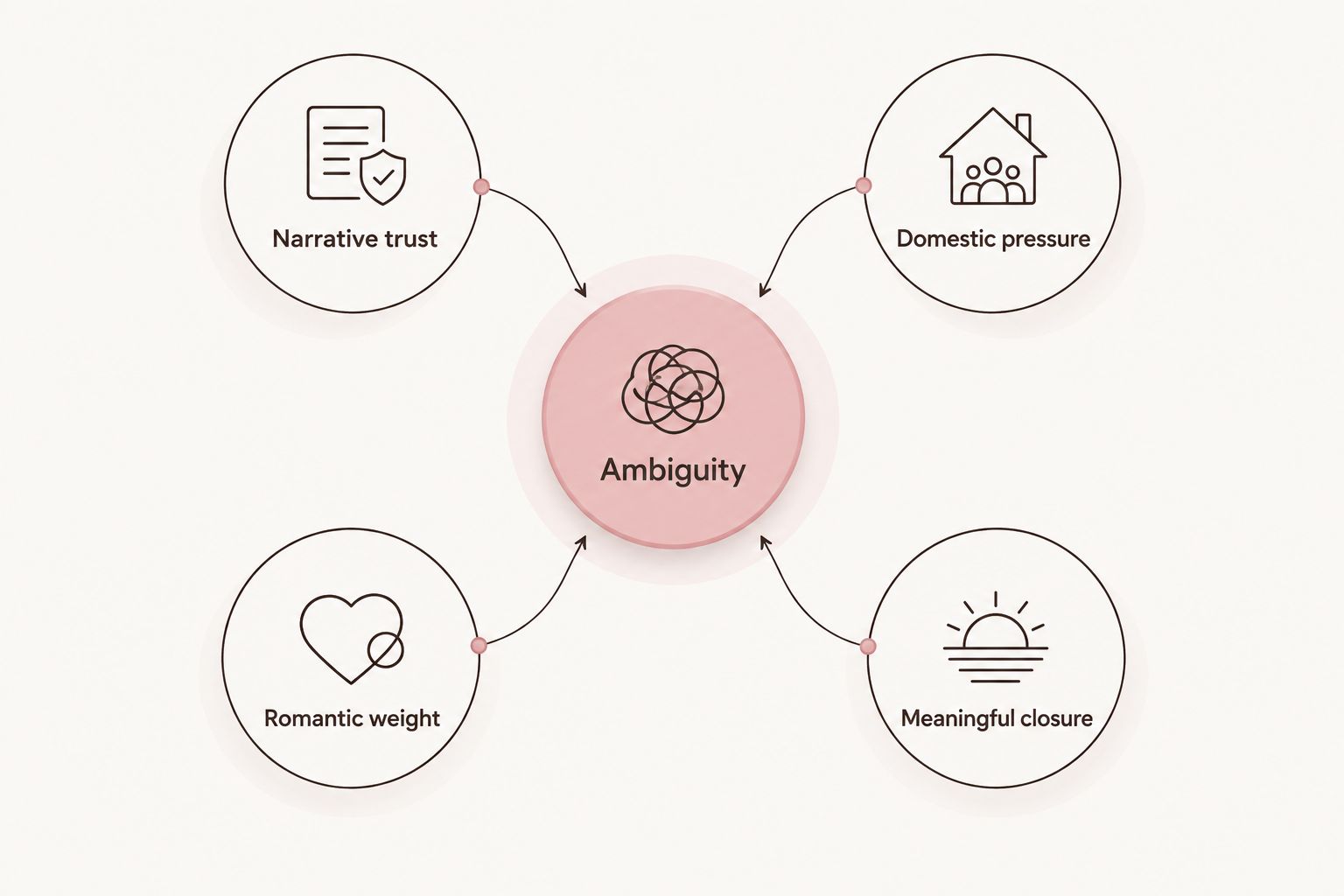
For this 2026 reading list, the ranking rests on five qualities:
- Ambiguity: More than one interpretation has support in the text. Missing information alone is not enough.
- Narrative trust: The person telling the story has limits, interests, or emotional blind spots you must consider.
- Domestic pressure: A household or family relationship makes uncertainty difficult to escape.
- Romantic weight: Attraction changes judgment rather than appearing as an unrelated subplot.
- Meaningful closure: The story reaches an ending even when its meaning remains unsettled.
These criteria separate a close read-alike from a book that merely shares a thriller label. A novel can match Verity's distrust while offering very little romance. Another can match its relationship tension but settle more of the factual mystery.
Books like Verity at a glance
The table distinguishes the kind of uncertainty each book offers. Choose the question you want to keep thinking about, not just the setting you recognize.
| Book | Best for | Standout matching quality | Key limitation |
|---|---|---|---|
| My Cousin Rachel — Daphne du Maurier | Attraction tangled with suspicion | Intimate judgment shaped by desire and incomplete evidence | Historical pacing; not a contemporary romantic thriller |
| A Head Full of Ghosts — Paul Tremblay | Competing accounts | Family experience filtered through memory, media, and interpretation | Horror takes priority over romance |
| The Turn of the Screw — Henry James | Supernatural uncertainty | An account that invites conflicting readings | Dense prose and little romantic payoff |
| The Haunting of Hill House — Shirley Jackson | Psychological and supernatural overlap | A house's influence intertwined with a character's perceptions | Atmosphere matters more than investigation |
| Rebecca — Daphne du Maurier | Moral unease within a marriage | Intimacy changes how readers judge troubling information | More factual resolution than the other picks |
1. My Cousin Rachel: best for attraction tangled with suspicion
Daphne du Maurier's My Cousin Rachel follows Philip Ashley as he tries to judge a woman already surrounded by suspicion. His response to Rachel becomes inseparable from his feelings about her. You have to assess the evidence and the person interpreting it.
That is the closest match to Verity here. Desire does not sit beside the mystery; it changes what looks persuasive. A gesture that seems reassuring under one reading becomes troubling under another.
The difference is the book's historical setting and patient development. Expect sustained doubt rather than a contemporary thriller's sequence of urgent reversals. Its uncertainty asks you to examine judgment, not decode a hidden answer from a single clue.
My Cousin Rachel pros:
- Attraction directly affects the narrator's assessment of evidence.
- Domestic intimacy makes suspicion personal rather than abstract.
- The unresolved question remains central to the reading experience.
My Cousin Rachel cons:
- The pace is measured rather than breathless.
- Readers seeking Verity's explicit sexual content will find a different register.
Best for: Readers who want to finish a book and immediately reconsider whether they trusted the right person.
Verdict: Read My Cousin Rachel first. It is the default choice on this 2026 list when romantic fixation and uncertain guilt matter equally.
2. A Head Full of Ghosts: best for competing accounts
Paul Tremblay's A Head Full of Ghosts centers on a family whose distress becomes the subject of a reality television production about an apparent possession. Retrospective storytelling and commentary complicate how that experience reaches you. The telling is part of the problem.
For a Verity reader, the match is the tension between a convincing account and the reasons to distrust it. Different ways of describing the same family produce different judgments. Public spectacle adds another layer: what makes a compelling story is not necessarily what establishes the truth.
This is horror, not a romance-led thriller. Its family relationships carry the emotional pressure, and its disturbing material is not limited to an eerie atmosphere. Brief content note: child endangerment, family trauma, and religious horror.
A Head Full of Ghosts pros:
- Competing interpretive frames give you something concrete to weigh.
- Family vulnerability keeps the uncertainty emotionally consequential.
- The narrative's construction rewards attention to who controls an account.
A Head Full of Ghosts cons:
- Romance is not the reason to choose it.
- Its commentary on horror and media interrupts a purely immersive reading experience.
Best for: Readers whose favorite part of Verity was deciding which version of events deserved belief.
Verdict: Read A Head Full of Ghosts for a dispute about evidence, not a replacement love story. It is the strongest contemporary horror fit on this shortlist.
3. The Turn of the Screw: best for supernatural uncertainty
Henry James's The Turn of the Screw places a governess in charge of children at an isolated country estate. Her account of disturbing events gives readers the central problem: how should her perceptions be understood? The narration offers no neutral vantage point from which to settle everything.
The connection to Verity is structural. You receive a powerful account from someone whose interpretation requires scrutiny, while the household's intimacy raises the stakes. The story makes reading itself an act of judgment.
The meaningful difference is the prose. James works through elaborate sentences, implication, and qualification rather than contemporary thriller momentum. Treating the novella as a race toward an explanation misses much of its effect.
The Turn of the Screw pros:
- The narrator's perspective is essential to the uncertainty.
- The confined household creates sustained pressure.
- Supernatural and psychological readings give discussion a clear focus.
The Turn of the Screw cons:
- The language demands more concentration than Verity's.
- Romantic tension does not deliver a conventional romance arc.
Best for: Readers who want to debate what an apparently authoritative narrator can actually establish.
Verdict: Read The Turn of the Screw if uncertainty matters more than speed. For your 2026 reading queue, choose it when you want a short work to read slowly, not a quick stylistic substitute for Colleen Hoover.
4. The Haunting of Hill House: best for psychological overlap
Shirley Jackson's The Haunting of Hill House brings Eleanor Vance into a group investigating a reputedly haunted house. The house's atmosphere and Eleanor's need for connection become difficult to separate. The result is uncertainty rooted in perception and belonging.
The Verity connection is the way an enclosed domestic space changes your confidence in what you are reading. A house becomes more than a backdrop. Emotional need influences how threatening or welcoming an encounter feels.
The difference is its center of gravity. Hill House is not organized around an erotic relationship or a competing written confession. It asks you to attend to loneliness, group dynamics, and the boundary between a hostile environment and a vulnerable mind.
The Haunting of Hill House pros:
- Psychological tension and supernatural unease reinforce each other.
- Eleanor's emotional investment makes interpretation matter.
- The setting contributes directly to the uncertainty.
The Haunting of Hill House cons:
- Romance is peripheral to the reading experience.
- Readers wanting a clue-by-clue investigation will find atmosphere instead.
Best for: Readers who want a disturbing house and a perspective they cannot treat as a transparent window.
Verdict: Read The Haunting of Hill House for lingering interpretive unease. Skip it as your immediate next choice if the romantic relationship was the main reason you enjoyed Verity.
5. Rebecca: best for moral ambiguity within a marriage
Daphne du Maurier's Rebecca follows an unnamed narrator who marries Maxim de Winter and enters a household still shaped by his first wife. Her insecurity influences what she notices and what she believes. Marriage does not give her a secure understanding of the person beside her.
The match to Verity is intimate and domestic: attraction, comparison, and loyalty complicate judgment. Rebecca is especially useful if your question is not just what happened, but what love encourages a person to excuse.
The qualification matters: Rebecca resolves more of its factual mystery than the other books here. Its place on this list rests on moral uncertainty and the implications of its ending, not an equally balanced set of explanations for every event.
Rebecca pros:
- The marriage carries the psychological tension.
- The narrator's insecurity shapes your access to the household.
- Troubling information changes the meaning of intimacy and loyalty.
Rebecca cons:
- It is a weaker match for readers demanding an unresolved factual mystery.
- Its suspense develops through atmosphere and social discomfort rather than constant twists.
Best for: Readers who want to question a relationship's meaning after learning more about it.
Verdict: Read Rebecca for moral unease; wait if factual ambiguity is non-negotiable. It is the outward reach of this ranking, not the closest substitute.
How these books are ranked
This ranking puts the match ahead of the shared genre. My Cousin Rachel leads because attraction and uncertain judgment work together. A Head Full of Ghosts follows because competing accounts drive its uncertainty, despite the move away from romance.
The Turn of the Screw and The Haunting of Hill House shift the question toward perception and the supernatural. Rebecca comes last because its moral aftertaste fits better than its degree of factual openness.
No ranking can tell you which interpretation to adopt. This one tells you which kind of unresolved question each book asks you to carry.
Which book should you choose?
Choose My Cousin Rachel if you want one answer. It preserves the connection between attraction, suspicion, and uncertain guilt without copying Verity's plot.
Choose A Head Full of Ghosts if accounts and counteraccounts interest you more than romance. Choose The Turn of the Screw if you want your confidence in a narrator to become the central problem. Keep Rebecca for the moment when moral discomfort matters more than an unresolved explanation.
For a personalized 2026 reading list, GetSimilarBooks lets you start with a title you enjoyed. Five hand-curated suggestions form the preview; the personalized list of 20–30 titles requires an email address.
Find your next read
Start with a book you enjoyed. Get five hand-curated suggestions, then request a personalized list by email.
FAQ
What’s the best book like Verity with an ambiguous ending?
My Cousin Rachel by Daphne du Maurier is the best fit when you want attraction, suspicion, and uncertain judgment together. Its narrator’s feelings affect how evidence is understood, making the relationship central to the ambiguity.
Which of these books has romance closest to Verity?
My Cousin Rachel most closely connects attraction with the central uncertainty. Rebecca also makes a relationship central, but it offers more factual resolution and leaves more of its unease in questions of loyalty and judgment.
Is Rebecca’s ending really ambiguous?
Rebecca is a qualified fit: its moral implications are more open than much of its factual mystery. Choose it for troubling questions about marriage and loyalty, not because it leaves every explanation equally plausible.
What should I read if I liked Verity’s conflicting accounts?
Read A Head Full of Ghosts by Paul Tremblay if conflicting accounts were your main interest. Memory, media, and retrospective interpretation complicate how a family’s experience is presented; romance is not its focus.
Are these recommendations spoiler-free?
The recommendations describe premises and the kind of uncertainty each book creates without revealing its resolution. They avoid identifying which interpretation to believe or disclosing the events that produce the ending.
Which recommendation should I choose if I don’t want much romance?
Choose The Turn of the Screw for narrator-centered uncertainty or The Haunting of Hill House for psychological and supernatural overlap. Neither is a romance-led substitute for Verity.
How does GetSimilarBooks help me choose another book?
GetSimilarBooks lets you enter a title you enjoyed and receive five hand-curated read-alike suggestions. An email-gated personalized list offers 20–30 titles for readers who want more choices.
One last thing
Before reading, write down the question you want the ending to leave open: What happened, whom should I believe, or what should I forgive? Those are different reading experiences. A recommendation that answers the wrong question will disappoint even when the atmosphere feels familiar.
After reading, separate an event you know occurred from a motive you inferred. That small distinction makes a second interpretation easier to evaluate without turning every unresolved detail into a secret clue.
Related guides
- Books like Verity with unreliable narrators
- Books like Verity with romance at the center
- Books like Verity without a romance plot
- Five unsettling reads ranked by their fit with Verity
Leave a Reply