Can AI recommend books as well as a human curator?

AI can recommend books you enjoy, but that does not establish that it matches a human curator across readers and reading needs. For your next read in 2026, judge either source by the same standard: a specific reason the book fits, an honest difference, and respect for what you want to avoid.
- Can AI recommend books as well as a human curator? Judge individual read-alikes, not the method alone.
- GetSimilarBooks offers five hand-curated book recommendations from a title you enjoyed.
- Fourth Wing readers should distinguish dragon bonds, romantic tension, and deadly training before choosing another fantasy.
- Verity readers should separate unsettling relationships from unreliable narration when choosing another thriller.
Can AI recommend books as well as a human curator?
A useful recommendation explains both the match and the mismatch. Neither a conversational answer nor a human-curated label replaces that explanation. A list of familiar titles is a starting point, not evidence that the books suit you.
If you finished Fourth Wing, asking for another fantasy romance leaves the central question unanswered. Did you want the dragons, the dangerous training, the attraction between adversaries, or less explicit romance? A focused request for books like Fourth Wing with less spice gives the recommendation a boundary you can actually check.
For a 2026 reading list, compare the methods by what you need them to do, rather than assuming either method wins every task.
| Recommendation source | Best for | Useful feature | Limitation to check |
|---|---|---|---|
| Conversational AI | Readers who want to revise a request through conversation | You can state preferences, reject suggestions, and request a different direction | Check titles, authors, and claimed book details; fluent wording is not verification |
| Human curator | Readers who want a selection with an editorial reason behind it | A curator can explain why a particular similarity matters | One person's interpretation of a book does not guarantee agreement with your taste |
The distinction is not that people understand books and software only recognizes labels. That is too simple. The practical question is whether the recommendation survives scrutiny once you ask what, exactly, makes the next book right for you.
Why this matters
A shared genre does not promise a shared reading experience. Two fantasy romances can differ sharply in pacing, explicit content, setting, and how much attention the central relationship receives.
The same problem appears after Verity. Another thriller might supply danger without the uncomfortable intimacy you wanted. A gothic novel might deliver that intimacy but move more slowly than you prefer.
Choosing your next book becomes easier when you separate what the book contains from what kept you reading. Dragons are a feature. Attachment to a dangerous creature is a relationship. Those lead to overlapping, but different, recommendations.
What should a good recommendation explain?
Use three checks before accepting a suggested title. These checks work whether the suggestion comes from a chatbot, a bookseller, a friend, or a curated reading list.
- Name the match. Ask for the reading quality you want repeated: competitive training, romantic distrust, a threatening household, or uncertainty about whose account to believe.
- Name the difference. Ask what changes: the setting, the pace, the role of romance, or the degree of fantasy. The difference should help you decide, not merely fill a sentence.
- Check the boundary. Confirm anything that would make you stop reading. That includes explicit sexual content, particular distressing themes, and whether you want a standalone story.
A recommendation that passes only the first check is incomplete. It tells you why a book belongs on the list without telling you why you might put it back.
You do not need an elaborate scoring system. Write down one must-have quality and one dealbreaker. If the explanation cannot address both, keep looking before committing to the book.
After Fourth Wing: choose the part you want repeated
If you finished Fourth Wing, start with the relationship between danger and attachment. Decide whether the romance must remain central or whether the threatening training environment matters more.
The following recommendations move from a closer romantic competition match toward a more specific match for the school setting. They are reading judgments, not claims that either title reproduces the whole experience.
| Book | Best for | Specific match | Meaningful difference |
|---|---|---|---|
| The Serpent and the Wings of Night by Carissa Broadbent | Readers prioritizing romance under deadly competitive pressure | Attraction develops alongside a dangerous contest and uncertain trust | Vampires and a tournament replace dragon-rider training |
| A Deadly Education by Naomi Novik | Readers prioritizing survival inside a dangerous school | Students face lethal threats while forming difficult alliances | The school and survival problem take more space than the romance |
The Serpent and the Wings of Night: romance under pressure
The Serpent and the Wings of Night is the closer starting point here if attraction under dangerous conditions kept you reading Fourth Wing. Its contest makes trust consequential rather than merely a matter of romantic preference.
Best for: readers who want romance tied to survival and competition. The trade-off is substantial: this is not another account of learning to bond with and ride dragons. If the creature relationship was your favorite element, the shared danger is not enough by itself.
Content note: violence and explicit sexual content. Verdict: Choose it for romantic danger, not for another dragon-rider story.
A Deadly Education: the school is the threat
A Deadly Education is the next choice if the training environment mattered more than the romantic storyline. Its dangerous school makes daily survival a central concern, and alliances have practical consequences.
Best for: readers drawn to hostile institutions, difficult friendships, and a sharp narrative voice. The difference is its balance: do not choose it expecting the same emphasis on romance as Fourth Wing.
Content note: violence and threats involving students. Verdict: Choose it for survival at school; skip it if central romance is nonnegotiable.
These recommendations illustrate why “more like this” needs an explanation. One preserves the connection between attraction and peril. The other preserves the pressure of an education that can kill you. Neither promises the same book again.
After Verity: separate intimacy from uncertainty
If you finished Verity, decide whether you want another invasive domestic situation or another story organized around manipulation. Those are related pleasures, but they are not interchangeable.
The order below starts with a more direct domestic-suspense direction, then moves toward a slower gothic alternative. Neither description reveals a major twist.
| Book | Best for | Specific match | Meaningful difference |
|---|---|---|---|
| The Last Mrs. Parrish by Liv Constantine | Readers wanting manipulation inside a wealthy household | Envy, access, and calculated relationships shape the suspense | Social ambition matters more than a writer discovering a manuscript |
| Rebecca by Daphne du Maurier | Readers wanting an unsettling house and intimate uncertainty | A relationship is shadowed by another woman's presence | Gothic atmosphere and gradual unease replace a contemporary thriller's pace |
The Last Mrs. Parrish: calculated domestic suspense
The Last Mrs. Parrish is the more direct starting point here if you want domestic suspense built around intrusion and manipulation. The attraction is watching access to a private life become a source of danger.
Best for: readers who want calculated behavior, wealthy-household tension, and relationships that reward suspicion. The difference is the engine of the story: social ambition drives the setup, rather than the discovery of another writer's work.
Content note: domestic abuse and sexual violence. Verdict: Choose it for calculated domestic tension, not for the manuscript premise.
Rebecca: an intimate gothic alternative
Rebecca is the outward step if the unsettling home and psychological pressure mattered more than rapid developments. Its narrator enters a marriage and a household already shaped by someone else's history.
Best for: readers who want atmosphere, insecurity, and uncertainty within an intimate relationship. The difference is pace and narrative texture. Expect a gothic novel, not a contemporary imitation of Verity.
Content note: psychological cruelty and death. Verdict: Choose it for sustained unease; skip it when you want immediate thriller momentum.
A recommendation can be a strong thematic match and still be the wrong choice tonight. Wanting a faster book is a real preference, not a failure to appreciate the alternative.
Why recommendation quality varies
The useful distinction is not simply automated versus human. These factors determine whether an explanation helps you choose:
- Starting title: A title establishes a reference point, but it does not reveal which part you enjoyed.
- Reading priority: Romantic tension, worldbuilding, voice, and pace point toward different next books.
- Content boundaries: Less explicit romance is a different request from no romance. State the distinction.
- Comparison detail: A named similarity is useful only when the accompanying difference is equally clear.
- Feedback: Explaining why you rejected a suggestion makes your next request more precise.
For your 2026 reading choices, make the reason for rejection concrete. “Too much explanation before anything happens” gives a recommender more direction than “I didn't connect with it.” So does “I liked the suspicion, but not the explicit content.”
How can you compare both methods fairly?
Give both sources the same short brief. Otherwise, you are comparing different requests rather than different recommendation methods.
For a Fourth Wing follow-up, ask for fantasy with dangerous training, an important central romance, and less explicit sexual content. Request a specific match and a meaningful difference for every suggestion. If dragon bonds are essential, say so before receiving the list.
For a Verity follow-up, ask for intimate psychological suspense with a threatening domestic atmosphere. Specify whether romance belongs at the center. Ask for spoiler-free reasons, not a description of the ending.
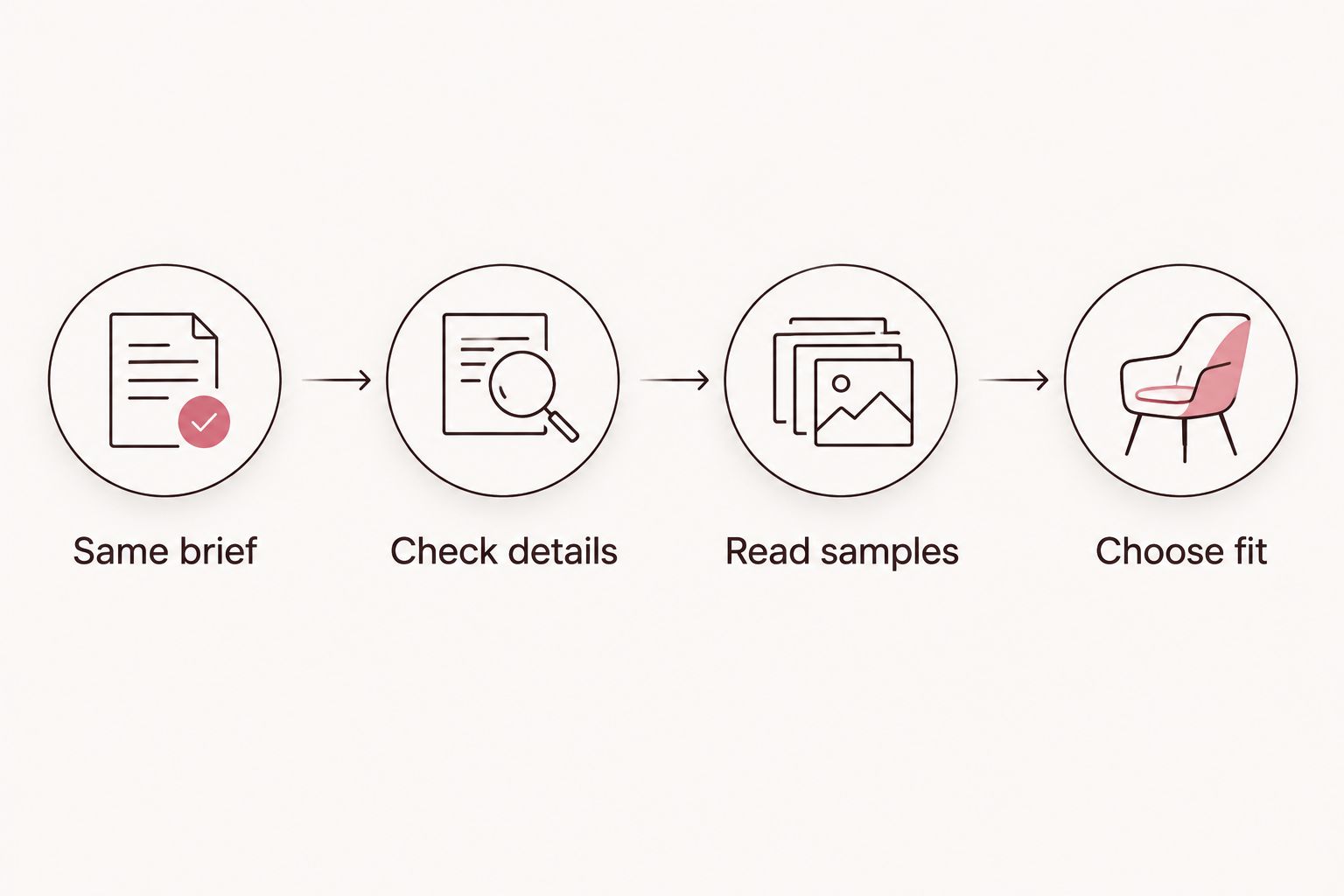
Use this comparison sequence for your 2026 shortlist:
- Same brief: Keep the starting title and preferences identical.
- Check details: Confirm the title, author, and any decisive content claim.
- Read samples: Compare your response to the actual prose.
- Choose fit: Pick the book that meets your priorities, regardless of its source.
The reading sample matters because an accurate description cannot reproduce the experience of a narrative voice. A premise can sound right while the sentences feel wrong for you.
When does a curated list make sense?
GetSimilarBooks is best for avid fiction readers who want hand-curated read-alikes from a book they already enjoyed. Entering a title returns five suggestions; an email-gated personalized list extends that to 20–30 titles.
The benefit is a defined starting point rather than an open-ended request. The limitation is equally clear: five suggestions remain a selection, not a guarantee of personal agreement. A longer list gives you more titles to consider, not proof that every title fits.
You can request GetSimilarBooks' free personalized list after identifying what you want repeated and what you want changed. Keep that distinction beside you when you review the results.
Find your next read
Start with a book you enjoyed. Get five hand-curated suggestions, then request a personalized list by email.
FAQ
Can AI recommend books as well as a human curator in 2026?
AI can suggest books you enjoy, but that alone does not establish equal performance across readers. Compare specific matches, meaningful differences, and respect for your boundaries rather than assuming either method wins.
What’s the best way to ask for books like Fourth Wing?
Name the part of Fourth Wing you want repeated, such as dangerous training, dragon bonds, or central romance. Then state what you want changed, including explicit content or pacing.
Can I get books like Verity without spoilers?
Yes. Ask for comparisons based on atmosphere, relationship dynamics, narrative voice, and pacing, with no explanation of twists or endings.
Is a human-curated book list always better?
No. Human curation does not guarantee agreement with your taste. Look for a reason behind each selection and an honest account of how it differs from your starting book.
How many recommendations does GetSimilarBooks give me?
GetSimilarBooks gives you five hand-curated read-alike suggestions from a title you enjoyed. Its email-gated personalized list contains 20–30 titles.
Should I trust content warnings in a book recommendation?
Treat a brief content note as a starting point, not an exhaustive inventory. Check any decisive boundary separately before reading, especially when you need to avoid a particular theme.
What should I do when every suggested book sounds wrong?
Explain one concrete reason each suggestion misses. Distinguish a wrong premise from a wrong pace, unwanted content, or a narrative voice you dislike.
One last thing
Before choosing your next book in 2026, ask one more question: Why might I dislike this recommendation? A useful answer identifies the trade-off without spoiling the story.
The mismatch often makes the decision. “Less romance, more survival” tells you more than another promise that a book is perfect for fans.
Related guides
- Books like Fourth Wing with dragons and rider bonds
- Books like Verity with unreliable narrators
- Book recommendation quiz to personalized list workflow
Leave a Reply