Is Verity a horror book or a thriller?

Verity is an adult psychological thriller with gothic atmosphere and explicit sexual content, not primarily a horror novel. Colleen Hoover builds its suspense around human motives, disturbing writing, and uncertainty about whom to trust; the thriller label does not mean the content is mild.
- Is Verity a horror book or a thriller? Colleen Hoover’s novel is primarily a psychological thriller.
- Verity suits readers who want domestic suspense, sexual tension, and disturbing questions about trust.
- Gothic atmosphere makes Verity unsettling, but it is not primarily a supernatural horror story.
- Check content warnings for child harm, death, violence, and explicit sex before choosing Verity.
Why this matters
Calling Verity horror sets one expectation. Calling it romance sets another. Neither label alone tells you what kind of reading experience you are choosing.
The useful distinction for your 2026 reading list is what creates the fear. In Verity, the pressure comes from intimate relationships, a private household, and writing that changes how the protagonist understands the people around her. Readers drawn to that atmosphere can explore books like Verity with a gothic atmosphere without treating every unsettling novel as horror.
Genre helps you choose the shelf. Content warnings help you decide whether to open the book. You need both, especially when a novel combines sexual attraction with distressing family material.
Is Verity a horror book or a thriller?
Verity is best described as a psychological thriller with domestic suspense and gothic elements. Its central setup follows writer Lowen Ashleigh as she takes on work connected to injured author Verity Crawford and encounters a disturbing manuscript. The suspense turns on interpretation, suspicion, and the danger of getting close to people you do not understand.
That setup explains the thriller classification more clearly than the book’s ability to frighten you. A novel can be deeply upsetting without making horror its main genre.
| Label | How it fits Verity | What you should expect |
|---|---|---|
| Psychological thriller | The clearest primary description | Suspicion, uncertain accounts, and escalating personal danger |
| Domestic suspense | A strong description of its setting and relationships | Private lives, family secrets, and tension inside a household |
| Gothic fiction | A useful description of its atmosphere | An oppressive home, an outsider, and a troubling personal history |
| Horror | Describes some readers’ response better than its main genre | Disturbing material, but not a primarily supernatural horror story |
| Romance | Describes a significant plot element, not the whole reading contract | Explicit sex and attraction entangled with the suspense |
Choose Verity for psychological tension, not for a promise of ghosts or a comforting love story. That distinction remains useful in 2026, whether you encounter the book on a thriller shelf or through a romance recommendation.
What makes the thriller label the strongest fit?
The central reading task is deciding what to believe. You encounter information that changes the apparent meaning of relationships and behavior, then have to judge its credibility.
That is different from reading mainly to discover the rules of a supernatural threat. Verity directs your attention toward people, motives, and accounts of events. Its disturbing atmosphere serves that uncertainty rather than replacing it.
You do not need to know the ending to make this distinction. In fact, reading detailed explanations of the ending before starting would remove part of the experience the thriller structure is designed to create.
Why Verity feels like horror to some readers
The thriller classification does not cancel the book’s horror-like effects. These are the main reasons the labels get mixed together:
- Domestic dread: A home becomes a place of suspicion rather than safety. Ordinary proximity carries the tension.
- Disturbing material: Child harm and death make parts of the novel distressing independently of its mystery.
- Gothic atmosphere: An outsider enters an established household and encounters an unsettling history.
- Intimate stakes: Attraction and vulnerability make trust consequential. The danger is not emotionally distant.
- Uncertain evidence: Written material changes how people appear, but reading an account is not the same as verifying it.
These factors explain why someone can accurately say the book frightened them while still classifying it as a thriller. “Scary” describes a response; “horror” describes a genre. The two overlap, but they are not interchangeable.
For your 2026 reading choices, separate the source of fear from its intensity. If distressing family material bothers you more than supernatural fiction, the absence of a conventional haunting is not reassurance. A book about human behavior can cross your personal boundaries just as quickly.
How to decide whether Verity is your kind of unsettling
Start with the reading experience you want, not the broadest genre label. These three checks give you a clearer answer than asking whether the book is simply scary.
- Psychological suspense: Choose Verity if you want to question motives, evaluate conflicting impressions, and distrust apparent intimacy. Do not choose it expecting a straightforward puzzle with emotionally neutral stakes.
- Supernatural fear: Look elsewhere if your main interest is ghosts, monsters, or an explicitly supernatural threat. Verity is not primarily built around those promises.
- Romantic tension: Choose Verity if attraction becoming part of the danger interests you. Look elsewhere if you want the love story to provide reliable emotional comfort.
The distinctions matter because two readers can enjoy the same scene for different reasons. One wants uncertainty about a character. Another wants the unsettling house. A third wants desire complicated by suspicion.
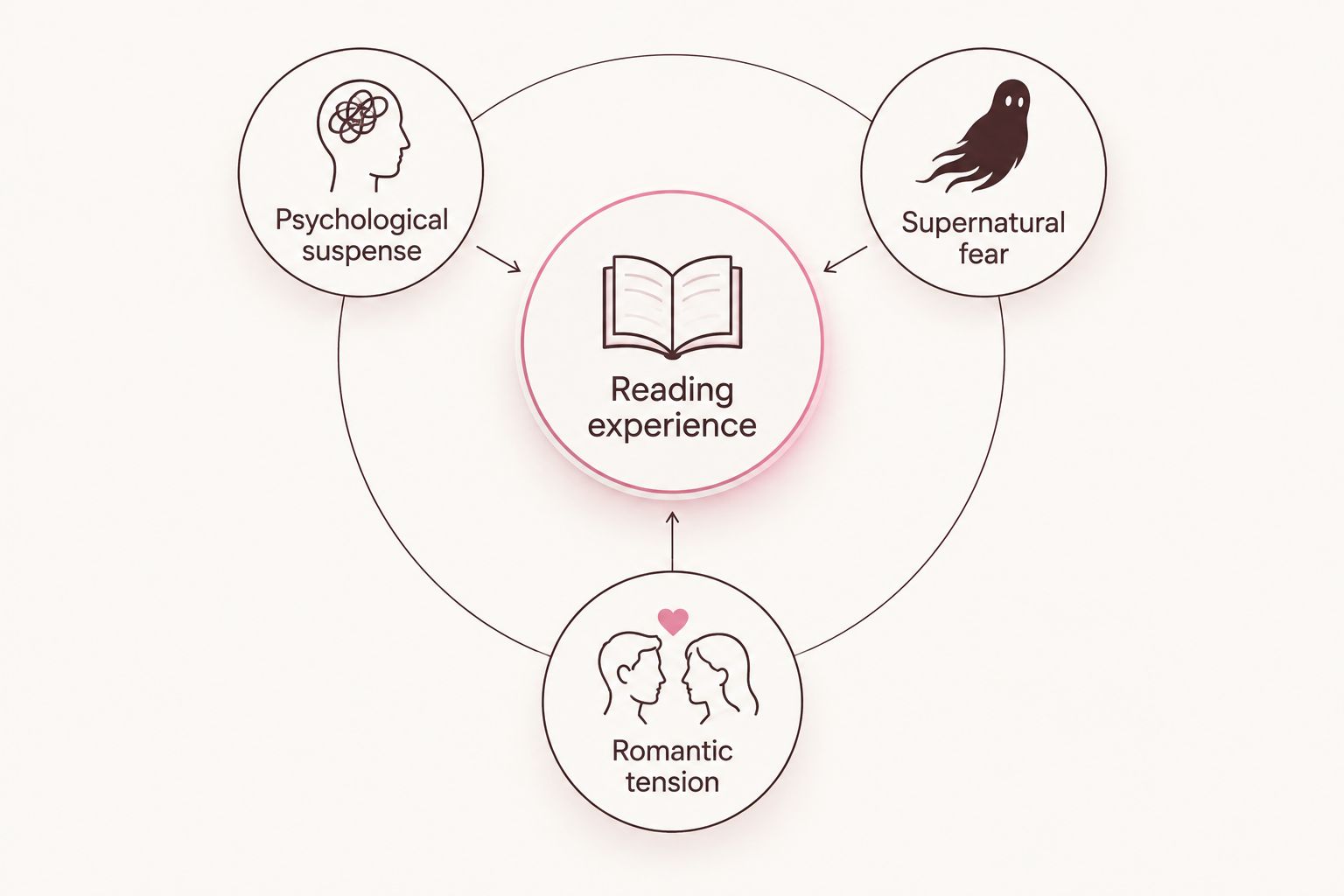
A useful personal test is to finish this sentence: “I want another book that makes me question…” Your answer might be a spouse, a narrator, a written account, or the safety of a home. That answer gives a read-alike recommendation something specific to match.
What should you read after Verity?
The closest next book depends on which part of Verity worked for you. These recommendations move from a contemporary domestic match toward narrower matches in atmosphere and psychological uncertainty. They are not ranked by quality.
| Book | Best for | Specific match | Meaningful difference |
|---|---|---|---|
| The Last Mrs. Parrish by Liv Constantine | Domestic manipulation | An outsider’s interest in an established marriage and concealed motives | Social ambition is more central; there is no matching writer-and-manuscript setup |
| Rebecca by Daphne du Maurier | Gothic household tension | A newcomer living under the influence of another woman’s presence | The suspense is slower and less sexually explicit |
| The Silent Patient by Alex Michaelides | Psychological uncertainty | Conflicting impressions and the interpretation of another person’s story | A therapist-patient framework replaces Verity’s domestic romantic setup |
The Last Mrs. Parrish: best for domestic manipulation
The Last Mrs. Parrish is the closest choice here if you want another contemporary thriller about an outsider, a marriage, and motives that deserve scrutiny. Liv Constantine makes social access and the desire for someone else’s life central to the tension.
The useful match is not merely that both books contain secrets. Both invite you to examine the gap between what a relationship looks like and what people want from it. That makes this a practical next step for readers drawn to Verity’s intimate power struggles.
The difference matters. The Last Mrs. Parrish places more weight on wealth, status, and calculated social positioning than on the unsettling experience of encountering a private manuscript. Its appeal is domestic manipulation rather than literary unease.
Read it for a contemporary marriage-centered thriller. Skip it if the hidden writing was your main interest.
Rebecca: best for gothic household tension
Rebecca matches the experience of entering a household that already has an emotional history. Daphne du Maurier makes a newcomer’s insecurity and the influence of an absent woman central to the atmosphere.
This is the better direction if the house, comparison, and feeling of being out of place stayed with you after Verity. The resemblance is structural and emotional. It does not depend on the novels sharing the same plot.
The trade-off is pace and presentation. Rebecca spends more time developing atmosphere and social discomfort, and it is less sexually explicit. Readers looking for another brisk contemporary thriller should not mistake a strong gothic match for an identical reading experience.
Read it for oppressive domestic atmosphere. Skip it if you want the same contemporary pace and explicitness.
The Silent Patient: best for psychological uncertainty
The Silent Patient suits readers most interested in interpreting a person whose story is difficult to access. Alex Michaelides builds the novel around a psychotherapist’s interest in a woman who has stopped speaking after a violent event.
The connection to Verity is the act of interpretation. What does someone’s behavior mean? How much confidence should you place in the account available to you? Those questions make the match more specific than simply calling both books twisty.
The important difference is the framework. Treatment, professional interest, and psychological investigation replace Verity’s writer-centered domestic setup. Do not choose it expecting the same balance of attraction and household tension.
Read it for uncertainty about another person’s story. Skip it if romantic tension is essential to your next book.
How do you get a closer read-alike match?
Name the feature you want repeated and the feature you want changed. “Like Verity, but less explicit” gives a recommendation a useful boundary. “Like Verity, with more emphasis on the manuscript” points toward a different set of books.
Getsimilarbooks is best for fiction readers who want title-based, hand-curated read-alike suggestions. Enter a book you enjoyed and you receive five suggestions; an email-gated personalized list expands that to 20–30 titles.
The benefit is a focused starting point rather than an undirected search. The limitation is just as clear: the longer list requires an email, and a recommendation is not a substitute for checking content warnings. In 2026, use Getsimilarbooks to narrow your next-read choices, then check the individual book against your boundaries.
Find your next read
Get five hand-curated suggestions, or request a personalized list of 20–30 titles with your email.
Is Verity scary if you do not read horror?
Verity can be unsettling without requiring an interest in horror. Its disturbing content and uncertainty about private behavior are more relevant to your comfort level than whether you normally read ghost stories.
If you avoid horror because of supernatural creatures, that preference alone does not rule it out. If you avoid distressing material involving children or families, check detailed content warnings before reading.
Is Verity more romance than thriller?
Verity is more useful to classify as a thriller than as a romance. Attraction and explicit sex are significant, but they sit inside a story organized around suspicion and danger.
Choose it when you want intimacy to complicate trust. Do not use its association with Colleen Hoover’s other work as a guarantee that it will deliver the same emotional experience.
Can you read Verity without learning the ending first?
Verity is best approached without an explanation of its ending. You can assess its genre, sexual content, and major content-warning categories without learning how the suspense develops.
Look for spoiler-free descriptions that name boundaries rather than recounting scenes. A content warning should help you make a decision, not require you to read a plot summary.
FAQ
Is Verity a horror book or a thriller?
Verity is primarily an adult psychological thriller with domestic suspense and gothic elements. Its disturbing material can feel horror-like, but it is not primarily a supernatural horror novel.
Does Verity have ghosts or monsters?
Verity is not primarily a ghost or monster story. Its main suspense concerns human behavior, disturbing writing, and uncertainty about whom to trust.
Does Verity contain explicit sex?
Verity contains explicit sexual content. Attraction is part of the suspense, so the thriller label should not be read as a sign that the book is suitable for every reader.
What content warnings should I check before reading Verity?
Check warnings for child harm, child death, violence, and explicit sex before reading Verity. A detailed content guide can explain boundaries more precisely, but look for spoiler controls if you want to preserve the mystery.
What is the closest book to Verity if I liked the marriage secrets?
The Last Mrs. Parrish by Liv Constantine is a strong next choice for domestic manipulation and concealed motives around a marriage. Its greater emphasis on social ambition makes it a different match from a writer-centered thriller.
Can Getsimilarbooks help me find another book like Verity?
Getsimilarbooks provides five hand-curated read-alike suggestions from a title you enjoyed. You can also request an email-gated personalized list of 20–30 titles; check each recommendation’s content warnings separately.
One last thing
A less frightening book is not always a better match. The better recommendation preserves the part you liked while changing the part you did not.
For your next read in 2026, write one sentence before choosing: “Keep the uncertainty, change the content.” Replace those two features with your own priorities. That is more useful than asking for another thriller and hoping the label does the work.
Related guides
- Books like Verity with unreliable narrators
- Books like Verity with romance at the center
- Books like Verity for readers avoiding child harm themes
Leave a Reply