Is Verity a standalone novel?

Yes. Verity by Colleen Hoover is a standalone novel: you do not need to read another book before it or continue into a series afterward. Some editions include an optional bonus chapter, but that extra material is not a separate sequel or a prerequisite for understanding the original novel.
- Is Verity a standalone novel? Yes. Colleen Hoover’s thriller requires no other books or series reading order.
- The optional bonus chapter belongs after the main novel. It is extra material, not a separate sequel.
- GetSimilarBooks suits readers seeking hand-curated book recommendations after Verity, rather than another required installment.
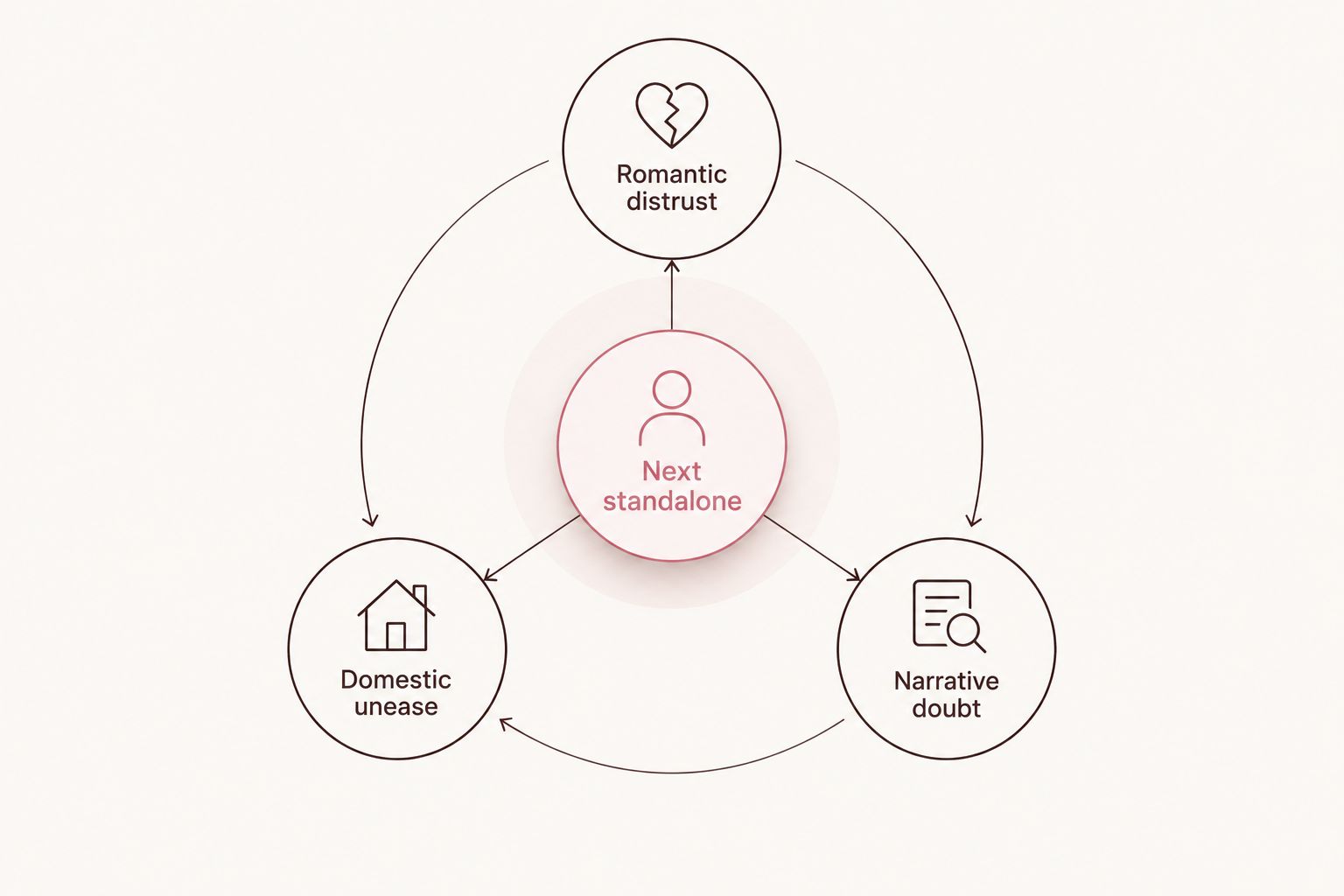
- Choose your next standalone by the feature you want repeated: romantic distrust, an unsettling household, or narrative uncertainty.
Why this matters
You can put Verity on your 2026 reading list without committing to a longer sequence. The useful distinction is between a book that leaves you thinking and a book that requires another installment. Verity belongs to the first category.
Once you finish, your next choice is a read-alike, not required continuation. GetSimilarBooks offers five hand-curated suggestions from a title you enjoyed, with an email-gated personalized list of 20–30 titles if you want more. That helps with the next-book decision; it is not a source of additional chapters in Hoover’s story.
Is Verity a standalone novel?
Yes. Verity is one standalone novel, not the opening volume of a required reading sequence. You can start with it even if you have never read Colleen Hoover before.
The publisher, Grand Central Publishing, describes the story around Lowen Ashleigh, a writer hired to complete work for the injured author Verity Crawford. That assignment provides the novel’s starting point. You do not need background from another Hoover book to understand the characters, their relationships, or the central situation.
| What you are considering | Do you need it? | Best for | Main limitation |
|---|---|---|---|
| The main novel | Yes, this is the story itself | Readers who want a self-contained psychological thriller | Its disturbing subject matter is not a fit for every reader |
| An edition containing the bonus chapter | No, the extra chapter is optional | Readers who want additional material after the original ending | Reading the extra material early spoils the main novel |
| Another Colleen Hoover novel | No | Readers who want more of Hoover’s writing | A shared author does not make another book a continuation |
| An unrelated read-alike | No | Readers who want a similar reading experience next | Similar atmosphere does not mean the same characters or story |
If your question is simply whether you need a reading order, the answer is no. Start with Verity, read the main novel in its printed order, and decide about supplementary material afterward.
What does standalone mean here?
Standalone means that Verity supplies the story you came to read within one novel. It does not mean every reader will agree about every character, motive, or implication.
That distinction matters for this particular book. A demand for certainty is different from a need for another installment. You can finish the novel and still have something to debate without having missed a required book.
The main novel: the complete starting point
Best for: readers who want the original story without additional material. The main novel introduces its own cast and establishes its own stakes. Earlier Hoover books do not provide a missing introduction.
For a first read, keep the process simple. Read the novel before looking up explanations, discussion threads, or detailed comparisons between editions. Even a question heading in an ending discussion can reveal more than you wanted to know.
The advantage is a direct reading experience. You encounter information in the order the novel presents it, rather than through someone else’s explanation. The trade-off is that you will need to sit with uncertainty instead of immediately resolving every question online.
If you are choosing an edition for a 2026 first read, focus on the format you prefer and whether you want the optional extra chapter. There is no need to assemble a set of related novels first.
The bonus chapter: optional reading after the novel
Best for: readers who have finished the main story and want additional material. Some editions of Verity include a bonus chapter. That chapter is supplementary fiction, not a separately titled sequel.
Read the main novel first. Then decide whether you want to continue into the extra material. This is a reading-order instruction within the work, not evidence that Verity has become a series.
The benefit of the bonus chapter is straightforward: you get more material connected to the story. The drawback is equally real: additional material gives you more to consider and does not guarantee a tidier reading experience.
Do not assume that every paperback, ebook, or audiobook contains the same extras. Check the edition description or contents rather than relying on a cover image alone. A familiar title does not tell you which supplementary material is included.
Should you pause before reading the bonus chapter?
Yes, if you want to form your own response to the original ending first. Finish the novel, note what you think, and return to the extra material afterward.
You do not need to treat that pause as a rule everyone must follow. It is simply a useful way to distinguish your response to the main story from your response to the addition. Neither choice requires reading another Hoover novel.
Why answers about Verity’s reading order vary
Different answers often address different questions. Keep these distinctions separate when you search for advice:
- Main story versus extras. A recommendation to read the bonus chapter afterward describes supplementary material, not a series order.
- Edition differences. An edition with extra content and an edition without it still contain the same central novel.
- Author lists versus story lists. A list of Colleen Hoover books can organize her work without implying that the books form one continuous narrative.
- Interpretation versus continuation. Questions about what to believe in a story do not automatically signal a missing installment.
- Read-alikes versus sequels. A book recommended after Verity usually offers a matching quality, not the next part of Lowen’s story.
For your 2026 reading plan, ask a precise question: do you need more story material, or do you want another book that creates a similar feeling? Those are different searches, and they lead to different recommendations.
What should you check before starting Verity?
Check content fit, not series order. Verity contains explicit sexual content, violence, and disturbing material involving children. Being a single-book commitment does not make it a light read or a young-adult recommendation.
If you are choosing for a younger reader, use the guide to whether Verity is appropriate for teens. Reading independence and content suitability are separate decisions.
A spoiler-conscious check can stay brief:
- Decide whether explicit sexual content fits your reading preferences.
- Check whether child-harm themes are a firm boundary.
- Avoid detailed ending discussions until you finish.
- Confirm whether your edition includes supplementary material.
You do not need a plot summary to answer those questions. A short content note is more useful than a scene-by-scene warning if you want to preserve the suspense.
What should you read after Verity if you want another standalone?
Choose the quality you want repeated before choosing a title. The following recommendations move from romantic and domestic deception toward a narrower match on narrative uncertainty. Each is a standalone reading option, not a continuation of Verity.
| Book | Author | Best for | Specific match | Meaningful difference |
|---|---|---|---|---|
| The Last Mrs. Parrish | Liv Constantine | Marriage, manipulation, and domestic suspense | Intimate relationships become a source of danger and distrust | Social ambition and status play a larger role |
| Rebecca | Daphne du Maurier | An unsettling household and romantic insecurity | A woman enters a home shaped by another woman’s presence | Its suspense develops through a slower Gothic atmosphere |
| The Silent Patient | Alex Michaelides | Suspicion about the account you are receiving | The reading experience depends on interpreting people and their stories | A therapist’s investigation matters more than a central romance |
Closest domestic match: The Last Mrs. Parrish
Best for: readers who want marriage, manipulation, and an intimate setting where trust is unsafe. Liv Constantine’s The Last Mrs. Parrish follows a woman’s calculated interest in an affluent couple. The connection to Verity is the use of close relationships as a source of suspense.
The meaningful difference is the attention to wealth, status, and social ambition. Choose it for domestic deception rather than for a writer discovering troubling material in someone else’s home.
Its strength as a match is the overlap between desire and manipulation. Its limitation is that it will not reproduce Verity’s particular setup. Read it for relationship-driven suspense, not as a substitute chapter.
Gothic match: Rebecca
Best for: readers who want a house, a marriage, and the pressure of another woman’s presence. Daphne du Maurier’s Rebecca places a young wife in a home still shaped by her husband’s previous wife. The match is emotional unease inside an intimate domestic space.
The difference is pace. Rebecca develops its tension through atmosphere, social discomfort, and the narrator’s insecurity rather than following the rhythm of a contemporary thriller.
That slower attention is its strength if the household itself interested you in Verity. It is a limitation if you want immediate shocks and frequent escalation. Read it for sustained unease; choose another title for a faster contemporary pace.
Narrative-doubt match: The Silent Patient
Best for: readers who want to question how a troubling story is being told. Alex Michaelides’s The Silent Patient centers on a psychotherapist’s interest in a woman who stops speaking after a violent event. Its connection to Verity is the invitation to examine accounts, motives, and withheld information.
The meaningful difference is the emphasis on a therapist’s investigation. Romance is not the main reason to choose this match, and the setting does not reproduce Verity’s household dynamic.
Its strength is the focus on interpretation. Its limitation is the weaker match for readers whose main interest was romantic tension. Read it for narrative suspicion, not for a romance-centered follow-up.
How do you choose the right next book?
For a 2026 reading list, use a preference rather than a broad genre label. “Another thriller” leaves too much undecided. “Another standalone where attraction makes trust difficult” gives you a clearer target.
Choose the feature that mattered most:
- Romantic distrust: prioritize the relationship as a source of suspense.
- Domestic unease: prioritize the home, the marriage, and the feeling of being an outsider.
- Narrative doubt: prioritize uncertainty about the account you are receiving.
Also name one thing you do not want repeated. That might be explicit sexual content, child-harm themes, or a strong romance focus. A useful read-alike can preserve the appeal while changing the part that did not work for you.
GetSimilarBooks is best for readers who want hand-curated book recommendations from a title they already enjoyed. The five suggestions provide a starting point; the email-gated personalized list expands that to 20–30 titles. The trade-off is that the longer list requires an email address, and you still need to check content boundaries for your own reading preferences.
Find your next standalone
Start with five hand-curated suggestions. Request a personalized list of 20–30 titles by email.
FAQ
Is Verity a standalone novel or part of a series?
Verity is a standalone novel by Colleen Hoover. You do not need to read another book before it or continue into a required series afterward.
Do I need to read any Colleen Hoover books before Verity?
No. Verity introduces its own characters and situation, so you can read it as your first Colleen Hoover novel.
Is the Verity bonus chapter a sequel?
No. The bonus chapter is supplementary material included in some editions, not a separate sequel. Read it only after finishing the main novel.
Do I need the bonus chapter to understand Verity?
No. The main novel is the standalone story; the bonus chapter is optional additional material. It is not a prerequisite for reading or discussing the original novel.
Which edition should I choose for a first read in 2026?
Choose an edition in your preferred format, then check its description if you specifically want the bonus chapter. Read the main novel before any supplementary material.
Is Verity suitable for a teen who wants a standalone thriller?
Verity is an adult thriller containing explicit sexual content, violence, and disturbing material involving children. Its standalone format does not make it a young-adult recommendation.
What should I read after Verity if I do not want a series?
The Last Mrs. Parrish, Rebecca, and The Silent Patient are standalone options with different points of overlap. Choose domestic manipulation, Gothic unease, or narrative uncertainty rather than expecting a continuation of Verity.
One last thing
Before searching for an explanation of the ending, write down which part of Verity you would want in another book. Keep that note separate from your interpretation of what happened.
That small distinction improves the next-book decision. You can want another unsettling household without wanting the same plot, or another unreliable account without wanting the same content. For your 2026 shortlist, repeat the reading experience that worked—not every feature of the book.
Related guides
- Books like Verity with romance at the center
- Books like Verity with endings open to interpretation
- Books like Verity about writers and hidden manuscripts
Leave a Reply