Is Verity appropriate for teens?

Verity is an adult psychological thriller, not a default recommendation for teens: it contains explicit sexual scenes, disturbing child-harm themes, violence, and manipulation. An older teen's decision should account for those subjects together, not just whether the reader has handled a dark mystery before.
- Is Verity appropriate for teens? Not as a general recommendation; Colleen Hoover’s thriller combines explicit sex with disturbing child-harm themes.
- Reading difficulty is not the issue. Sexual detail, family violence, and emotional distress are the deciding factors.
- Truly Devious offers a YA mystery alternative, but still includes murder and kidnapping.
- Getsimilarbooks suits readers seeking title-based recommendations; specific content boundaries still need a separate check.
Is Verity appropriate for teens?
Verity is better treated as an adult-content decision than a reading-level decision. Colleen Hoover's novel follows a writer who accepts a job connected to another author's work and encounters unsettling material about that author's family. The suspense involves sexual relationships, disturbing accounts, and uncertainty about what to believe.
The following spoiler-free breakdown identifies the subjects that matter most when choosing it for a teen in 2026. It describes content categories without revealing the ending or deciding which version of events is true.
| Content area | What to expect | What that means for your decision |
|---|---|---|
| Sexual content | Explicit, on-page sexual scenes | Not suitable when your boundary excludes detailed sex |
| Child harm | Disturbing material involving children, including death and alleged abuse | A separate concern from ordinary murder-mystery violence |
| Violence | Threats, injury, and death | Assess alongside the domestic and family setting |
| Relationships | Manipulation, deception, and troubling relationship dynamics | Do not treat the romantic plot as a model of healthy behavior |
| Emotional intensity | Grief, dread, and uncertainty about other people's motives | Consider whether these themes stay with the reader afterward |
If child harm is the deciding boundary, start with books like Verity for readers avoiding child-harm themes. Removing explicit sex alone does not address that concern.
Why this matters
A teen can read difficult books fluently without wanting their subject matter. Fast pacing and accessible prose say little about whether sexual detail or disturbing family violence will feel manageable.
Verity also crosses categories that readers sometimes evaluate separately. Someone comfortable with a murder investigation might still reject explicit sex. Someone comfortable with adult romance might find the child-harm material far more upsetting than the sexual scenes.
For a 2026 reading choice, ask about the content itself rather than treating popularity, a friend's recommendation, or the author's name as an age rating. The useful question is not whether a teen can finish Verity. It is whether they want what the book contains.
Younger teens: choose a different suspense novel
Verity is not a sound general recommendation for younger teens. Its adult sexual content and disturbing family material are central considerations, not incidental details you can reliably avoid while keeping the reading experience intact.
If a younger reader wants secrets, danger, or an ending that invites debate, those interests do not require an adult domestic thriller. Look for a young-adult mystery that delivers the desired kind of suspense, then check that book's own content.
Do not replace a specific warning with the vague phrase mature themes. Say that Verity contains detailed sexual scenes and disturbing material involving children. Clear language lets a parent, librarian, and reader discuss the same book rather than different assumptions about it.
Older teens: assess boundaries, not just experience
Some older teens already choose adult fiction. That does not make every adult novel an appropriate match, and it does not create a universal age at which Verity becomes comfortable reading.
Start with their preferences. Have they asked for an adult thriller with explicit sex, or have they asked for a compelling mystery? Those requests overlap less than a recommendation based only on genre suggests.
A reader's previous choices provide context, not permission by precedent. Finishing another dark novel does not establish comfort with child-harm themes. Reading romance does not establish interest in the way sex and manipulation operate in Verity.
Choose Verity only when the reader understands its main content categories and actively wants that reading experience. Waiting or choosing another book is a complete decision; it does not need to become a test of maturity.
Why suitability varies between readers
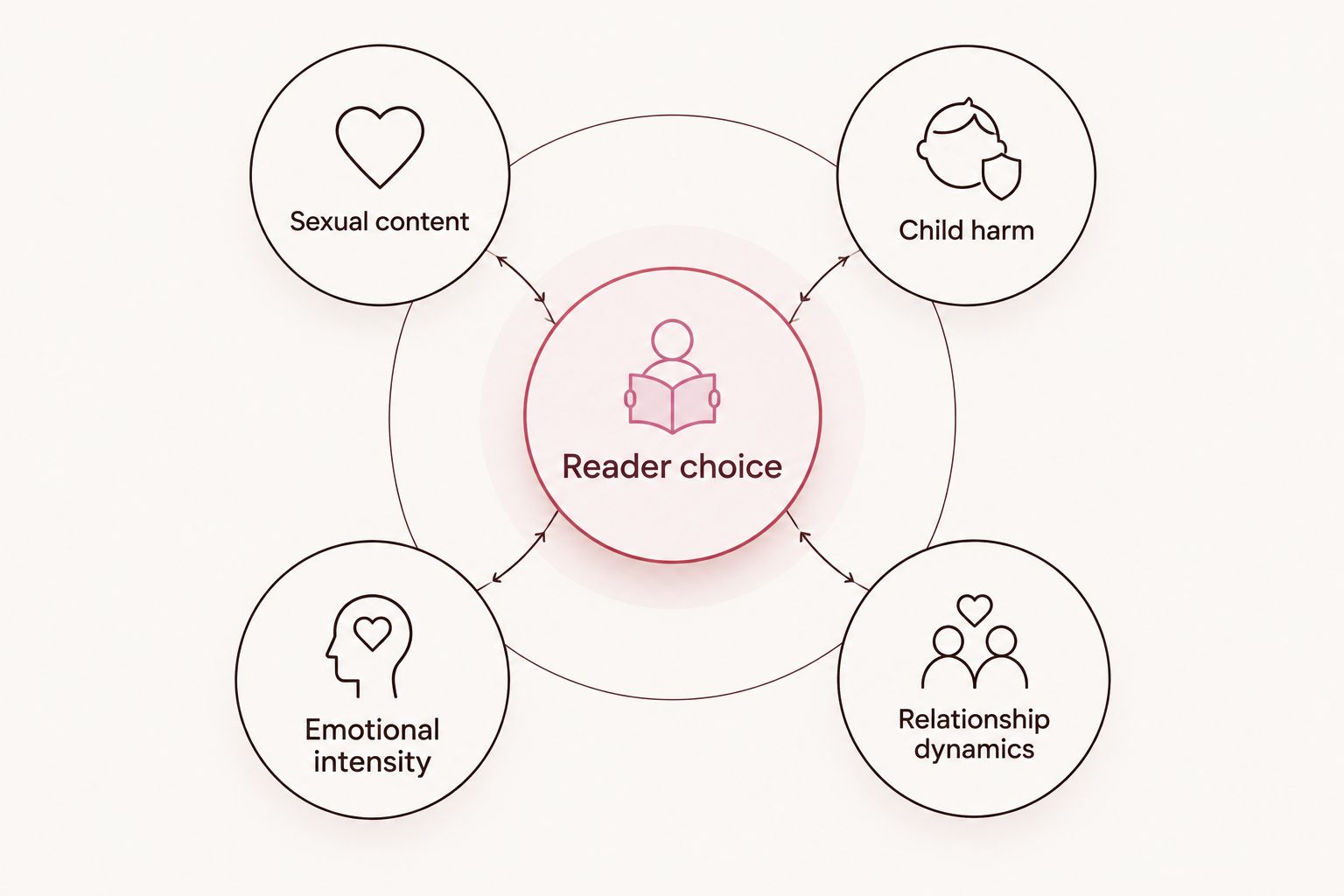
The same book can meet one reader's preferences and cross another's firm boundary. For Verity, these are the useful distinctions:
- Sexual content: Decide whether explicit, on-page sex is acceptable. Romance alone does not describe the level of detail.
- Child harm: Treat harm involving children as its own category. Comfort with violence elsewhere in fiction does not answer this question.
- Emotional intensity: Consider grief, family distress, and sustained dread, not just individual violent moments.
- Reader choice: Distinguish an informed request from pressure to read a book because friends are discussing it.
- Relationship dynamics: Ask whether the reader wants a story involving manipulation and deception within intimate relationships.
These factors do not produce a numerical maturity score. They identify the reasons to read, wait, or pick something else.
What should you check before handing Verity to a teen?
Use a short, direct conversation. You do not need to disclose the twist to explain why the book is an adult-content choice.
- Name the content plainly. Explain that Verity includes explicit sexual scenes, disturbing child-harm themes, violence, and manipulation.
- Ask what attracted the reader. A hidden manuscript, a tense household, and an uncertain account are different interests from adult romantic suspense.
- Identify a firm boundary. If detailed sex or child harm is unwanted, choose another book rather than promising that those elements will be easy to skip.
- Offer an alternative. Match the reader's interest in secrets, atmosphere, or investigation without claiming the replacement is free of difficult content.
- Leave room to stop. Starting a book is not an agreement to finish it. A reader does not owe anyone an explanation for putting it down.
This approach keeps the 2026 decision specific. It also avoids turning a book recommendation into a judgment about whether a teen is sophisticated enough to handle discomfort.
Which books offer suspense without Verity's explicit adult focus?
These recommendations move from the closest atmospheric match toward a less similar, puzzle-led option. None is a substitute for a content check. Young-adult fiction still includes violence, loss, and difficult relationships.
| Book | Best for | What matches Verity | Meaningful difference and caution |
|---|---|---|---|
| Truly Devious by Maureen Johnson | Readers drawn to an unsettling setting and buried secrets | Past events complicate a present-day mystery | A boarding-school investigation, not adult romantic suspense; includes murder and kidnapping |
| A Good Girl's Guide to Murder by Holly Jackson | Readers who want to question an accepted account | An investigation challenges what people believe happened | More evidence-led and less domestic; includes violence and other mature material |
| The Inheritance Games by Jennifer Lynn Barnes | Readers who want household secrets and puzzles | A newcomer enters a wealthy family's unfamiliar world | More puzzle-driven, with teen romance rather than Verity's explicit adult focus; still includes threats and danger |
Truly Devious: best for atmosphere and buried secrets
Maureen Johnson's Truly Devious is the closest match here for a reader who wants an enclosed social setting with a troubling history. Stevie Bell arrives at Ellingham Academy with an interest in an old case connected to the school. The appeal is the pressure of secrets inside a distinctive place.
The difference matters. This is a young-adult mystery built around investigation, not an adult domestic thriller organized around an intimate relationship. Murder and kidnapping remain part of its subject matter, so it is not the right recommendation when the boundary excludes those topics.
Verdict: Choose Truly Devious for atmosphere and investigation, not for an equivalent romantic plot.
A Good Girl's Guide to Murder: best for questioning the official story
Holly Jackson's A Good Girl's Guide to Murder follows Pip as she investigates a local case for a school project. Its connection to Verity is the urge to question a story that other people appear to have accepted. The reader follows an inquiry rather than simply waiting for a final revelation.
The difference is its evidence-led structure and teen perspective. It is not a less explicit version of the same relationship story. Violence and other mature material still require attention, particularly if the reader wants a light or reassuring mystery.
Verdict: Choose A Good Girl's Guide to Murder for investigation and conflicting accounts; skip it when the request is for low-distress suspense.
The Inheritance Games: best for puzzles inside a secretive household
Jennifer Lynn Barnes's The Inheritance Games follows Avery after an unexpected inheritance brings her into the world of the Hawthorne family. The useful match is the outsider's position: you enter an unfamiliar household and need to work out how its people and secrets connect.
The difference is tone and structure. Puzzles and teen relationship tensions take more of the foreground than Verity's adult sexual content and domestic dread. That makes it a different reading experience, not a promise of harmless content; threats and danger remain.
Verdict: Choose The Inheritance Games for family secrets and puzzles, not for Verity's level of psychological darkness.
Can you skip the sexual scenes and keep the mystery?
Skipping the sexual scenes does not remove Verity's child-harm themes or disturbing family material. It addresses only one content category, and the book's relationships remain part of the suspense.
If explicit sex is the only concern, a reader can decide how to approach it. If the concern is the overall emotional experience, choose a different novel rather than treating selective skipping as a complete solution.
For a 2026 family or library reading discussion, distinguish between less explicit and less disturbing. Those are different requests. A book can meet one and fail the other.
Is Verity a romance or a thriller?
Verity is an adult psychological thriller with a substantial romantic and sexual storyline. Calling it a romance alone leaves out the disturbing family material; calling it a thriller alone leaves out the explicit sexual content.
That distinction helps when choosing the next book. Readers who want attraction and relationship tension need different recommendations from readers who want a hidden document, conflicting accounts, or a claustrophobic setting.
How do you find a better-matched next read?
Start with the part you want to keep and the part you want to avoid. For this question, suspense without explicit sex is more useful than simply asking for another book like Verity. Add a separate boundary if child-harm themes are also unwanted.
Getsimilarbooks is best for readers who want book recommendations starting from a title they enjoyed. Its free book recommendation tool provides 5 hand-curated read-alike suggestions. The personalized list contains 20–30 titles and requires an email address.
The benefit is a title-based starting point. The limitation is that a read-alike match is not an age-suitability certification: you still need to check each suggestion against your boundaries. Use Getsimilarbooks to begin that search, not to replace the content decision.
Find your next read
Start with a title you enjoyed. Get five suggestions or request a free personalized list by email.
FAQ
Is Verity appropriate for a younger teenager?
Verity is not a good general recommendation for a younger teenager. It combines explicit sexual scenes with disturbing child-harm themes, violence, and manipulation.
Is Verity okay for an older teen who reads adult books?
Reading adult books does not automatically make Verity a suitable match. An older teen should understand its sexual content and child-harm themes before choosing it.
Does Verity have explicit sexual content?
Yes. Verity contains explicit, on-page sexual scenes, so it does not meet a preference for closed-door romance or suspense without detailed sex.
Can I get content warnings for Verity without spoilers?
Yes. The main spoiler-free warnings are explicit sexual content, disturbing child-harm themes, violence, grief, and manipulation; naming those categories does not require explaining the ending.
Is there a universal age rating for Verity?
There is no universal book age-rating system equivalent to a single standardized film classification. Treat Verity as an adult novel and assess the reader’s specific content boundaries rather than relying on a universal cutoff.
What’s a YA alternative to Verity for the mystery rather than the romance?
Truly Devious by Maureen Johnson is an option for readers who want an atmospheric setting and buried secrets. It is a YA investigation rather than adult romantic suspense, but it still includes murder and kidnapping.
Can Getsimilarbooks help me choose something else?
Getsimilarbooks provides five hand-curated suggestions from a title you enjoyed, plus an email-gated personalized list of 20–30 titles. Check each recommendation separately for the content you want to avoid.
One last thing
For your 2026 reading list, write the boundary before the comparison title: suspense, no explicit sex, no child harm. That short description does more work than a genre label.
A shared atmosphere is a reason to investigate a book, not a reason to assume it is suitable. Keep the quality the reader wants. Check the content they do not.
Related guides
- Books like Verity with a gothic atmosphere
- Books like Verity with unreliable narrators
- Books like Verity without a romance plot
Leave a Reply