Can Project Hail Mary be read as a standalone?

Yes, Project Hail Mary can be read as a standalone in 2026. You do not need to read The Martian or Artemis first, and the novel completes its central story. The questions at the start are part of Project Hail Mary, not gaps left by another book.
- Can Project Hail Mary be read as a standalone? Yes. Andy Weir’s other novels are not required.
- Start with Project Hail Mary if you want a complete space-survival story with first contact.
- Read The Martian or Artemis separately if their settings appeal to you; neither supplies missing context.
Why this matters
A reading-order search usually asks a practical question: will you understand the book you just picked up? With Project Hail Mary, you can begin on page one without homework. If you have already finished it and want a different book, the books like Project Hail Mary, closest match first guide addresses that separate decision.
Can Project Hail Mary be read as a standalone in 2026?
Yes. Project Hail Mary is an independent novel, not an installment in a series with The Martian or Artemis. You can read it first, last, or as your only Andy Weir book. Its characters and central mission are introduced within its own pages.
Here is the reading-order decision without a plot summary:
- Have you read another Andy Weir novel? You do not need to. Open Project Hail Mary.
- Does the opening leave you with questions? Keep reading. The book is designed to reveal its situation as the story progresses.
- Are you expecting a sequel to finish the central mission? Project Hail Mary resolves that story within the novel.
That is the distinction that matters. A standalone can leave you thinking about its characters after the final page. It does not need to answer every imaginable question about their lives. It does need to tell a complete central story, and Project Hail Mary does.
Is Project Hail Mary connected to The Martian or Artemis?
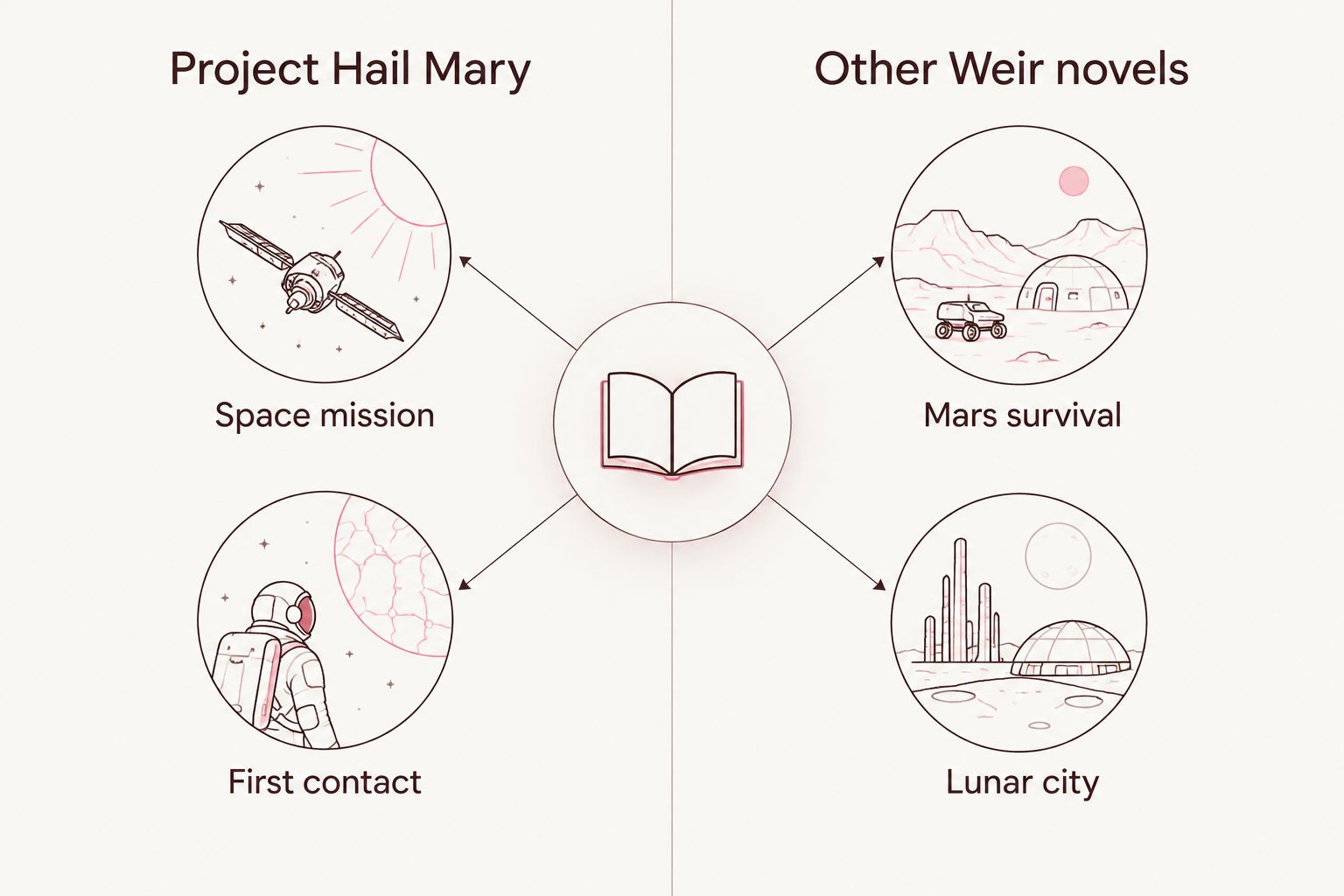
No. Project Hail Mary, The Martian, and Artemis are separate novels by Andy Weir. They share an author and an interest in solving difficult problems, but you do not need events or characters from one to follow another.
| Book | Best for | What works | What to expect instead |
|---|---|---|---|
| Project Hail Mary | Readers who want space survival with first contact | Its mission gives the science problems an immediate purpose | Its opening asks you to accept uncertainty before you get answers |
| The Martian | Readers who want survival problem-solving on Mars | The focus stays close to the practical work of staying alive | It is not the same first-contact story |
| Artemis | Readers who want a story set in a lunar city | Its setting puts human schemes alongside technical problems | It is not a solitary deep-space mission |
Best starting point for a standalone space mission: Project Hail Mary. Choose The Martian for Mars survival or Artemis for a lunar-city story, not because either is a prerequisite. All three offer a distinct entry point; none is the missing first volume of Project Hail Mary.
The comparison also explains why an author reading order is the wrong tool here. Publication order tells you when books appeared. It does not create a story dependency where none exists. In 2026, the useful question is which premise you want to read, not which Andy Weir title you must finish first.
What does standalone mean for Project Hail Mary?
It means the novel provides the context needed for its own main plot and brings that plot to an ending. You are not expected to recognize a returning cast or remember an earlier mission from another book. Read it as its own story.
That does not mean every answer arrives immediately. The opening puts you close to a character who is trying to understand his circumstances. His uncertainty shapes how you receive information. If a detail is unclear early on, do not assume you missed a previous installment.
It also does not mean the book is short, simple, or light on science. Standalone describes its relationship to other books, not its pace or level of technical detail. If you want the central mission without reading several volumes, the format fits. If you want a continuing series with an ongoing cast, this is a different kind of commitment.
A good check is to ask what you would need to know before starting. For a continuing series, an earlier installment often establishes relationships and conflicts the next book assumes you remember. Project Hail Mary establishes the information its mission needs within Project Hail Mary. You can let the story supply it in the order intended.
Why do readers ask about a Project Hail Mary reading order?
Several features make the question reasonable. None turns the novel into a sequel.
- The same author wrote other space stories. Andy Weir also wrote The Martian and Artemis. A shared author is a reason to compare books, not evidence of a shared plot.
- The opening withholds information. The central character has questions. You are meant to encounter those questions with him, not arrive with answers from another novel.
- Science drives the action. Technical explanations can feel like background knowledge you should already have. The story supplies the context it needs as problems arise.
- The premise supports a big story. A large-scale mission can sound like the middle of a series. Project Hail Mary still tells its central story in one novel.
- You may want more after finishing. Wanting another book with a similar feel is not the same as needing a sequel to understand the ending.
These are reasons to decide whether the book suits your taste, not reasons to delay it. In 2026, the answer to the reading-order question remains simple: there is no earlier Andy Weir novel to complete first.
Should you read The Martian before Project Hail Mary?
No. Read The Martian first only if survival on Mars interests you more than Project Hail Mary's mission. It will not explain Project Hail Mary's characters or supply a missing chapter.
The two books can still suit the same reader for a concrete reason: both spend time on people working through dangerous practical problems. The difference matters just as much. The Martian centers on survival on Mars; Project Hail Mary adds a first-contact element to its space mission. Pick by the kind of problem you want to follow.
If you finish one and want the other, you can switch without checking a timeline. You are choosing another Andy Weir novel, not advancing to the next numbered part of a story.
Do you need to read Artemis before Project Hail Mary?
No. Artemis takes place in a lunar city and follows a different story. Its setting and characters are not required context for Project Hail Mary.
Artemis is the less direct match if the appeal of Project Hail Mary is its isolated mission. Choose it when a populated setting and human schemes sound more interesting. Choose Project Hail Mary when you want the mission and its unfolding questions. Neither choice spoils the other by being read out of order.
Does Project Hail Mary have a complete ending?
Yes. The novel brings its central story to an ending, so you do not need another volume to find out how the main mission turns out. That is the useful sense of standalone for a reader deciding what to start.
You can still have questions you want to discuss afterward. A complete ending is not a promise that every possible future event gets described. It means the book does not hand its main resolution to a required next installment.
For a book club, that distinction helps. Members can commit to one novel and discuss the choices it makes without assigning an earlier volume. They can also disagree about what matters most in the ending without needing a sequel to complete the assigned story. This answer avoids the ending's details so you can make that decision before reading.
What should you read after Project Hail Mary?
First decide what you want to repeat. If it is the survival problem-solving, The Martian is the clearer Andy Weir option. If it is the first-contact element, a different author's novel built around meeting an unfamiliar intelligence is a better direction than choosing Artemis solely because it shares an author.
If it is the mix rather than one feature, name the part you would miss most: the scientific puzzles, the relationship at the center, the isolation, or the humor. Those preferences lead to different books. A shared science-fiction label is not a close match on its own.
GetSimilarBooks is best for readers who have finished Project Hail Mary and want read-alikes chosen for what they enjoyed, not an author reading order. Its book recommendation tool starts with a title you liked and returns five hand-curated suggestions. The first five are a preview; an email-gated personalized list extends the choices to 20–30 titles.
That makes the next step specific. If the first-contact relationship stayed with you, use Project Hail Mary as your starting title and keep that preference in mind as you assess the suggestions. If the experiments mattered more, judge the picks by how much room they give problem-solving. GetSimilarBooks book recommendations are a way to make that distinction; they are not another installment of the novel.
GetSimilarBooks lets you request a free personalized list after the initial five suggestions. Use it when you know what you liked about Project Hail Mary but do not know the next title.
Find your next read
Start with a book you liked, then request a personalized list of 20–30 titles by email.
FAQ
Can Project Hail Mary be read as a standalone in 2026?
Yes. Project Hail Mary tells its central story in one novel, and you do not need another Andy Weir book first.
Is Project Hail Mary a sequel to The Martian?
No. Project Hail Mary and The Martian are separate novels by Andy Weir, with different central stories.
Do I need to read Artemis before Project Hail Mary?
No. Artemis is a separate story set in a lunar city; it does not provide required context for Project Hail Mary.
Will I understand Project Hail Mary if it is my first Andy Weir book?
Yes. Project Hail Mary introduces the information needed for its own mission. Questions in the opening are part of the story.
Does Project Hail Mary end on a cliffhanger that requires another book?
No. Its central mission reaches an ending within the novel; you do not need a second volume for the main resolution.
Which should I read first, The Martian or Project Hail Mary?
Start with the premise you prefer. The Martian focuses on survival on Mars; Project Hail Mary pairs a space mission with first contact. Neither requires the other.
Is Project Hail Mary part of a series?
No. Project Hail Mary is a standalone novel, not an installment that depends on The Martian or Artemis.
One last thing
The opening's unanswered questions are a reason to keep reading Project Hail Mary, not a sign that you started in the wrong place. In 2026, you can pick it up without a reading-order checklist. Finish the book before deciding which part of it you want your next read to match.
Related guides
- Books like Project Hail Mary with first-contact aliens
- Books like Project Hail Mary with humor in the science
- Books like Project Hail Mary for book clubs
Leave a Reply