Books like The Martian: five picks, closest match first

Best overall: Project Hail Mary. Best for another Andy Weir adventure: Artemis. Best short read: All Systems Red. These five books like The Martian are ordered from closest match outward, with the similarities and differences that matter when choosing your next read in 2026.
- Project Hail Mary is the closest match for The Martian’s scientific problem-solving, accessible explanations, and humor.
- Artemis keeps Andy Weir’s technical puzzles but replaces isolated survival with a lunar heist.
- Seveneves emphasizes orbital survival; Rendezvous with Rama emphasizes exploration; All Systems Red emphasizes a sarcastic narrator.
- GetSimilarBooks offers five hand-curated read-alikes, plus a personalized list of 20–30 titles after you provide your email.
Already read the obvious choices? Enter a title you enjoyed at GetSimilarBooks for recommendations built around a book you actually liked. GetSimilarBooks is best for readers who want book recommendations starting from a specific favorite.
Why this matters
The Martian offers more than an astronaut in danger. Its appeal comes from watching a capable person explain a problem, attempt a solution, and deal with the consequences when something else breaks. Mark Watney’s humor makes the technical detail feel conversational rather than instructional.
A useful read-alike preserves that experience. Another space setting alone is not enough: a novel about interstellar politics can feel less like The Martian than a tightly focused engineering story.
This 2026 shortlist separates scientific problem-solving, narrative voice, and survival pressure. Choose the quality you miss most, not simply the next book with a spacecraft on its cover.
What makes the best books like The Martian?
- Scientific problem-solving: The characters use observation, calculation, experiments, or engineering to change their situation.
- Survival pressure: Technical choices have immediate consequences, rather than serving only as background information.
- Narrative humor: A distinctive voice gives you relief from danger without removing the stakes.
- Readable explanations: You can follow why a solution works without arriving with specialist knowledge.
- Meaningful differences: Each recommendation offers a reason to continue and a reason to choose something else.
These criteria explain the order. The closest match combines several qualities; the later choices preserve one particularly well while changing the reading experience.
The five picks at a glance
| Rank and book | Best for | Standout match | Key limitation |
|---|---|---|---|
| 1. Project Hail Mary — Andy Weir | The closest overall read-alike | Scientific experiments narrated with humor | More speculative science and a different narrative structure |
| 2. Artemis — Andy Weir | Another Weir novel without repeating the survival setup | Technical improvisation inside a functioning lunar settlement | Crime and conspiracy replace solitary survival |
| 3. Seveneves — Neal Stephenson | Detailed orbital survival | Engineering under catastrophic pressure | Denser explanations and a much larger narrative scope |
| 4. Rendezvous with Rama — Arthur C. Clarke | Methodical space exploration | Observation and deduction in an unfamiliar environment | Less humor and less intimate characterization |
| 5. All Systems Red — Martha Wells | A short, sarcastic science-fiction read | A capable narrator dealing with danger and inconvenient humans | More action and character conflict than scientific explanation |
1. Project Hail Mary: best read-alike for scientific problem-solving
Project Hail Mary, by Andy Weir, is the default recommendation if you want the closest overall experience. A man wakes aboard a spacecraft without knowing who he is or why he is there. Understanding his situation becomes part of the work of surviving it.
The match is the reasoning on the page. You follow questions, tests, failed assumptions, and revised plans, with a conversational narrator carrying the explanations. Like The Martian, the book makes working through a problem a source of suspense.
The meaningful difference: Project Hail Mary moves further into speculative science and unfolds through a different structure. It does not reproduce Watney’s mission-log experience, and knowing less about its discoveries improves the first read.
Project Hail Mary pros:
- Scientific investigation drives the plot.
- Humor keeps explanations approachable.
- Problems develop into further problems rather than disappearing after one clever answer.
Project Hail Mary cons:
- Its speculative elements depart from The Martian’s near-term survival framework.
- Its unfolding backstory interrupts the immediate situation.
Best for: Readers who want to understand the solution, not just witness the rescue.
Verdict: Buy Project Hail Mary first if you have not read it. Avoid detailed plot summaries before starting.
2. Artemis: best read-alike for another Andy Weir adventure
Artemis follows Jazz Bashara, a smuggler living in a lunar city, as a criminal opportunity pulls her into a larger conspiracy. The environment matters: infrastructure, materials, and the practical demands of living on the Moon shape what characters can do.
The connection to The Martian is technical improvisation. Weir again gives physical constraints an active role in the story, and Jazz’s first-person narration supplies a casual, irreverent voice. You still get plans whose success depends on understanding how things work.
The meaningful difference: Jazz is not Watney in a different spacesuit. Artemis is a heist and conspiracy novel with social friction, questionable decisions, and a populated setting rather than a lone professional trying to get home.
Artemis pros:
- Lunar engineering affects the action.
- The first-person voice is informal and direct.
- A functioning settlement provides different practical problems from an isolated habitat.
Artemis cons:
- Criminal schemes take priority over survival logistics.
- Readers attached to Watney’s temperament should expect a different protagonist.
Best for: Readers who want more of Weir’s technical storytelling but welcome a change of plot.
Verdict: Buy Artemis for the engineering-minded heist; skip it if solitude was the main attraction.
3. Seveneves: best read-alike for detailed orbital survival
Seveneves, by Neal Stephenson, begins with the destruction of the Moon and the threat that the resulting debris poses to Earth. Humanity’s response turns orbital survival into an engineering problem on a civilization-wide scale.
This is the pick for readers who stopped to think through The Martian’s equipment failures and resource constraints. Hardware, orbital mechanics, and the consequences of technical decisions receive sustained attention. Survival depends on systems, not simply courage.
The meaningful difference: Seveneves expands far beyond one person’s predicament. Its cast is larger, its explanations are denser, and its later narrative takes a substantial leap beyond the opening emergency. Expect a change in both scale and structure.
Seveneves pros:
- Engineering constraints carry real narrative weight.
- Orbital survival receives extensive attention.
- Collective decision-making adds problems that individual competence cannot solve alone.
Seveneves cons:
- Long technical passages slow the immediate action.
- The major structural shift changes the kind of story you are reading.
Best for: Readers who wanted more technical depth and broader consequences from The Martian.
Verdict: Buy Seveneves for the engineering; skip it if you want Watney’s brisk, joke-led delivery.
4. Rendezvous with Rama: best read-alike for methodical exploration
Rendezvous with Rama, by Arthur C. Clarke, follows a human expedition investigating a vast alien object passing through the solar system. The central pleasure is discovery: observing an unfamiliar environment, forming explanations, and deciding how to proceed with incomplete knowledge.
The Martian connection lies in disciplined attention. The environment is not decorative scenery; understanding its physical properties determines the expedition’s choices. If you enjoyed watching Watney notice something useful and reason from it, that investigative quality is the match here.
The meaningful difference: Clarke puts the mysterious object ahead of an intimate, wisecracking narrator. The story values scale, uncertainty, and unanswered questions more than personal confession or a steady stream of jokes.
Rendezvous with Rama pros:
- Exploration proceeds through observation and deduction.
- Physical surroundings shape the expedition’s decisions.
- The central mystery rewards attention to unfamiliar details.
Rendezvous with Rama cons:
- Character relationships are less central than the exploration.
- Not every mystery receives a tidy explanation.
Best for: Readers who prefer scientific curiosity to banter and want discovery without constant combat.
Verdict: Buy Rendezvous with Rama for the expedition; skip it if a close narrator-reader bond is essential.
5. All Systems Red: best read-alike for a short, sarcastic voice
All Systems Red, by Martha Wells, introduces Murderbot, a security unit that has secretly overridden its governor module. While protecting a survey team, it would rather avoid awkward human interaction and watch entertainment feeds.
The connection to Watney is voice under pressure. Murderbot is capable, observant, and dryly funny while dealing with threats that demand action. Its commentary gives the danger a personal texture without requiring long explanations of the technology.
The meaningful difference: All Systems Red is a novella driven by security threats, identity, and uncomfortable relationships. It does not offer The Martian’s sustained sequence of calculations and improvised experiments. This is a match for the narration more than the science.
All Systems Red pros:
- A sharply defined narrator carries the story.
- Competence and sarcasm work together under pressure.
- The novella format gives you a shorter commitment than the other picks.
All Systems Red cons:
- Technical mechanisms receive less explanation.
- The larger character story continues in subsequent books.
Best for: Readers who miss Watney’s commentary more than his calculations.
Verdict: Buy All Systems Red for the voice; skip it if you need the science worked out on the page.
How the ranking works
The order reflects similarity to The Martian, not a claim that one novel is universally better than another. For this 2026 list, scientific problem-solving and readable explanations carry the most weight, followed by survival pressure and humor.
Project Hail Mary combines those qualities most closely. Artemis retains Weir’s approach but changes the story’s engine. Seveneves deepens the engineering while widening the scope; Rendezvous with Rama favors investigation; All Systems Red favors voice.
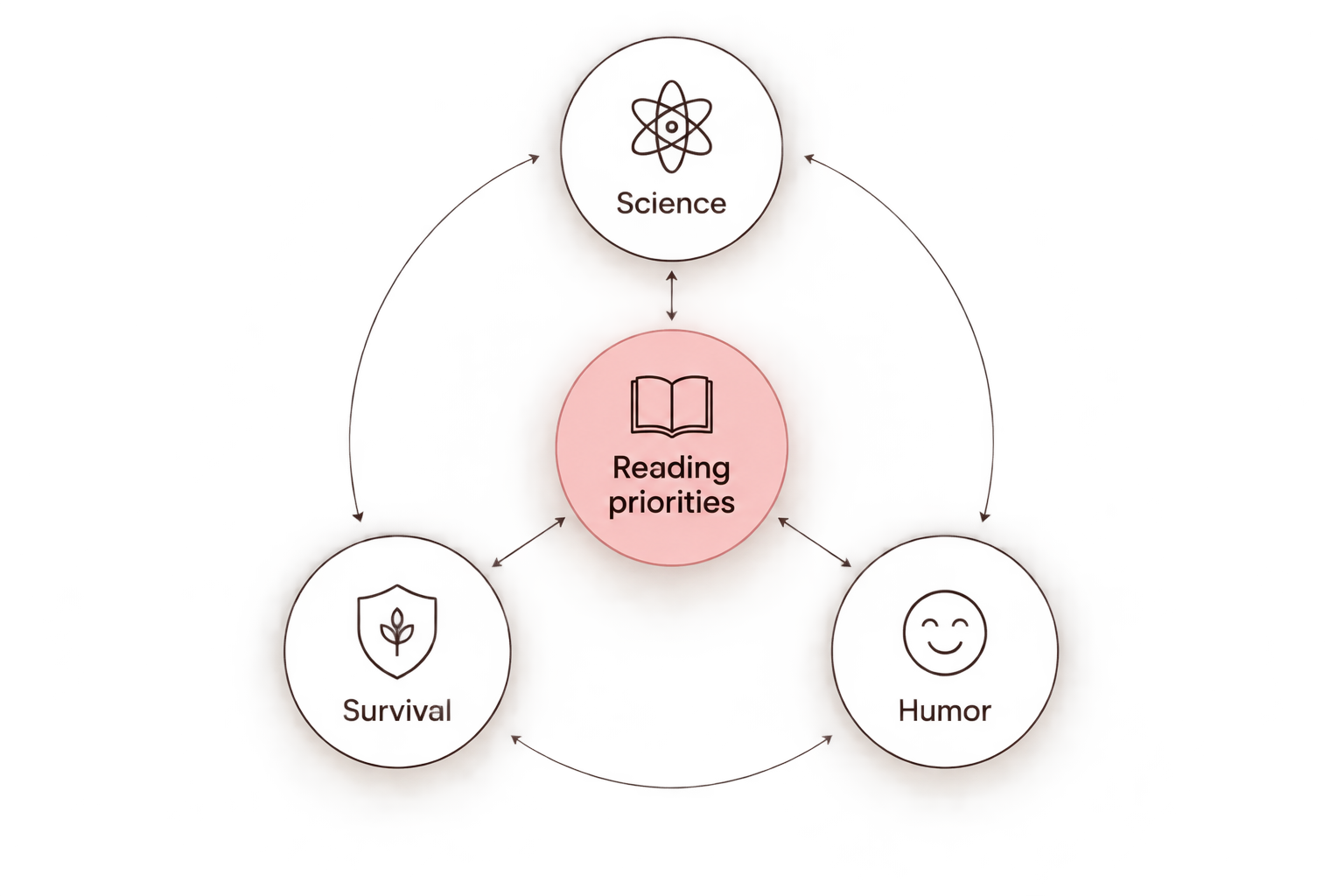
Use these three priorities to make the final choice:
- Science: Start with Project Hail Mary; choose Seveneves when you want denser engineering.
- Survival: Choose Project Hail Mary for a focused predicament or Seveneves for collective survival.
- Humor: Choose All Systems Red when the narrator matters more than the technical explanation.
Which book should you choose?
Start with Project Hail Mary. It preserves the strongest combination of explanation, experimentation, danger, and humor. If you have already read it, move to Artemis for another Weir novel or Seveneves for a more demanding engineering story.
For your 2026 reading list, avoid treating “hard science fiction” as a complete recommendation. That label does not tell you whether a book is funny, intimate, slow, or focused on an ensemble.
For a broader selection, give GetSimilarBooks 1 title you enjoyed. The tool returns 5 hand-curated recommendations; providing your email adds a personalized list of 20–30 titles. The initial selection is useful for a quick choice, while the longer list gives you more directions to explore.
Find your next read
Start with a book you enjoyed. Get five read-alikes, plus a personalized list of 20–30 titles by email.
FAQ
What’s the closest book to The Martian?
Project Hail Mary by Andy Weir is the closest overall match on this list. It combines scientific problem-solving, accessible explanations, survival pressure, and a humorous narrator, while moving further into speculative science.
Should I read Artemis or Project Hail Mary after The Martian?
Read Project Hail Mary for the closer match to The Martian’s problem-solving experience. Choose Artemis if you want technical improvisation inside a lunar heist rather than another isolated survival predicament.
Which book like The Martian has the most engineering detail?
Seveneves is the strongest choice here for sustained engineering detail and orbital survival. Its larger cast, denser explanations, and major structural shift make it a different reading experience from The Martian.
What’s a short book like The Martian?
All Systems Red by Martha Wells is the short-form choice on this list. The novella matches the appeal of a capable, sarcastic narrator under pressure, but offers less scientific explanation.
Do I need to read The Martian before Project Hail Mary?
No. The Martian and Project Hail Mary are separate novels, so you do not need to read one to understand the other. You can choose either without completing a series first.
Which recommendation is best if I dislike sarcastic narrators?
Rendezvous with Rama is the best fit here if you prefer methodical exploration to sarcastic narration. Seveneves is another option when detailed engineering matters more to you than a conversational first-person voice.
Are these still useful recommendations in 2026?
Yes. This 2026 list ranks books by their specific similarities to The Martian rather than by publication recency. The deciding factors are scientific problem-solving, survival pressure, readability, and narrative voice.
One last thing
Your next read does not need to improve on The Martian in every way. It needs to preserve the part you are not finished with: the experiment, the isolation, or the joke after something breaks.
Write that preference beside the title before requesting recommendations. “More science, less banter” is a more useful instruction than “more space books.”
Related guides
- Books like Project Hail Mary, closest match first
- Books like Project Hail Mary with humor in the science
- Is Project Hail Mary hard science fiction?
- How to find similar books without spoilers
Leave a Reply