How many books are in the Harry Potter series?
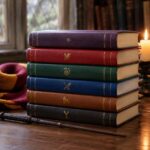
There are 7 books in the main Harry Potter series by J. K. Rowling as of 2026, beginning with Harry Potter and the Sorcerer’s Stone and ending with Harry Potter and the Deathly Hallows. That count excludes Harry Potter and the Cursed Child, a stage-play script, and companion books about the wizarding world. Read the 7 novels in publication order for the complete original story; you do not need the extras.
- How many books are in the Harry Potter series? There are 7 main novels, read in publication order.
- Harry Potter and the Cursed Child continues the story as a play script, not an eighth novel.
- The Sorcerer’s Stone and the Philosopher’s Stone are regional titles for the same first book.
- Companion books add wizarding-world background but are not required to understand the original series.
Why this matters
A shelf of Harry Potter editions can make a finished series look much bigger than it is. Illustrated editions, regional titles, scripts, and companion books do not all represent additional installments in Harry’s original story.
Count distinct novels, not covers or formats. If you are choosing the series for a child, length is only part of the decision: the later books contain darker material. The guide to whether Harry Potter is appropriate for 8-year-olds addresses that separate question.
How many books are in the Harry Potter series?
The main Harry Potter series contains 7 novels. The table below gives the reading order without revealing major plot developments. The order is the same for a first-time reader in 2026 as for someone rereading the original story.
| Reading order | Book title | What to expect, without spoilers |
|---|---|---|
| 1 | Harry Potter and the Sorcerer’s Stone | Harry discovers the wizarding world and begins attending Hogwarts. Published as Philosopher’s Stone in the UK. |
| 2 | Harry Potter and the Chamber of Secrets | A school mystery builds on the people, places, and rules introduced in the first book. |
| 3 | Harry Potter and the Prisoner of Azkaban | Harry learns more about his family’s past as the world outside Hogwarts becomes more important. |
| 4 | Harry Potter and the Goblet of Fire | A magical competition expands the setting and marks a shift toward greater danger. |
| 5 | Harry Potter and the Order of the Phoenix | Institutional conflict, resistance, and Harry’s growing frustration take a larger role. |
| 6 | Harry Potter and the Half-Blood Prince | Earlier history becomes central to understanding the conflict ahead. |
| 7 | Harry Potter and the Deathly Hallows | The central conflict reaches its conclusion, with a structure that breaks from the usual school-year pattern. |
Start with Sorcerer’s Stone and follow the table downward. Later novels assume you know earlier relationships, discoveries, and consequences. Reading a synopsis instead of an installment preserves some information but removes the gradual development that gives later scenes their weight.
The opening books also establish details that become significant later. You do not need to identify those details in advance. Let the books supply them in order rather than searching for explanations that reveal future events.
Main novels: 7 books
The 7 main novels are the best fit if you want Harry’s original story from beginning to end. They form a connected sequence rather than a collection of independent adventures. Individual books resolve immediate problems, but the larger conflict continues across the series.
The strength of reading all seven is continuity: friendships, rivalries, and apparently small discoveries accumulate meaning. The limitation is commitment. You cannot jump to a later installment and expect every relationship or revelation to carry the same force.
The tone also changes. The early books give more space to discovery, school routines, and contained mysteries; the later books spend more time on grief, manipulation, prejudice, and war. That progression matters when you are choosing a read-aloud or deciding whether to continue immediately with a younger reader.
There is no requirement to read the entire series without a break. Finish an installment, consider its tone, and decide whether the next book suits the reader now. A complete series does not have to become an uninterrupted reading project.
Main novels plus Cursed Child: 8 works, not 8 novels
If you add Harry Potter and the Cursed Child to the original series, you have 8 works: 7 novels and 1 stage-play script. That is a broader reading list, not a revised count of the main novels.
Cursed Child takes place after the original series and follows the next generation as well as familiar characters. The play is by Jack Thorne, based on an original story by J. K. Rowling, John Tiffany, and Jack Thorne. Its format matters as much as its position in the timeline.
Best for: readers who specifically want a later-set stage story. Dialogue and stage directions carry the action, rather than the descriptive narration of the novels. That makes it a different reading experience, not simply another volume written in the same style.
Read it after Deathly Hallows if you choose to include it. Starting there exposes information about where characters end up. Skip it if your goal is only to finish the original seven-book narrative; that narrative already has an ending.
The play’s two-part structure does not make it two additional main-series novels. When checking an edition, distinguish the structure of the production from the number of books in Harry’s original story.
Companion collection: 3 books outside the main sequence
The Hogwarts Library collection brings together 3 companion books: Fantastic Beasts and Where to Find Them, Quidditch Through the Ages, and The Tales of Beedle the Bard. None is a numbered installment in the original sequence.
These books explore material connected to the fictional world. They do not continue Harry’s school years in the way the main novels do. Choose one for its subject, not because you think it is a missing chapter of the central story.
| Companion book | Best for | Meaningful difference from the novels |
|---|---|---|
| Fantastic Beasts and Where to Find Them | Readers interested in magical creatures | A fictional reference book, not a Harry-centered adventure |
| Quidditch Through the Ages | Readers interested in the wizarding sport | Background and sporting history rather than a continuing plot |
| The Tales of Beedle the Bard | Readers interested in wizarding folklore | A collection of tales rather than a full-length series installment |
The benefit is extra texture. The limitation is that these books will not replace the experience of following Harry, Ron, and Hermione through another sustained adventure.
For a first read in 2026, the simplest approach is to finish the novels before exploring the companion collection. In particular, The Tales of Beedle the Bard has connections to the final novel that are easier to appreciate afterward.
Why the Harry Potter book count varies
Different counts usually answer different questions. Someone counting the original narrative gets a different result from someone counting every related publication on a shelf.
- Main novels: The original sequence contains 7 distinct novels. This is the answer to the usual series-count question.
- Stage script: Adding Cursed Child produces a broader list, but it does not turn the script into a novel.
- Companion books: Fictional textbooks and folklore collections expand the setting without extending the numbered sequence.
- Regional titles: Sorcerer’s Stone and Philosopher’s Stone identify the same first installment, not separate adventures.
- Formats and adaptations: Illustrated editions, audiobooks, ebooks, and films should not be counted as new main-series novels.
The useful distinction is between the story, its continuation in another medium, and background material. Keep those categories separate when choosing what to read.
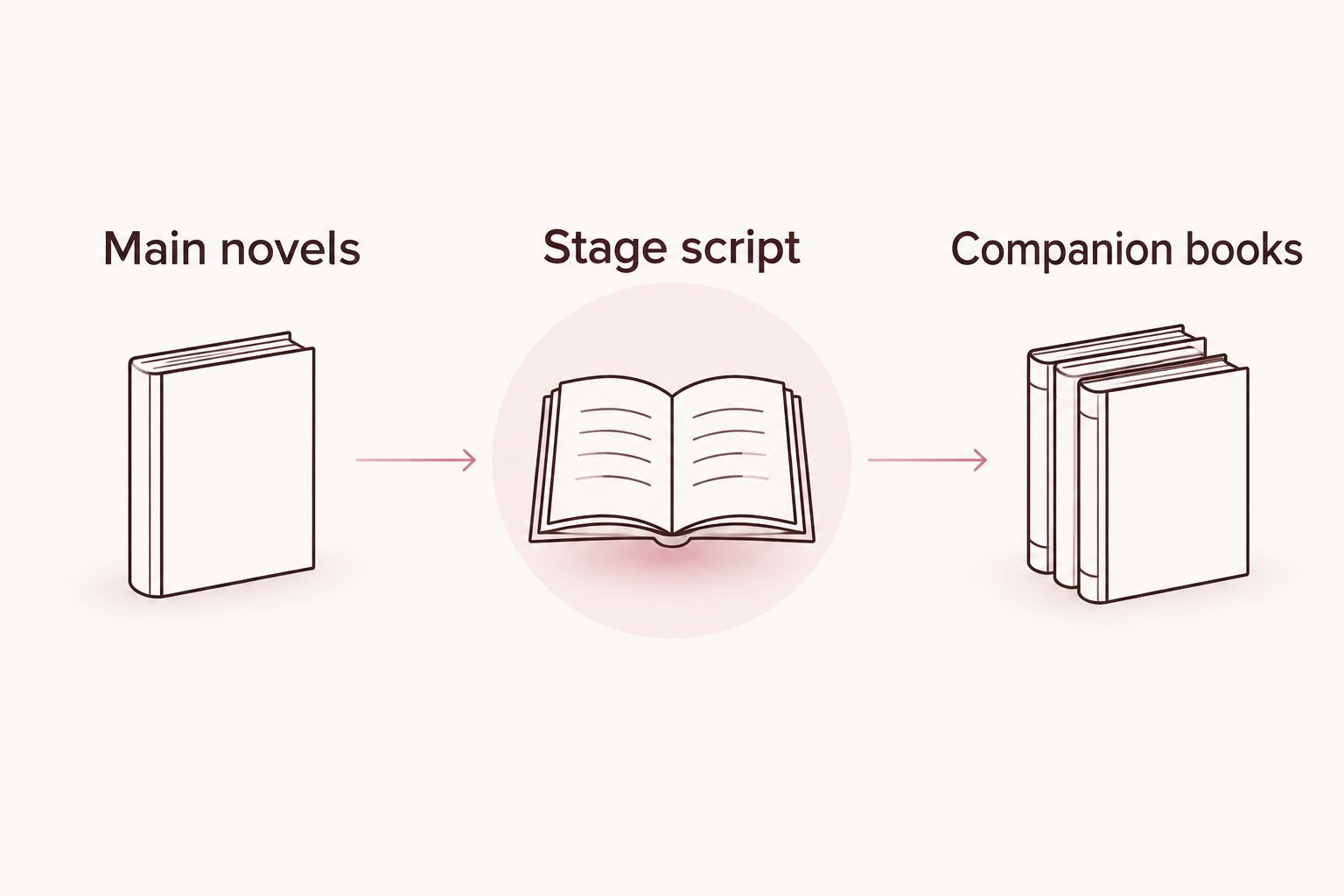
For a 2026 reading checklist, write down the seven titles rather than relying on a retailer’s collection name. A collection can include extra material, and a matching set of covers tells you little about which distinct works it contains.
Are there 7 or 8 Harry Potter books?
There are 7 main Harry Potter novels, or 8 works if you deliberately include the Cursed Child play script. Say which category you mean rather than treating both totals as interchangeable.
The original novel sequence ends with Deathly Hallows. A later-set story does not make that ending incomplete.
Why are there 8 Harry Potter movies but 7 books?
There are 7 main books, but the film adaptation of Deathly Hallows is split into two movies. That produces 8 films adapting the original novel sequence.
The split happened in the adaptation, not in the novels. You do not need to find a separate Deathly Hallows Part 2 novel to finish reading.
Do I need to read anything before the 7 Harry Potter books?
The 7 Harry Potter books need no prequel or companion reading. Begin with Sorcerer’s Stone, also titled Philosopher’s Stone, and let the first novel introduce the setting.
If you have already watched the films, the same order still works. Familiarity with the screen story does not replace the relationships, explanations, and smaller developments presented in the books.
After the seventh book, choose what you want to keep
Finishing Harry Potter does not automatically mean you want another story with a magic school. You might want the friendships, the mystery running beneath everyday life, or the feeling of discovering a hidden world. Those are different reading needs.
Before choosing a follow-up, name the quality that mattered most. Also name one thing you want changed: a shorter commitment, an older cast, or a lighter tone. That gives a recommendation more direction than a shared fantasy label.
Getsimilarbooks is best for fiction readers who want read-alike book recommendations from a title they already enjoyed. At Getsimilarbooks, you can enter a book title and receive five hand-curated suggestions. The free personalized list expands that to 20–30 titles and requires an email address.
The distinction is practical: Getsimilarbooks helps you choose your next book; it is not needed to work out the Harry Potter reading order. Finish the original sequence first if completing Harry’s story is your goal.
FAQ
How many books are in the Harry Potter series in 2026?
There are 7 books in the main Harry Potter novel series in 2026. The count excludes the Cursed Child play script, companion books, and alternative editions.
What are the Harry Potter books in order?
Read Sorcerer’s Stone, Chamber of Secrets, Prisoner of Azkaban, Goblet of Fire, Order of the Phoenix, Half-Blood Prince, and Deathly Hallows. In the UK, the first book is titled Philosopher’s Stone.
Is Harry Potter and the Cursed Child the eighth book?
Harry Potter and the Cursed Child is a later-set stage-play script, not an eighth main-series novel. Read it after the original seven books if you want to include the stage story.
Are Philosopher’s Stone and Sorcerer’s Stone different books?
Philosopher’s Stone and Sorcerer’s Stone are regional titles for the same first Harry Potter installment. You do not need to read both to complete the series.
Do the Fantastic Beasts books count as Harry Potter novels?
Fantastic Beasts and Where to Find Them is a companion book, not one of the 7 main Harry Potter novels. Related film screenplays also sit outside the original novel sequence.
Can I stop reading after Deathly Hallows?
Yes. Deathly Hallows concludes the central story told across the 7 original novels. Companion books and the Cursed Child script are optional additional reading.
Why do some Harry Potter collections contain more than seven books?
A collection can combine the original novels with scripts, companion books, or other editions. Check the individual titles rather than using the number of volumes to identify the main series.
Can a recommendation tool help me after Harry Potter?
Getsimilarbooks offers book recommendations based on a title you enjoyed. You receive five hand-curated suggestions, with a free personalized list of 20–30 titles available after providing an email address.
One last thing
Do not count Philosopher’s Stone and Sorcerer’s Stone twice. That single title difference can make a reading checklist look as though it contains a missing installment. Check the order number, not just the wording on the cover.
For your 2026 reading list, keep the task simple: seven original novels first, optional extras afterward. Then choose your next series by what you loved, not by whether its cover promises another school of magic.
Related guides
- Books like Harry Potter for middle schoolers
- Books like Harry Potter for adult readers
- Books like Harry Potter with darker themes
Leave a Reply