
Paul Allsbrook, GetSimilarBooks Editor
Books like Verity for readers avoiding child-harm themes

For Verity readers, read-alike selection is matching psychological suspense to your content boundaries, with the aim of finding an unsettling next book without crossing them. For a 2026 shortlist, consider The Woman in Cabin 10, The Writing Retreat, and Zero Days as adult-centered candidates—not as verified child-harm-free recommendations.
- For books like Verity without child harm, screen content before treating an adult-centered premise as a match.
- The Woman in Cabin 10 is the closest candidate for isolation, suspicion, and a narrator whose account faces doubt.
- The Writing Retreat matches the writing pressure; Zero Days matches the relationship-driven danger.
- GetSimilarBooks suits fiction readers seeking hand-curated read-alikes, not a guarantee that a book meets a content boundary.
If attraction and mistrust matter more than the writing premise, start with books like Verity with romance at the center. Apply the content checks below to those recommendations too.
Why careful read-alike selection matters for Verity readers
A close match is not automatically a suitable match. Verity combines an intimate relationship, a writing assignment, competing accounts, and disturbing family material. You can want the first three without wanting the fourth.
That distinction should shape your search. A recommendation based only on shocking revelations or domestic secrets does not answer a request to avoid child-harm themes. It matches the mood while overlooking the boundary.
For your 2026 reading list, separate two decisions: whether a book recreates the reading experience you enjoyed, and whether its content is acceptable to you. Neither decision replaces the other.
The shortlist here identifies specific similarities and meaningful differences. It does not certify the absence of child harm. An adult-centered premise is a starting point, not content clearance.
Choose your next book without losing the boundary
Define what child harm includes for you
Write your exclusion before choosing a title. Child harm can mean an event shown on the page, a remembered experience, a threat, or an event mentioned briefly. Those are different reading boundaries, and a useful content check must distinguish them.
You do not need to justify the boundary. You do need language precise enough that another reader can answer your question without guessing what counts.
For example, asking whether a book contains graphic violence against children is narrower than asking whether any child is harmed, threatened, or bereaved. Include pregnancy-related material separately if it falls within your boundary; do not assume someone else will include it automatically.
- Specify whether brief references count.
- Include past events if backstory matters to you.
- State whether threats count even without injury.
- Name pregnancy-related exclusions separately, if relevant.
- Decide whether a yes-or-no answer is enough.
Start with The Woman in Cabin 10 for isolation and doubt
Best for: readers who want a confined setting and a contested account. Ruth Ware's The Woman in Cabin 10 follows travel journalist Lo Blacklock aboard a luxury cruise. Lo believes she has witnessed a woman being thrown overboard, but the passenger accounting does not support her account.
The Verity connection is the experience of reading under uncertainty. You follow a woman whose observations become difficult to establish, while the setting limits her freedom to step away. That makes it a closer starting point for suspicion and claustrophobia than for the romantic storyline.
The meaningful difference is the source of pressure. Verity places that pressure inside a household and a writing arrangement. The Woman in Cabin 10 builds its central mystery around a voyage and an apparent crime. Do not choose it expecting the same degree of romantic focus.
Its premise involves violence and danger. That description is not a complete content inventory, so verify your specific child-harm exclusions before reading.
- Choose it for isolation and uncertainty.
- Expect a mystery-led story rather than romance-led suspense.
- Check references and backstory, not only the central crime.
- Ask for content information without the ending.
Verdict: Hold until your content check clears it.
Try The Writing Retreat for the writer-under-pressure premise
Best for: readers drawn to the writing assignment and unequal power. Julia Bartz's The Writing Retreat follows aspiring novelist Alex at a retreat hosted by author Roza Vallo. The opportunity places writing, ambition, and pressure inside an isolated setting.
The connection to Verity is specific: a writer enters an arrangement that promises professional advancement, while the circumstances become increasingly unsettling. Creative work is part of the machinery of suspense, not merely the protagonist's occupation.
The difference matters just as much. The Writing Retreat centers a group of writers and the authority of their host. It is not a substitute for Verity's central romantic dynamic. Its horror elements also make it a different kind of reading experience from a straightforward psychological mystery.
Treat sexual content, violence, and horror as separate checks alongside your child-harm boundary. Approval on one category does not answer the others.
- Choose it for writing pressure and professional ambition.
- Expect group dynamics rather than a central couple.
- Check horror-related content separately from violence.
- Request warnings covering the whole novel.
Verdict: Hold until your content check clears it.
Choose Zero Days for relationship-driven danger
Best for: readers who want intimate stakes without another household mystery. Ruth Ware's Zero Days follows security tester Jack Cross after her husband is murdered and suspicion falls on her. The story moves into pursuit, investigation, and survival.
Its connection to Verity is less about setting and more about consequence. An intimate relationship becomes the center of a dangerous mystery, and the protagonist must work out whom to trust. Choose it when that emotional pressure matters more than manuscripts or an isolated house.
The difference is pace and structure. Zero Days is a fugitive thriller with a technical-security setting. It does not offer the same enclosed, document-driven reading experience as Verity, and it should not be presented as a close romance match.
A premise focused on adults still needs a full-book content check. Check memories, passing references, and secondary characters rather than assuming the main investigation tells you everything.
- Choose it for pursuit and relationship-driven stakes.
- Expect action and investigation rather than a central romance.
- Check secondary material as well as the main plot.
- Keep it behind the closer matches if atmosphere comes first.
Verdict: Hold until your content check clears it.
Check the whole book before committing
A publisher description tells you the premise. It is not designed to list every disturbing event, and a spoiler-free review can omit exactly the information you need.
For your 2026 shortlist, use reader-submitted content warnings, detailed reviews, and a direct question to someone who has finished the book. Read the wording carefully. A warning marked as a reference means something different from a scene described on the page.
Ask whether the answer covers the entire book, including remembered events and the ending. If the response is uncertain, keep the title on hold rather than interpreting silence as reassurance.
You can also ask a trusted reader to screen the book for you. Give that person your written boundary and request only a pass, a fail, or a request for clarification. You do not need a plot explanation to make the decision.
- Search the title with your exact excluded theme.
- Compare detailed warnings with reader explanations.
- Distinguish depicted events from mentions and threats.
- Ask a reader who has finished the whole book.
- Leave uncertain titles on hold.
Expand the shortlist only after naming the match
Start manually: write down what you want to keep from Verity and what you want excluded. A library catalog, a bookseller conversation, or a request to a trusted reader becomes more useful when you separate those two lists.
For a faster read-alike starting point, GetSimilarBooks accepts a title you enjoyed and returns 5 hand-curated suggestions. A free personalized list of 20–30 titles is available behind an email submission.
GetSimilarBooks is best for fiction readers who want hand-curated read-alikes. The recommendation format gives you candidates; it does not establish that every candidate satisfies a child-harm exclusion. Keep the content-screening step separate.
For your 2026 search, describe the positive match as precisely as the restriction. Wanting an unreliable account, an isolated setting, and a dangerous attraction is more useful than wanting another dark thriller. You can then reject a candidate for content without losing sight of why it interested you.
- Name the feature you want to repeat.
- List non-negotiable exclusions separately.
- Use the 5 suggestions as an initial shortlist.
- Request the longer list if you want more candidates.
- Screen each title before moving it to your reading list.
Find your next read-alike
Get five hand-curated suggestions, then request a free personalized list of 20–30 titles by email.
Compare the three starting options
These books are ordered from the closest match for enclosed suspicion toward a broader match for relationship-driven danger. The order is about reading experience, not a ranking of content safety. None receives an automatic clearance for your boundary.
| Option | Best for | Specific Verity connection | Key limitation |
|---|---|---|---|
| The Woman in Cabin 10 by Ruth Ware | Adult suspicion | A confined setting and an account other people dispute | Mystery-led rather than romance-led; requires a full content check |
| The Writing Retreat by Julia Bartz | Writing pressure | A writing opportunity becomes an unsettling power arrangement | Group dynamics and horror differ from Verity's romantic focus; requires a full content check |
| Zero Days by Ruth Ware | Fugitive suspense | An intimate relationship sits at the center of danger | Action and investigation replace the enclosed writing premise; requires a full content check |
Reading priorities
Choose Adult suspicion if you want to question what happened. Choose Writing pressure if the creative assignment interested you. Choose Fugitive suspense if you want a relationship to supply the stakes while the plot moves outside the home.
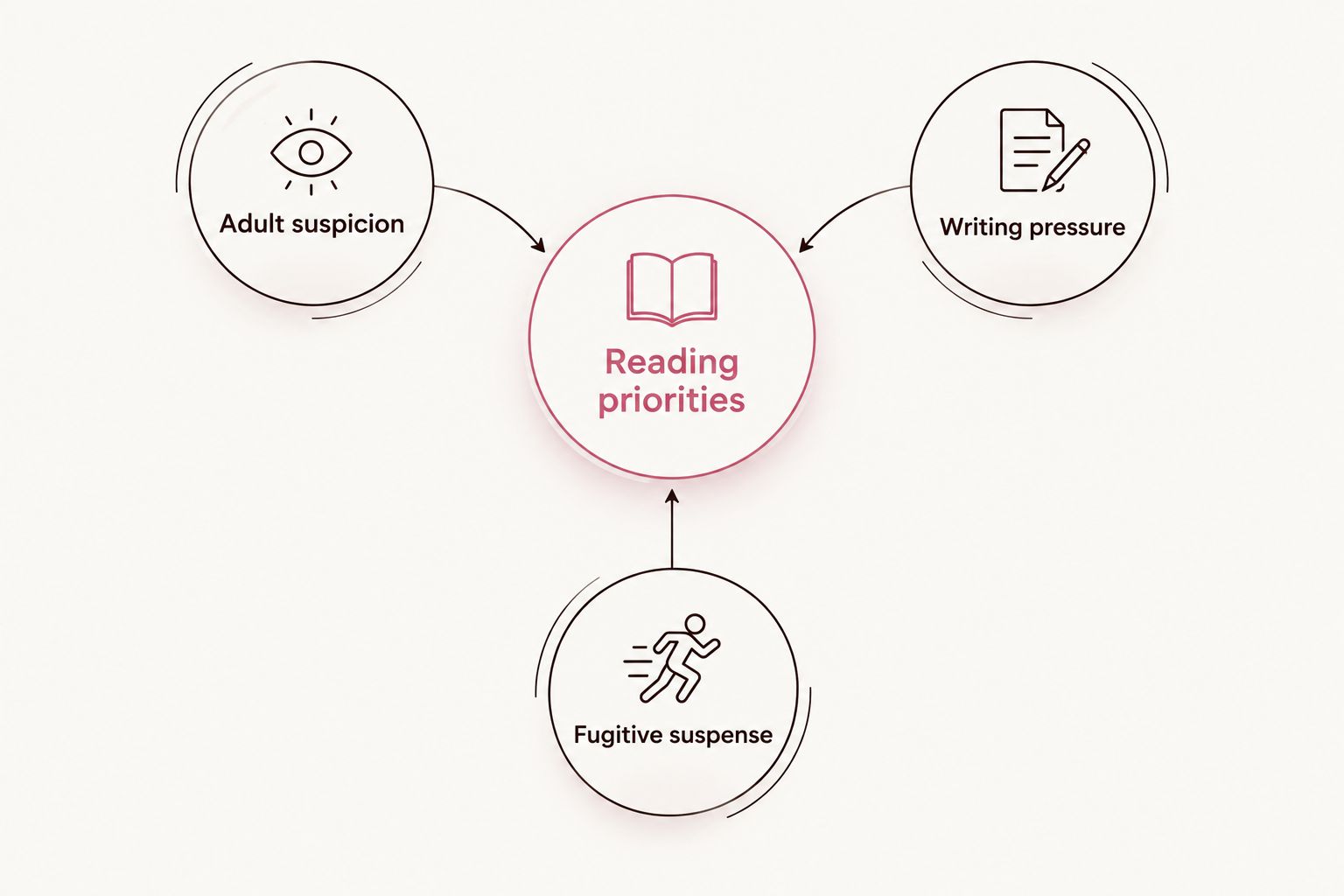
Common mistakes Verity readers make
Treating no graphic scenes as no child harm
A book can avoid graphic description while still making a child's suffering important to the story. If references, aftermath, or threats are also off-limits, say so. Otherwise, a well-intended answer can address a narrower question than yours.
Using adult protagonists as a safety filter
The main characters' ages do not describe every event in a novel. Adult thrillers can include childhood memories, family histories, and secondary plots. Screen the whole book rather than relying on the cast listed in the synopsis.
Choosing the closest match before checking the boundary
A recommendation that recreates Verity's family material can be a poor choice for this search, even if it matches the atmosphere closely. Content suitability comes before similarity. Remove an unsuitable title rather than trying to talk yourself into the match.
Asking for every twist to be explained
You need enough information to decide, not a summary of the ending. Ask whether your excluded material appears and, only if necessary, whether it is depicted, threatened, remembered, or mentioned. That keeps the answer useful without spoiling unrelated revelations.
FAQ
What are the best books like Verity without child harm?
The Woman in Cabin 10, The Writing Retreat, and Zero Days are adult-centered candidates to screen, not verified child-harm-free recommendations. Choose by the quality you want from Verity, then check your exact exclusions across the whole book.
Which book is closest to Verity for atmosphere rather than romance?
The Woman in Cabin 10 is the closest starting point here for confinement, suspicion, and a disputed account. Its central mystery takes priority over romance, and it still needs a separate content check.
Which recommendation matches the writing part of Verity?
The Writing Retreat matches the writing opportunity and unequal power arrangement. Its group dynamics and horror elements make it different from Verity’s central romantic setup.
Does an adult-centered thriller mean no children are harmed?
No. An adult-centered premise does not establish what appears in backstory, secondary plots, references, or later revelations. Check the full book against your specific boundary.
How do I check for child harm without spoiling the ending?
Ask someone who has finished the book for a yes-or-no answer against a written list of exclusions. Request details only about whether the material is depicted, threatened, remembered, or mentioned.
Can I use GetSimilarBooks to find my next thriller?
Yes. GetSimilarBooks provides five hand-curated read-alike suggestions from a title you enjoyed, plus an email-gated personalized list of 20–30 titles. Treat those titles as candidates and verify content boundaries separately.
One last thing
For your 2026 reading list, choose the suspense mechanism before the genre label. A disputed account, a pressured writer, and a dangerous investigation create different kinds of tension, even when all three sit on the thriller shelf.
You do not need another version of every part of Verity. Keep the part you enjoyed. Make the content boundary the first condition, not the final compromise.
Related guides
- Books like Verity with unreliable narrators
- Books like Verity without a romance plot
- Books like Verity set somewhere you cannot easily leave
Books like Verity with endings open to interpretation

Best overall: My Cousin Rachel by Daphne du Maurier. Best for competing accounts: A Head Full of Ghosts by Paul Tremblay. Best for supernatural uncertainty: The Turn of the Screw by Henry James. These books like Verity with ambiguous endings leave you weighing evidence rather than simply waiting for a final twist.
- My Cousin Rachel leads these books like Verity with ambiguous endings: attraction and suspicion make the same evidence look different.
- A Head Full of Ghosts suits readers who want competing accounts, family tension, and uncertainty about what to believe.
- The Turn of the Screw prioritizes supernatural uncertainty; Rebecca offers moral ambiguity rather than an equally unresolved mystery.
- GetSimilarBooks offers five hand-curated read-alikes, with an email-gated personalized list of 20–30 titles for readers seeking more.
An ambiguous ending is not the same as an unexplained twist. This 2026 shortlist favors books that give you reasons to argue with your own interpretation. If you want recommendations built around a title you already enjoyed, Getsimilarbooks starts with five hand-curated suggestions.
Why this matters
Verity makes you reconsider the relationship between a written account, a person's behavior, and your willingness to believe either. The useful match is not simply another thriller with a shocking last chapter. It is a book in which the evidence stays uncomfortable after the action ends.
My Cousin Rachel is the best next read for Verity readers who want attraction to interfere with judgment. It puts uncertainty inside the relationship rather than saving all its work for a closing reveal.
The five recommendations below move from intimate suspicion toward supernatural uncertainty and, finally, moral unease. They do not all reproduce Verity's romance or sexual content. That difference matters as much as the match.
What makes the best ambiguous-ending read-alike?
For this 2026 reading list, the ranking rests on five qualities:
- Ambiguity: More than one interpretation has support in the text. Missing information alone is not enough.
- Narrative trust: The person telling the story has limits, interests, or emotional blind spots you must consider.
- Domestic pressure: A household or family relationship makes uncertainty difficult to escape.
- Romantic weight: Attraction changes judgment rather than appearing as an unrelated subplot.
- Meaningful closure: The story reaches an ending even when its meaning remains unsettled.
These criteria separate a close read-alike from a book that merely shares a thriller label. A novel can match Verity's distrust while offering very little romance. Another can match its relationship tension but settle more of the factual mystery.
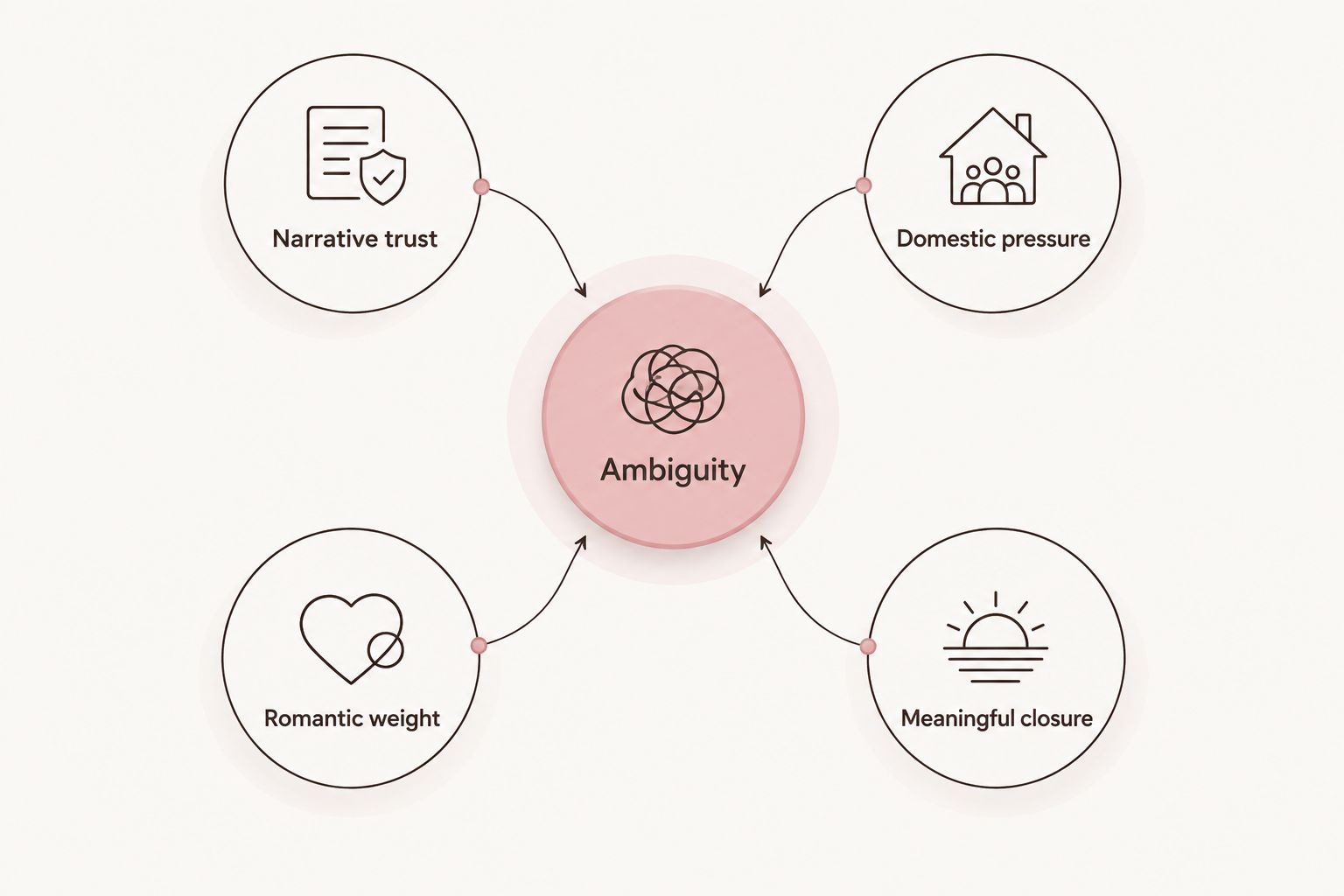
Books like Verity at a glance
The table distinguishes the kind of uncertainty each book offers. Choose the question you want to keep thinking about, not just the setting you recognize.
| Book | Best for | Standout matching quality | Key limitation |
|---|---|---|---|
| My Cousin Rachel — Daphne du Maurier | Attraction tangled with suspicion | Intimate judgment shaped by desire and incomplete evidence | Historical pacing; not a contemporary romantic thriller |
| A Head Full of Ghosts — Paul Tremblay | Competing accounts | Family experience filtered through memory, media, and interpretation | Horror takes priority over romance |
| The Turn of the Screw — Henry James | Supernatural uncertainty | An account that invites conflicting readings | Dense prose and little romantic payoff |
| The Haunting of Hill House — Shirley Jackson | Psychological and supernatural overlap | A house's influence intertwined with a character's perceptions | Atmosphere matters more than investigation |
| Rebecca — Daphne du Maurier | Moral unease within a marriage | Intimacy changes how readers judge troubling information | More factual resolution than the other picks |
1. My Cousin Rachel: best for attraction tangled with suspicion
Daphne du Maurier's My Cousin Rachel follows Philip Ashley as he tries to judge a woman already surrounded by suspicion. His response to Rachel becomes inseparable from his feelings about her. You have to assess the evidence and the person interpreting it.
That is the closest match to Verity here. Desire does not sit beside the mystery; it changes what looks persuasive. A gesture that seems reassuring under one reading becomes troubling under another.
The difference is the book's historical setting and patient development. Expect sustained doubt rather than a contemporary thriller's sequence of urgent reversals. Its uncertainty asks you to examine judgment, not decode a hidden answer from a single clue.
My Cousin Rachel pros:
- Attraction directly affects the narrator's assessment of evidence.
- Domestic intimacy makes suspicion personal rather than abstract.
- The unresolved question remains central to the reading experience.
My Cousin Rachel cons:
- The pace is measured rather than breathless.
- Readers seeking Verity's explicit sexual content will find a different register.
Best for: Readers who want to finish a book and immediately reconsider whether they trusted the right person.
Verdict: Read My Cousin Rachel first. It is the default choice on this 2026 list when romantic fixation and uncertain guilt matter equally.
2. A Head Full of Ghosts: best for competing accounts
Paul Tremblay's A Head Full of Ghosts centers on a family whose distress becomes the subject of a reality television production about an apparent possession. Retrospective storytelling and commentary complicate how that experience reaches you. The telling is part of the problem.
For a Verity reader, the match is the tension between a convincing account and the reasons to distrust it. Different ways of describing the same family produce different judgments. Public spectacle adds another layer: what makes a compelling story is not necessarily what establishes the truth.
This is horror, not a romance-led thriller. Its family relationships carry the emotional pressure, and its disturbing material is not limited to an eerie atmosphere. Brief content note: child endangerment, family trauma, and religious horror.
A Head Full of Ghosts pros:
- Competing interpretive frames give you something concrete to weigh.
- Family vulnerability keeps the uncertainty emotionally consequential.
- The narrative's construction rewards attention to who controls an account.
A Head Full of Ghosts cons:
- Romance is not the reason to choose it.
- Its commentary on horror and media interrupts a purely immersive reading experience.
Best for: Readers whose favorite part of Verity was deciding which version of events deserved belief.
Verdict: Read A Head Full of Ghosts for a dispute about evidence, not a replacement love story. It is the strongest contemporary horror fit on this shortlist.
3. The Turn of the Screw: best for supernatural uncertainty
Henry James's The Turn of the Screw places a governess in charge of children at an isolated country estate. Her account of disturbing events gives readers the central problem: how should her perceptions be understood? The narration offers no neutral vantage point from which to settle everything.
The connection to Verity is structural. You receive a powerful account from someone whose interpretation requires scrutiny, while the household's intimacy raises the stakes. The story makes reading itself an act of judgment.
The meaningful difference is the prose. James works through elaborate sentences, implication, and qualification rather than contemporary thriller momentum. Treating the novella as a race toward an explanation misses much of its effect.
The Turn of the Screw pros:
- The narrator's perspective is essential to the uncertainty.
- The confined household creates sustained pressure.
- Supernatural and psychological readings give discussion a clear focus.
The Turn of the Screw cons:
- The language demands more concentration than Verity's.
- Romantic tension does not deliver a conventional romance arc.
Best for: Readers who want to debate what an apparently authoritative narrator can actually establish.
Verdict: Read The Turn of the Screw if uncertainty matters more than speed. For your 2026 reading queue, choose it when you want a short work to read slowly, not a quick stylistic substitute for Colleen Hoover.
4. The Haunting of Hill House: best for psychological overlap
Shirley Jackson's The Haunting of Hill House brings Eleanor Vance into a group investigating a reputedly haunted house. The house's atmosphere and Eleanor's need for connection become difficult to separate. The result is uncertainty rooted in perception and belonging.
The Verity connection is the way an enclosed domestic space changes your confidence in what you are reading. A house becomes more than a backdrop. Emotional need influences how threatening or welcoming an encounter feels.
The difference is its center of gravity. Hill House is not organized around an erotic relationship or a competing written confession. It asks you to attend to loneliness, group dynamics, and the boundary between a hostile environment and a vulnerable mind.
The Haunting of Hill House pros:
- Psychological tension and supernatural unease reinforce each other.
- Eleanor's emotional investment makes interpretation matter.
- The setting contributes directly to the uncertainty.
The Haunting of Hill House cons:
- Romance is peripheral to the reading experience.
- Readers wanting a clue-by-clue investigation will find atmosphere instead.
Best for: Readers who want a disturbing house and a perspective they cannot treat as a transparent window.
Verdict: Read The Haunting of Hill House for lingering interpretive unease. Skip it as your immediate next choice if the romantic relationship was the main reason you enjoyed Verity.
5. Rebecca: best for moral ambiguity within a marriage
Daphne du Maurier's Rebecca follows an unnamed narrator who marries Maxim de Winter and enters a household still shaped by his first wife. Her insecurity influences what she notices and what she believes. Marriage does not give her a secure understanding of the person beside her.
The match to Verity is intimate and domestic: attraction, comparison, and loyalty complicate judgment. Rebecca is especially useful if your question is not just what happened, but what love encourages a person to excuse.
The qualification matters: Rebecca resolves more of its factual mystery than the other books here. Its place on this list rests on moral uncertainty and the implications of its ending, not an equally balanced set of explanations for every event.
Rebecca pros:
- The marriage carries the psychological tension.
- The narrator's insecurity shapes your access to the household.
- Troubling information changes the meaning of intimacy and loyalty.
Rebecca cons:
- It is a weaker match for readers demanding an unresolved factual mystery.
- Its suspense develops through atmosphere and social discomfort rather than constant twists.
Best for: Readers who want to question a relationship's meaning after learning more about it.
Verdict: Read Rebecca for moral unease; wait if factual ambiguity is non-negotiable. It is the outward reach of this ranking, not the closest substitute.
How these books are ranked
This ranking puts the match ahead of the shared genre. My Cousin Rachel leads because attraction and uncertain judgment work together. A Head Full of Ghosts follows because competing accounts drive its uncertainty, despite the move away from romance.
The Turn of the Screw and The Haunting of Hill House shift the question toward perception and the supernatural. Rebecca comes last because its moral aftertaste fits better than its degree of factual openness.
No ranking can tell you which interpretation to adopt. This one tells you which kind of unresolved question each book asks you to carry.
Which book should you choose?
Choose My Cousin Rachel if you want one answer. It preserves the connection between attraction, suspicion, and uncertain guilt without copying Verity's plot.
Choose A Head Full of Ghosts if accounts and counteraccounts interest you more than romance. Choose The Turn of the Screw if you want your confidence in a narrator to become the central problem. Keep Rebecca for the moment when moral discomfort matters more than an unresolved explanation.
For a personalized 2026 reading list, GetSimilarBooks lets you start with a title you enjoyed. Five hand-curated suggestions form the preview; the personalized list of 20–30 titles requires an email address.
Find your next read
Start with a book you enjoyed. Get five hand-curated suggestions, then request a personalized list by email.
FAQ
What’s the best book like Verity with an ambiguous ending?
My Cousin Rachel by Daphne du Maurier is the best fit when you want attraction, suspicion, and uncertain judgment together. Its narrator’s feelings affect how evidence is understood, making the relationship central to the ambiguity.
Which of these books has romance closest to Verity?
My Cousin Rachel most closely connects attraction with the central uncertainty. Rebecca also makes a relationship central, but it offers more factual resolution and leaves more of its unease in questions of loyalty and judgment.
Is Rebecca’s ending really ambiguous?
Rebecca is a qualified fit: its moral implications are more open than much of its factual mystery. Choose it for troubling questions about marriage and loyalty, not because it leaves every explanation equally plausible.
What should I read if I liked Verity’s conflicting accounts?
Read A Head Full of Ghosts by Paul Tremblay if conflicting accounts were your main interest. Memory, media, and retrospective interpretation complicate how a family’s experience is presented; romance is not its focus.
Are these recommendations spoiler-free?
The recommendations describe premises and the kind of uncertainty each book creates without revealing its resolution. They avoid identifying which interpretation to believe or disclosing the events that produce the ending.
Which recommendation should I choose if I don’t want much romance?
Choose The Turn of the Screw for narrator-centered uncertainty or The Haunting of Hill House for psychological and supernatural overlap. Neither is a romance-led substitute for Verity.
How does GetSimilarBooks help me choose another book?
GetSimilarBooks lets you enter a title you enjoyed and receive five hand-curated read-alike suggestions. An email-gated personalized list offers 20–30 titles for readers who want more choices.
One last thing
Before reading, write down the question you want the ending to leave open: What happened, whom should I believe, or what should I forgive? Those are different reading experiences. A recommendation that answers the wrong question will disappoint even when the atmosphere feels familiar.
After reading, separate an event you know occurred from a motive you inferred. That small distinction makes a second interpretation easier to evaluate without turning every unresolved detail into a secret clue.
Related guides
- Books like Verity with unreliable narrators
- Books like Verity with romance at the center
- Books like Verity without a romance plot
- Five unsettling reads ranked by their fit with Verity
Books like Verity about writers and hidden manuscripts

Best overall: The Ghost Writer by Alessandra Torre. Best for a secretive author's life story: The Thirteenth Tale by Diane Setterfield. Best for stolen-story anxiety: The Plot by Jean Hanff Korelitz. These books like Verity with writers put authors, private texts, and the question of who controls a story at the center.
- The Ghost Writer leads these books like Verity with writers: an assistant, a secretive novelist, and a dangerous confession.
- The Thirteenth Tale suits readers who want family secrets and a writer deciding what another writer gets to know.
- The Plot is the pick for literary theft; Disclaimer makes a disturbing novel the threat.
- GetSimilarBooks offers five hand-curated suggestions, plus a free personalized list of 20–30 titles with email signup.
The order runs from the closest writer-and-secret match outward, not from best-written to worst-written. For a different starting title, GetSimilarBooks lets you enter a book you enjoyed and receive five hand-curated read-alike suggestions.
Why this matters
Verity is not simply a thriller featuring a novelist. Lowen's access to another writer's private work changes how she understands the household around her. The manuscript becomes an accusation, but reading it does not settle what deserves belief.
That distinction shapes this 2026 reading list. A writer protagonist alone is not enough; the writing must create the danger, expose a secret, or make the reader question the account being offered.
Choose the matching mechanism before the matching mood. If you want another disturbing document, your next book is different from the one you need for professional envy or a secretive author's house.
What makes the best books like Verity with writers?
These criteria separate a close read-alike from a thriller that happens to mention publishing:
- Writer access: A writing assignment, biography, or professional relationship gives someone access they would not otherwise have.
- Private text: A manuscript, confession, draft, or letter changes what a character believes about real events.
- Trust gap: The written account and the surrounding evidence do not fit neatly together.
- Emotional stakes: Reading or publishing the text threatens a relationship, a reputation, or someone's safety.
- Meaningful difference: Each recommendation has a clear departure from Verity, whether that is less romance, slower pacing, or a more literary structure.
The first four criteria describe the attraction. The last prevents a false promise: none of these novels recreates every part of Colleen Hoover's book.
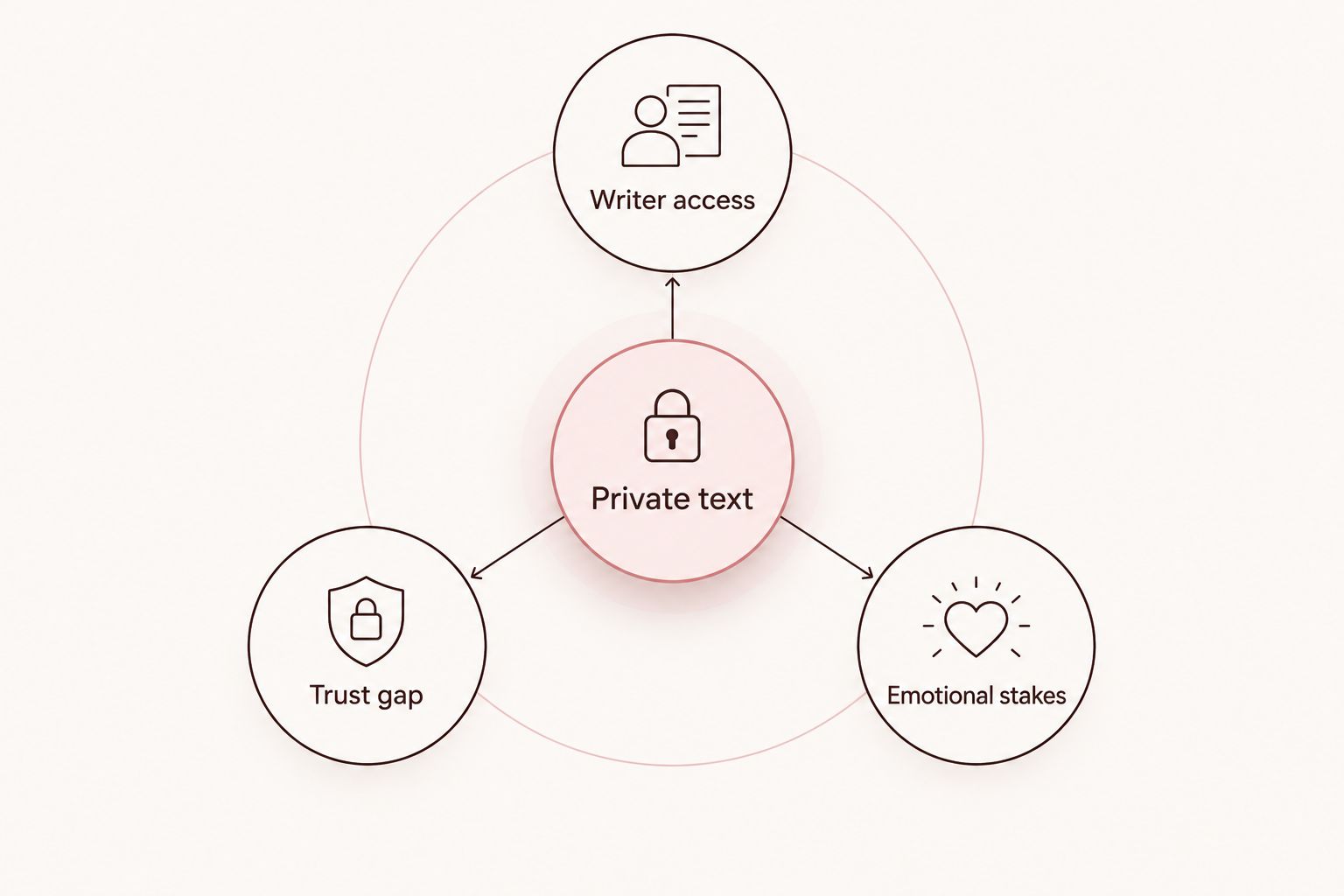
The five books at a glance
Use this comparison to choose your next read in 2026. The differences matter as much as the similarities, especially if romance was central to your experience of Verity.
| Rank and book | Best for | Standout match | Key limitation |
|---|---|---|---|
| 1. The Ghost Writer — Alessandra Torre | An assistant uncovering a novelist's confession | A writing job becomes access to a concealed personal story | Less focused on an erotic romantic triangle |
| 2. The Thirteenth Tale — Diane Setterfield | A secretive author's family history | A biographer must interpret the account she is given | More gothic and deliberate than a fast domestic thriller |
| 3. The Plot — Jean Hanff Korelitz | Literary theft and professional fear | A successful novel creates a threatening connection to its source | Career anxiety replaces romantic obsession |
| 4. Disclaimer — Renée Knight | A novel that exposes private history | A fictional text appears to know a reader's buried past | The threatened reader, not a hired writer, is central |
| 5. The Woman in the Library — Sulari Gentill | Drafts, letters, and layered storytelling | Correspondence surrounds an unfolding murder manuscript | More structurally playful than emotionally similar |
1. The Ghost Writer: best for an assistant and a novelist's confession
The Ghost Writer by Alessandra Torre is the closest fit if the writing assignment was your favorite part of Verity. Novelist Helena Ross is dying and hires another writer to help finish a final book. What she intends to tell is a confession, not another ordinary work of fiction.
The match is the access. A professional arrangement brings another writer close to a guarded woman's private history, and the work requires listening to material that changes the meaning of her life. Writing is not background decoration; it is the reason the hidden account can emerge.
The important difference is emotional emphasis. The Ghost Writer directs attention toward Helena's account and the burden of telling it. Do not choose it expecting Lowen's romantic situation to repeat under different names.
The Ghost Writer pros:
- A novelist's concealed history drives the central premise.
- The assistant relationship makes access to the story feel consequential.
- Confession and authorship remain closely connected.
The Ghost Writer cons:
- It is not a substitute for Verity's erotic tension.
- The confession framework gives the book a different rhythm from discovering an unattended manuscript.
Best for: Readers who want the next writing job to become something much more personal and disturbing.
Brief content note: terminal illness and disturbing family material are central to the setup. Choose another entry if those subjects are your main exclusions.
For this 2026 shortlist, start here when you want the closest premise rather than the closest genre label. Verdict: Read The Ghost Writer first.
2. The Thirteenth Tale: best for a secretive author's family history
Diane Setterfield's The Thirteenth Tale brings biographer Margaret Lea into the orbit of celebrated author Vida Winter. Winter has repeatedly offered invented accounts of her past; now she wants Margaret to record her story. The assignment opens onto a family history shaped by secrecy.
The connection to Verity is the problem of receiving someone else's account from inside their world. Margaret must listen, investigate, and decide how the pieces belong together. The author's authority does not remove the need for scrutiny.
The Thirteenth Tale is the better choice when you want the novelist's past to occupy the whole room. Its gothic atmosphere and attention to storytelling matter more than romantic suspense. The house, the family, and the act of telling carry the pressure.
The Thirteenth Tale pros:
- The relationship between storyteller and biographer is central.
- Family secrets give the writing assignment emotional weight.
- The novel sustains questions about identity and the ownership of a life story.
The Thirteenth Tale cons:
- Its pace is more deliberate than Verity's.
- It does not reproduce Verity's sexual tension or contemporary domestic setup.
Best for: Readers who want a secretive author, a listening outsider, and a gothic family history.
Brief content note: disturbing family relationships and violence belong to the story. The appeal is not a hidden document alone, but the difficulty of turning another person's account into something you can trust.
Choose it when atmosphere matters more than speed. Verdict: Read The Thirteenth Tale for the author's secrets, not the romance.
3. The Plot: best for literary theft and professional fear
Jean Hanff Korelitz's The Plot follows struggling writer Jacob Finch Bonner. After learning that a former student has died, Jacob uses the student's striking story idea in a novel of his own. Success brings an anonymous accusation that he has stolen the story.
The shared ground with Verity is professional vulnerability. A writer's relationship to a text becomes dangerous because the text has a history that cannot simply be edited away. Authorship turns into a question of entitlement, evidence, and exposure.
The difference is equally clear: this is not an outsider discovering a confession in a wealthy household. Jacob's own career and decisions sit at the center. If you wanted more about the uneasy business of writing someone else's material, that shift is the attraction.
The Plot pros:
- The story's origin creates the threat rather than merely supplying a clue.
- Publishing success raises the cost of being exposed.
- Professional envy and ownership give the suspense a distinct focus.
The Plot cons:
- Romantic tension is not the main engine.
- Readers seeking a literally hidden manuscript will find a stolen premise instead.
Best for: Readers interested in who gets to tell a story, especially when the answer benefits the person telling it.
Brief content note: death and disturbing family history are part of the material. Avoid detailed plot explanations before reading; the relationship between a story and its source is the point of discovery.
Verdict: Read The Plot for authorship anxiety; skip it if romance is essential.
4. Disclaimer: best for a novel that exposes private history
Renée Knight's Disclaimer starts with Catherine Ravenscroft encountering a novel that appears to describe a concealed episode from her own life. A text that should be fictional becomes intensely personal. Someone has turned private history into a story she cannot read at a safe distance.
This is the strongest pick here if the manuscript itself mattered more to you than the writer's occupation. As in Verity, reading changes the apparent meaning of people and events. The text creates a gap between what is presented and what the reader can confidently conclude.
The departure is perspective. Catherine is the threatened reader rather than a novelist hired to finish someone else's work. The pressure comes from being represented in a book, not from gaining access to an author's household.
Disclaimer pros:
- A disturbing written account is the central intrusion.
- Private history and present-day consequences stay connected.
- The setup makes the act of reading feel threatening.
Disclaimer cons:
- It is a looser match for readers specifically seeking a writer protagonist.
- Its emotional focus differs from Verity's attraction-and-suspicion dynamic.
Best for: Readers who want to ask what happens when somebody else writes the version of events that others believe.
Brief content note: sexual violence is part of the book's subject matter. This is an especially useful exclusion to check before choosing it for a reading group.
For a 2026 reading plan, put this after the closer writer-centered matches. Verdict: Read Disclaimer for the dangerous text, not the writing job.
5. The Woman in the Library: best for drafts and unsettling correspondence
Sulari Gentill's The Woman in the Library places a murder story inside a correspondence framework. The manuscript follows people brought together by a scream in the Boston Public Library, while letters address the author and her work. Those layers make writing and reading part of the structure.
The match to Verity is not the romantic situation or the household. It is the experience of reading a text while another layer changes your relationship to it. The surrounding correspondence stops the manuscript from functioning as a sealed, self-contained story.
The Woman in the Library is the outward pick for readers who liked watching one narrative interfere with another. Choose it for the construction, rather than expecting another private confession by a threatening novelist.
The Woman in the Library pros:
- The manuscript and correspondence create distinct reading layers.
- The author's work remains visible within the novel's structure.
- The framing offers a different use of reader uncertainty.
The Woman in the Library cons:
- The murder-mystery framework is a larger departure from Verity.
- The layered format interrupts immersion if you prefer a single continuous viewpoint.
Best for: Readers who enjoy drafts, letters, and the question of who is responding to a story.
The useful distinction is formal rather than atmospheric. This book belongs at the end because its relationship to Verity rests on how the narrative works, not on repeating its central circumstances.
Verdict: Read The Woman in the Library for narrative layers; skip it for a close domestic match.
How the books are ranked
The order prioritizes the relationship between the writer, the private account, and the person receiving it. A similar job arrangement comes first; shared questions about authorship and interpretation come next.
GetSimilarBooks treats a useful read-alike as a specific match with a stated difference. This list follows that principle: it does not rank books by sales, review scores, or an unsupported claim that every Verity reader will love them.
Which book should you choose?
Start with The Ghost Writer if you are undecided. It retains the clearest link between a novelist, an assistant, and a concealed personal account. Choose The Thirteenth Tale instead if you want a slower gothic story about an author's past.
Before choosing, answer two questions: do you need the protagonist to be a writer, and do you need the suspicious text to exist inside the story? The Plot best serves the first interest; Disclaimer best serves the second.
For a 2026 reading group, agree on that distinction before selecting one book. It prevents a discussion about expectations from replacing a discussion about the novel.
FAQ
What’s the closest book to Verity about another writer?
The Ghost Writer by Alessandra Torre is the closest match on this list. A novelist hires another writer to help produce a final book built around a concealed personal account.
Which book should I read for a manuscript that reveals secrets?
Disclaimer by Renée Knight is the strongest pick here for a disturbing text that exposes private history. The central character encounters a novel that appears to describe a concealed episode from her life.
Is The Thirteenth Tale like Verity?
The Thirteenth Tale resembles Verity through an outsider’s access to a secretive author’s history. It is more gothic and deliberate, and romance is not the main reason to choose it.
Does The Plot have a hidden manuscript like Verity?
The Plot centers on an appropriated story idea rather than the discovery of a hidden confession. Choose it for literary theft, publishing pressure, and the danger attached to a novel’s source.
Which recommendation is best if I don’t need a romance plot?
The Plot is the clearest choice if professional ambition interests you more than romance. The central threat concerns authorship and exposure rather than an attraction-and-suspicion relationship.
Are these recommendations spoiler-free?
These recommendations describe premises and matching qualities without revealing major twists. Brief content notes identify sensitive subjects without explaining their role in later events.
How do I get more personalized books like Verity with writers?
GetSimilarBooks lets you enter a title you enjoyed and receive five hand-curated read-alike suggestions. You can also request a free personalized list of 20–30 titles with email signup.
One last thing
A hidden manuscript and an unreliable narrator are not the same device. A document can be accurate yet incomplete; a reader can misunderstand it without the writer lying. That distinction is a better recommendation filter than simply asking for another shocking ending.
Tell GetSimilarBooks which part you want repeated when requesting your free personalized list: the writing assignment, the private confession, or the uncertainty around the text. Name the mechanism, not just the mood.
Related guides
- Books like Verity: five unsettling reads ranked by fit
- Books like Verity with unreliable narrators
- Books like Verity with romance at the center
- Books like Verity without a romance plot
Books like Verity set somewhere you cannot easily leave

Best overall: Rebecca by Daphne du Maurier. Best for a paid outsider in a dangerous household: The Only One Left by Riley Sager. Best for a physically blocked escape: One by One by Ruth Ware. These books like Verity with isolated settings match different parts of its appeal: intimate suspicion, household secrets, and the feeling that leaving is harder than arriving.
- Rebecca leads these books like Verity with isolated settings for its marriage, imposing house, and unsettling predecessor.
- The Only One Left pairs a live-in caregiver with a remote mansion and a disputed family history.
- The Turn of the Key puts a nanny inside an isolated Scottish house where technology offers little reassurance.
- One by One and And Then There Were None make physical escape central, with less emphasis on romance.
Want recommendations based on the title you finished? GetSimilarBooks provides five hand-curated read-alikes, with a personalized list of 20–30 titles available by email.
Why this matters
An isolated setting does not automatically make a thriller a good Verity read-alike. Colleen Hoover’s novel puts a writer inside another family’s home, where attraction and disturbing written material make trust difficult. The house matters because the relationships inside it feel unsafe.
For this 2026 reading list, the closest matches preserve that personal unease before moving toward stories where geography supplies the trap. Start near the top if you want domestic tension. Move lower if you want the road, weather, or water to decide whether anyone gets out.
What makes the best isolated Verity read-alikes
- Intimate suspicion: Someone close enough to offer comfort is also difficult to trust.
- Household secrets: The building contains a family history that newcomers cannot easily verify.
- Blocked escape: Distance, weather, employment, or emotional pressure makes departure difficult. These are different kinds of confinement.
- Outsider perspective: A new arrival must interpret rules and relationships that everyone else already understands.
- Meaningful differences: Romance, narrative pace, and the source of danger should help you choose, not disappear behind a shared thriller label.
The 2026 reading list at a glance
The order moves from intimate household unease toward physical confinement. It is not a ranking of which book contains the most danger.
| Rank | Book | Best for | Standout match | Key limitation |
|---|---|---|---|---|
| 1 | Rebecca — Daphne du Maurier | Marriage and an unsettling predecessor | A newcomer living under another woman’s shadow at Manderley | Slower, more psychologically enclosed than Verity |
| 2 | The Only One Left — Riley Sager | A caregiver inside a threatening household | A cliffside mansion, a dependent employer, and a disputed past | Caregiving and family history matter more than romantic attraction |
| 3 | The Turn of the Key — Ruth Ware | An isolated house and uncertain testimony | A live-in nanny recounts events at a remote Scottish home | Childcare tension replaces the central romantic relationship |
| 4 | One by One — Ruth Ware | A genuinely blocked escape | An avalanche isolates a corporate retreat in the French Alps | Ensemble workplace conflict rather than domestic intimacy |
| 5 | And Then There Were None — Agatha Christie | Island confinement and shared suspicion | Ten strangers gather on an island under different invitations | Little of Verity’s romantic or confessional texture |
1. Rebecca: best for marriage and an unsettling predecessor
Daphne du Maurier’s Rebecca follows an unnamed young woman who marries Maxim de Winter and moves to Manderley. There, his first wife’s presence persists through the house, its routines, and the people who remember her.
Best for: You wanted more of Verity’s uncomfortable triangle between a newcomer, a partner, and a woman whose influence fills the home.
Rebecca is the closest match here for intimate suspicion. Ordinary domestic details become evidence of belonging or exclusion. You spend time interpreting gestures, silences, and loyalties rather than simply waiting for an escape route to open.
The difference is important: Manderley is not a locked-room trap. The narrator’s confinement is social and emotional, and du Maurier gives insecurity more room than a fast-moving contemporary thriller usually does.
Rebecca pros:
- Makes a previous relationship feel present in everyday life.
- Gives the house a clear role in the narrator’s discomfort.
- Connects romantic attachment with uncertainty about another person.
Rebecca cons:
- Takes time to build its atmosphere.
- Does not offer the same contemporary, sexually explicit approach as Verity.
Content note: psychological manipulation and death.
Verdict: Buy Rebecca for the marriage-and-house combination; skip it if literal confinement is your main requirement.
2. The Only One Left: best for a caregiver in a dangerous household
Riley Sager’s The Only One Left places caregiver Kit McDeere at Hope’s End, a deteriorating mansion on the Maine coast. Her charge, Lenora Hope, is associated with a notorious family tragedy and offers to tell her story through a typewriter.
Best for: You liked Verity’s arrangement of a paid outsider entering a wealthy household and encountering a disturbing account of its past.
The strongest connection is the imbalance of knowledge. Kit needs to understand a household whose defining events happened before she arrived. Lenora’s account supplies information, but information from someone inside the story is not the same as independent proof.
Hope’s End adds physical unease to that uncertainty. Its cliffside position makes the setting part of the threat, not just expensive scenery. Unlike Verity, however, the main connection is between caregiver and patient rather than a central romantic entanglement.
The Only One Left pros:
- Closely matches the live-in employment setup.
- Makes a written account central to the reader’s questions.
- Combines household suspicion with a precarious building.
The Only One Left cons:
- Offers less of Verity’s romantic focus.
- Uses elaborate thriller plotting rather than sustained domestic realism.
Content note: murder, family violence, and caregiving involving severe disability.
Verdict: Buy The Only One Left if the job, the house, and the troubling account were your favorite parts of Verity.
3. The Turn of the Key: best for an isolated house and uncertain testimony
Ruth Ware’s The Turn of the Key follows Rowan Caine, a nanny taking a live-in position at a remote Scottish home. The story unfolds through her account to a solicitor after a child’s death.
Best for: You want another newcomer inside someone else’s family, with reasons to question how the story is being told.
The house combines older architecture with modern monitoring and automated systems. That contrast matters: equipment intended to make domestic life manageable does not make Rowan feel secure. Distance and responsibility also complicate the simple advice to leave.
This is a closer match to Verity’s anxious reading experience than to its romance. You are assessing an explanation offered under pressure, while childcare and household expectations keep the narrator tied to the setting.
The Turn of the Key pros:
- Makes live-in employment a source of vulnerability.
- Uses a remote home rather than a crowded public setting.
- Gives the narrator a clear reason to shape her account carefully.
The Turn of the Key cons:
- Romance is not the main attraction.
- Child endangerment is central, not a passing detail.
Content note: child death, grief, and distress involving children.
Verdict: Buy The Turn of the Key for domestic surveillance and uncertain testimony; skip it if child-focused danger is a hard boundary.
4. One by One: best for a genuinely blocked escape
Ruth Ware’s One by One takes employees of a technology company to a chalet in the French Alps. An avalanche cuts the retreat off, turning workplace tension into a problem nobody can simply leave behind.
Best for: You want the setting to impose a physical barrier, rather than relying on a character’s decision to stay.
The Verity connection is suspicion under enforced proximity. Everyone must keep dealing with people whose motives are unclear. The important difference is scale: the pressure comes from a group with professional rivalries, not a newcomer drawn into a couple’s private life.
For a 2026 reading shortlist built around the phrase “cannot easily leave,” this is the clearest snowbound choice. Pick it for the blocked route out, not for an equivalent romantic relationship.
One by One pros:
- Gives isolation a direct geographical cause.
- Turns existing workplace conflicts into immediate tension.
- Keeps a limited group together under worsening circumstances.
One by One cons:
- Provides less intimate romantic tension than Verity.
- Requires interest in corporate relationships and competing perspectives.
Content note: murder and avalanche-related danger.
Verdict: Buy One by One when physical confinement matters more than a close match to Verity’s relationships.
5. And Then There Were None: best for island confinement
Agatha Christie’s And Then There Were None brings ten strangers to an island off the Devon coast. Their invitations differ, but accusations concerning their pasts turn the gathering into a shared crisis.
Best for: You want a contained group, a limited setting, and suspicion that spreads across the whole cast.
This is the furthest recommendation from Verity’s romantic core. Its strength is structural: the island restricts the story’s world, and the people within it must keep reassessing one another. The setting leaves little room for a reassuring outside perspective.
Choose Christie for the logic of confinement rather than a similar narrative voice. The prose and social attitudes belong to an earlier period, and the emotional emphasis differs sharply from Hoover’s.
And Then There Were None pros:
- Makes island isolation essential to the premise.
- Connects present suspicion with concealed histories.
- Gives the reader a defined group to assess.
And Then There Were None cons:
- Does not supply a central romance comparable to Verity’s.
- Contains dated language and attitudes.
Content note: multiple deaths and suicide-related material.
Verdict: Buy And Then There Were None for the confinement puzzle; skip it if romantic obsession is nonnegotiable.
How these books are ranked
This ranking prioritizes the combination of outsider vulnerability, household secrets, and intimate suspicion. Physical isolation breaks ties; it does not automatically put a book first. That is why Rebecca leads despite offering fewer literal obstacles to departure than One by One.
The selections compare their published premises and narrative features. The order does not imply a hands-on test, a reader survey, or that every recommendation matches every part of Verity.
Which isolated thriller should you choose?
Choose Rebecca if you are undecided. It preserves the uncomfortable overlap between attachment and suspicion that makes Verity more specific than a generic remote-house thriller.
Use this distinction to narrow your 2026 reading choice:
- Intimate suspicion: Choose Rebecca for marriage, or The Only One Left for a caregiver’s access to household secrets.
- Household secrets: Choose The Turn of the Key if the newcomer’s account interests you more than romance.
- Physical isolation: Choose One by One for a snowbound group.
- Blocked escape: Choose And Then There Were None for an island-centered mystery.
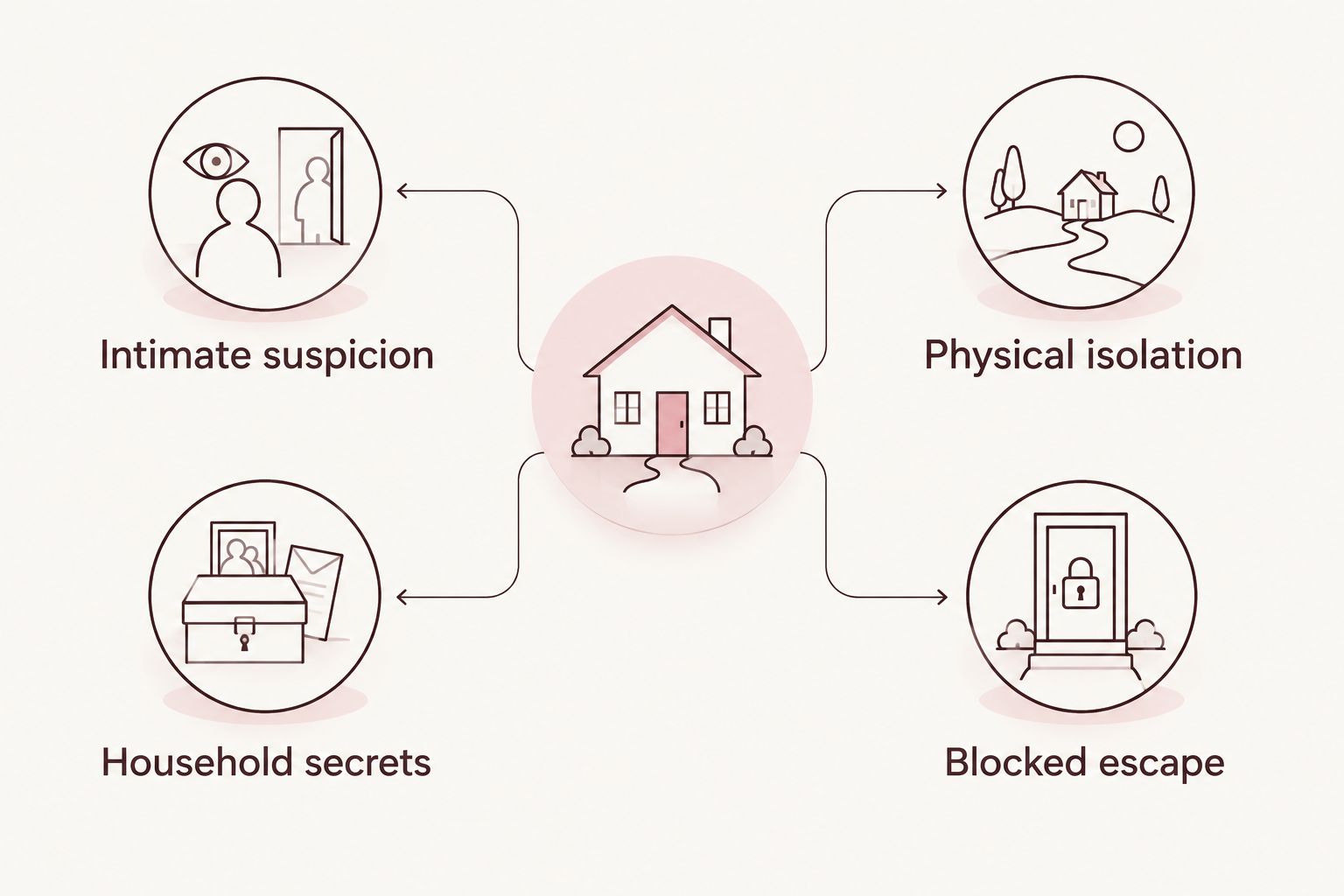
GetSimilarBooks is a read-alike finder for readers who want a short, title-led recommendation list. Enter the book you enjoyed, then use these differences to decide which suggestion deserves your next evening.
Find your next read-alike
Get five hand-curated suggestions, then request a personalized list of 20–30 titles by email.
FAQ
What are the best books like Verity with isolated settings?
Rebecca, The Only One Left, and The Turn of the Key are the closest choices for household suspicion and a vulnerable newcomer. One by One and And Then There Were None are stronger choices when physical confinement matters more than romance.
Which book should I read first after Verity in 2026?
Start with Rebecca if you want marriage, an imposing house, and another woman’s lingering influence. Choose The Only One Left instead if the paid-outsider setup and a disturbing written account matter more.
Which recommendation has the strongest physical isolation?
One by One and And Then There Were None make physical separation central to their premises. One uses a snowbound Alpine retreat; the other places its cast on an island.
Is Rebecca as fast-paced as Verity?
No. Rebecca spends more time building social discomfort, insecurity, and atmosphere, so choose it for intimate tension rather than an equivalent pace.
Which book is closest to Verity’s live-in work arrangement?
The Only One Left is the closest match for a paid outsider entering a household with a troubling history. The Turn of the Key also uses live-in employment, but centers childcare and the nanny’s account.
Do these recommendations contain major spoilers?
The comparisons describe premises, settings, and broad content concerns without revealing solutions or late twists. The Turn of the Key’s child death is part of its framing premise, not a disclosed solution.
Can GetSimilarBooks help me find more isolated-setting thrillers?
GetSimilarBooks offers five hand-curated read-alike suggestions after you enter a title you enjoyed. You can also request an email-gated personalized list of 20–30 titles.
One last thing
Before choosing your next book in 2026, ask what would happen if the protagonist simply walked away. If leaving would end the problem, you want physical confinement. If the relationship or unanswered question would follow them, you want psychological confinement.
That distinction explains this list’s order. The closest Verity match is not necessarily the book with the most remote address.
Related guides
- Books like Verity with romance at the center
- Books like Verity with unreliable narrators
- Books like Verity: five unsettling reads ranked by fit
Books like Verity without a romance plot

Best overall: The Push by Ashley Audrain. Best for hidden accounts: The Silent Patient by Alex Michaelides. Best for a threatening child: Baby Teeth by Zoje Stage. These books like Verity without romance keep the distrust, disturbing family dynamics, or uncertain evidence—not a central love story—for your 2026 reading list.
- The Push leads these books like Verity without romance for its intimate voice and disturbing family conflict.
- The Silent Patient fits readers who want a written account, withheld information, and psychological suspense.
- Baby Teeth centers on a mother-child struggle, not romantic attraction.
- Without a romance plot does not mean without marriage, infidelity, sexual content, or abuse.
Why this matters
Verity combines several reading experiences: an unsettling household, a disturbing written account, uncertainty about whom to believe, and a sexual relationship. Remove the romance, and the strongest replacement depends on which remaining element held your attention.
A marriage under pressure is not the same thing as a romance plot. These recommendations include spouses, affairs, and damaged relationships. Their central questions concern danger, responsibility, or concealed events—not whether a couple will get together.
GetSimilarBooks is a book recommendation tool for readers who want read-alikes matched to what they enjoyed. For this search, the useful distinction is simple: keep the psychological pressure; remove romantic pursuit as the main attraction.
What makes the best books like Verity without romance
The selection criteria for this 2026 list are about the reading experience, not a shared thriller label:
- No central courtship: Attraction must not supply the book's main forward motion. A troubled marriage can still qualify.
- Intimate danger: The threat comes close to home, family, identity, or a trusted relationship.
- Uncertain evidence: A narrator, diary, memory, or interpretation gives you something to question.
- Specific overlap: Each recommendation preserves an identifiable part of Verity, rather than merely promising a twist.
- An honest difference: Pacing, structure, and emotional emphasis matter as much as similarities.
Order carries meaning. The first recommendation preserves Verity's domestic and maternal unease. The later recommendations move toward stranger structures and quieter gothic suspense.
The recommendations at a glance
| Book | Best for | Standout match with Verity | Key limitation |
|---|---|---|---|
| The Push — Ashley Audrain | Motherhood and disputed perception | An intimate account of a family coming apart | Emotional damage matters more than a puzzle |
| The Silent Patient — Alex Michaelides | Hidden accounts and withheld information | A written record complicates a psychological mystery | Infidelity remains important |
| Baby Teeth — Zoje Stage | A threatening child inside the family | Domestic fear and competing perspectives | More confrontation than investigation |
| The Last House on Needless Street — Catriona Ward | Deep uncertainty about perception | Conflicting accounts resist a simple explanation | Stranger and less straightforward |
| We Have Always Lived in the Castle — Shirley Jackson | Quiet gothic distrust | An insular household and a distinctive narrator | Less momentum than a contemporary thriller |
1. The Push: best for motherhood and disputed perception
Ashley Audrain's The Push follows Blythe, a mother who fears something is wrong in her relationship with her daughter. Her husband interprets events differently. The book makes that disagreement intimate, exhausting, and difficult to put aside.
This is the closest match if Verity's treatment of motherhood disturbed you more than its romantic relationship interested you. Both books place a mother's account under pressure and make the family home feel unsafe. The Push keeps its attention on motherhood, inherited damage, and the consequences of not being believed.
The difference is emphasis. The Push is more invested in emotional experience than in an outsider uncovering a household's secrets. Its marriage matters because it shapes credibility and isolation, not because it offers a love story to root for.
The Push pros:
- A close, personal voice makes uncertainty feel immediate.
- Family conflict supplies the tension without a central courtship.
- Motherhood is central rather than background motivation.
The Push cons:
- Readers seeking a procedural investigation should choose elsewhere.
- Harm involving children makes this an emotionally severe recommendation.
Best for: You want Verity's maternal dread with the romance removed.
Verdict: Buy The Push for the closest emotional match.
2. The Silent Patient: best for hidden accounts and withheld information
Alex Michaelides's The Silent Patient centers on Alicia Berenson, who stops speaking after killing her husband, and Theo Faber, a psychotherapist determined to understand her. Alicia's diary adds another account for you to examine.
Choose this for the experience of reading material that seems revealing while still leaving important questions unresolved. That relationship between a written record and an outside interpretation is the clearest connection to Verity. The suspense asks you to evaluate accounts, motives, and omissions.
The setting changes the experience. Instead of placing a writer inside another author's home, The Silent Patient builds its inquiry around psychotherapy and a killing. It has no central courtship, but marital betrayal remains part of the story; this is not a recommendation for avoiding infidelity.
The Silent Patient pros:
- A diary gives readers a concrete account to question.
- The central inquiry supplies a clear narrative direction.
- Suspense does not depend on wanting a romantic pairing to succeed.
The Silent Patient cons:
- Relationship betrayal remains important to the mystery.
- The investigative focus offers less sustained domestic intimacy than The Push.
Best for: You liked Verity's manuscript and the problem of deciding what it proves.
Verdict: Buy The Silent Patient for the written-account mystery, not for another dark romance.
3. Baby Teeth: best for a threatening child inside the family
Zoje Stage's Baby Teeth follows Suzette and her daughter Hanna through alternating perspectives. Hanna's hostility toward her mother and attachment to her father turn the household into a contest over control and belief.
The match is the fear that danger exists inside an ordinary family while another family member fails to recognize it. If Verity left you thinking about children, parental intentions, and the gap between appearance and private behavior, Baby Teeth keeps those concerns close.
The difference is structural. You spend time with both mother and daughter rather than following an outsider's discovery. The book emphasizes an escalating struggle more than the interpretation of a recovered document.
Baby Teeth pros:
- Alternating perspectives make the family conflict immediate.
- Domestic tension remains central throughout the premise.
- The parental relationship matters without becoming a romance plot.
Baby Teeth cons:
- Hostility between parent and child is the main experience, not a secondary element.
- Readers wanting a concealed-history investigation get less of that here.
Best for: You want the unsettling-child element to become the main story.
Content note: Threats and violence within a family, including harm involving a child.
Verdict: Buy Baby Teeth for direct domestic menace; skip it if child-centered cruelty is your limit.
4. The Last House on Needless Street: best for uncertain perception
Catriona Ward's The Last House on Needless Street brings together a secluded man, a missing-child case, and accounts that do not fit comfortably together. Its narrators require close attention. Explaining too much about their relationship would damage the reading experience.
This is the recommendation for readers who finished Verity wanting to reconsider what they had accepted as evidence. The connection is interpretive unease: an account can be detailed and still leave you with the wrong understanding.
The difference is considerable. The Last House on Needless Street is stranger, more structurally disorienting, and closer to psychological horror than a conventional domestic thriller. Do not choose it expecting Verity's pacing or romantic tension.
The Last House on Needless Street pros:
- Conflicting accounts make perspective part of the mystery.
- The isolated setting sustains unease without a central romance.
- Structural uncertainty gives attentive readers something to work through.
The Last House on Needless Street cons:
- Deliberate confusion delays a clear view of events.
- Its unusual narrative approach is a larger departure from Verity.
Best for: You want to question the frame of the story, not just a character's honesty.
Content note: Child abuse, trauma, and disturbing material.
Verdict: Buy The Last House on Needless Street if uncertainty is the attraction; skip it if you need immediate clarity.
5. We Have Always Lived in the Castle: best for quiet gothic distrust
Shirley Jackson's We Have Always Lived in the Castle follows Merricat Blackwood, who lives with her sister Constance and their uncle after a poisoning killed other members of their family. Hostile neighbors and an arriving cousin disturb their enclosed world.
The match is a household whose routines and explanations deserve scrutiny. Merricat's voice creates unease without requiring a succession of thriller set pieces. If Verity's house interested you as a place of private rules and concealed history, Jackson offers a quieter version of that discomfort.
The difference is pace and purpose. This is gothic fiction, not a contemporary thriller built around romantic suspense. Questions of power, belonging, and intrusion matter more than a rapid investigation.
We Have Always Lived in the Castle pros:
- A distinctive narrator makes ordinary details feel consequential.
- The house and family history carry the tension.
- No central love story is needed to organize the suspense.
We Have Always Lived in the Castle cons:
- Its restrained pace will not satisfy every page-turner reader.
- The unease is more important than a neatly explained sequence of revelations.
Best for: You want an unsettling household and a narrator worth questioning, without thriller speed.
Verdict: Buy We Have Always Lived in the Castle for atmosphere; skip it if momentum is your first requirement.
Choose the part of Verity you want to keep
For your 2026 reading queue, make the decision before you collect more titles. Choose the element you want repeated:
- Maternal dread: Start with The Push.
- Written evidence: Choose The Silent Patient.
- Family menace: Choose Baby Teeth.
- Uncertain perception: Choose The Last House on Needless Street.
- Gothic distrust: Choose We Have Always Lived in the Castle.
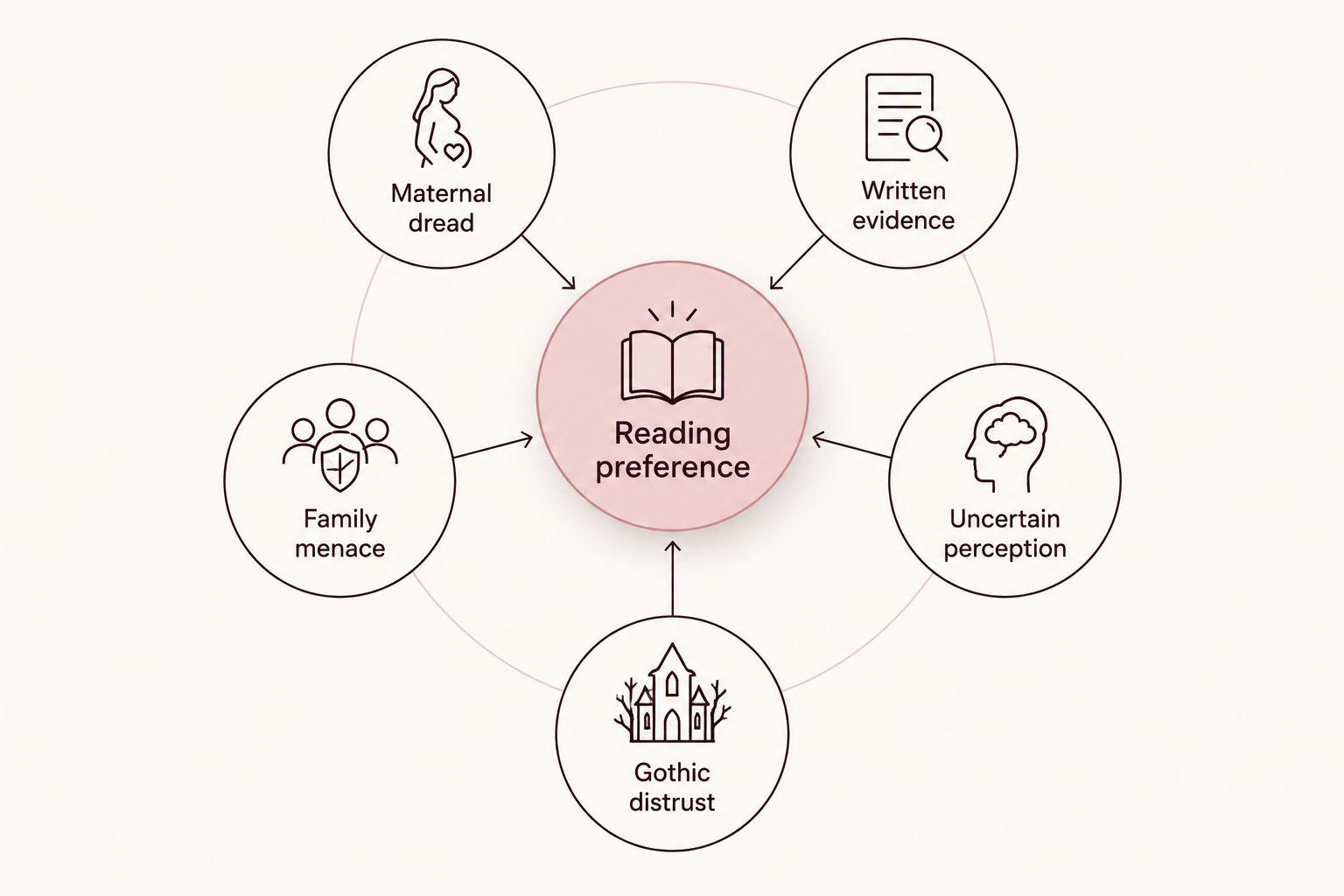
Your reading preference is more useful than the instruction to find another thriller. GetSimilarBooks gives you 5 hand-curated suggestions from a title you enjoyed. Its personalized list contains 20–30 titles and requires an email address.
GetSimilarBooks is best for fiction readers who want read-alike recommendations from a book they already enjoyed. For this search, keep the distinction clear: no central romance is different from no sexual content or relationship conflict.
Find your next read
Enter a book you enjoyed for five hand-curated suggestions, then request a personalized list by email.
How the recommendations are ordered
This 2026 list ranks books by their specific overlap with Verity after removing a central romance plot. The Push leads because its intimate voice, motherhood focus, and disputed perception preserve a strong combination of those qualities.
The Silent Patient shifts toward written evidence. Baby Teeth concentrates on family menace. The final recommendations move further into narrative disorientation and gothic atmosphere. This is a fit ranking, not a claim that every reader should prefer the same book.
Which book should you choose?
Start with The Push if you are undecided. It keeps the family pressure and uncertainty about a mother's account without asking you to follow a developing romance.
Choose The Silent Patient instead if Verity's written account was the part you most wanted to discuss afterward. For a 2026 reading list, those are the clearest starting points: emotional distrust first, evidence-driven suspense second.
FAQ
What’s the best book like Verity without romance?
The Push by Ashley Audrain is the strongest starting point for maternal dread, intimate narration, and disputed perception. Its central concern is a family coming apart, not a developing romantic relationship.
Does no romance mean these books have no sexual content?
No. The absence of a central romance plot does not exclude sexual content, infidelity, abuse, or references to sexual violence. Check title-specific content guidance if any of those are firm limits.
Is The Silent Patient a romance?
The Silent Patient is a psychological thriller, not a romance. Marriage and infidelity matter to its mystery, but a developing love story is not its central purpose.
Is The Push or Baby Teeth closer to Verity?
The Push is closer for an intimate maternal account that other people question. Baby Teeth is the better choice when you specifically want a threatening child and an escalating mother-daughter struggle.
Which recommendation feels most like Verity’s manuscript?
The Silent Patient is the clearest choice because Alicia’s diary provides a written account to examine alongside an outside inquiry. The similarity is the problem of interpreting evidence, not an identical plot.
Which book should I choose if I want less violence involving children?
We Have Always Lived in the Castle is the clearest alternative here to the child-centered distress in The Push and Baby Teeth. It still contains a history of fatal poisoning and hostility, so it is not a gentle read.
Can GetSimilarBooks help me find more books without a central romance?
GetSimilarBooks provides five hand-curated read-alikes when you enter a title you enjoyed. You can also request an email-gated personalized list of 20–30 titles; check individual books against your romance and content limits.
One last thing
The most useful distinction is not romance versus relationships. It is romantic pursuit versus psychological pressure. A book can contain a marriage on nearly every page and still give you none of the courtship you want to avoid.
Before choosing, finish this sentence: I want Verity's uncertainty about ____. A parent, a document, a household, or a narrator will point you toward different books.
Related guides
- Books like Verity: five unsettling reads ranked by fit
- Books like Verity with unreliable narrators
- Books like Verity with romance at the center
Books like Verity built around family secrets

Best overall: The Turn of the Key by Ruth Ware. Best for inherited family secrets: The Family Upstairs by Lisa Jewell. Best for a troubled marriage: Rebecca by Daphne du Maurier. These five books like Verity with family secrets are ordered from the closest domestic setup outward, with the match and the difference explained before you choose.
- The Turn of the Key leads these books like Verity with family secrets: an outsider enters a household hiding trouble.
- Home Before Dark suits readers who liked Verity’s disturbing written account and uncertainty about a family’s past.
- The Family Upstairs puts inheritance, concealed identities, and a household’s history ahead of romance.
- Rebecca emphasizes marital unease; Sharp Objects emphasizes damaging family relationships and a darker crime investigation.
For another recommendation built around your own favorite, GetSimilarBooks offers five hand-curated suggestions and a free personalized list of 20–30 titles when you provide your email. GetSimilarBooks is best for fiction readers who want read-alikes matched to a book they already enjoyed.
Why this matters
Verity combines several attractions: an outsider inside a private home, a disturbing manuscript, sexual tension, and uncertainty about what happened within a family. A book can match one of those elements and miss the reason you kept reading.
This 2026 list treats family secrets as the main requirement, not an incidental twist. The recommendations differ in how they expose those secrets: through employment, a published family story, inheritance, marriage, or a return home. Choose the route that interests you rather than expecting every book to reproduce Colleen Hoover’s mixture.
What makes the best family-secret read-alike?
- Household access: The central character enters, returns to, or reexamines a home whose private history matters.
- Consequential secrets: Hidden information changes relationships and decisions. It is not merely a surprise saved for the ending.
- Uncertain accounts: Letters, memories, stories, and competing versions make you question what to believe.
- Emotional proximity: The danger involves relatives, partners, caregivers, or people living together.
- A clear trade-off: Each recommendation names what you lose from Verity, whether that is romance, speed, or the manuscript device.
A shared thriller label is not enough. The strongest match recreates the pressure of discovering something you were never meant to know.
Books like Verity with family secrets at a glance
| Rank | Book and author | Best for | Standout connection to Verity | Key limitation |
|---|---|---|---|---|
| 1 | The Turn of the Key — Ruth Ware | An outsider inside a secretive home | A live-in job puts a newcomer close to a troubled family | Childcare and surveillance take priority over romance |
| 2 | Home Before Dark — Riley Sager | Questioning a written family history | A published account shapes a daughter’s understanding of her childhood | Haunted-house questions replace much of the romantic tension |
| 3 | The Family Upstairs — Lisa Jewell | Inheritance and concealed family history | A house draws its inheritor into the past of its occupants | Multiple perspectives spread the suspense across characters |
| 4 | Rebecca — Daphne du Maurier | Marriage overshadowed by the past | A new wife enters a household dominated by her predecessor | Slower, more atmospheric storytelling |
| 5 | Sharp Objects — Gillian Flynn | A disturbing return to family | A reporter’s investigation brings her back into damaging family relationships | More graphic distress and less romantic focus |
The order is a 2026 reading recommendation, not a claim that the first book is better written than the last. The first pick most closely matches Verity’s outsider-in-the-house setup. The later picks preserve family unease while changing the reading experience.
1. The Turn of the Key: best for an outsider inside the family home
Ruth Ware’s The Turn of the Key follows Rowan Caine as she takes a live-in nanny position in a remote Scottish house fitted with smart technology. The story is framed through her letters to a lawyer after a child’s death.
The match is immediate: accepting a job also means entering a private world. Like Lowen in Verity, Rowan must interpret a household from an incomplete position, where access to intimate details does not necessarily produce understanding.
The Turn of the Key pros:
- The employment setup creates a concrete reason for an outsider to remain in an unsettling home.
- Childcare makes ordinary domestic decisions carry emotional weight.
- The letter framing gives the narrator a reason to explain—and defend—her account.
The Turn of the Key cons:
- The central pressure comes from caregiving, surveillance, and suspicion rather than an erotic relationship.
- Readers who dislike stories involving children in danger should choose another direction.
Best for: Readers who want the discomfort of living among strangers while discovering that their home has a private history.
The meaningful difference is where the suspense lives. Verity ties discovery to a writer’s account and an intimate relationship; The Turn of the Key makes the job itself the trap. That gives this recommendation a strong structural match without promising the same romantic experience.
Verdict: Buy if the outsider’s access to a troubled household was your favorite part of Verity. Skip if romance is essential.
2. Home Before Dark: best for a disturbing written family history
Riley Sager’s Home Before Dark follows Maggie Holt back to Baneberry Hall, the house her family fled during her childhood. Her father’s bestselling book describes their time there as a supernatural ordeal, but Maggie does not trust his account.
This is the pick for the reader who kept turning Verity’s pages because a written narrative seemed both revealing and suspect. The book alternates Maggie’s present-day experience with material from her father’s account, making the family story something you can examine rather than simply accept.
Home Before Dark pros:
- A book within the book supplies a direct connection to Verity’s reading experience.
- The daughter’s stake in the story makes the investigation personal.
- The house connects present-day discoveries with an inherited version of the past.
Home Before Dark cons:
- The haunted-house framing is a substantial part of the premise, not a passing decoration.
- Romantic tension does not carry the main story.
Best for: Readers who want to compare a troubling written account against what its family members remember and discover.
The important distinction is authorship. Verity’s manuscript introduces a private account; Home Before Dark centers a public story that has already shaped Maggie’s life. You are questioning not just what happened, but what growing up inside that story has done to her.
Verdict: Buy if the manuscript was Verity’s strongest hook for you. Skip if you want another romance-led domestic thriller.
3. The Family Upstairs: best for inheritance and concealed identities
Lisa Jewell’s The Family Upstairs begins with Libby Jones inheriting a substantial London house and learning more about the family she came from. Other narrative strands reveal lives connected to the house and its disturbing past.
The connection to Verity is the gap between a home’s outward appearance and what happened inside it. Here, though, family history is the main engine rather than background to a developing relationship.
The Family Upstairs pros:
- The inheritance gives the search for family history a clear starting point.
- Multiple perspectives let different pieces of the household’s past accumulate.
- Questions about belonging and identity give the secrets consequences beyond solving a puzzle.
The Family Upstairs cons:
- Changing perspectives interrupt the close, single-narrator experience some Verity readers want.
- Coercive control and child abuse make the family material distressing.
Best for: Readers who want to uncover who belonged to a household, what held it together, and why its history remained concealed.
Do not choose this primarily for romance. Choose it because you want the relatives, former occupants, and concealed connections to become the story’s center. The house matters as the place where those lives intersect, not merely as an ominous setting.
Of these five books, The Family Upstairs is the clearest move toward an interlocking family-history mystery. It asks you to hold several accounts in mind rather than attach every question to one relationship.
Verdict: Buy if family secrets matter more to you than matching Verity’s romantic intensity. Skip if switching narrators breaks your momentum.
4. Rebecca: best for a marriage overshadowed by its predecessor
Daphne du Maurier’s Rebecca follows an unnamed young woman who marries the widower Maxim de Winter and moves to Manderley. His first wife, Rebecca, remains a powerful presence in the house and in the new wife’s imagination.
The Verity connection lies in entering an intimate relationship whose history you cannot independently understand. The new wife must make sense of other people’s memories, household loyalties, and her own insecurity.
Rebecca pros:
- Marriage and the household’s past are inseparable from the suspense.
- The narrator’s uncertainty makes small social encounters feel consequential.
- Manderley gives the relationship a setting shaped by someone who is absent but constantly discussed.
Rebecca cons:
- The pace is more patient than a contemporary twist-driven thriller.
- Do not expect Verity’s explicit sexual content or manuscript structure.
Best for: Readers who want jealousy, marital uncertainty, and a home that seems to belong to another woman.
Rebecca belongs on a 2026 read-alike list because the connection is specific, not because every gothic novel resembles Verity. Both place a newcomer beside a man whose previous relationship remains difficult to interpret. Rebecca spends more time inside that newcomer’s anxious perception.
Pick it for atmosphere and emotional pressure. Its suspense develops through observation, conversation, and the narrator’s sense that she does not belong.
Verdict: Buy if the previous wife’s influence interested you more than Verity’s speed. Wait if you need immediate, frequent revelations.
5. Sharp Objects: best for a damaging return to family
Gillian Flynn’s Sharp Objects follows journalist Camille Preaker back to her Missouri hometown to report on the murders of young girls. Returning also brings her into close contact with her mother and younger half-sister.
This is the furthest recommendation from Verity’s setup, but a strong match for readers drawn to disturbing relationships beneath a family’s public face. Camille knows the household already; familiarity makes returning difficult rather than reassuring.
Sharp Objects pros:
- The family relationships matter independently of the external investigation.
- Camille’s reporting creates tension between professional observation and personal involvement.
- The hometown setting extends private family pressure into a wider social environment.
Sharp Objects cons:
- Self-harm, abuse, and violence involving children make this a particularly difficult read.
- The crime investigation receives more attention than romance.
Best for: Readers who want psychological damage and family conflict rather than another outsider discovering a manuscript.
The difference matters. Verity asks what an unfamiliar household conceals; Sharp Objects asks what happens when you return to people whose influence you have not escaped. That changes the emotional texture from intrusion to confrontation.
For a 2026 reading list focused on family secrets, this is the darker branch. Choose it deliberately, not simply because both authors write unsettling fiction.
Verdict: Buy if you want a harsher family-centered psychological mystery. Skip if child violence or self-harm is outside your reading limits.
How the recommendations are ranked
These comparisons use premise, narrative structure, family involvement, and the role of romance. They do not represent a claim that a human curator read every title for this article.
The Turn of the Key leads on the outsider’s live-in position. Home Before Dark follows on the troubling written account. The Family Upstairs, Rebecca, and Sharp Objects move outward toward inheritance, marriage, and returning home. Order carries meaning: closeness first, then distinct alternatives.
Which book should you choose?
Start with The Turn of the Key if you are undecided. It gives you the clearest return to a newcomer interpreting a family from inside its house.
Use this shorter decision instead if you already know your priority:
- The written account: Choose Home Before Dark.
- Concealed family connections: Choose The Family Upstairs.
- Marital unease: Choose Rebecca.
- Damaging family relationships: Choose Sharp Objects.
If none fits, tell GetSimilarBooks which part of Verity you want repeated. Five suggestions are the preview; the email-gated personalized list contains 20–30 titles.
Find your next read
Enter a book you enjoyed for five suggestions, then request a free personalized list by email.
FAQ
What’s the closest book to Verity with family secrets?
The Turn of the Key by Ruth Ware is the closest match here for its live-in outsider and troubled household. Home Before Dark is a closer choice if Verity’s disturbing written account was your main attraction.
Which book like Verity focuses most on family history?
The Family Upstairs by Lisa Jewell puts concealed family history at the center. An inherited house connects the present-day search with accounts of its former occupants.
Is Home Before Dark similar to Verity?
Home Before Dark resembles Verity through a troubling written account that the central character has reasons to question. Its haunted-house premise takes priority over romantic tension.
Is Rebecca a good choice after Verity?
Rebecca is a good choice if you want marital unease and a household shaped by a previous wife. Expect slower atmospheric suspense rather than Verity’s explicit sexual content and manuscript device.
Which recommendation is the darkest?
Sharp Objects is the recommendation for readers seeking distressing family relationships alongside a crime investigation. It includes self-harm, abuse, and violence involving children.
Do these recommendations spoil the endings?
These recommendations describe premises, matching qualities, and reading differences without revealing the central resolutions. Content notes identify difficult subjects without explaining their role in the endings.
How do I get a personalized list after reading Verity?
GetSimilarBooks lets you enter a title you enjoyed for five hand-curated read-alike suggestions. You can also provide your email to request a free personalized list of 20–30 titles.
One last thing
For your next 2026 read, try naming what you do not want repeated. “Family secrets, but less romance” points toward The Family Upstairs; “marital uncertainty, but a slower pace” points toward Rebecca. A useful read-alike preserves your favorite pressure while changing something you are ready to leave behind.
Related guides
- Books like Verity with romance at the center
- Books like Verity with unreliable narrators
- Books like Verity: five unsettling reads ranked by fit
Books like Fourth Wing with deeper worldbuilding

Best overall: Fireborne by Rosaria Munda. Best for dragon bonds and social history: Dragonflight by Anne McCaffrey. Best for a broader epic: The Priory of the Orange Tree by Samantha Shannon. These 2026 reading picks move from Fourth Wing’s familiar pleasures toward worlds with more political, cultural, and magical depth.
- Fireborne leads these books like fourth wing with more worldbuilding: dragon-rider training meets the aftermath of revolution.
- Dragonflight makes dragon-rider bonds part of a society’s survival, but its sexual dynamics need a content check.
- The Rage of Dragons prioritizes military training, caste, and revenge over romance or rider bonds.
- The Priory of the Orange Tree and The Way of Kings offer broader worlds with less Fourth Wing-style pacing.
- GetSimilarBooks offers five hand-curated suggestions, plus an email-gated personalized list of 20–30 titles.
Why this matters
More worldbuilding does not necessarily mean more names, maps, or invented history. The useful question is whether the world changes what characters can do: whom they can love, which institutions they trust, and what power costs them.
Fourth Wing combines dangerous training, bonded dragons, romance, and concealed political truths. These recommendations preserve different parts of that combination. None reproduces the whole package.
GetSimilarBooks book recommendations suit readers who want their next pick matched to a specific part of Fourth Wing. You can use GetSimilarBooks to enter a title you enjoyed and request read-alike suggestions. First, decide which ingredient you refuse to lose.
What makes the best worldbuilding match?
For this 2026 list, depth means that the setting creates consequences, not merely scenery. These criteria explain both the ranking and its limits:
- Dragon bonds: Dragons have agency, and their relationships with humans affect the wider society.
- Military pressure: Training, command, and warfare shape choices rather than supplying a dangerous backdrop.
- Political consequences: Governments and social hierarchies influence ordinary lives as well as the central conflict.
- Magic rules: Supernatural abilities have conditions, costs, or institutional uses that matter to the story.
- Romantic emphasis: The recommendation makes clear whether romance drives the plot or sits behind other concerns.
A book does not need all these qualities to belong here. It needs a specific connection to Fourth Wing and a meaningful expansion beyond that connection.
The recommendations at a glance
The order moves from the closest overall match toward larger departures. A lower position means a bigger change in the reading experience, not a weaker novel.
| Book | Best for | Standout worldbuilding feature | Key limitation |
|---|---|---|---|
| Fireborne — Rosaria Munda | Dragon-rider training and political loyalties | A rider corps shaped by revolution and class | Romance is less sexually explicit than Fourth Wing |
| Dragonflight — Anne McCaffrey | Dragon bonds embedded in society | Dragonriders, Holds, and collective survival | Coercive sexual dynamics and dated gender assumptions |
| The Rage of Dragons — Evan Winter | Military training and unequal power | Caste, warfare, and dangerous magical training | No central human-dragon bonding relationship |
| The Priory of the Orange Tree — Samantha Shannon | Competing cultures and queer romance | Different religious and political relationships with dragons | Multiple viewpoints interrupt the single-heroine momentum |
| The Way of Kings — Brandon Sanderson | Magic systems and institutions | Storm-shaped ecology, warfare, and social hierarchy | Romance is not the main attraction |
1. Fireborne: best for dragon-rider training and political loyalties
Rosaria Munda’s Fireborne is the closest match if Fourth Wing left you wanting dragon riders whose personal relationships are inseparable from political history. Annie and Lee train within a rider system rebuilt after a revolution, but their backgrounds give them very different relationships with the new order.
The academy connection is immediate. The deeper match lies in the question of institutional loyalty: what happens when belonging to an elite force requires accepting decisions you cannot comfortably defend?
Where Fireborne adds depth
The revolution is not distant decoration. Its consequences shape access to authority, public expectations, and the meaning of merit. Competition between riders becomes an argument about who deserves power and what a changed society actually owes its people.
Fireborne pros:
- Dragon-rider training supplies the most direct connection to Fourth Wing.
- Class history gives rivalry and advancement consequences beyond personal ambition.
- Dual viewpoints expose competing loyalties without making either position simple.
Fireborne cons:
- Political dilemmas receive more attention than explicit romantic payoff.
- Readers seeking an adult romantasy experience will find a different emphasis.
Best for: You want the rider competition to remain, but want the institution behind it examined more closely.
Verdict: Read Fireborne first. It asks you to give up less of Fourth Wing’s central setup than the other recommendations.
2. Dragonflight: best for dragon bonds embedded in society
Anne McCaffrey’s Dragonflight follows Lessa into the world of Pern’s dragonriders. Its strongest connection to Fourth Wing is the bond between humans and dragons, but the surrounding social structure gives that bond a different purpose.
Pern’s dragons protect the planet from Thread, a destructive threat that falls from the sky. Dragonriders are therefore part of a survival system, not simply an elite fighting force.
Where Dragonflight adds depth
The relationships between Weyrs, Holds, and Crafts connect dragonriding to work, obligation, and political authority. A society’s willingness to support its protectors becomes part of the conflict.
That distinction matters. The dragons are not detachable from the worldbuilding; the society is organized around what they do and whether people believe their protection remains necessary.
Dragonflight pros:
- Human-dragon bonds are central rather than incidental.
- Social organization gives the riders obligations beyond combat.
- Collective survival connects practical problems with political resistance.
Dragonflight cons:
- Coercive sexual dynamics and gender hierarchy require a content check.
- The older storytelling style differs sharply from Fourth Wing’s contemporary voice.
Best for: You want to understand how a society functions around bonded dragons, rather than follow another academy romance.
Verdict: Read Dragonflight for the dragon society; skip it if coercive sexual dynamics are a firm boundary.
3. The Rage of Dragons: best for military training and unequal power
Evan Winter’s The Rage of Dragons follows Tau, a young man pursuing martial skill and revenge within a rigidly stratified society. The Fourth Wing connection is the pressure of training inside a violent system that does not distribute opportunity equally.
This is not a dragon-rider romance. Dragons belong to the world’s military power, but a personal rider bond is not the emotional center of Tau’s story.
Where The Rage of Dragons adds depth
Caste determines whose lives and ambitions carry weight. Military advancement offers a route through that hierarchy without making the hierarchy disappear.
Magic also intersects with warfare and the pursuit of skill. Training is not just a sequence of increasingly difficult exercises; it becomes a way to examine what ambition and vengeance consume.
The Rage of Dragons pros:
- Intensive training preserves Fourth Wing’s sense of physical pressure.
- Caste makes institutional inequality concrete.
- Warfare and magic reinforce the social order rather than existing separately from it.
The Rage of Dragons cons:
- Revenge, not romance, drives the main narrative.
- Sustained violence and obsession make this a harsher reading experience.
Best for: You cared most about training, unequal power, and the effort required to survive a military system.
Verdict: Read The Rage of Dragons for relentless military progression; skip it if bonded dragons are non-negotiable.
4. The Priory of the Orange Tree: best for competing cultures and queer romance
Samantha Shannon’s The Priory of the Orange Tree expands the frame from a training institution to multiple societies with different beliefs about dragons, religion, and legitimate rule. Its characters occupy courts, religious traditions, and dragon-riding institutions rather than sharing one central academy.
The connection to Fourth Wing lies in dragons, dangerous loyalties, and romance under political pressure. The experience is broader and more distributed.
Where The Priory of the Orange Tree adds depth
Different cultures do not merely wear different clothes. Their beliefs about dragons affect diplomacy, identity, and the stories they tell about their own past.
The novel also includes a central sapphic romance. That relationship sits inside a larger political narrative rather than replacing it, so choose this for the combination of intimacy and cultural scale.
The Priory of the Orange Tree pros:
- Contrasting traditions give dragons different meanings across the world.
- Court politics connect private relationships with public responsibilities.
- Multiple viewpoints let you see beyond one institution’s account of events.
The Priory of the Orange Tree cons:
- Viewpoint changes interrupt the intimacy of following one central heroine.
- The opening asks for patience while its settings and conflicts take shape.
Best for: You want dragons and queer romance within a wider conflict between cultures and belief systems.
Verdict: Read The Priory of the Orange Tree when breadth matters more than academy momentum.
5. The Way of Kings: best for magic systems and institutions
Brandon Sanderson’s The Way of Kings is the largest departure here. Its strongest connections to Fourth Wing are military hierarchy, unequal access to power, and characters discovering that accepted explanations of their world are incomplete.
Dragons and romance are not the reason to choose it. The attraction is Roshar: a setting where storms affect ecology, buildings, travel, and everyday survival.
Where The Way of Kings adds depth
The environment changes how people live rather than supplying weather between action scenes. Social distinctions, military structures, and magical artifacts also shape who controls resources and whose suffering receives attention.
The novel reveals its supernatural rules gradually. You spend substantial time with work, survival, and conflicting accounts of history before the larger pattern becomes clear.
The Way of Kings pros:
- Ecology and material conditions make the setting feel structurally different.
- Military life receives attention from sharply unequal social positions.
- Magic and historical mysteries support a larger developing framework.
The Way of Kings cons:
- Romance is secondary, not a substitute for Fourth Wing’s central relationship.
- The long setup delays some explanations and payoffs.
Best for: You are ready to trade romantic urgency for a more extensive fantasy setting.
Verdict: Read The Way of Kings for the world itself; wait if you need romance to carry the opening.
How these books are ranked
The ranking prioritizes matching qualities before sheer scale. Fireborne retains rider training and intimate political conflict. Dragonflight keeps dragon bonds but changes the social and romantic framework. The remaining books move outward through military progression, cross-cultural conflict, and extensive setting construction.
This is not a ranking by map size, glossary length, or publication date. The 2026 selection asks a narrower question: which book expands the part of Fourth Wing you actually enjoyed?
Which book should you choose?
Choose Fireborne if you are undecided. Its combination of rider training, class tension, and divided loyalties makes the clearest bridge from Fourth Wing to more politically developed fantasy.
Choose Dragonflight when the dragon bond matters most. Choose The Rage of Dragons when training matters most. The Priory of the Orange Tree is the better direction for competing cultures and queer romance; The Way of Kings is the bigger change toward setting-led epic fantasy.
For a 2026 reading list, choose by the difference you welcome, not just the similarity you recognize. GetSimilarBooks book recommendations offer five hand-curated suggestions from a title you enjoyed. Five is the preview; the free personalized list contains 20–30 titles and requires an email address.
Find your next read-alike
Enter a title for five suggestions, then request a free personalized list of 20–30 titles by email.
FAQ
What are the best books like Fourth Wing with more worldbuilding in 2026?
Start with Fireborne for dragon-rider training shaped by revolution and class. Choose Dragonflight for dragon-centered society, or The Priory of the Orange Tree for competing cultures and a broader political story.
Is Fireborne the closest match to Fourth Wing?
Fireborne is the closest overall match on this list because it combines dragon-rider training, rivalry, and political loyalty. Its romance is less sexually explicit, and its institutional conflicts receive more attention.
Which recommendation has the strongest focus on dragon bonds?
Dragonflight is the strongest choice here for human-dragon bonds embedded in a society’s survival. Check its coercive sexual dynamics and gender assumptions before choosing it for the romance.
Is The Rage of Dragons a dragon-rider romance?
No. The Rage of Dragons centers on military training, caste, and revenge rather than a romantic rider bond. Choose it for physical progression and institutional pressure.
Which book combines deeper worldbuilding with queer romance?
The Priory of the Orange Tree combines a central sapphic romance with contrasting religious traditions, court politics, and dragons. Its multiple viewpoints make it less intimate and concentrated than Fourth Wing.
Should I read The Way of Kings if romance was my favorite part?
The Way of Kings is not the best next choice if romance must drive the story. Choose it when magic, military structures, and an extensively developed setting matter more than romantic momentum.
How can I get recommendations based on what I liked about Fourth Wing?
GetSimilarBooks lets you enter a book you enjoyed and receive five hand-curated read-alike suggestions. You can also request a free personalized list of 20–30 titles by providing an email address.
One last thing
For your next 2026 read, name what you are willing to lose. Keep dragons and accept less romance; keep military pressure and accept no rider bond; keep romance and accept a slower, wider story. That decision is more useful than asking for everything in Fourth Wing, only bigger.
Related guides
- Books like Fourth Wing with dragons and rider bonds
- Books like Fourth Wing with political intrigue
- Books like Fourth Wing set in a military academy
- Books like Fourth Wing with slow-burn romance
Books like Verity with romance at the center

Best overall: Layla by Colleen Hoover. Best for Gothic romantic unease: Rebecca by Daphne du Maurier. Best for a developing relationship alongside danger: The Witness by Nora Roberts. These five books like Verity with romance keep attraction central, but differ in how much you can trust the relationship.
- For books like Verity with romance, start with Colleen Hoover’s Layla for intimacy disrupted by supernatural uncertainty.
- Choose Rebecca for a marriage overshadowed by another woman, not a reassuring love story.
- Choose Too Late for dark romantic suspense involving coercive control and criminal danger.
- Choose Nora Roberts’s The Witness for romantic suspense with a more dependable emotional connection.
- GetSimilarBooks suits readers seeking personalized book recommendations after Verity.
Why the romance changes the recommendation
Verity puts desire and suspicion in the same room. Lowen’s attraction to Jeremy matters because it affects how she interprets the household, the manuscript, and the woman whose work she has come to finish. The relationship is part of the uncertainty, not a break from it.
That distinction drives this 2026 reading list. A thriller with a spouse in the background is not necessarily a useful match. You need a book in which attraction changes a decision, increases vulnerability, or makes someone harder to judge.
GetSimilarBooks provides book recommendations from a title you enjoyed: five hand-curated suggestions first, followed by a free personalized list of 20–30 titles when you provide an email address. Use Verity as your starting title, then decide whether you want its dangerous intimacy or a romance you can trust more.
The ranking below moves from the closest overall reading experience toward clearer romantic reassurance. It is a fit guide, not a prediction that you will like every book equally.
What makes the best books like Verity with romance
These are the criteria that matter for a romance-centered match in 2026:
- Romantic stakes: The relationship must affect the central conflict. Attraction alone does not qualify a book.
- Intimate uncertainty: A partner, household, or personal history must complicate what the reader believes.
- Sustained tension: The relationship needs pressure beyond an opening encounter or a late revelation.
- Emotional direction: Some readers want an unsettling attachment; others want a couple to support. The distinction should be explicit.
- Meaningful differences: Supernatural events, Gothic restraint, and crime-driven suspense produce different experiences, even when all involve secrets.
No single title repeats every part of Verity. Decide which quality you want to preserve before choosing the next book. If the romance matters most, a less similar thriller can still be the better recommendation.
Books like Verity with romance at a glance
The first three books preserve more of Verity’s uncomfortable intimacy. The final two shift toward romantic suspense in which the relationship offers something other than another reason for suspicion.
| Book | Best for | Standout matching quality | Key limitation |
|---|---|---|---|
| Layla — Colleen Hoover | Supernatural romantic obsession | A couple’s relationship becomes inseparable from disturbing uncertainty | Paranormal events change the rules of the mystery |
| Rebecca — Daphne du Maurier | Gothic marriage anxiety | A new relationship exists in the shadow of another woman | Restrained romantic expression and a slower pace |
| Too Late — Colleen Hoover | Dark crime-driven romantic suspense | Attraction develops under coercion and danger | Abuse is central, not incidental |
| The Obsession — Nora Roberts | Romance alongside recovery | A developing relationship shares space with a threatening past | Broader life-building takes time away from immediate suspense |
| The Witness — Nora Roberts | A more dependable romantic connection | Trust develops while a dangerous history threatens the heroine | Less ambiguity about the romantic relationship |
1. Layla: best for supernatural romantic obsession
By Colleen Hoover. Best for: readers who want another intimate, unsettling Hoover novel.
Layla follows Leeds as his relationship with Layla changes after a violent incident. A return to the bed-and-breakfast where they met becomes entangled with strange events and a new attachment. Explaining much more would spoil the uncertainty that makes it a useful Verity follow-up.
The strongest match is not simply the shared author. Both novels put a man’s emotional availability, a woman’s vulnerability, and a troubling domestic situation under pressure. Attraction does not sit safely outside the mystery.
The main difference is decisive: Layla moves into paranormal territory. If you want every unsettling event to remain explainable through human behavior, choose another book. If you liked the feeling that a romantic choice might also be a terrible mistake, start here.
Layla pros:
- Romantic attachment drives the central conflict.
- A contained setting keeps attention on the relationships.
- Disturbing uncertainty extends beyond a conventional love triangle.
Layla cons:
- Supernatural explanations change the reading contract.
- Manipulation and questions of bodily autonomy make this an uncomfortable romance.
For your 2026 shortlist, Layla is the closest starting point when relationship anxiety matters more than a strictly realistic mystery. It is not a substitute for Verity’s exact plot mechanics.
Verdict: Buy if you want romantic obsession with paranormal uncertainty; skip if supernatural fiction breaks the spell.
2. Rebecca: best for Gothic marriage anxiety
By Daphne du Maurier. Best for: readers drawn to the shadow of another woman.
Rebecca follows an unnamed young woman who marries the wealthy widower Maxim de Winter and moves to Manderley. His late wife remains an overwhelming presence in the house and in the new bride’s imagination. The marriage develops inside that comparison.
The Verity connection is specific: a woman enters an established household and struggles to understand the relationship that came before her. What she wants to believe about her husband affects how she reads the evidence around her.
Rebecca is not the choice for explicit scenes or constant romantic affirmation. Its intimacy is psychological. The narrator’s insecurity, the house’s social rules, and the distance between husband and wife create the pressure.
Rebecca pros:
- The marriage is central to the novel’s uncertainty.
- The absent first wife shapes the present relationship.
- The household creates sustained Gothic tension.
Rebecca cons:
- Its measured pace differs from a contemporary twist-driven thriller.
- A central marriage does not make it a reassuring genre romance.
Choose Rebecca when you want to remain unsettled by a relationship rather than simply root for it. The book rewards attention to what the narrator assumes, not only to what other characters tell her.
Verdict: Buy for jealousy, secrecy, and Gothic intimacy; skip if you need overt romantic warmth.
3. Too Late: best for dark crime-driven romantic suspense
By Colleen Hoover. Best for: readers who want attraction under immediate human threat.
Too Late centers on Sloan, her controlling relationship with Asa, and her connection with Carter. Criminal activity and coercion place that connection under pressure. The danger comes from people and power, not supernatural events.
Compared with Verity, the appeal lies in emotional entanglement under unsafe conditions. Romantic decisions carry consequences beyond whether two people will stay together. Sloan’s circumstances make freedom and safety part of the relationship question.
The difference is that Too Late brings abuse and criminal danger into the foreground. It is not primarily a puzzle about interpreting a manuscript or deciding between competing accounts. Read it for the pressure on the characters, not for a replica of Verity’s structure.
Too Late pros:
- The romantic connection directly affects the danger.
- Human motives keep the suspense grounded outside paranormal fiction.
- Coercion creates stakes beyond ordinary relationship conflict.
Too Late cons:
- Sexual violence, abuse, and drug-related crime are significant content concerns.
- The threatening relationship occupies substantial space alongside the desired romance.
Of the two Colleen Hoover novels recommended here, Layla suits uncertainty about reality; Too Late suits danger rooted in control. That is the more useful distinction than calling both books dark romances.
Verdict: Buy for intense, crime-driven romantic suspense; skip if coercive relationships are a firm reading boundary.
4. The Obsession: best for romance alongside recovery
By Nora Roberts. Best for: readers who want a heroine building a life, not only surviving a mystery.
The Obsession follows Naomi, whose childhood discovery of her father’s crimes shapes her adult life. As a photographer establishing a home, she develops a relationship with Xander. A threatening past remains part of the story rather than disappearing when romance arrives.
The connection to Verity is the collision between private intimacy and disturbing knowledge. A home can promise safety while carrying another emotional meaning. The romance matters because Naomi’s ability to let someone close is part of what is at stake.
The difference is tonal and structural. Roberts spends time on work, friendship, a house, and the practical business of making a life. Those elements give the romance room, but they also interrupt the concentrated unease you get from Verity’s enclosed household.
The Obsession pros:
- The heroine has a developed life outside the central threat.
- Romance connects to trust and recovery.
- Domestic detail gives the relationship an everyday setting.
The Obsession cons:
- Home-building and community scenes slow the suspense.
- Childhood trauma and violent crime remain substantial parts of the story.
In a 2026 reading plan, put The Obsession after Verity when you want the emotional temperature to change. You still get danger, but the relationship is not built solely around suspicion.
Verdict: Buy for romance with recovery and domestic detail; skip if you want uninterrupted psychological pressure.
5. The Witness: best for a more dependable romantic connection
By Nora Roberts. Best for: readers who want to trust the developing couple.
The Witness follows Abigail, a woman living cautiously because of a dangerous past, and Brooks, the local police chief who becomes interested in her. Their developing relationship conflicts with the isolation she uses to protect herself.
The Verity match is weaker on ambiguity but stronger on the interaction between intimacy and risk. Letting someone into a private life has consequences. The relationship changes what the heroine can keep separate and what she must confront.
The major difference is the emotional role of the romance. The Witness gives you more reason to invest in the couple as a connection worth protecting. If Jeremy’s uncertainty was the attraction, this is a step outward. If that uncertainty left you wanting a steadier relationship, it is the better next move.
The Witness pros:
- Trust develops as part of the central story.
- Romantic and suspense stakes affect each other.
- The heroine’s self-protective habits create specific relationship friction.
The Witness cons:
- It offers less doubt about the romantic partner’s role.
- Procedural and crime elements replace much of Verity’s Gothic unease.
Verdict: Buy for romantic suspense with a couple to support; skip if the love interest must remain a source of dread.
How the ranking works
This order follows closeness to Verity’s romantic unease, not literary status or a claimed reading test. Layla comes first for its combination of attachment and disturbing uncertainty. Rebecca follows for the pressure of a previous relationship inside a household.
Too Late shifts toward overt coercion and criminal danger. The Obsession and The Witness move farther from ambiguity and closer to relationships that offer connection alongside suspense.
For readers choosing in 2026, the decisive question remains simple: Do you want the relationship to create the fear, or help the characters face it? Both answers belong on a romance-centered list, but they should not produce the same recommendation.
Which book should you choose?
Start with Layla if you are undecided and open to paranormal fiction. Choose Rebecca instead if you want a realistic Gothic setting and can trade explicit romance for psychological intimacy.
If your request is really for a relationship you can support, choose The Witness. Do not choose the closest match automatically when the quality you want to change is the very thing that makes it similar.
GetSimilarBooks provides book recommendations for readers who want to continue beyond these five titles. Request the free personalized list after the initial suggestions if you want 20–30 titles rather than another general roundup. The expanded list requires an email address.
FAQ
What’s the best book like Verity with romance?
Layla by Colleen Hoover is the best starting point if you want romantic attachment tangled with disturbing uncertainty. Its major difference is the use of supernatural events, so choose Rebecca instead if you want a non-paranormal alternative.
Is Rebecca a romance like Verity?
Rebecca centers on a marriage, but it is a Gothic novel rather than a reassuring genre romance. It matches Verity through jealousy, household secrets, and the influence of another woman on a current relationship.
Which book like Verity has a romance I can root for?
The Witness by Nora Roberts is the clearest choice here for a developing couple you can support. Its suspense comes from a dangerous past rather than sustained uncertainty about the romantic partner.
Is Layla more similar to Verity than Too Late?
Layla is closer to Verity for intimate uncertainty, while Too Late is closer for attraction under dangerous human pressure. Choose Layla for paranormal unease and Too Late for crime-driven romantic suspense.
Are these books suitable if I avoid abusive relationships?
Too Late is not a suitable choice if coercive relationships are a firm boundary. Layla also raises concerns around manipulation and bodily autonomy; check detailed content guidance before choosing any title when a particular subject is non-negotiable.
Do all books like Verity count as romance novels?
No. A thriller can put a relationship at its center without following the emotional expectations of genre romance. Rebecca is the clearest example on this list: the marriage matters, but reassurance is not the point.
Can GetSimilarBooks give me more recommendations after Verity?
Yes. GetSimilarBooks offers five hand-curated read-alike suggestions from a title you enjoyed, plus a free personalized list of 20–30 titles. The expanded list requires an email address.
One last thing
A trustworthy love interest can make a book feel less like Verity and more like what you actually want next. Before choosing, finish this sentence: I want the attraction again, but not necessarily the doubt. If that is true, move The Witness to the top of your list.
Related guides
- Books like Verity: five unsettling reads ranked by fit
- Books like Fourth Wing with slow-burn romance
- Books like Fourth Wing with more spice
Books like Verity with unreliable narrators

Best overall: Gone Girl by Gillian Flynn. Best for an openly untrustworthy voice: Sometimes I Lie by Alice Feeney. Best for memory gaps: The Girl on the Train by Paula Hawkins. These books like Verity with unreliable narrators are ordered from close domestic suspense to a more distant Gothic match, with the differences spelled out for your 2026 reading list.
- Gone Girl leads these books like Verity with unreliable narrators for competing accounts of an intimate relationship.
- Sometimes I Lie puts an admitted liar at the center; expect less romantic tension than Verity.
- The Girl on the Train makes memory and observation the problem, rather than a discovered manuscript.
- GetSimilarBooks offers five hand-curated read-alike suggestions and an email-gated personalized list of 20–30 titles.
Why this matters
The useful question after Verity is not simply whether another thriller has a twist. It is what makes the account difficult to trust: deliberate deception, missing memories, a persuasive document, or a narrator whose judgment keeps getting in the way.
GetSimilarBooks is a book recommendation tool for readers who want their next choice tied to a book they enjoyed. Enter a title at GetSimilarBooks for 5 hand-curated read-alike suggestions; the free personalized list of 20–30 titles requires an email address.
This list stays with one specific need: narrators who make you question the story you are receiving. It does not treat an unpleasant character, a concealed culprit, and an unreliable narrator as interchangeable.
What makes the best Verity read-alike?
For this 2026 shortlist, the strongest matches share a reading experience, not just a thriller label.
- Narrative uncertainty: The account itself gives you reasons to question its completeness or accuracy.
- Intimate stakes: Marriage, attraction, family, or a household makes trust consequential rather than abstract.
- Competing accounts: What someone says conflicts with another voice, a memory, or a written record.
- Enclosed tension: A home or tightly connected social circle limits the distance between suspicion and danger.
- Meaningful difference: Each recommendation has a clear departure from Verity, especially around romance, pacing, or structure.
A good match preserves the reason you kept reading, not every feature of the original. If the manuscript was your favorite element, that points toward a different choice than the attraction between Lowen and Jeremy.
The recommendations at a glance
The order moves outward from domestic mistrust toward Gothic interpretation. It is not an ordering of literary quality.
| Book | Best for | Standout match | Key limitation |
|---|---|---|---|
| Gone Girl — Gillian Flynn | Competing accounts of a marriage | Intimacy becomes a contest over whose story you accept | More caustic than romantic |
| Sometimes I Lie — Alice Feeney | An explicitly untrustworthy narrator | The narrator warns you that lying is part of the problem | Less sustained romantic tension |
| The Girl on the Train — Paula Hawkins | Memory gaps and uncertain observation | A witness cannot confidently reconstruct what she experienced | Less enclosed than Verity |
| The Turn of the Key — Ruth Ware | A written defense inside a threatening household | A nanny tells her story in a letter to a lawyer | Romance is not the central draw |
| Rebecca — Daphne du Maurier | Gothic jealousy and limited perspective | A narrator interprets a marriage through insecurity and a predecessor's shadow | Not the same kind of deception-driven thriller |
1. Gone Girl: best for competing accounts of a marriage
Gillian Flynn's Gone Girl follows a wife's disappearance and the scrutiny surrounding her husband. Its 2 narrators, Nick and Amy, place the marriage at the center of the uncertainty: the relationship looks different depending on whose account you are reading.
That is the strongest connection to Verity. Private life becomes evidence, and an intimate account does not become trustworthy merely because it sounds revealing. You read for the distance between a convincing story and a credible one.
The meaningful difference: Gone Girl turns a sharper, more satirical eye on marriage and public perception. Do not choose it expecting Verity's particular mixture of attraction, proximity, and dread.
Gone Girl pros:
- Competing perspectives make trust part of the structure.
- The marriage supplies both emotional stakes and grounds for suspicion.
- Public appearances complicate what happens in private.
Gone Girl cons:
- The tone is cutting rather than tender.
- Romantic tension is not the same kind of reward as in Verity.
Best for: Readers who kept comparing the manuscript with the people standing outside it.
Verdict: Buy Gone Girl for marital mistrust and competing versions of intimacy. Choose it first if you want another relationship in which the story itself becomes contested ground.
2. Sometimes I Lie: best for an openly untrustworthy voice
Alice Feeney's Sometimes I Lie centers on Amber, who is in a coma and can hear what happens around her. The opening establishes that she sometimes lies; the question of reliability is an invitation, not a late surprise disclosed by this recommendation.
The match with Verity is the pressure to interpret a narrator while continuing to depend on her. You cannot simply set the account aside. It is your route into the story, even when you have reasons to resist it.
The meaningful difference: Sometimes I Lie makes unstable narration more immediately explicit. Verity's appeal also rests on the charged relationship between the person reading a document and the household surrounding her; Feeney's setup places you inside the uncertain voice itself.
Sometimes I Lie pros:
- The premise establishes narrative doubt immediately.
- Past and present give you material to compare.
- The narrator's restricted situation creates close psychological tension.
Sometimes I Lie cons:
- It is a weaker fit if attraction was your main reason for reading Verity.
- Its structure asks you to keep track of shifting information.
Best for: Readers who want to question individual statements, not merely guess the culprit.
Verdict: Buy Sometimes I Lie for direct, sustained distrust of the narrator. Read it without searching for detailed explanations of the ending.
3. The Girl on the Train: best for memory gaps
Paula Hawkins's The Girl on the Train follows Rachel, a commuter whose observations of a couple become entangled with a disappearance. Alcohol-related memory gaps make her attempts to reconstruct events difficult, including for Rachel herself.
The connection to Verity is the gap between apparent knowledge and dependable evidence. Watching people does not mean understanding them. Remembering something does not settle exactly what happened.
The meaningful difference: This is not chiefly a story about a dangerous written account discovered inside a household. Its uncertainty grows through observation, memory, and intersecting perspectives across connected lives.
The Girl on the Train pros:
- Memory has a concrete role in the uncertainty.
- Domestic relationships remain central to the suspense.
- Other perspectives complicate Rachel's understanding.
The Girl on the Train cons:
- Alcohol misuse is a substantial part of the reading experience.
- The setting is less tightly contained than Verity's household.
Best for: Readers who want an uncertain witness rather than an account built around admitted lying.
Verdict: Buy The Girl on the Train for memory-based suspense. Skip it if you specifically want another writer entering a house and finding a troubling text.
A distinction matters here: missing memories are not proof of deliberate deception. The interest lies in what Rachel can establish, what she assumes, and what remains outside her recall.
4. The Turn of the Key: best for a written defense
Ruth Ware's The Turn of the Key is framed through a nanny's letter to a lawyer after a child's death. She recounts taking a job in a remote Scottish household equipped with smart-home technology.
The letter supplies the strongest Verity connection. You receive an account written for a purpose, by someone with a personal stake in how it is understood. That does not settle whether it is truthful; it tells you to consider its audience as well as its contents.
The meaningful difference: The household, caregiving role, and apparent threats do more of the suspense work than romantic attraction. The technology also changes the atmosphere: this is not simply an old house with unexplained noises.
The Turn of the Key pros:
- A written account invites close attention to wording and omission.
- A live-in job puts the narrator inside an unfamiliar family's private life.
- The house creates tension through both isolation and surveillance.
The Turn of the Key cons:
- A child's death is part of the stated premise.
- It is not a close substitute for Verity's romantic component.
Best for: Readers who found the act of reading Verity's manuscript more unsettling than the attraction surrounding it.
Verdict: Buy The Turn of the Key for a document-framed household thriller. Move it above the memory-based choices if written testimony is your main interest.
5. Rebecca: best for Gothic jealousy and limited perspective
Daphne du Maurier's Rebecca follows an unnamed young woman who marries Maxim de Winter and moves to Manderley. Her understanding of the marriage forms under the influence of his first wife Rebecca's continuing presence in the household's memory.
This is the furthest match, and the distinction matters. The narrator's insecurity and limited knowledge shape how she interprets people; that is not the same proposition as an openly dishonest narrator.
The meaningful difference: Rebecca offers Gothic atmosphere, social unease, and jealous interpretation rather than Verity's contemporary thriller structure. Choose it for the unsettling experience of entering a home already organized around another woman.
Rebecca pros:
- The house and the marriage are inseparable sources of tension.
- The narrator's self-doubt affects what she notices and believes.
- A predecessor's presence shapes the current relationship.
Rebecca cons:
- The pacing is more gradual than the closer thriller matches.
- It is a poor choice if deliberate narratorial lying is your strict requirement.
Best for: Readers who want the household, jealousy, and uncertain judgment more than twist-driven momentum.
Verdict: Buy Rebecca for Gothic interpretation; skip it for an exact unreliable-narrator replacement. Its distance from Verity is part of the recommendation, not a detail to conceal.
How this 2026 reading order works
The ranking gives the most weight to intimate mistrust and an account you must actively assess. Gone Girl leads because competing accounts and a troubled marriage work together. Sometimes I Lie follows for its explicit challenge to the narrator's credibility.
The later choices isolate different parts of the experience. The Girl on the Train emphasizes memory, The Turn of the Key emphasizes written testimony, and Rebecca emphasizes interpretation inside a marriage.
Use this shorter route if one feature matters more than the overall match:
- Competing accounts: Choose Gone Girl.
- Broken memory: Choose The Girl on the Train.
- Written testimony: Choose The Turn of the Key.
These are reading-fit judgments, not claims that every narrator deceives in the same way. That distinction keeps the recommendations useful without explaining away their surprises.
Which book should you choose?
Start with Gone Girl if you are undecided. It is the clearest default here for a relationship whose private history becomes a struggle over credibility.
Choose Sometimes I Lie instead if you want the narrator's trustworthiness questioned from the outset. Choose Rebecca only when you actively want a change of pace and a Gothic household rather than another contemporary domestic thriller.
GetSimilarBooks book recommendations are best for readers who want their next choice tied to a title they already enjoyed. For your next 2026 read, request the free personalized list when a broader selection is more useful than another fixed ranking.
Find your next read
Enter a title for five read-alikes, or share your email for a personalized list of 20–30 titles.
FAQ
What’s the best book like Verity with an unreliable narrator?
Gone Girl by Gillian Flynn is the strongest overall recommendation here for competing accounts of an intimate relationship. It is more caustic than romantic, so choose it for marital mistrust rather than a similar love story.
Should I read Sometimes I Lie or The Girl on the Train after Verity?
Choose Sometimes I Lie for an openly untrustworthy voice; choose The Girl on the Train for memory gaps and uncertain observation. Both make you assess the account, but they create that uncertainty differently.
Which recommendation is closest to Verity’s manuscript setup?
The Turn of the Key is the best choice here for a written account produced by someone with a personal stake in its reception. Its letter-to-a-lawyer framing differs from Verity’s manuscript, but both ask you to examine the purpose behind a text.
Is Rebecca really an unreliable-narrator thriller like Verity?
Rebecca is a more distant match built around limited perspective, insecurity, and Gothic suspense. It belongs here for readers interested in uncertain interpretation, not as an interchangeable example of deliberate narratorial deception.
Do these Verity recommendations contain major spoilers?
This guide describes premises and narrative structures without revealing the central solutions. It identifies Amber’s admitted lying in Sometimes I Lie because that is established at the opening, not a concealed ending.
Are these books good choices if I mainly liked Verity’s romance?
This list is a stronger fit for narrative distrust than for romance. Gone Girl centers a marriage, but its tone is caustic; The Turn of the Key prioritizes household suspense rather than romantic development.
How do I get a personalized list of books after Verity?
Enter a title in GetSimilarBooks for five hand-curated read-alike suggestions. The free personalized list contains 20–30 titles and requires an email address.
One last thing
For your 2026 reading list, write down what you believed at the midpoint of your next thriller—and the detail that persuaded you. Do it before the explanation arrives.
That small reading habit separates a persuasive narrator from persuasive evidence. It also gives you a better request for your next recommendation: not merely another twist, but another book that made you trust the wrong kind of detail.
Related guides
- Books like Verity: five unsettling reads ranked by fit
- Books like ACOTAR: five picks, closest match first
- Standalone books like Fourth Wing
Books like Fourth Wing with queer romance

Best overall: Dragonfall by L. R. Lam. Best for dragon-rider bonds: So Let Them Burn by Kamilah Cole. Best for deadly trials: The Final Strife by Saara El-Arifi. These books like Fourth Wing with queer romance lead this 2026 reading list because they match specific parts of the experience, not just the fantasy label.
- For books like Fourth Wing with queer romance, start with Dragonfall for dangerous attraction between a thief and a dragon.
- So Let Them Burn matches dragon-rider bonds, but its sister-centered story gives romance less space.
- The Final Strife matches deadly trials; The Priory of the Orange Tree favors dragons and sapphic political fantasy.
- The Midnight Lie suits readers who want sapphic attraction across a dangerous social divide rather than dragon combat.
Why this matters
Fourth Wing combines several pleasures: dragon bonds, dangerous training, romantic friction, and institutions that conceal the truth. A queer fantasy recommendation needs to identify which of those pleasures survives the switch. A dragon on the cover does not guarantee a similar reading experience.
The five recommendations below move from the closest combined match toward more selective alternatives. Each puts queer relationships in the main narrative rather than treating a queer supporting character as enough.
GetSimilarBooks is best for readers who want book recommendations matched to a particular reading experience. You can enter a title in GetSimilarBooks for five hand-curated suggestions, then request a free personalized list of 20–30 titles by email. For this 2026 shortlist, the useful question is narrower: which part of Fourth Wing do you want back?
What makes the best queer Fourth Wing read-alike?
These are the ranking criteria. No single recommendation reproduces every element.
- Queer romance: The relationship must matter to the principal characters and the story. Representation elsewhere in the cast is not a substitute for the romance you searched for.
- Dragon bonds: Dragons should affect the characters' choices, loyalties, or survival. Their presence alone does not establish a Fourth Wing match.
- Deadly trials: Competition, training, or another sustained threat should create pressure beyond whether the couple gets together.
- Romantic friction: Secrecy, conflicting loyalties, or unequal power should complicate attraction. The obstacle needs to be part of the story, not merely a label.
- Political intrigue: Institutions and inherited accounts of the world should invite scrutiny. This is especially useful if you preferred Fourth Wing's larger conflict to its classroom scenes.
Treat these as reading priorities, not a checklist every book must complete. Choosing your two strongest priorities gives you a clearer starting point than asking for everything at once.
Queer Fourth Wing read-alikes at a glance
| Book | Best for | Standout matching quality | Key limitation |
|---|---|---|---|
| Dragonfall — L. R. Lam | Dangerous attraction involving a dragon | Queer desire complicated by secrecy and incompatible goals | No military academy or conventional rider bond |
| So Let Them Burn — Kamilah Cole | Dragon-rider bonds and divided loyalties | A dragon bond creates a personal and political crisis | Sisterhood carries more weight than romance |
| The Final Strife — Saara El-Arifi | Deadly trials and sapphic tension | Competitive stakes within a violent social hierarchy | No dragons; addiction and oppression shape the story |
| The Priory of the Orange Tree — Samantha Shannon | Sapphic romance within dragon-centered politics | Intimacy, duty, and competing beliefs about dragons | Expansive viewpoints slow the romantic focus |
| The Midnight Lie — Marie Rutkoski | Sapphic attraction across a social divide | Desire exposes the limits of an oppressive world | No dragons, military training, or combat tournament |
1. Dragonfall: best for dangerous attraction involving a dragon
L. R. Lam's Dragonfall pairs a thief with a dragon who takes human form. Their connection brings attraction into direct conflict with hidden intentions. That makes it the strongest starting point when you want dragons and a queer central relationship in the same story.
The useful Fourth Wing parallel is intimacy under threat. Getting closer does not remove the danger; it makes trust more consequential. The important difference is equally clear: this is not a rider falling for another rider, and it does not recreate the structure of Basgiath.
Dragonfall pros:
- Dragons participate directly in the central relationship rather than sitting behind the human romance.
- Concealed motives give attraction a practical cost.
- The thief-and-dragon pairing offers a different source of tension from academy rivalry.
Dragonfall cons:
- It does not supply a training cohort, military classes, or rider selection.
- A dragon taking human form is a different fantasy from bonding with a separate dragon companion.
Best for: Readers who want queer romantic tension and dragons to be inseparable from the premise.
Choose this over So Let Them Burn if the relationship is your first priority. Choose the latter if the bond between a rider and a dragon matters more. That distinction prevents the most obvious mismatch: picking a dragon book for a kind of dragon relationship it never promises.
Verdict: Buy for the closest combination of queer attraction, dragons, and dangerous trust.
2. So Let Them Burn: best for dragon-rider bonds and divided loyalties
Kamilah Cole's So Let Them Burn follows sisters Faron and Elara in the aftermath of a war. When Elara bonds with an enemy dragon, the consequences reach beyond her own future. The sisters' loyalties become tangled with the wider political conflict.
This is the clearest match for readers who cared about what a dragon bond demands from a person. The bond is not decorative. It creates obligations and forces choices. Queer relationships belong to the story, but sisterhood is its central emotional structure.
So Let Them Burn pros:
- Dragon bonding drives the conflict instead of merely supplying transport or spectacle.
- The sisters provide distinct perspectives on loyalty and responsibility.
- The aftermath of war complicates easy divisions between allies and enemies.
So Let Them Burn cons:
- Romance does not occupy the same position it does in a romance-led fantasy.
- The sisters' separate pressures interrupt a single-couple reading experience.
Best for: Readers who want dragon-rider bonds, queer characters, and difficult loyalties more than continuous romantic focus.
This is a young adult fantasy, not a substitute for Fourth Wing's adult sexual content. Pick it for the dragons and emotional stakes rather than expecting a matching level of explicitness. If the bond itself is your deciding factor, the guide to Fourth Wing read-alikes with dragons and rider bonds follows that thread further.
Verdict: Buy for consequential dragon bonds; hold if romance must dominate every major turn.
3. The Final Strife: best for deadly trials and sapphic tension
Saara El-Arifi's The Final Strife places its characters inside a society organized by blood-based hierarchy. Trials offer a route toward power, while the characters' relationships expose the violence behind that system. Sapphic attraction develops within an ensemble story rather than apart from its political stakes.
The Fourth Wing match is pressure: proving yourself inside an institution does not mean that institution deserves your loyalty. Training and competition matter, but so does the question of who benefits from the rules. There are no dragons to soften that distinction.
The Final Strife pros:
- Trials provide an external source of danger alongside the relationships.
- Attraction sits within conflicting ambitions and an unequal society.
- The political structure gives competition consequences beyond personal victory.
The Final Strife cons:
- Multiple central characters share the narrative space.
- Addiction, violence, and systemic oppression make it a heavier choice than a romance-first adventure.
Best for: Readers who want sapphic relationships alongside deadly competition and institutional betrayal.
Choose this when the part you miss is the struggle to survive a system that calls itself legitimate. Do not choose it because you want another dragon academy. The resemblance is structural and emotional, not a repetition of Fourth Wing's setting or creatures.
Its position here reflects that trade-off. It matches more of the competitive pressure than the remaining books, but less of the dragon-centered fantasy that defines the first two recommendations.
Verdict: Buy for trials, sapphic tension, and a social order worth questioning.
4. The Priory of the Orange Tree: best for sapphic dragon politics
Samantha Shannon's The Priory of the Orange Tree places a central sapphic relationship within a larger conflict involving dragons, religion, and political duty. Its characters inherit sharply different understandings of the world. Those beliefs affect both public decisions and private trust.
Choose it for the intersection of dragons and intimacy constrained by responsibility. Do not choose it for academy pacing. The narrative travels across viewpoints and locations, giving the larger world substantial attention before every thread comes together.
The Priory of the Orange Tree pros:
- The sapphic relationship matters to the central story.
- Dragons connect to competing traditions and political interests.
- The main narrative offers a self-contained reading experience.
The Priory of the Orange Tree cons:
- Viewpoint changes take you away from the central romance.
- Extensive world-building asks for more patience than a tightly focused training narrative.
Best for: Readers who want sapphic romance, dragons, and a broad political canvas rather than constant romantic proximity.
This is the better choice when you want to widen the frame. Fourth Wing concentrates much of its early tension inside a training institution; The Priory of the Orange Tree asks you to follow a world with several centers of power. That shift is the appeal, but it is also the main reason to pass.
Verdict: Buy for a self-contained dragon epic with a central sapphic relationship; hold for academy momentum.
5. The Midnight Lie: best for sapphic attraction across a social divide
Marie Rutkoski's The Midnight Lie follows Nirrim, whose restricted life changes through her connection with Sid. Attraction draws Nirrim toward experiences and questions her society has kept out of reach. The romance and the social boundaries belong to the same conflict.
This is the furthest recommendation from Fourth Wing's dragon-and-training setup. Its match is the feeling of wanting someone who unsettles your understanding of the world. Choose it when romantic discovery matters more than military danger.
The Midnight Lie pros:
- Sapphic attraction sits at the center of Nirrim's changing perspective.
- Class restrictions give intimacy consequences beyond the couple.
- The narrower personal focus keeps desire closely connected to discovery.
The Midnight Lie cons:
- It offers neither dragon bonds nor an academy competition.
- The story continues beyond this book, so it is not the standalone option here.
Best for: Readers who want an intimate sapphic fantasy about desire, restricted freedom, and a world that conceals its workings.
Read this after the closer matches if you still want dragons and combat. Move it to the front if you realize those were never the essential ingredients. Its place at the end is not a judgment of quality; it marks the largest departure from the original search.
Verdict: Buy for sapphic romantic discovery; skip if dragons or deadly training are non-negotiable.
How this ranking works
This 2026 list ranks matching qualities, not literary merit. Dragonfall combines queer attraction with dragons most directly; So Let Them Burn moves closer to rider bonds but gives sisterhood greater weight. The remaining choices progressively trade dragon-and-training similarities for trials, political scope, or romantic intimacy.
These are premise-and-structure comparisons, not claims of hands-on testing or a curator having read every title. GetSimilarBooks book recommendations are most useful when you distinguish a meaningful match from a shared genre.
Which book should you choose?
Start with Dragonfall if you are undecided. It keeps both dragons and queer attraction close to the central premise. That is the simplest default for this particular query.
Change that choice only for a clear reason:
- Pick So Let Them Burn when the dragon-rider relationship matters more than the amount of romance.
- Pick The Final Strife when competition and an unjust institution supplied your favorite tension.
- Pick The Priory of the Orange Tree when you want a larger, self-contained political fantasy.
- Pick The Midnight Lie when sapphic intimacy matters more than dragons or combat.
For your 2026 reading list, also separate romantic focus from sexual explicitness. A central queer relationship does not promise frequent sex scenes, and an adult fantasy label does not tell you how much page space the couple receives.
If none of those trade-offs fits, request GetSimilarBooks' free personalized list. Name Fourth Wing and the quality you want repeated, rather than asking for fantasy in general.
Find your next queer fantasy
Start with five hand-curated suggestions, then request a free personalized list of 20–30 titles by email.
FAQ
What’s the best book like Fourth Wing with queer romance?
Dragonfall by L. R. Lam is the strongest starting point for queer attraction and dragons in the central premise. It replaces the military-academy setup with a dangerous connection between a thief and a dragon who takes human form.
Which queer Fourth Wing read-alike has dragon-rider bonds?
So Let Them Burn by Kamilah Cole is the clearest choice for dragon-rider bonds. The bond creates personal and political consequences, while the sisters’ relationship carries more weight than romance.
What’s a sapphic fantasy with deadly trials like Fourth Wing?
The Final Strife by Saara El-Arifi pairs sapphic relationships with trials and a violent social hierarchy. It matches competitive pressure and institutional conflict, not dragons or rider training.
Is The Priory of the Orange Tree a good follow-up to Fourth Wing?
The Priory of the Orange Tree is a good follow-up if you want dragons, a central sapphic relationship, and political conflict. Its multiple viewpoints and extensive world-building make it a different choice from a closely focused academy story.
Which recommendation should I choose if I care more about romance than dragons?
Choose The Midnight Lie for sapphic attraction tied to personal discovery and an oppressive social divide. It has no dragon-rider setup, so its match rests on intimacy and a changing understanding of the world.
Are all these books as sexually explicit as Fourth Wing?
No; these recommendations match queer relationships and fantasy elements, not a uniform level of sexual explicitness. So Let Them Burn is young adult fantasy, while the other books also differ in how much attention they give romance.
Can I get a personalized list of queer Fourth Wing read-alikes?
GetSimilarBooks provides five hand-curated suggestions after you enter a title you enjoyed. You can also request a free personalized list of 20–30 titles by email.
One last thing
A useful 2026 reading rule: choose the difference you actually want. Moving from human riders to a dragon love interest is a different decision from moving from academy rivalry to sapphic court politics. Both answer this search, but they answer different needs.
Before choosing, finish this sentence: “I want Fourth Wing again, except…” If your answer is only “with queer romance,” start with Dragonfall. If the answer also changes the pacing, the setting, or the relationship's share of the story, use that difference to choose deliberately.
Related guides
- Books like Fourth Wing with slow-burn romance
- Books like Fourth Wing with deadly trials
- Books like Fourth Wing with political intrigue