
admin
Completed series for readers who loved Fourth Wing

Best overall: The Aurelian Cycle, starting with Fireborne. Best for a lethal school: The Scholomance. Best for an adult romantic arc: The War of Lost Hearts. These five completed series offer different parts of the Fourth Wing experience, with their main stories finished in 2026.
- For books like Fourth Wing completed series readers can finish, start with Rosaria Munda’s The Aurelian Cycle.
- Choose The Scholomance for a dangerous school, or The Prison Healer for deadly trials and healing skills.
- The War of Lost Hearts offers adult fantasy romance, but not a dragon-rider academy.
- GetSimilarBooks suits readers seeking book recommendations matched to what they loved, rather than a shared genre label.
Why this matters
A completed series solves the waiting problem. It does not automatically solve the matching problem. A dragon story with little romance and a romantic fantasy without dragons answer different needs.
For your 2026 reading list, the useful question is what you want to repeat: Violet’s resourcefulness, the rider bonds, the dangerous training, or the attraction complicated by secrets. These recommendations separate those qualities rather than pretending every book delivers all of them.
GetSimilarBooks offers five hand-curated read-alike suggestions from a title you enjoyed. For this list, the order moves from the closest dragon-and-war match toward books that preserve a narrower part of the appeal.
What makes the best completed Fourth Wing read-alike?
- Finished main story: The central series has an ending. Completion here refers to the named sequence, not a promise that its author will never revisit the setting.
- Pressure with consequences: Training, trials, or military conflict must shape the characters’ decisions, not simply decorate the setting.
- Earned attachment: Friendships and romantic relationships matter because danger tests them.
- A specific matching quality: Each recommendation needs more than a fantasy label. Dragons, survival skills, healing, and forbidden attachments offer different connections.
- An honest difference: Romance intensity, narrative voice, and the heroine’s role can change your experience more than a familiar premise.
No title below reproduces every part of Fourth Wing. Choose the feature you refuse to lose, then accept the clearest trade-off.
Completed series at a glance
All five named main sequences are complete in 2026. The book counts below cover those sequences, not related short fiction or separate companion series.
| Series and author | Best for | Start with | Main-series length | Key limitation |
|---|---|---|---|---|
| The Aurelian Cycle — Rosaria Munda | Dragon riders and divided loyalties | Fireborne | 3 books | Romance is less explicit and less dominant |
| The Scholomance — Naomi Novik | A school built around survival | A Deadly Education | 3 books | No dragons or military training |
| The Prison Healer — Lynette Noni | Deadly trials and a healer heroine | The Prison Healer | 3 books | The opening setting is a prison, not an academy |
| An Ember in the Ashes — Sabaa Tahir | Military oppression and dangerous loyalties | An Ember in the Ashes | 4 books | Violence and political struggle outweigh romantic comfort |
| The War of Lost Hearts — Carissa Broadbent | Adult romance and healing through war | Daughter of No Worlds | 3 books | No school competition or rider bonds |
1. The Aurelian Cycle: best for dragon riders and divided loyalties
Rosaria Munda’s trilogy starts with Fireborne, followed by Flamefall and Furysong. It follows Annie and Lee, dragon riders whose shared upbringing does not erase their very different relationships to their country’s former ruling order.
This is the closest match when Fourth Wing left you wanting more aerial combat, competitive training, and relationships strained by political allegiance. The dragons belong to a military and social system. Becoming a rider means taking a position inside that system, not escaping it.
The important difference is emphasis. Fireborne gives political responsibility and competing perspectives more space than explicit romance. Expect decisions about power to carry as much weight as attraction.
The Aurelian Cycle pros:
- Dragon riders and aerial conflict sit at the center of the story.
- Training and competition create pressure within personal relationships.
- Contrasting viewpoints complicate simple divisions between loyalists and rebels.
The Aurelian Cycle cons:
- The romantic content is less explicit than Fourth Wing.
- Political debate takes space that a romance-first reader might want spent elsewhere.
Best for: Readers who want dragons, rider competition, and divided loyalties before they want another version of Violet and Xaden.
If the bond with the dragon matters more than the completed-series requirement, the guide to Fourth Wing read-alikes with dragons and rider bonds narrows that particular need.
Verdict: Buy The Aurelian Cycle for the closest dragon-rider match on this list.
2. The Scholomance: best for a school built around survival
Naomi Novik’s completed trilogy runs from A Deadly Education through The Last Graduate to The Golden Enclaves. Its magical school contains monsters, scarce safety, and students whose alliances can determine whether they survive.
El’s voice makes the difference. She is abrasive, funny, and deeply suspicious of other people’s motives. If you liked watching Violet assess threats and turn an apparent disadvantage into a workable strategy, El offers another heroine who thinks hard about survival.
The school is not a military academy. There are no dragon-rider placements, and the danger does not follow an orderly training curriculum. Romance matters, but the trilogy also asks who receives protection and who gets left exposed.
The Scholomance pros:
- Everyday school decisions carry survival consequences.
- A sharp first-person voice keeps the danger personal.
- Friendship develops through difficult choices rather than instant group loyalty.
The Scholomance cons:
- El’s dense, digressive narration will not suit every reader.
- The romance is less explicit than Fourth Wing, and there are no dragons.
Best for: Readers who want the lethal-school feeling and a resourceful, socially isolated heroine.
Read the opening voice before committing to the trilogy. The narration is not incidental packaging; El’s running judgments are a large part of the experience.
Verdict: Buy The Scholomance for school survival, not military romantasy.
3. The Prison Healer: best for deadly trials and a healer heroine
Lynette Noni’s trilogy consists of The Prison Healer, The Gilded Cage, and The Blood Traitor. The first book follows Kiva, a young healer working inside a brutal prison, where survival depends on skills that do not look like conventional strength.
The connection to Violet is specific: both heroines must make knowledge useful in a setting that rewards physical power. Kiva’s healing work gives her a role within an institution she cannot simply leave. A sequence of deadly trials adds another direct point of contact.
This is a survival-and-secrets recommendation, not a dragon recommendation. Its romantic thread is less explicit than Fourth Wing, and the prison setting creates a different kind of confinement from a training college.
The Prison Healer pros:
- A healer heroine offers a meaningful alternative to brute-force competence.
- Deadly trials give the opening book a clear source of pressure.
- Secrets complicate trust and the developing romantic relationship.
The Prison Healer cons:
- Readers seeking aerial battles or rider bonds will not find them here.
- The romance does not match Fourth Wing in explicitness.
Best for: Readers who followed Violet for her resourcefulness, care for others, and ability to endure dangerous tests.
Keep this one spoiler-free. Detailed explanations of later relationships and allegiances would remove part of the reason to read it. The premise provides enough information to judge the match.
Verdict: Buy The Prison Healer for trials and practical intelligence under pressure.
4. An Ember in the Ashes: best for military oppression
Sabaa Tahir’s four-book sequence begins with An Ember in the Ashes and continues through A Torch Against the Night, A Reaper at the Gates, and A Sky Beyond the Storm. Laia’s effort to save her brother intersects with Elias’s life inside a brutal military order.
The Fourth Wing connection is institutional violence: what happens when the organization demanding your loyalty does not deserve it? Military training, resistance, and dangerous attachments make the overlap concrete. The story also gives characters reasons to mistrust the roles assigned to them.
This is a darker recommendation than a simple academy-romance label suggests. Captivity, torture, and violence are part of the reading experience. The main four-book arc is complete in 2026; related fiction in the setting is separate from that sequence.
An Ember in the Ashes pros:
- Military discipline and political oppression directly shape the plot.
- Multiple perspectives show the cost of resistance from different positions.
- Romantic attachments exist alongside difficult questions of loyalty.
An Ember in the Ashes cons:
- Sustained brutality makes this a poor choice for a comforting romantic escape.
- The broader conflict takes more attention than a single central couple.
Best for: Readers who want the machinery of military power challenged, not merely a romance staged inside it.
Choose this when your strongest response to Fourth Wing concerned secrecy, obedience, and the price of dissent. Choose another entry if dragons or explicit romance are essential.
Verdict: Buy An Ember in the Ashes for resistance inside a violent military world.
5. The War of Lost Hearts: best for an adult romantic arc
Carissa Broadbent’s completed trilogy begins with Daughter of No Worlds, followed by Children of Fallen Gods and Mother of Death & Dawn. Tisaanah seeks the training and power she needs after escaping slavery, while her relationship with the withdrawn mage Max develops alongside a widening conflict.
The match is emotional rather than architectural. You get a determined heroine, difficult magical training, a central romance, and a war that makes private happiness harder to protect. You do not get a dragon academy.
This is the strongest choice here if the young-adult approach of the earlier recommendations leaves out something you want. It includes explicit sexual content and traumatic material, including slavery and violence. The relationship has room to develop beyond initial hostility or attraction.
The War of Lost Hearts pros:
- The central romance has sustained importance across the trilogy.
- Magical training connects personal ambition with larger obligations.
- Trauma and recovery affect how the characters form attachments.
The War of Lost Hearts cons:
- The opening is slower than a succession of academy trials.
- Readers seeking dragons, school rankings, or rider bonds need another choice.
Best for: Adult fantasy-romance readers who want a finished romantic and wartime arc rather than a matching school setting.
Verdict: Buy The War of Lost Hearts when the relationship matters more than the academy.
How the ranking works
The order prioritizes concrete overlap with Fourth Wing: dragon riders first, then a lethal school, trials, military oppression, and finally adult romantic development. Completion is the entry requirement, not a measure of literary quality.
This is a reading-fit guide for 2026, not a claim that every recommendation has been personally tested or that one series wins every category. The first pick is the safest setting match. The last asks you to trade the setting for the relationship.
Which completed series should you choose?
Start with Fireborne if you cannot name one feature you want above all the others. Dragons, training, competitive pressure, and political loyalties give The Aurelian Cycle the broadest overlap.
If you can name the feature, let it decide:
- School survival: Choose The Scholomance.
- Deadly trials: Choose The Prison Healer.
- Military resistance: Choose An Ember in the Ashes.
- Adult romance: Choose The War of Lost Hearts.
GetSimilarBooks offers a free personalized list of 20–30 titles behind an email request. Name the part of Fourth Wing you want repeated and the difference you will not enjoy; those details are more useful than asking for fantasy alone.
Find your next finished story
Start with a title you loved, then request your free personalized list of 20–30 books.
FAQ
What’s the closest completed series to Fourth Wing?
The Aurelian Cycle by Rosaria Munda is the closest match on this list for dragon riders, competitive training, and divided political loyalties. Its three-book main story is complete, but its romance is less explicit than Fourth Wing.
Which completed series has a dangerous school like Fourth Wing?
The Scholomance by Naomi Novik is the strongest school-survival match here. It follows students facing monsters and unequal protection inside a magical school, rather than soldiers training with dragons.
Which completed Fourth Wing read-alike has the most adult romance?
The War of Lost Hearts is the adult fantasy-romance choice on this list. It includes explicit sexual content and a central relationship, but it does not reproduce the dragon-rider academy setting.
Is The Prison Healer trilogy finished in 2026?
Yes. Lynette Noni’s trilogy is complete in 2026 and consists of The Prison Healer, The Gilded Cage, and The Blood Traitor. Choose it for a healer heroine, dangerous trials, and secrets that complicate trust.
Do all these completed series have dragons?
No. The Aurelian Cycle is the dragon-rider recommendation; the other selections match different qualities, including lethal schooling, trials, military pressure, and romance. A shared fantasy category does not mean a shared reading experience.
Can I read just the first book of these series?
You can sample any first book, but these recommendations concern completed series rather than standalone novels. Expect unresolved threads that continue into later volumes.
How can I get recommendations based on what I liked about Fourth Wing?
GetSimilarBooks lets you enter a title you enjoyed and receive five hand-curated read-alike suggestions. You can also request a free personalized list of 20–30 titles through email.
One last thing
A finished series can still have a first-book cliffhanger. Completion means the next installment exists, not that every volume closes neatly. If stopping at an unresolved ending frustrates you, plan to read the whole sequence rather than treating the opening book as a standalone.
Related guides
- Books like Fourth Wing set in a military academy
- Books like Fourth Wing with deadly trials
- Books like Fourth Wing told from both sides of the romance
Books like Fourth Wing with slow-burn romance

Best overall: The Serpent and the Wings of Night. Best for training-ground tension: Blood & Steel. Best for a longer romantic wait: The Cruel Prince. These books like Fourth Wing with slow burn romance make attraction compete with danger, divided loyalties, or hard-earned trust. This 2026 reading list starts with the closest match and moves outward.
- The Serpent and the Wings of Night leads these books like Fourth Wing with slow burn romance: deadly trials, reluctant allies.
- Blood & Steel suits readers who want warrior training and attraction complicated by a mentor relationship.
- The Hurricane Wars puts enemies-to-lovers tension inside a political alliance rather than a military academy.
- The Cruel Prince offers a longer romantic wait; romance stays secondary to court intrigue.
- GetSimilarBooks offers five hand-curated read-alikes, plus a free personalized list of 20–30 titles behind an email signup.
Why this matters
A slow burn is not simply a romance with fewer explicit scenes. You want reasons for the characters to hesitate: incompatible loyalties, dangerous secrets, an unequal position, or trust that costs something to give. Attraction can arrive early while commitment takes much longer.
GetSimilarBooks is best for readers who want book recommendations built around a particular favorite. Enter that title at GetSimilarBooks for five hand-curated suggestions. For this list, the useful question is narrower: which part of Violet and Xaden's tension do you want again?
What makes the best slow-burn Fourth Wing read-alike?
Use these criteria to choose your next book in 2026. A shared fantasy label does not make two reading experiences alike.
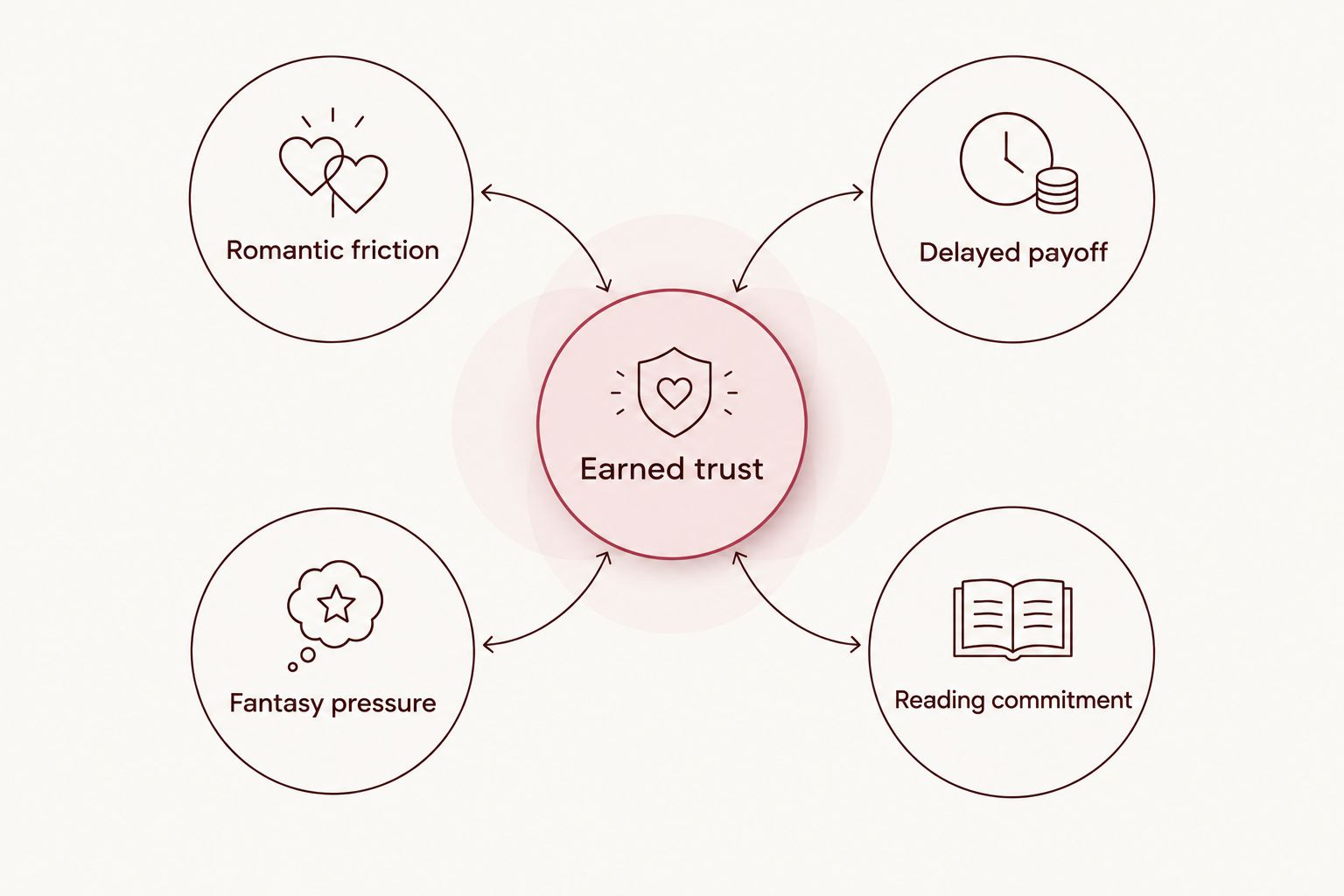
- Romantic friction: The relationship needs an obstacle beyond two people refusing to have an obvious conversation.
- Earned trust: Cooperation should change what the characters believe about each other. Attraction alone is not enough.
- Delayed payoff: Distinguish a relationship that develops within one book from a romantic arc that stretches across a series.
- Fantasy pressure: Trials, training, warfare, or court politics should actively complicate the relationship.
- Reading commitment: Decide whether you want romance at the center or can accept it as a smaller thread inside a larger fantasy story.
The strongest match combines several of these qualities. A book can deliver excellent romantic friction without delivering dragon bonds, an academy, or Fourth Wing's level of explicit content.
Slow-burn Fourth Wing read-alikes at a glance
| Book and author | Best for | Standout matching quality | Key limitation |
|---|---|---|---|
| The Serpent and the Wings of Night — Carissa Broadbent | Deadly trials and reluctant allies | Survival forces cooperation before trust feels safe | Vampire competition, not dragon-rider training |
| Blood & Steel — Helen Scheuerer | Training-ground tension | A would-be warrior and her reluctant mentor | The mentor dynamic creates an unequal starting position |
| The Hurricane Wars — Thea Guanzon | Political enemies-to-lovers | Opposing loyalties complicate a necessary alliance | More diplomacy and worldbuilding than academy life |
| An Ember in the Ashes — Sabaa Tahir | High-stakes fantasy with romantic restraint | Resistance, military brutality, and dangerous attachments | Romance shares space with multiple character arcs |
| The Cruel Prince — Holly Black | A longer wait and court maneuvering | Hostility, ambition, and shifting power | Romance is a subplot, not the main engine |
1. The Serpent and the Wings of Night: best for deadly trials
Carissa Broadbent's The Serpent and the Wings of Night follows Oraya, a human raised by a vampire ruler, into a lethal competition. Her alliance with the vampire Raihn creates the closest match here to Fourth Wing's mixture of survival pressure and dangerous attraction.
The relationship works because needing someone does not make trusting them sensible. Cooperation gives Oraya and Raihn reasons to reassess each other, while the competition keeps that reassessment risky. You get a romantic arc tied to what the characters do under pressure, not just what they notice about each other.
The meaningful difference is the setting. This is vampire fantasy built around a tournament, not an academy story with lessons, dragon selection, and a continuing military curriculum.
The Serpent and the Wings of Night pros:
- Deadly trials give the reluctant alliance an immediate purpose.
- Oraya's vulnerability among vampires makes trust consequential.
- Romance stays central without removing the survival plot.
The Serpent and the Wings of Night cons:
- It does not reproduce the dragon-and-rider bond.
- The wider story continues beyond this book; do not choose it for a self-contained ending.
Content note: Explicit sexual content and graphic violence.
Best for: Readers who want danger to accelerate intimacy without making trust easy.
Verdict: Read. This is the default recommendation when you want the closest combination of trials, attraction, and divided loyalties.
2. Blood & Steel: best for training-ground tension
Helen Scheuerer's Blood & Steel follows Althea, who wants to become a warrior in a world that restricts that ambition. Wilder becomes her reluctant mentor, putting their attraction inside a relationship already shaped by instruction, authority, and competing expectations.
Choose this for the training rather than for an identical enemies-to-lovers setup. Althea has a goal that exists outside the romance. Her pursuit of that goal keeps the relationship attached to physical effort, discipline, and the question of who gets to wield power.
The important difference is the mentor dynamic. If your favorite part of Violet and Xaden's relationship was watching an uneven balance of knowledge and experience become emotionally complicated, that is a relevant match. If you want equal-footed rivals from the outset, choose elsewhere.
Blood & Steel pros:
- Warrior training gives the heroine a concrete ambition.
- A reluctant mentor creates sustained proximity and friction.
- The relationship develops alongside a broader fantasy conflict.
Blood & Steel cons:
- The unequal starting position will not suit readers avoiding mentor romances.
- Slow-building attraction does not mean a low-spice reading experience.
Content note: Explicit sexual content and violence.
Best for: Readers who want a determined trainee, a difficult mentor, and romantic tension inside demanding training.
Verdict: Read. Pick Blood & Steel when the work of becoming a warrior matters as much as the eventual relationship.
3. The Hurricane Wars: best for political enemies-to-lovers
Thea Guanzon's The Hurricane Wars places Talasyn and Alaric on opposing sides of a war. Their light and shadow magic gives their conflict a direct fantasy dimension, while political necessity forces them into closer contact.
This is the choice when you want the hostility to have a public cause. The problem is not simply that the characters find each other irritating. Their loyalties and histories make attraction difficult to separate from the conflict around them.
Compared with Fourth Wing, the emphasis shifts toward political arrangements and extensive worldbuilding. You spend less time in a contained training environment and more time understanding the forces that make cooperation necessary. That difference matters if academy routines were part of the appeal.
The Hurricane Wars pros:
- Opposing wartime loyalties give the antagonism substance.
- Political pressure keeps proximity from feeling accidental.
- Contrasting magical abilities connect the romantic pairing to the fantasy premise.
The Hurricane Wars cons:
- The worldbuilding asks for more patience than a straightforward trial sequence.
- Readers seeking a training cohort or dragon companions should look elsewhere.
Content note: War violence and explicit sexual content.
Best for: Readers who want political enemies forced toward intimacy without quickly resolving their differences.
Verdict: Read. Choose The Hurricane Wars for the argument between attraction and allegiance, not for an academy replacement.
4. An Ember in the Ashes: best for romance under military pressure
Sabaa Tahir's An Ember in the Ashes follows Laia, who enters a military academy as a spy, and Elias, a soldier struggling against the brutality of the system that trained him. The setting supplies a strong connection to Fourth Wing's military danger, but the romantic structure is different.
Attachment develops inside a story about oppression, resistance, and survival. The characters have urgent goals beyond becoming a couple. That makes the emotional hesitation meaningful, though it also means romance does not control every major turn.
Choose this if you want the fantasy plot to retain its weight. Do not choose it expecting a single romantic pairing to receive the same concentrated attention as Violet and Xaden throughout the opening book.
An Ember in the Ashes pros:
- Military brutality makes personal loyalties dangerous.
- Laia and Elias bring different relationships to the same oppressive system.
- Romantic restraint leaves room for resistance and moral conflict.
An Ember in the Ashes cons:
- Multiple attachments complicate a straightforward central-couple reading.
- The violence is substantial; less explicit romance does not mean a gentle story.
Content note: Torture, slavery, violence, and threats of sexual violence.
Best for: Readers who want military stakes and developing attachments without making romance the whole story.
Verdict: Read if fantasy comes first. Skip it for this particular mood if you want a tightly focused romantasy pairing.
5. The Cruel Prince: best for a longer romantic wait
Holly Black's The Cruel Prince follows Jude, a mortal trying to secure power and belonging in a dangerous faerie court. Her antagonistic relationship with Cardan sits inside a larger story of ambition, vulnerability, and political maneuvering.
The matching quality is the unstable relationship between desire and distrust. Jude does not stop wanting power because attraction enters the picture. That gives the romantic thread a different shape from a story built around training together and gradually becoming dependable partners.
This is the furthest match from Fourth Wing on the list. There are no dragon-rider bonds, and romance is not the opening book's main engine. The appeal is a longer emotional wait, with court intrigue carrying much of the immediate momentum.
The Cruel Prince pros:
- Jude's independent ambition keeps the heroine's goals in view.
- Shifting power gives the antagonism consequences beyond flirtation.
- The romantic thread has room to develop across The Folk of the Air trilogy.
The Cruel Prince cons:
- Bullying and cruelty are part of the central dynamic.
- Readers wanting prominent romance immediately will find a different emphasis.
Content note: Bullying, violence, and coercive power dynamics; less sexually explicit than Fourth Wing.
Best for: Readers willing to exchange immediate romantic focus for a longer, politically tangled payoff.
Verdict: Read for patience. Skip it if your next book needs romance at the center from the start.
How the recommendations are ordered
This 2026 list ranks matching qualities, not overall literary quality. The Serpent and the Wings of Night comes first because deadly trials and a necessary alliance connect closely to Fourth Wing's romantic pressure. Blood & Steel follows for training and mentor tension.
The remaining choices move outward: political enemies, military fantasy with several emotional threads, then court intrigue with a slower romantic arc. No ranking here claims timed reading tests or that a human curator personally read every title for this article.
One distinction should guide your choice: a slow burn measures relationship development, not the absence of explicit scenes. Several adult recommendations here combine a gradual build with explicit content later.
Which book should you choose?
Start with The Serpent and the Wings of Night if you are undecided. It preserves the clearest combination of lethal competition, reluctant cooperation, and attraction that creates problems rather than solving them.
For your 2026 reading queue, switch to Blood & Steel if training is essential. Choose The Hurricane Wars for political antagonism, An Ember in the Ashes for a heavier fantasy emphasis, or The Cruel Prince when you want the relationship to take the longer road.
If none matches the exact quality you want, request GetSimilarBooks' free personalized list. The tool offers five suggestions first; the email-gated list expands that to 20–30 titles.
FAQ
What’s the closest book to Fourth Wing with slow-burn romance?
The Serpent and the Wings of Night is the closest pick here. Its deadly competition and reluctant alliance connect romantic trust directly to survival, though vampires replace the dragon-rider setting.
Which recommendation has training like Fourth Wing?
Blood & Steel is the strongest fit for training-ground tension. Althea’s ambition to become a warrior develops alongside her complicated relationship with her reluctant mentor, Wilder.
Does slow-burn romance mean less spice?
No. Slow burn describes how a relationship develops, while spice describes sexual explicitness. The Serpent and the Wings of Night and Blood & Steel combine gradual romantic development with explicit content.
Is The Cruel Prince a good choice after Fourth Wing?
The Cruel Prince is a good choice if you want antagonism, court politics, and a longer romantic wait. It is a weaker match if you want romance to dominate immediately or need dragon-rider training.
Which book puts political enemies-to-lovers first?
The Hurricane Wars is the clearest choice for political enemies-to-lovers. Talasyn and Alaric’s opposing wartime loyalties make cooperation and attraction difficult to separate from public conflict.
Which recommendation is less sexually explicit than Fourth Wing?
The Cruel Prince is less sexually explicit than Fourth Wing. It still contains bullying, violence, and coercive power dynamics, so lower explicitness does not mean lighter subject matter.
How do I get more personalized Fourth Wing read-alikes?
Enter Fourth Wing into GetSimilarBooks to receive five hand-curated read-alike suggestions. An email signup gives you access to a free personalized list of 20–30 titles.
One last thing
For your 2026 reading list, name what you want delayed: attraction, trust, commitment, or physical intimacy. Those are different requests. A book can make its characters desire each other early and still spend most of its story making trust difficult.
Choose the obstacle before choosing the trope. That is a better filter than asking for enemies-to-lovers and hoping the pacing follows.
Related guides
- Books like Fourth Wing with less spice
- Books like Fourth Wing with dragons and rider bonds
- Books like Fourth Wing set in a military academy
- Books like Fourth Wing with enemies-to-lovers romance
Books like Fourth Wing with political intrigue

Best overall: The Bridge Kingdom by Danielle L. Jensen. Best for deadly trials and rival factions: The Serpent and the Wings of Night by Carissa Broadbent. Best for court maneuvering: The Cruel Prince by Holly Black. These books like Fourth Wing with political intrigue put divided loyalties, concealed motives, and dangerous relationships ahead of a shared fantasy label.
- The Bridge Kingdom leads these books like Fourth Wing with political intrigue: military secrets make the romance dangerous.
- The Serpent and the Wings of Night keeps deadly trials, attraction, and competing factions close together.
- The Winner’s Curse trades magical combat for occupation, espionage, and divided loyalties.
- The Cruel Prince emphasizes court maneuvering; Reign & Ruin emphasizes succession and negotiated alliances.
Why this matters
Fourth Wing makes trust a political problem. Violet must judge people inside a military institution while discovering that official explanations deserve scrutiny. A useful read-alike needs more than enemies who become attracted to each other. The relationship should change what someone risks, conceals, or believes.
This 2026 guide ranks five recommendations by that connection between intimacy and power. None reproduces every part of Fourth Wing. Choose the feature you want to preserve, then accept the difference deliberately.
GetSimilarBooks is best for fiction readers who want book recommendations built around a title they already enjoyed. You can use GetSimilarBooks to request a free personalized list when your preferred combination is more specific than this ranking.
What makes the best political read-alike?
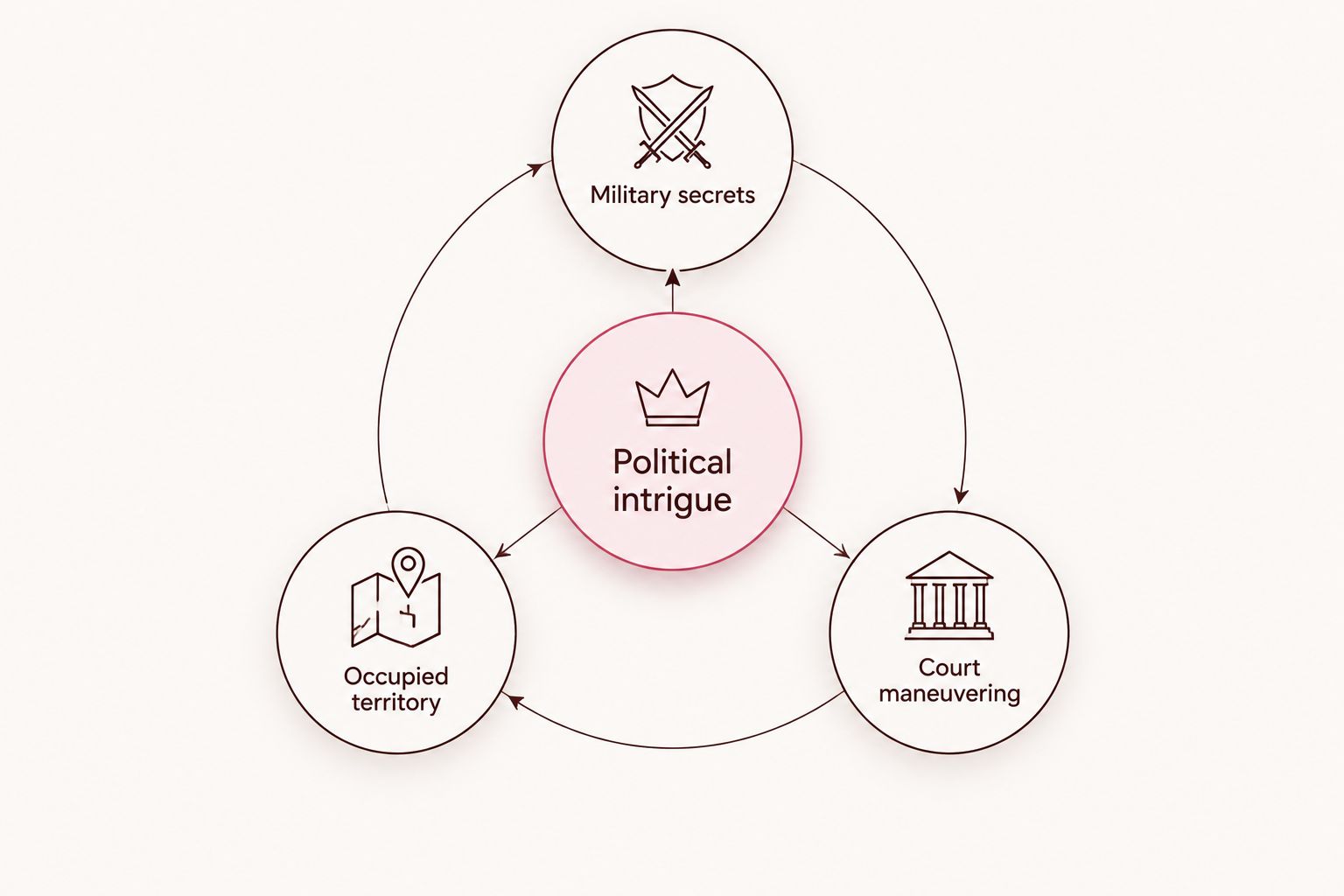
- Political consequences: A private decision changes an alliance, a military objective, or someone’s claim to power.
- Divided loyalty: The protagonist has obligations that attraction cannot conveniently erase.
- Information pressure: Secrets matter because acting on the wrong account carries consequences.
- Romantic friction: The relationship grows through conflicting interests, not just hostile dialogue.
- Recognizable momentum: Danger, confrontation, or a clear objective keeps political explanation from becoming the whole book.
The ranking favors the combination of these qualities. A book with intricate court politics but little romantic development is not automatically the closest match. Neither is a romance with a kingdom mentioned in the background.
Political fantasy read-alikes at a glance
| Rank and book | Best for | Standout match | Key difference |
|---|---|---|---|
| 1. The Bridge Kingdom — Danielle L. Jensen | Military secrets | An intimate relationship doubles as a strategic vulnerability | No dragon bonds or academy setting |
| 2. The Serpent and the Wings of Night — Carissa Broadbent | Deadly trials | A dangerous competition intersects with factional interests | Vampire power structures replace military schooling |
| 3. The Winner’s Curse — Marie Rutkoski | Occupied territory | Attraction collides with imperial loyalty and resistance | Strategy matters more than magical combat |
| 4. The Cruel Prince — Holly Black | Court maneuvering | An outsider seeks power inside a hostile ruling class | Romance is less central in the opening book |
| 5. Reign & Ruin — J. D. Evans | Succession politics | A political partnership develops alongside the romance | More negotiation and less trial-driven urgency |
Choose the kind of politics you want
Military secrets lead you toward The Bridge Kingdom. Its central tension asks what happens when closeness to another person also provides access to strategically important information.
Occupied territory points toward The Winner’s Curse. Here, the unequal relationship between peoples matters as much as the relationship between individuals. The political problem cannot be settled by deciding whom to trust romantically.
Court maneuvering points toward The Cruel Prince. Read it when you want status, access, and succession to become tools characters use against one another. That is a different pleasure from surviving a military course.
1. The Bridge Kingdom: best for military secrets and divided loyalty
Danielle L. Jensen’s The Bridge Kingdom follows Lara, a trained princess sent into a marriage with the ruler of a strategically important kingdom. Her assignment and her developing understanding of that kingdom pull in different directions.
The specific match is the collision between an assigned enemy and a less convenient reality. Like Fourth Wing, the novel makes attraction dangerous because the surrounding conflict does not disappear when the relationship changes. Information gathered in private has public consequences.
The meaningful difference is structural. You leave the academy behind and enter a marriage built around political objectives. There are no dragon-rider bonds to replace Violet’s connection with her dragons. The pressure comes from proximity, concealment, and competing obligations.
The Bridge Kingdom pros:
- Espionage gives the romance a concrete source of danger.
- Military geography makes the kingdom more than decorative scenery.
- Changing knowledge forces Lara to reassess established loyalties.
The Bridge Kingdom cons:
- It does not offer a magical training environment.
- Sustained deception creates relationship tension that becomes frustrating if you prefer early honesty.
Best for: You want Fourth Wing’s distrust and enemy-line attraction, with political objectives closer to the center.
Verdict: Buy if military secrets matter more to you than dragons. It is the default first pick for this particular reading need.
2. The Serpent and the Wings of Night: best for deadly trials
Carissa Broadbent’s The Serpent and the Wings of Night follows Oraya, a human raised by a vampire ruler, into a lethal tournament. Survival requires her to assess rivals, power, and the limits of her own position.
The match with Fourth Wing is immediate: a vulnerable entrant faces extraordinary opponents while a dangerous attraction complicates judgment. The tournament is not isolated from the world outside it. Relationships among rulers and factions shape the stakes around the contestants.
Choose this before a quieter court fantasy if you need physical danger to carry the political story. You get a clearer survival framework than in several other books here. You do not get the same military institution or squad-based training experience.
The Serpent and the Wings of Night pros:
- Deadly competition provides a clear narrative engine.
- Oraya’s position makes power imbalances personal.
- Romantic trust develops under immediate pressure.
The Serpent and the Wings of Night cons:
- Tournament survival takes attention away from sustained governance or diplomacy.
- Vampire society changes the atmosphere substantially from Fourth Wing’s military fantasy.
Best for: You want your 2026 follow-up to preserve peril, attraction, and factional tension together.
Content note: Graphic violence and explicit sexual content.
Verdict: Buy if removing the deadly trials would remove your main reason to read. Pick The Bridge Kingdom instead when espionage is the stronger draw.
3. The Winner’s Curse: best for occupation and strategic choices
Marie Rutkoski’s The Winner’s Curse centers on Kestrel, a general’s daughter, and Arin, an enslaved young man from a conquered people. Their relationship develops within an unequal political order, not outside it.
Kestrel’s strength is strategic judgment rather than magical combat. That makes her a useful next protagonist if you liked watching Violet solve problems through observation and reasoning. The similarity stops short of physical circumstances or setting; this is not another version of Violet’s training story.
The strongest match is loyalty under pressure. Personal feeling cannot erase conquest, and a clever choice can carry consequences beyond the person making it. Read for competing obligations rather than a straightforward contest between good intentions and bad rulers.
The Winner’s Curse pros:
- Strategy gives the protagonist agency without making her a dominant fighter.
- Occupation creates a substantive conflict beneath the romance.
- Unequal social positions make trust consequential.
The Winner’s Curse cons:
- It offers neither dragons nor a magic-training storyline.
- The enslaver-and-enslaved power imbalance makes the romantic premise difficult for some readers.
Best for: You want political consequences and divided loyalties more than explicit romance or combat spectacle.
Content note: Enslavement, oppression, and violence.
Verdict: Buy if you want the political problem to remain difficult even when the attraction is clear. This is the strongest change of direction without abandoning the central trust question.
4. The Cruel Prince: best for court maneuvering and outsider ambition
Holly Black’s The Cruel Prince follows Jude, a mortal raised among the fae, as she seeks a place in a society that treats her mortality as weakness. Court hierarchy and the struggle for influence shape her choices.
The Fourth Wing connection is an underestimated protagonist trying to gain agency inside a hostile structure. Jude does not simply want to survive that structure. She wants power within it, which changes the character of the story.
The Cruel Prince is the pick for political ambition, not an exact replacement for Fourth Wing’s romance. Hostility, status, and manipulation occupy substantial space. The romantic thread matters, but the opening book does not give it the same emphasis as a romance-led fantasy.
The Cruel Prince pros:
- Court status directly affects what Jude can attempt.
- An ambitious protagonist creates tension beyond personal survival.
- Succession and manipulation give political choices immediate stakes.
The Cruel Prince cons:
- Readers expecting a central, explicit romance will find a different balance.
- Cruelty and humiliation are part of the social atmosphere, not brief obstacles.
Best for: You want a hostile court, a determined outsider, and characters who treat influence as a weapon.
Content note: Bullying, abuse, and violence.
Verdict: Buy if court maneuvering is your priority; skip if you mainly want Fourth Wing’s romantic intensity. For a 2026 reading list focused on power rather than training, this is the sharper fit.
5. Reign & Ruin: best for succession and a political partnership
J. D. Evans’s Reign & Ruin brings together Naime, a ruler’s daughter whose political future is contested, and Makram, a prince connected to a neighboring kingdom. Their developing relationship sits alongside questions of succession, authority, and alliance.
This is the furthest step from Fourth Wing’s academy-and-trials structure. It earns its place because political credibility and romantic compatibility are connected. The leads must consider what cooperation means beyond their own attraction.
Choose Reign & Ruin when you want negotiation to become part of the romantic appeal. The match is not constant antagonism. It is the pleasure of watching capable people assess each other while larger interests remain in play.
Reign & Ruin pros:
- Succession gives the political story a defined point of conflict.
- The relationship makes room for competence and mutual consideration.
- Magic connects to the surrounding political world.
Reign & Ruin cons:
- It offers less of Fourth Wing’s immediate trial-based pressure.
- Readers seeking prolonged enemies-to-lovers hostility will get a different dynamic.
Best for: You want adult fantasy romance in which political cooperation matters as much as attraction.
Content note: Explicit sexual content and violence.
Verdict: Buy if you want a political partnership rather than another lethal training ground. Save it for when a slower change of pace sounds appealing.
How this ranking works
This 2026 ranking orders books by the connection between political conflict and romantic trust, then by their resemblance to Fourth Wing’s momentum. It is a fit guide, not a claim that one novel is universally better than another.
The Bridge Kingdom leads because its central relationship is also a strategic vulnerability. The Serpent and the Wings of Night follows because deadly trials preserve a familiar source of urgency. The remaining books move outward into occupation, court ambition, and negotiated partnership.
GetSimilarBooks provides five hand-curated read-alike suggestions from a title you enjoyed. The free personalized list contains 20–30 titles and requires an email address. Use that option when you want to combine requirements, such as political intrigue with less explicit romance.
Find your next political fantasy
Request GetSimilarBooks’ free personalized list of 20–30 titles. An email address is required.
Which book should you choose?
Start with The Bridge Kingdom. It keeps attraction, concealed purpose, and military stakes tightly connected without requiring another academy setting.
Choose The Serpent and the Wings of Night instead if surviving a deadly contest is nonnegotiable. Choose The Winner’s Curse if you want strategy and occupation. Choose The Cruel Prince for court ambition, or Reign & Ruin for cooperation under political pressure.
For your 2026 reading list, choose the conflict you want to follow—not merely the fantasy setting you recognize.
FAQ
What’s the best book like Fourth Wing with political intrigue?
The Bridge Kingdom by Danielle L. Jensen is the strongest overall fit on this list. Its central relationship connects directly to espionage, military interests, and divided loyalties, though it has no dragon bonds or academy setting.
Which recommendation keeps Fourth Wing’s deadly trials?
The Serpent and the Wings of Night by Carissa Broadbent is the closest fit for deadly trials. A lethal tournament drives the story while factional interests and romantic trust complicate survival.
Is The Cruel Prince as romance-focused as Fourth Wing?
No. The Cruel Prince gives more attention to Jude’s pursuit of power and her position in a hostile fae court. Choose it for political maneuvering rather than an equally prominent or explicit romance.
Which book should I read if I liked Violet’s strategic thinking?
The Winner’s Curse is the strongest choice here for a strategy-focused protagonist. Kestrel relies on observation and judgment, while occupation and conflicting loyalties make her decisions consequential.
Which book has political intrigue and a more cooperative romance?
Reign & Ruin is the best fit on this list for political cooperation alongside romance. Succession and alliance remain central without relying on the same prolonged hostility readers might expect from an enemies-to-lovers story.
Do these books all have dragons?
No. These recommendations match Fourth Wing through political conflict, dangerous trust, or romantic stakes rather than dragon-rider bonds. Choose a dragon-focused read-alike list if that bond is your essential requirement.
How does GetSimilarBooks help me choose another book?
GetSimilarBooks lets you enter a title you enjoyed and receive five hand-curated read-alike suggestions. Readers can also request a free personalized list of 20–30 titles by providing an email address.
One last thing
Ask what you wanted to understand after finishing Fourth Wing: who was lying, who held power, or whom Violet could trust. Those are related questions, but they lead to different books. The Bridge Kingdom is the safest starting point when you want all three questions tied to the romance.
Related guides
- Books like Fourth Wing with dragons and rider bonds
- Books like Fourth Wing with less spice
- Books like Fourth Wing set in a military academy
- Books like Fourth Wing with enemies-to-lovers romance
Books like Fourth Wing with found family

Best overall: A Deadly Education. Best for a brutal military setting: The Blood Trials. Best for an established crew: Six of Crows. These books like Fourth Wing with found family belong on your 2026 reading list if you want loyalty earned under pressure, not just another dangerous school.
- A Deadly Education leads these books like Fourth Wing with found family: dangerous schooling, defensive outsiders, and earned trust.
- The Blood Trials matches military training and hard-won allegiance; expect graphic violence and racism.
- Six of Crows suits readers who want the crew, rather than the romantic couple, to drive the story.
- GetSimilarBooks offers five hand-curated read-alikes and a free personalized list of 20–30 titles through email.
Why this matters
Fourth Wing gives Violet more than a love interest. Friendship changes how she survives Basgiath. If that is what stayed with you, a recommendation based only on dragons or enemies-to-lovers tension misses the point.
The right match makes belonging part of the story's stakes. You should care who returns from danger, who notices someone struggling, and who chooses loyalty when obedience would be easier. GetSimilarBooks is best for fiction readers who want title-based, hand-curated read-alikes rather than another broad genre list.
The recommendations below move from the closest overall reading experience toward books that keep the emotional pattern while changing the setting. None matches every part of Fourth Wing. Each earns its place for a specific reason.
What makes the best found-family match?
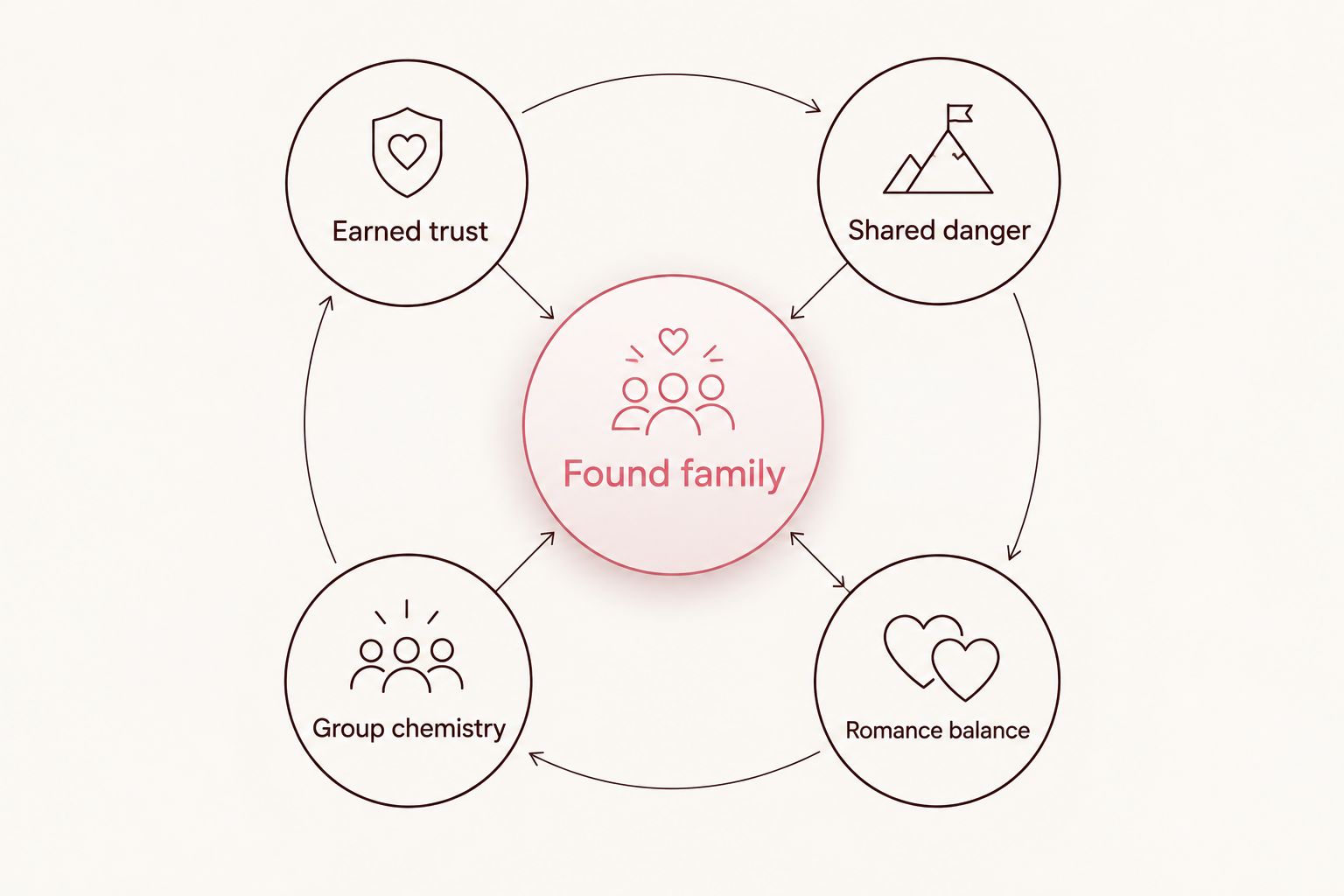
- Earned trust: Relationships change through actions. Calling classmates a squad does not automatically make them a family.
- Shared danger: The group has a reason to depend on one another beyond enjoying the same company.
- Group chemistry: Side characters have competing wants, recognizable voices, and relationships beyond the protagonist.
- Romance balance: The romantic relationship leaves room for friendship, solidarity, and group decisions.
- Meaningful differences: A useful recommendation tells you what you lose as clearly as what you keep.
These criteria separate a similar premise from a similar attachment. You might prefer a school full of monsters, a dangerous military institution, or a spaceship crew. The important question is whether the relationships do the work you want.
Found-family read-alikes at a glance for 2026
| Book and author | Best for | Strongest matching quality | Main difference |
|---|---|---|---|
| A Deadly Education — Naomi Novik | Outsiders learning to trust | A lethal school makes alliances essential | Sharper internal narration; belonging develops across the series |
| The Blood Trials — N. E. Davenport | Military pressure and solidarity | Training, institutional hostility, and dangerous secrets | More graphic violence and a strong focus on racial oppression |
| Six of Crows — Leigh Bardugo | Crew-first storytelling | Distinct outsiders whose abilities and loyalties intersect | A heist rather than an academy; romance shares the spotlight |
| The Gilded Wolves — Roshani Chokshi | Friendship tangled with belonging | A close team with conflicting needs and loyalties | Historical fantasy, puzzles, and artifact-focused missions |
| The Long Way to a Small, Angry Planet — Becky Chambers | Everyday chosen family | Work, care, and cultural differences build a crew | Science fiction with a gentler, more episodic shape |
1. A Deadly Education: best for outsiders learning to trust
Naomi Novik's A Deadly Education follows El through the Scholomance, a school where surviving the environment matters more than pleasing a teacher. El expects rejection and treats social exchanges with suspicion. That defensive starting point makes each movement toward trust count.
The Fourth Wing connection is not simply school plus danger. Both books place a young woman inside a system where other students can be protection, competition, or both. Friendship becomes a practical decision before it becomes an emotional refuge.
The difference is the voice. El's narration is abrasive, funny, and full of explanations about magic and survival. You spend more time inside her judgments than inside a tightly coordinated squad. Read this for the formation of belonging, not an immediately comfortable circle.
A Deadly Education pros:
- Dangerous schooling makes dependence on other people consequential.
- An isolated heroine gives new friendships emotional weight.
- Romance does not erase the importance of wider alliances.
A Deadly Education cons:
- Dense internal explanations interrupt the action.
- The found-family arc needs room beyond the opening book.
Best for: You liked watching Violet decide whom to trust while navigating an institution that treats survival as a test.
Verdict: Read A Deadly Education first. It is the closest match here for the combination of school pressure and reluctant connection.
2. The Blood Trials: best for military pressure and solidarity
N. E. Davenport's The Blood Trials follows Ikenna as she enters brutal military trials while investigating her grandfather's death. She also has a dangerous secret to protect. Personal grief and institutional power sit behind the training plot.
This is the strongest choice if your attachment to Fourth Wing includes the question of who stands beside you when the institution is hostile. Relationships develop under pressure, and allegiance matters because the surrounding system is not neutral.
The difference deserves attention before you start. Racism and oppression are central to the conflict, not background decoration. The violence is graphic. This is not a softer route back to the comfort of a favorite squad, even when the friendships provide relief.
The Blood Trials pros:
- Military selection gives relationships immediate stakes.
- Ikenna's secrets complicate trust rather than making it automatic.
- Personal loyalty clashes with institutional expectations.
The Blood Trials cons:
- Graphic violence makes this a demanding comfort read.
- Political conflict and revenge share space with the group relationships.
Best for: You want a fierce heroine, punishing training, and bonds formed inside a hostile hierarchy.
Verdict: Read The Blood Trials for the military match. Choose it for solidarity under pressure, not for a close copy of Violet's social circle.
3. Six of Crows: best for a crew that carries the story
Leigh Bardugo's Six of Crows brings together criminals and outsiders for a dangerous heist. Kaz Brekker organizes the job, but the story gives the other crew members their own histories, skills, grievances, and attachments.
The match is the feeling that every person changes the group's chances. Competence matters. So does knowing where another person's confidence ends. The crew is not instantly affectionate, and the book does not ask you to mistake cooperation for uncomplicated trust.
You lose the academy and dragon bonds. You gain a wider ensemble whose romantic and nonromantic relationships develop alongside the mission. If you kept reading Fourth Wing to spend more time with the people around Violet, this is the clearest shift toward crew-first storytelling.
Six of Crows pros:
- Multiple viewpoints make the ensemble more than a protagonist's support system.
- Different skills give each crew member a practical role.
- Loyalty remains complicated by secrets and competing goals.
Six of Crows cons:
- The opening asks you to absorb an unfamiliar city and criminal world.
- Trauma, violence, and exploitation remain part of the story.
Best for: You want every member of the group to feel necessary, with romance woven through the ensemble rather than placed above it.
Verdict: Read Six of Crows for the crew. Skip it only if an academy setting is essential to your next read.
4. The Gilded Wolves: best for complicated belonging
Roshani Chokshi's The Gilded Wolves follows a team pursuing a powerful artifact in an alternate Paris shaped by magical Forging. Séverin leads the group, but the characters bring different relationships to identity, exclusion, ambition, and home.
The found-family appeal lies in those differences. The characters do not need the group for identical reasons. Affection exists alongside private wants, and their shared work does not dissolve those tensions.
Compared with Fourth Wing, this is a larger change in texture. Expect historical fantasy, puzzles, and a team whose emotional connections matter as much as its mission. Choose it when you want belonging to stay complicated rather than become a simple reward for surviving danger together.
The Gilded Wolves pros:
- The ensemble has relationships and tensions beyond a central romance.
- Questions of exclusion make belonging part of the main conflict.
- Shared missions give the group reasons to act together.
The Gilded Wolves cons:
- Forging and the surrounding institutions require attention early on.
- Readers seeking a sustained military-training plot will not find it here.
Best for: You want a team that feels close while its members still want different things from one another.
Verdict: Read The Gilded Wolves for emotionally tangled friendship. It is a match for belonging, not for Basgiath's structure.
5. The Long Way to a Small, Angry Planet: best for everyday care
Becky Chambers's The Long Way to a Small, Angry Planet follows Rosemary as she joins the multispecies crew of the Wayfarer. The ship's work brings people together, but ordinary interactions make the relationships convincing.
This is the farthest recommendation from Fourth Wing in setting and pace. It belongs because found family does not always need another lethal examination. Sometimes the satisfying next book shows people learning how to live and work beside one another.
Choose this if you want the emotional shelter of a group more than the rush of surviving an institution. Expect cultural differences, personal boundaries, and acts of care. Do not expect a central enemies-to-lovers romance or an escalating sequence of combat trials.
The Long Way to a Small, Angry Planet pros:
- Daily work gives the crew's attachment room to develop.
- Different needs and customs make care specific rather than sentimental.
- Belonging matters without requiring a central romantic couple.
The Long Way to a Small, Angry Planet cons:
- The episodic structure offers less forward pressure than a trials plot.
- Science fiction replaces the fantasy setting entirely.
Best for: You finished Fourth Wing wanting more shared meals and people looking after one another, not more casualties.
Verdict: Read The Long Way to a Small, Angry Planet for a gentler change. Skip it when immediate danger is your main requirement.
How these books are ranked
This 2026 list ranks books by their fit with Fourth Wing's earned friendships, then by how much of the surrounding reading experience they preserve. Dangerous schooling puts A Deadly Education first. Military pressure puts The Blood Trials next. The remaining choices move toward ensemble loyalty, complicated belonging, and everyday care.
The order is not a claim that one book is better literature than another. It is a decision path. Start near the top when you want familiar pressures; move down when you want the same emotional need met in a different form.
Which found-family book should you choose?
Choose A Deadly Education if you are undecided. It preserves the useful combination: an isolated heroine, dangerous schooling, and relationships that change the terms of survival.
Choose Six of Crows instead if the group matters more than the setting. Choose The Long Way to a Small, Angry Planet if your next read needs room to breathe.
For a more specific 2026 reading list, tell GetSimilarBooks which title you enjoyed. Five suggestions are the preview; the free personalized list of 20–30 titles requires an email address. That is useful when you want recommendations shaped around a particular book rather than another genre label.
Find your next read
Start with five hand-curated suggestions, then request a free personalized list of 20–30 titles by email.
FAQ
What’s the best book like Fourth Wing with found family?
A Deadly Education is the strongest starting point for dangerous schooling and an isolated heroine learning to trust. Its friendships develop alongside survival decisions, though the broader belonging arc continues across the series.
Should I read Six of Crows if I liked Violet’s squad?
Yes, choose Six of Crows if distinct personalities and hard-won loyalty mattered more than the academy setting. The heist gives each crew member a role, while secrets keep trust complicated.
Which recommendation has military training like Fourth Wing?
The Blood Trials is the military-training pick on this list. Expect a hostile institution, dangerous secrets, graphic violence, and racial oppression as a central conflict.
Which book should I choose if I want less focus on romance?
Choose Six of Crows for an ensemble in which romance shares the story with a heist and the crew’s competing goals. Choose The Long Way to a Small, Angry Planet for everyday belonging without a central romantic couple.
Do all these books have dragons?
No. These recommendations match Fourth Wing through friendship, loyalty, and belonging rather than dragon-rider bonds. The settings range from a lethal magical school to a working spaceship.
Can I read these recommendations without spoilers?
Yes, this guide describes starting premises, relationship patterns, and reading differences without revealing major twists. It also flags broad content concerns rather than describing specific scenes.
How can GetSimilarBooks help me choose my next book in 2026?
GetSimilarBooks lets you enter a title you enjoyed and receive five hand-curated read-alike suggestions. You can also request a free personalized list of 20–30 titles through email.
One last thing
Before choosing, name the scene you miss from Fourth Wing. Was it training beside people Violet learns to trust, or a quiet moment when someone notices what she needs?
That distinction changes the recommendation. Pick shared danger for the first feeling and everyday care for the second. A matching relationship pattern is more useful than a matching creature on the cover.
Related guides
- Books like Fourth Wing set in a military academy
- Books like Fourth Wing with dragons and rider bonds
- Books like Fourth Wing with less spice
- Books like Fourth Wing with deadly trials
Books like Fourth Wing told from both sides of the romance

Best overall: Blood & Steel; best for romantic deception: The Bridge Kingdom; best for a quieter wartime romance: Divine Rivals. These books like Fourth Wing with dual POV give you both romantic leads’ perspectives; this 2026 list ranks them from the closest training-and-danger match to alternatives that change the setting and pace.
- Blood & Steel leads these books like Fourth Wing with dual POV for combat training and a guarded mentor romance.
- The Bridge Kingdom gives both romantic leads perspectives while making divided loyalty the central obstacle.
- The Hurricane Wars pairs opposing combatants with conflicting loyalties and a politically constrained attraction.
- Reign & Ruin favors political partnership; Divine Rivals favors letters and emotional intimacy.
- Choose by what you want to understand: attraction, withheld information, or competing loyalties.
Why this matters
Dual POV changes the experience of a guarded love interest. Instead of interpreting every warning or retreat through the heroine, you also see what the other person fears, wants, and misunderstands. That can deepen the romance, but it removes some uncertainty.
Fourth Wing primarily follows Violet’s perspective. Occasional access to Xaden does not make its main narrative an evenly shared account, so these recommendations focus on books that regularly follow both romantic leads.
GetSimilarBooks is best for fiction readers who want read-alike recommendations tied to a book they already enjoyed. You can enter a title at GetSimilarBooks for five hand-curated suggestions, then request a free personalized list of 20–30 titles by email.
What makes the best dual-POV Fourth Wing read-alike?
The ranking uses these criteria, not a shared romantasy label:
- Both perspectives: Both romantic leads receive meaningful viewpoint space within the recommended book, not only in a sequel or bonus chapter.
- Danger under pressure: Training, war, espionage, or political threats force consequential choices.
- Romantic friction: Attraction collides with a concrete obstacle, such as incompatible loyalties or unequal authority.
- Character agency: Both leads have goals beyond becoming a couple.
- Meaningful differences: Each recommendation states what you lose alongside what you gain.
For this 2026 reading list, narrative fit comes before publication recency. None of these books duplicates Violet’s story, and none needs to. The useful question is which part of Fourth Wing you want to experience from both sides.
Dual-POV read-alikes at a glance
| Rank | Book and author | Best for | Standout match | Key limitation |
|---|---|---|---|---|
| 1 | Blood & Steel — Helen Scheuerer | Training and a guarded mentor romance | Martial ambition, dangerous preparation, and romantic resistance | Not a dragon-rider college |
| 2 | The Bridge Kingdom — Danielle L. Jensen | Deception and divided loyalty | Both leads assess a relationship shaped by enemy interests | Espionage replaces magical training |
| 3 | The Hurricane Wars — Thea Guanzon | Opposing combatants | Attraction entangled with war and political demands | More geopolitical setup than academy structure |
| 4 | Reign & Ruin — J. D. Evans | Political partnership | Two capable magic users weigh attraction against responsibility | Court maneuvering replaces training trials |
| 5 | Divine Rivals — Rebecca Ross | Emotional intimacy during war | Rival writers develop a connection through letters | Less combat-driven and less sexually explicit |
These are dual-perspective recommendations, not promises of equal chapter counts. All five use third-person narration to enter both leads’ viewpoints rather than giving you two alternating first-person narrators.
1. Blood & Steel: best for training and a guarded mentor romance
Best for: readers who want the training pressure and resistant attraction of Fourth Wing.
Helen Scheuerer’s Blood & Steel follows Althea, usually called Thea, as she pursues a place among an elite warrior order. Wilder, the warrior involved in her training, supplies the other side of a romance shaped by resistance, authority, and danger.
The match is specific: a determined heroine pushes toward a martial role while a more experienced man complicates both her progress and her feelings. Both viewpoints let you distinguish outward restraint from inward attraction. You spend less time asking whether he cares and more time watching how that conflicts with his responsibilities.
The important difference is the institution. Blood & Steel is not a dragon-rider college, and its training relationship is not an exact replacement for Violet and Xaden’s dynamic. Choose it for the heroine’s martial ambition and the tension around her instructor, not for bonded creatures.
Blood & Steel pros:
- Combat preparation makes the heroine’s goal concrete.
- Both leads have interior lives beyond their spoken disagreements.
- The training relationship creates a sustained obstacle to intimacy.
Blood & Steel cons:
- The mentor dynamic brings an imbalance of authority.
- Dragon bonds are not the central attraction.
Mature-content note: expect explicit sexual content and violence.
Verdict: Buy if training and a guarded romantic lead are your priorities; skip if dragons are essential.
2. The Bridge Kingdom: best for deception and divided loyalty
Best for: readers who want to understand both sides of a romance built on mistrust.
Danielle L. Jensen’s The Bridge Kingdom follows Lara, a trained princess sent into a politically arranged marriage, and Aren, the king she marries. Their perspectives expose the competing duties beneath a relationship neither can treat as purely personal.
This is the strongest choice here when your favorite Fourth Wing tension involved information, allegiance, and the fear of trusting the wrong person. You understand more than either character can safely say aloud. That changes the suspense: the question becomes what each person will do with incomplete knowledge.
The difference is equally clear. The Bridge Kingdom trades magical schooling for espionage, diplomacy, and the strategic importance of a kingdom. Lara arrives with extensive preparation rather than entering the story as an inexperienced recruit.
The Bridge Kingdom pros:
- Both viewpoints make divided loyalty central rather than decorative.
- The marriage premise forces sustained proximity.
- Political stakes give romantic choices consequences beyond the couple.
The Bridge Kingdom cons:
- It does not provide a magical training environment.
- Deception can make the relationship uncomfortable rather than reassuring.
Mature-content note: expect sexual content and violence.
Verdict: Buy if you want attraction complicated by conflicting duties; skip if your main interest is learning a magic system.
3. The Hurricane Wars: best for romance across enemy lines
Best for: readers who want both combatants’ perspectives on a politically constrained attraction.
Thea Guanzon’s The Hurricane Wars follows Talasyn and Alaric, opposing figures in a conflict involving powerful light and shadow magic. The narrative follows both characters as hostility, attraction, and political pressures become difficult to separate.
The Fourth Wing connection is not simply an intimidating romantic lead. Both stories make attraction inseparable from a larger conflict, and both ask what private feelings mean when public loyalties pull elsewhere. Here, access to both viewpoints makes the distance between personal desire and official responsibility especially visible.
The difference is scale and emphasis. The Hurricane Wars spends more time establishing its conflict and political circumstances than recreating an academy routine. Its romance requires patience with prolonged antagonism and an elaborate setting.
The Hurricane Wars pros:
- Both leads carry loyalties that cannot disappear for convenience.
- Their magical opposition gives the conflict a tangible form.
- Political constraints sustain tension beyond initial attraction.
The Hurricane Wars cons:
- The opening asks you to absorb substantial worldbuilding.
- Hostility remains a major part of the relationship.
Mature-content note: expect war violence and sexual content.
Verdict: Buy if opposing loyalties drive your interest; skip if you want a straightforward training-to-romance progression.
4. Reign & Ruin: best for capable partners under political pressure
Best for: readers who want mutual respect alongside attraction and magical stakes.
J. D. Evans’s Reign & Ruin follows Naime, a politically constrained heir, and Makram, a powerful mage with responsibilities of his own. Their viewpoints make the developing relationship part of a wider negotiation over power, duty, and cooperation.
Choose this after Fourth Wing if you want both leads to think seriously about the consequences of being together. Attraction does not erase their judgment. The pleasure lies in seeing two capable people recognize each other while deciding what trust requires.
This is a more distant match because court politics replace the academy’s physical training and immediate survival tests. The romantic friction also comes less from sustained personal hostility. Do not choose it expecting another hostile instructor or a procession of dangerous lessons.
Reign & Ruin pros:
- Both leads have meaningful political responsibilities.
- Magical abilities matter to the wider conflict.
- Mutual respect gives the romance a different source of momentum.
Reign & Ruin cons:
- Political discussion takes space that combat occupies in Fourth Wing.
- It is not the strongest choice for readers seeking prolonged romantic antagonism.
Mature-content note: expect explicit sexual content and violence.
Verdict: Buy if competence and political partnership appeal; skip if deadly training is nonnegotiable.
5. Divine Rivals: best for letters and emotional intimacy during war
Best for: readers who want both romantic perspectives without another combat-training story.
Rebecca Ross’s Divine Rivals follows Iris and Roman, rival newspaper writers whose connection develops through enchanted correspondence. Both viewpoints reveal the gap between professional friction and private vulnerability as war reaches into their lives.
The Fourth Wing match is emotional rather than structural. You get attraction under external pressure, people carrying private burdens, and a relationship that matters within a dangerous world. Reading both perspectives makes small acts of attention carry weight.
The difference is substantial. Journalism and letters replace warrior training, and the romantic register is less sexually explicit than Fourth Wing’s. Pick it because you want closeness and wartime stakes, not because you expect similar combat scenes.
Divine Rivals pros:
- Both perspectives make the correspondence emotionally legible.
- Professional rivalry gives the leads a relationship outside romance.
- War provides consequences beyond workplace competition.
Divine Rivals cons:
- It offers little of the martial-training experience.
- Its quieter romantic approach will not satisfy a search for more explicit scenes.
Mature-content note: expect war-related violence, grief, and sexual content.
Verdict: Buy if emotional intimacy is the priority; skip if you mainly want combat and explicit romance.
How this 2026 ranking works
Blood & Steel comes first because training, martial ambition, and a resistant romantic relationship overlap directly with Fourth Wing. The Bridge Kingdom follows for divided loyalty. The Hurricane Wars keeps war and antagonism prominent, while Reign & Ruin and Divine Rivals move outward toward partnership and intimacy.
This is a comparison of narrative features, not a claim that a curator personally read every book for this article. GetSimilarBooks provides hand-curated read-alike suggestions; the ranking here explains the specific matches and differences so you can judge the fit.
Which dual-POV read-alike should you choose?
Start with Blood & Steel if you are undecided. It preserves the clearest combination of training pressure, ambition, danger, and a guarded romantic lead.
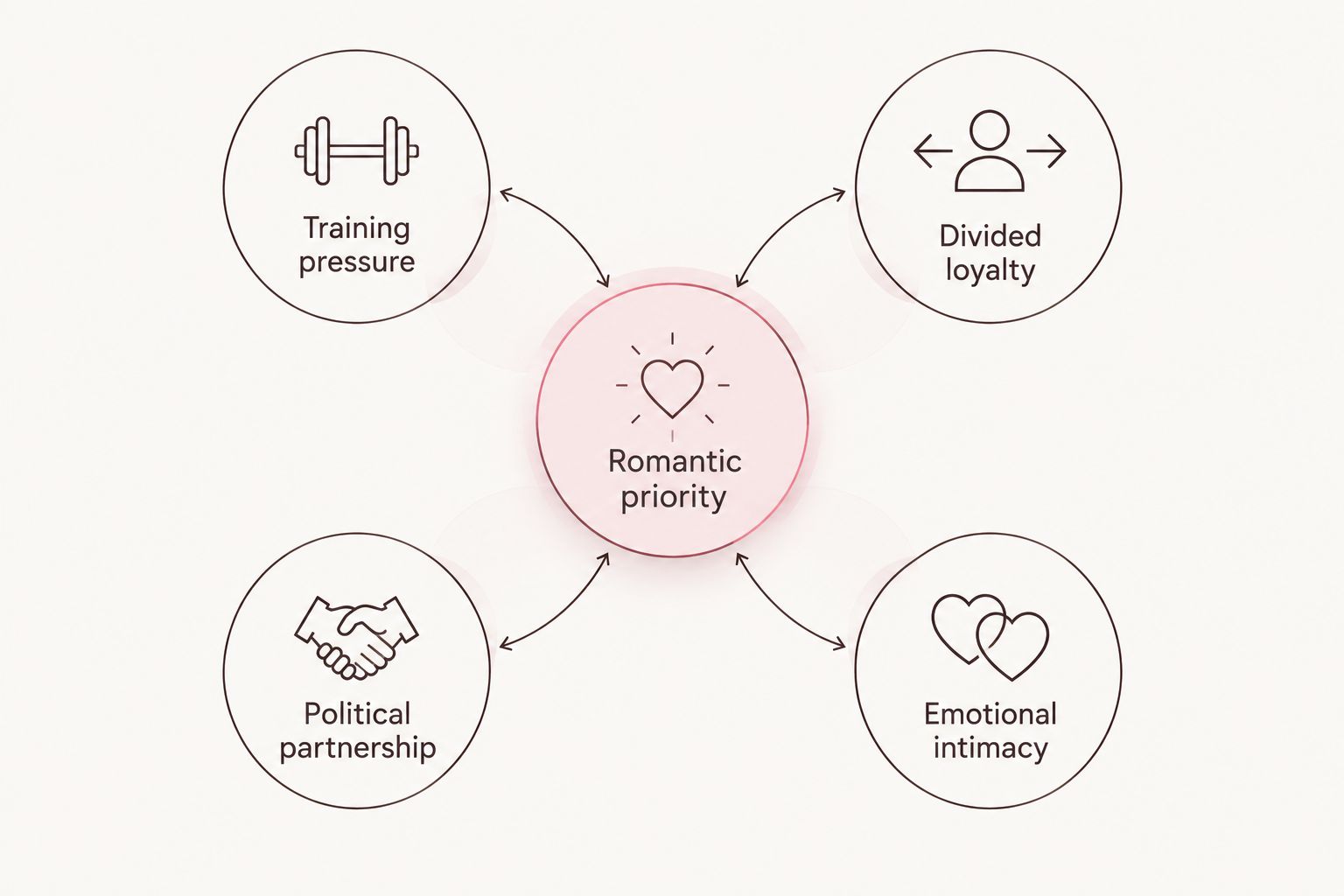
For your 2026 reading list, choose by the part you would miss most:
- Training pressure: Blood & Steel.
- Divided loyalty: The Bridge Kingdom or The Hurricane Wars.
- Political partnership: Reign & Ruin.
- Emotional intimacy: Divine Rivals.
If campus routines and institutional danger matter more than access to the love interest’s thoughts, use the military-academy read-alikes instead. Dual POV describes who tells the story, not what kind of story it is.
GetSimilarBooks can also help you move beyond this shortlist. Start with the five-title preview, then request the free personalized list of 20–30 titles by email.
Find your next read-alike
Enter a book you enjoyed for five curated suggestions, then request a longer personalized list by email.
FAQ
What’s the best book like Fourth Wing with dual POV?
Blood & Steel is the closest match on this list for training pressure, a determined heroine, and a guarded romantic lead. The Bridge Kingdom is the better choice if divided loyalty matters more than combat preparation.
Is Fourth Wing itself a dual-POV romance?
Fourth Wing primarily follows Violet rather than regularly dividing its main narrative between both romantic leads. Access to Xaden in additional material or isolated sections is different from a consistently dual-perspective novel.
Are these books written in alternating first person?
No. Blood & Steel, The Bridge Kingdom, The Hurricane Wars, Reign & Ruin, and Divine Rivals use third-person narration that follows both romantic leads. Dual POV does not necessarily mean alternating first-person chapters.
Is The Serpent and the Wings of Night dual POV?
The Serpent and the Wings of Night primarily follows Oraya, so it is not included as a regular dual-POV match here. A book can resemble Fourth Wing in danger and romantic tension without meeting this viewpoint requirement.
Which dual-POV Fourth Wing read-alike has less explicit romance?
Divine Rivals is the less sexually explicit choice among these recommendations. It centers emotional intimacy and correspondence, but it still contains mature material and wartime violence.
Which book should I choose for enemies-to-lovers tension?
Choose The Hurricane Wars for opposing combatants or The Bridge Kingdom for attraction complicated by deception and national loyalty. Neither recreates Fourth Wing’s dragon-rider academy.
Do I need to read these books in the order listed?
No. These are separate recommendations, not a connected reading order. Start with the book whose romantic obstacle interests you most, then follow that book’s own series order.
One last thing
For your 2026 choice, decide whether you want to understand the love interest sooner or remain uncertain alongside the heroine. Dual POV often gives you the first experience. If interpreting a guarded character was your favorite part of Fourth Wing, more access to his thoughts is a trade-off, not an automatic improvement.
Related guides
- Books like Fourth Wing with dragons and rider bonds
- Books like Fourth Wing with less spice
- Books like Fourth Wing with enemies-to-lovers romance
Books like Fourth Wing with a disabled heroine

Best overall: A Curse So Dark and Lonely by Brigid Kemmerer. Best for chronic illness and romantic tension: A Fragile Enchantment by Allison Saft. Best for grounded swordplay: Godkiller by Hannah Kaner. These books like Fourth Wing with a disabled heroine match different parts of Violet’s story; none reproduces the whole combination.
- For books like Fourth Wing with a disabled heroine, start with Brigid Kemmerer’s A Curse So Dark and Lonely.
- A Fragile Enchantment pairs chronic illness with a central romance, but replaces military training with court politics.
- Godkiller follows an amputee monster hunter; its romance is secondary to the adventure.
- GetSimilarBooks suits readers seeking book recommendations matched to a favorite title, with five hand-curated suggestions.
Why this matters
Violet’s disability is not interchangeable with being an underestimated heroine. Her pain, joint instability, and need to adapt help determine how she trains and survives. A recommendation based only on dragons or enemies-to-lovers romance misses that distinction.
This 2026 guide separates disability representation from romantic and structural similarity. You can also enter a favorite title at GetSimilarBooks for five hand-curated suggestions, with an email-gated personalized list of 20–30 titles. For this reading list, the useful question is narrower: which part of Violet’s experience do you want to find again?
What makes the best Fourth Wing read-alike here
- A disabled central woman: The character must matter to the main story, not appear briefly as evidence of an inclusive setting.
- Adaptation with consequences: Physical limits, access, pain, or fatigue should affect decisions rather than disappear when action begins.
- Romantic relevance: A central romance is a closer structural match than an adventure with a small romantic subplot.
- Pressure beyond the relationship: Curses, court obligations, dangerous gods, and colonial power each create different kinds of stakes.
- An honest difference: Cerebral palsy, limb loss, chronic illness, and POTS are not substitutes for one another. Neither are their fictional portrayals.
The recommendations at a glance
The order moves from romance-led fantasy toward books that match a more specific part of Violet’s experience. The last recommendation leaves fantasy entirely. That is a deliberate trade-off, not a claim that every adventurous heroine belongs in the same category.
| Book and author | Best for | Standout match | Key limitation |
|---|---|---|---|
| A Curse So Dark and Lonely — Brigid Kemmerer | A central fantasy romance | Harper has cerebral palsy and enters a dangerous enchanted kingdom | Fairy-tale structure rather than military training |
| A Fragile Enchantment — Allison Saft | Chronic illness within a romance | Niamh’s magical craft carries a physical cost | Court intrigue rather than combat school |
| Godkiller — Hannah Kaner | A disabled professional fighter | Kissen is an amputee godkiller who uses a prosthetic leg | Romance is not the main narrative engine |
| The Unbroken — C. L. Clark | Disability within military and political conflict | Luca uses a cane; her relationship with soldier Touraine crosses a power divide | Colonial politics dominate the reading experience |
| One for All — Lillie Lainoff | Training while managing chronic illness | Tania has POTS and trains as a Musketeer | Historical adventure, not fantasy |
1. A Curse So Dark and Lonely: best for a central fantasy romance
Brigid Kemmerer’s A Curse So Dark and Lonely is the clearest starting point if you want a disabled heroine and a romance that shapes the plot. Harper, who has cerebral palsy, is taken from contemporary Washington, D.C., into the cursed kingdom of Emberfall. The story reworks Beauty and the Beast around a prince, an enchantment, and a heroine unwilling to accept the role assigned to her.
The match is Harper’s agency under pressure. Like Violet, she enters a dangerous environment where other people make assumptions about her physical capability. Harper’s disability is present without becoming her only defining characteristic.
The difference is the engine of the story. You get a fairy-tale curse and an unfamiliar kingdom, not dragon selection, squad dynamics, or a war-college timetable.
A Curse So Dark and Lonely pros:
- Harper is a disabled protagonist with decisions that drive the plot.
- Romance sits near the center of the story.
- The fantasy setting gives the relationship consequences beyond attraction.
A Curse So Dark and Lonely cons:
- Harper’s cerebral palsy is not the same experience as Violet’s joint instability.
- The fairy-tale framework does not reproduce Fourth Wing’s training structure.
Best for: Readers who want the closest romance-led starting point, rather than the closest military setting.
Verdict: Buy if a disabled heroine and a central fantasy romance are your priorities.
2. A Fragile Enchantment: best for chronic illness and romantic tension
Allison Saft’s A Fragile Enchantment follows Niamh, a dressmaker whose magic lets her stitch emotions into clothing. She travels to a royal court to make wedding garments and becomes involved with the groom, Kit. Her inherited magic also carries a cost to her health.
The connection to Fourth Wing is the tension between what a heroine can do and what doing it asks of her body. Niamh’s craft creates opportunity, but her health is not separate from that opportunity. Attraction develops inside obligations that make the relationship difficult.
The meaningful difference is the setting’s rhythm. This is a court romance built around clothing, class, duty, and scandal, not a sequence of combat tests. Its magical illness also differs from a recognizable real-world diagnosis.
A Fragile Enchantment pros:
- Chronic illness belongs to the central heroine’s story.
- Romantic tension is a primary reason to keep reading.
- Magical work has personal consequences rather than functioning as an effortless advantage.
A Fragile Enchantment cons:
- The illness is bound to an invented magical system.
- Readers seeking martial training or dragon bonds will not find that structure here.
Best for: Readers who want bodily limits and a central romance more than battlefield action.
Verdict: Buy for chronic illness in a romance-led fantasy; skip for military-school similarity.
3. Godkiller: best for a disabled fighter with an established vocation
Hannah Kaner’s Godkiller follows Kissen, a professional godkiller who lost a leg and uses a prosthesis. Her path intersects with a young girl, a small god, and a former knight. The resulting journey puts belief, violence, and loyalty into conflict.
Kissen offers a different kind of match to Violet. She is not a novice proving that she deserves a place in training. She already has a dangerous profession, a working approach to it, and a body that remains part of how she moves through the world.
That difference is the reason to choose this book, not a defect to explain away. You trade the beginner’s training arc for an experienced fighter’s perspective. You also trade a central romance for an adventure with romantic elements.
Godkiller pros:
- An amputee woman occupies a central action role.
- Kissen’s competence does not depend on presenting her body as nondisabled.
- The journey creates relationships beyond the romantic pairing.
Godkiller cons:
- Multiple viewpoints divide attention across the traveling group.
- Romance does not organize the entire plot as it does in Fourth Wing.
Best for: Readers who want a disabled woman doing dangerous work without another academy initiation.
Verdict: Buy for the fighter and the journey; skip if a central romance is essential.
4. The Unbroken: best for military politics and an unequal romance
C. L. Clark’s The Unbroken centers on Touraine, a soldier taken from her homeland as a child, and Luca, a princess pursuing political power. Luca has a physical disability and uses a cane. Their relationship develops within an occupying empire and a struggle over its authority.
The match is institutional pressure. Fourth Wing asks what happens when loyalty to a military system clashes with other obligations; The Unbroken makes that conflict inseparable from colonial rule. Its central relationship is between women whose positions give them sharply unequal power.
Be precise about the disability match: Luca is the disabled political protagonist. Touraine is the soldier. This is not a story about a disabled cadet passing physical trials, and recommending it that way would misrepresent the book.
The Unbroken pros:
- A disabled woman holds a central political role.
- Military loyalty and institutional power drive the conflict.
- The sapphic relationship has consequences beyond the couple.
The Unbroken cons:
- Political conflict takes priority over romantic reassurance.
- Luca’s position differs substantially from Violet’s vulnerable place in training.
Best for: Readers interested in military institutions, compromised loyalties, and a politically difficult sapphic relationship.
Verdict: Buy for military politics; skip if you want romance to provide a clear refuge from them.
5. One for All: best for chronic illness inside a training story
Lillie Lainoff’s One for All reimagines The Three Musketeers around Tania, a young woman with postural orthostatic tachycardia syndrome, or POTS. She enters a world of fencing, secret training, and political danger. The book gives physical symptoms a place inside an adventure rather than outside it.
For this particular search, the strongest connection is the training question: how does a heroine learn demanding skills without the story treating her body as an obstacle that must simply vanish? Tania’s experience offers a closer match on chronic illness and adaptation than many dragon fantasies do.
The limit is clear. One for All is historical adventure, not romantasy. Choose it because the disability-and-training combination matters most, not because it promises magic, bonded creatures, or Fourth Wing’s romantic emphasis.
One for All pros:
- The heroine has a named real-world chronic condition.
- Training and physical adaptation belong to the main adventure.
- Female friendship gives the story another source of connection.
One for All cons:
- There is no fantasy world or dragon bond.
- Romance is not the closest point of comparison with Fourth Wing.
Best for: Readers willing to leave fantasy to keep chronic illness and demanding training together.
Verdict: Buy for the training match; skip if a fantasy setting is nonnegotiable.
How the books are ranked
This 2026 ranking prioritizes a disabled central woman, then the combination of romance, danger, and adaptation. It does not rank the quality or authenticity of different disabilities. The order describes reading fit, not whose experience matters most.
A Curse So Dark and Lonely comes first because it keeps the disabled heroine and fantasy romance together. One for All comes last because it leaves fantasy, despite its strong training connection. No recommendation here depends on a claim that every book was personally read by a human curator.
Which book should you choose?
Start with A Curse So Dark and Lonely if you are undecided. It preserves the clearest combination of a disabled heroine, an unfamiliar fantasy setting, and a plot-shaping romance.
For your 2026 reading list, choose the element you would miss most:
- Romance first: Pick A Curse So Dark and Lonely, or A Fragile Enchantment for chronic illness and court tension.
- Adventure first: Pick Godkiller for an experienced fighter, or The Unbroken for military politics.
- Historical first: Pick One for All when chronic illness and training matter more than magic.
Your reading priority is more useful than a longer undifferentiated list. GetSimilarBooks book recommendations begin with a title you enjoyed; the free personalized list gives you more options once these five have clarified what you want next.
Find your next read
Enter a favorite title for five suggestions, then request a personalized list of 20–30 titles by email.
FAQ
What are the best books like Fourth Wing with a disabled heroine?
Start with A Curse So Dark and Lonely for fantasy romance, A Fragile Enchantment for chronic illness, or Godkiller for an amputee fighter. The Unbroken and One for All match military politics and training more closely than the romance structure.
Which recommendation is closest to Violet’s chronic illness experience?
One for All offers the clearest named real-world chronic-illness connection through Tania’s POTS and demanding training. A Fragile Enchantment also centers bodily limits, but Niamh’s illness is linked to fictional magic. Neither condition is interchangeable with Violet’s experience.
Does A Curse So Dark and Lonely have a disabled main character?
Yes. Harper, a central protagonist in A Curse So Dark and Lonely, has cerebral palsy. The book combines her perspective with a fantasy romance and a cursed kingdom.
Is Godkiller a romance like Fourth Wing?
Godkiller contains romance, but its main structure is a fantasy adventure with multiple viewpoints. Choose it for Kissen’s role as an amputee professional fighter rather than for a romance-led plot.
Is the disabled heroine in The Unbroken the soldier?
No. Luca is the disabled princess who uses a cane; Touraine is the soldier. Their relationship connects political authority, military loyalty, and colonial conflict.
Is One for All a fantasy novel?
No. One for All is a historical adventure inspired by The Three Musketeers. It belongs on this list because Tania’s chronic illness and training provide a specific connection to Violet’s story.
How can I get more personalized book recommendations in 2026?
GetSimilarBooks provides five hand-curated read-alike suggestions when you enter a title you enjoyed. Readers can also request an email-gated personalized list of 20–30 titles.
One last thing
Do not let dragons become a substitute for the match you actually want. A historical fencer with POTS can be a closer read-alike for Violet’s training experience than a nondisabled dragon rider. For your next 2026 read, name the feature you want to keep before choosing the setting.
Related guides
- Books like Fourth Wing with less spice
- Books like Fourth Wing with dragons and rider bonds
- Books like Fourth Wing with enemies-to-lovers romance
Books like Fourth Wing set in a military academy

Best overall: Fireborne by Rosaria Munda. Best for a brutal military school: An Ember in the Ashes by Sabaa Tahir. Best for academy training that leads into war: The Poppy War by R. F. Kuang. These books like Fourth Wing with a military academy are ranked from the closest combination of dragons, training, and romantic tension to more distant matches built around institutional pressure.
- Fireborne leads these books like fourth wing with a military academy: dragonrider training, competition, and romantic tension.
- An Ember in the Ashes fits readers who want a brutal military academy and divided loyalties.
- The Poppy War puts military education before romance and moves beyond school into graphic warfare.
- The Will of the Many emphasizes hierarchy and secrets; Ender’s Game replaces fantasy with space-based military training.
Why this matters
Basgiath is not just a backdrop. Fourth Wing makes training, rank, physical danger, and attraction collide. Another fantasy romance does not automatically recreate that experience.
For this 2026 reading list, the question is specific: does the institution shape the characters' choices, relationships, and chances of survival? Each recommendation below answers yes, but the resemblance changes as you move down the list.
GetSimilarBooks is best for readers who want book recommendations anchored to a title they already enjoyed. Enter your starting book at GetSimilarBooks for five hand-curated suggestions, with an email-gated personalized list of 20–30 titles available when you want more options.
What makes the best military-academy read-alike?
- Academy life: Training and evaluation must affect the plot, not disappear after the opening chapters.
- Training: Lessons, exercises, and competitive selection should create meaningful pressure.
- Dragons: Dragonriders bring Fireborne closer to Fourth Wing than a shared school setting alone would.
- Romance: Attraction should be assessed separately from military-school similarity. These books do not all give romance equal space.
- Hierarchy: Rank, privilege, and institutional loyalty should complicate relationships.
- War: The connection between training and the conflict outside school should matter.
Decide which quality you cannot lose before choosing. Wanting dragons produces a different answer from wanting an academy that treats its students as expendable.
Military-academy books at a glance
This 2026 shortlist separates the closest overall match from books that reproduce one particular part of Basgiath. All five selections have training institutions central to their stories; not all are fantasy romances.
| Book and author | Best for | Standout match | Key limitation |
|---|---|---|---|
| Fireborne — Rosaria Munda | Dragonrider training and divided loyalties | Competitive flight training tied to class and political upheaval | Less sexually explicit than Fourth Wing |
| An Ember in the Ashes — Sabaa Tahir | A brutal military academy | Blackcliff's discipline, coercion, and competing loyalties | No dragons; the story extends beyond student life |
| The Poppy War — R. F. Kuang | Military education turning into war | An outsider entering an elite military institution | Romance is not the focus; wartime violence is graphic |
| The Will of the Many — James Islington | Hierarchy, examinations, and institutional secrets | An outsider concealing his identity within an elite academy | No dragonrider element; romance is secondary |
| Ender's Game — Orson Scott Card | Tactical training and manipulated competition | Military exercises that shape friendships and leadership | Science fiction with a child protagonist and no romance focus |
1. Fireborne: best for dragonrider training and divided loyalties
Fireborne follows Annie and Lee, young dragonriders whose lives are shaped by a revolution and the society that replaces the old ruling order. Their training brings personal history, competition, and political allegiance into the same space.
This is the closest overall match because the dragons belong to a military and political system. Flight training is not decorative. Who gets to lead matters beyond the training ground.
Why Fireborne matches Fourth Wing
Fireborne gives you dragonriders, competitive advancement, and romantic tension between people whose positions make trust difficult. Its 2 viewpoint characters also let you see how the same institution looks to people with different histories.
The meaningful difference is emphasis. Fireborne spends more attention on class, revolution, and the legitimacy of power. Expect a different balance from Fourth Wing's explicit romance and immediate physical jeopardy.
Fireborne pros:
- Dragonrider training makes the resemblance more specific than a shared fantasy-school setting.
- Competition creates friction between characters with genuine personal ties.
- Political loyalties complicate decisions inside and outside training.
Fireborne cons:
- Readers seeking Fourth Wing's level of sexual explicitness will not find an equivalent.
- Political questions take substantial space alongside the character relationships.
Best for: You want dragons and military training together, with romance present but not carrying every major turn.
Verdict: Buy Fireborne if dragonriders are the part of Fourth Wing you refuse to give up.
2. An Ember in the Ashes: best for a brutal military school
An Ember in the Ashes follows Laia, who enters Blackcliff Military Academy as a spy, and Elias, a soldier training within it. That pairing gives you both an outsider's exposure to the institution and an insider's conflict with its demands.
Blackcliff is the strongest match here for readers interested in an academy's cruelty. Discipline, obedience, and the threat of punishment shape what characters can safely say or do.
Why An Ember in the Ashes matches Fourth Wing
Like Fourth Wing, An Ember in the Ashes makes attraction difficult to separate from allegiance and survival. Characters cannot treat their relationships as private matters untouched by the system around them.
The difference is structural: Laia is not simply another cadet competing alongside Elias. The story combines military training with infiltration and resistance, so you get less of a single shared student experience.
An Ember in the Ashes pros:
- Blackcliff makes military authority a direct source of tension.
- The paired perspectives show different forms of vulnerability within the same institution.
- Romantic tension develops alongside serious conflicts of loyalty.
An Ember in the Ashes cons:
- There are no dragons or rider bonds.
- Violence and sexual threats make the setting oppressive rather than escapist.
Best for: You want the danger of Basgiath and characters forced to question the institution training them.
Verdict: Buy An Ember in the Ashes for the military school's brutality, not for a dragon-riding substitute.
3. The Poppy War: best for military education turning into war
The Poppy War follows Rin, an outsider who earns admission to Sinegard, an elite military academy. Academic competition, social prejudice, combat training, and the discovery of unusual abilities shape the opening stretch.
The academy is consequential, but it is not the novel's permanent boundary. The story moves into war and becomes substantially darker than its school-based opening suggests.
Why The Poppy War matches Fourth Wing
Rin's struggle to establish herself inside a powerful institution creates a clear point of comparison with Violet. Both stories connect military education to a wider conflict rather than treating school success as the final goal.
The difference is decisive: The Poppy War is not a romance-led recommendation. Its interest lies in power, warfare, and the consequences of using violence. Do not choose it expecting attraction to soften the experience.
The Poppy War pros:
- Admission and achievement expose inequalities within the military institution.
- Training connects directly to the wider war.
- Rin's outsider status gives academic and military advancement personal stakes.
The Poppy War cons:
- The academy setting gives way to a broader wartime narrative.
- Graphic violence, including sexual violence, makes this a much harsher reading choice.
- Romance is not the central reward.
Best for: You want the outsider-at-an-elite-academy premise to develop into dark military fantasy.
Verdict: Buy The Poppy War for war and power; skip it if romance is your main requirement.
4. The Will of the Many: best for hierarchy and institutional secrets
The Will of the Many follows Vis, who conceals his identity while entering the Catenan Academy. The school operates within a society whose hierarchy depends on people surrendering Will to those above them.
Training, examinations, social positioning, and hidden agendas all matter. The appeal is the effort of surviving an institution while withholding information that would change how others treat you.
Why The Will of the Many matches Fourth Wing
The strongest connection is the relationship between student life and state power. Success inside the academy means dealing with a system whose assumptions deserve scrutiny.
The difference is what drives the reading experience. The Will of the Many puts more weight on concealed identity, strategy, and mystery than on romance. Its academy is also a route into imperial power, not a dragonrider school.
The Will of the Many pros:
- The hierarchy affects both the setting's magic and its social relationships.
- Examinations and competition give academy life concrete stakes.
- Vis's hidden identity adds tension to ordinary interactions.
The Will of the Many cons:
- No dragon-and-rider relationship anchors the story.
- Readers mainly seeking romantic development will find it secondary.
Best for: You liked questioning what Basgiath teaches and want an academy story organized around secrets and rank.
Verdict: Buy The Will of the Many for institutional mystery and strategic competition.
5. Ender's Game: best for tactical training and manipulated competition
Ender's Game follows a child recruited into Battle School, where military training includes team-based exercises in a zero-gravity battle room. Competition tests leadership as well as tactical ability.
This is the furthest match on the list. It replaces fantasy, dragons, and adult attraction with science-fiction warfare and adults directing children's education toward military ends.
Why Ender's Game matches Fourth Wing
Ender's Game fits the academy request because training changes relationships. Exercises affect status, alliances, isolation, and the pressure placed on the protagonist.
The difference is not cosmetic. A child protagonist and the absence of a central romance create a different emotional experience. Choose it for the design and consequences of military education, not for romantasy.
Ender's Game pros:
- Tactical exercises are central rather than background detail.
- Leadership develops through conflict within the student group.
- Adult control makes the institution itself part of the problem.
Ender's Game cons:
- It offers neither dragons nor fantasy magic.
- Childhood isolation and manipulation replace romantic tension.
Best for: You want military-school strategy and are willing to leave fantasy romance behind.
Verdict: Buy Ender's Game for tactical academy fiction; skip it for a romance-led follow-up.
How these books are ranked
The order reflects fit, not a claim that one novel is better literature. Dragonrider training puts Fireborne first. Blackcliff's military-school pressure puts An Ember in the Ashes next, followed by books that move further from Fourth Wing's combination of dragons, danger, and romance.
Publication recency is not the selection rule for this 2026 guide. The recommendation depends on which reading experience each book supplies. No recommendation assumes that a shared genre label guarantees the same appeal.
GetSimilarBooks' book recommendations serve the same reader need: start with a book you liked, then choose the qualities you want to preserve. The tool provides five hand-curated read-alikes; the personalized list requires an email address.
Which military-academy book should you choose?
Start with Fireborne if you cannot decide. It preserves the most distinctive combination here: dragonriders, competitive training, personal loyalties, and romantic tension.
Choose An Ember in the Ashes instead if the institution's cruelty matters more than dragons. Choose The Poppy War only when you actively want the transition from military education into graphic warfare.
For your 2026 reading queue, separate romance intensity from academy fit. The Fourth Wing read-alikes with less spice guide addresses that different decision; lower sexual explicitness does not automatically mean lower violence.
FAQ
What’s the closest book to Fourth Wing with a military academy?
Fireborne by Rosaria Munda is the closest overall match on this list. It combines dragonrider training, competitive advancement, political loyalties, and romantic tension, with less sexual explicitness than Fourth Wing.
Which recommendation has the most brutal military school?
An Ember in the Ashes is the strongest choice here for a brutal military-school setting. Blackcliff’s discipline and coercion shape the story, which includes violence and sexual threats.
Is The Poppy War a romance like Fourth Wing?
The Poppy War is not a romance-led alternative to Fourth Wing. It starts with military education and develops into graphic wartime fantasy, so choose it for power and conflict rather than a central love story.
Does The Will of the Many have a military academy?
The Will of the Many centers on the Catenan Academy, an elite institution tied to imperial hierarchy and power. Its closest connections to Fourth Wing are competitive training, concealed information, and institutional secrets, not dragons or prominent romance.
Which military-academy recommendation has dragons?
Fireborne is the dragonrider recommendation on this list. Dragon training and the political responsibilities of riders make it a more specific match than a fantasy novel that merely includes dragons.
Can I read Ender’s Game if I mainly liked Basgiath’s training?
Ender’s Game fits readers interested in tactical exercises, team conflict, and military-school pressure. It is science fiction with a child protagonist, so it does not reproduce Fourth Wing’s adult romantic experience.
How can I get personalized Fourth Wing read-alikes in 2026?
GetSimilarBooks provides five hand-curated read-alike suggestions when you enter a title you enjoyed. You can also request an email-gated personalized list of 20–30 titles when you want a longer selection.
One last thing
Choose your next book by the lesson you most wanted to attend, not just the creature on the cover. Flight training points toward Fireborne; tactical exercises point toward Ender's Game. That distinction prevents a technically accurate recommendation from becoming the wrong reading experience.
Related guides
- Books like Fourth Wing with dragons and rider bonds
- Books like Fourth Wing with enemies-to-lovers romance
- Books like Fourth Wing: five picks, closest match first
Books like Fourth Wing with deadly trials

Best overall: The Serpent and the Wings of Night. Best for brutal military training: The Blood Trials. Best for a romance-led competition: Trial of the Sun Queen. These books like Fourth Wing with deadly trials are ranked from the closest combination of danger and attraction to books that preserve the survival pressure but change the romance.
- The Serpent and the Wings of Night leads these books like fourth wing with deadly trials for dangerous alliances and romance.
- The Blood Trials is the strongest choice for lethal military training, institutional hostility, and a combative heroine.
- Trial of the Sun Queen suits readers who want a deadly contest centered on romantic selection.
- A Deadly Education prioritizes magical-school survival; The Hunger Games prioritizes an organized fight to survive.
Why this matters
Deadly trials are not interchangeable. A military assessment, a tournament, and a school full of monsters create different kinds of suspense. Fourth Wing combines training pressure, hostile peers, physical vulnerability, and a romance that complicates survival. Matching only the danger misses much of the appeal.
This 2026 reading list separates those ingredients so you can choose what to keep. None of these recommendations requires a major spoiler to explain its fit.
If your favorite ingredient is harder to name, GetSimilarBooks lets you start with a title you enjoyed and receive five hand-curated read-alike suggestions. Its personalized list expands that selection to 20–30 titles after you provide an email address.
What makes the best Fourth Wing read-alike
For this 2026 ranking, the strongest matches combine a specific survival structure with relationships that change the stakes.
- Trial stakes: Failure threatens a character's life, not just a place on a leaderboard.
- Romance weight: Attraction affects trust, alliances, or decisions under pressure.
- Training pressure: Preparation exposes weaknesses before a consequential test.
- Survival method: Skill, strategy, allies, or unusual abilities matter more than convenient rescue.
- Match distance: Each recommendation states what you lose as well as what you gain compared with Fourth Wing.
The first three books preserve more of the romance-and-danger combination. The final two move outward: one keeps the hostile school, while the other strips the contest down to survival and political control.

Books like Fourth Wing with deadly trials at a glance
Read the limitation column before choosing. It tells you whether a book replaces dragon-rider training with a tournament, a courtship contest, or a different kind of dangerous education.
| Rank and book | Best for | Standout matching quality | Key limitation |
|---|---|---|---|
| 1. The Serpent and the Wings of Night — Carissa Broadbent | Romance under tournament pressure | A vulnerable human navigating lethal vampire competition | No military academy or dragon-rider bond |
| 2. The Blood Trials — N. E. Davenport | Brutal military initiation | Dangerous training, hostile peers, and concealed power | Military conflict takes more space than courtship |
| 3. Trial of the Sun Queen — Nisha J. Tuli | Romance-led deadly selection | A heroine competing in a dangerous contest for a ruler's favor | Court selection replaces military training |
| 4. A Deadly Education — Naomi Novik | A school that threatens its students | Magical education built around staying alive | Romance is not the main engine |
| 5. The Hunger Games — Suzanne Collins | Arena survival and contested trust | Preparation, alliances, and lethal competition | No magic, dragons, or adult-romance emphasis |
1. The Serpent and the Wings of Night: best for dangerous alliances
Carissa Broadbent's The Serpent and the Wings of Night is the closest overall match here for readers who want lethal competition and a central romance. Oraya is a human raised among vampires who enters the Kejari, a deadly tournament. Her physical disadvantage makes the question of whom to trust especially consequential.
The match is not simply that both books contain dangerous tests. Oraya, like Violet, must survive among people whose advantages make her position precarious. Attraction develops inside that imbalance rather than apart from it.
The meaningful difference: Broadbent builds the story around a tournament and vampire power, not a military curriculum. You get dangerous cooperation without the daily structure of a dragon-rider academy.
The Serpent and the Wings of Night pros:
- The tournament gives the danger a clear structure.
- Oraya's vulnerability makes strategy and alliances important.
- The romance remains closely connected to the survival plot.
The Serpent and the Wings of Night cons:
- It does not reproduce the training-school experience.
- Vampire politics replace dragons and rider bonds.
Best for: You want a romance that becomes harder, not easier, when survival requires trust.
Content note: Graphic violence and explicit sexual content.
Verdict: Read The Serpent and the Wings of Night first for the closest danger-and-romance match.
2. The Blood Trials: best for brutal military training
N. E. Davenport's The Blood Trials follows Ikenna through dangerous military initiation while she investigates her grandfather's death. Her concealed blood magic adds another threat to a setting already shaped by prejudice and institutional hostility. The trials test whether she can survive the organization she is trying to enter.
This is the strongest recommendation if Basgiath's training pressure mattered more to you than the dragons. Ikenna faces an institution that does not offer a neutral playing field. Her relationships with other recruits develop under that pressure.
The meaningful difference: The Blood Trials places military ambition, racism, and political conflict near the center. Romance is present, but do not choose it expecting every major turn to serve the love story.
The Blood Trials pros:
- Military initiation supplies a direct match for lethal training.
- Concealed power makes exposure another survival risk.
- Conflict among recruits gives alliances practical weight.
The Blood Trials cons:
- Military and political concerns take substantial space.
- Its science-fantasy setting differs from Fourth Wing's dragon-centered world.
Best for: You want a furious, determined heroine confronting a hostile military system.
Content note: Graphic violence, racism, and explicit sexual content.
Verdict: Read The Blood Trials if the training institution was your favorite source of tension.
3. Trial of the Sun Queen: best for romance-led selection
Nisha J. Tuli's Trial of the Sun Queen follows Lor, a human prisoner drawn into a competition for the Sun King's favor. The contest offers a possible escape from her previous circumstances, but it places her among rivals inside an unfamiliar system. Understanding that system matters as much as wanting to win.
The Fourth Wing connection lies in a heroine entering a dangerous hierarchy from a disadvantaged position. Rules, status, and attraction shape her choices. The contest keeps personal relationships close to the question of survival.
The meaningful difference: This is a court-centered selection story, not a military-school story. Its central setup asks whom a ruler will choose rather than who can become a rider or soldier.
Trial of the Sun Queen pros:
- The competition creates a clear reason for rivals to clash.
- Lor's outsider position supports the vulnerable-heroine match.
- Romantic selection is built into the premise.
Trial of the Sun Queen cons:
- Court dynamics replace much of the training atmosphere.
- The opening book begins a larger romantic story rather than resolving every relationship question.
Best for: You want dangerous trials but prefer court intrigue and romantic uncertainty to military procedure.
Content note: Violence, abuse, and sexual content.
Verdict: Read Trial of the Sun Queen for a deadly contest where romantic selection shapes the rules.
4. A Deadly Education: best for a hostile magical school
Naomi Novik's A Deadly Education takes place at the Scholomance, where magical students face monsters and survival depends on more than classroom performance. El has formidable destructive potential, but power does not automatically make her life straightforward. Resources, reputation, and alliances all matter.
The closest Fourth Wing connection is the sustained pressure of attending a school where staying alive is never a background concern. Ordinary student decisions carry unusual consequences. Cooperation becomes necessary even when trusting someone feels unwise.
The meaningful difference: The school is the ongoing survival problem, rather than merely the location of a tournament. El's sharp, argumentative narration also creates a different reading experience from Violet's.
A Deadly Education pros:
- School routines remain tied to danger.
- Alliances affect survival beyond individual combat ability.
- El's unwanted reputation complicates her access to help.
A Deadly Education cons:
- Romance is secondary to the school and its survival system.
- Dense explanations of magic interrupt the action-driven rhythm.
Best for: You want another dangerous education and do not require romance to dominate.
Content note: Monster attacks, violence, and threats to children.
Verdict: Read A Deadly Education for the school pressure; skip it if explicit romance is essential.
5. The Hunger Games: best for arena survival
Suzanne Collins's The Hunger Games follows Katniss Everdeen into a televised contest where young people must fight to survive. Preparation, public presentation, and alliances shape what happens inside the arena. Katniss must judge other people while knowing that the contest makes trust dangerous.
This is the furthest match in genre but a direct match in survival mechanics. Skills developed before the competition matter, and help comes with questions about motive. The system organizing the contest remains as important as the individual opponents.
The meaningful difference: There is no magical education or dragon bond. The romance operates within coercion, performance, and political control rather than an adult romantasy framework.
The Hunger Games pros:
- The contest has unmistakable life-or-death stakes.
- Preparation and practical skills affect survival.
- Alliances force difficult judgments about trust.
The Hunger Games cons:
- It offers no fantasy creatures or magical powers.
- Its treatment of romance differs sharply from Fourth Wing's explicit adult relationship.
Best for: You want the arena, the alliances, and the moral pressure more than another romantasy.
Content note: Violence involving children, death, and coercion.
Verdict: Read The Hunger Games for survival tension; skip it if dragons or explicit romance are non-negotiable.
How this 2026 reading order works
The ranking prioritizes the overlap between lethal tests, vulnerability, and romance. The Serpent and the Wings of Night keeps those elements tightly connected. The Blood Trials moves closer to military initiation, while Trial of the Sun Queen shifts toward courtship competition.
A Deadly Education and The Hunger Games sit lower because they change the romantic emphasis, not because their survival plots are weaker. Their places reflect distance from this particular reading request. This is a comparison of story premises and reading priorities, not a claim that every book was personally tested against a scoring system.
Before choosing, answer 3 questions:
- Do you need romance to drive the main plot?
- Do you want training before the danger, or a contest already underway?
- Are dragons essential, or was the pressure around them the attraction?
GetSimilarBooks suits readers who want book recommendations anchored to a title they already enjoyed. Start with Fourth Wing, then use these distinctions to identify what you want the next recommendation to preserve.
Find your next read-alike
Get five hand-curated suggestions, then request a personalized list of 20–30 titles with your email.
Which deadly-trials book should you choose?
For a single first pick in 2026, choose The Serpent and the Wings of Night. It preserves the strongest combination of physical disadvantage, dangerous cooperation, and a central romance.
Choose The Blood Trials instead if you keep thinking about the training, recruit rivalries, and institutional hostility. Choose Trial of the Sun Queen if the competition needs to revolve around romantic selection. Neither substitutes a shared genre label for a specific reason to read.
If you want only 1 book to try, stop at the match that preserves your favorite source of tension. Reading all five is not necessary to find your next book.
FAQ
What’s the closest book to Fourth Wing with deadly trials?
The Serpent and the Wings of Night is the closest overall pick here for lethal competition and a central romance. Its human heroine enters a vampire tournament where alliances complicate survival.
Which book is most like Fourth Wing’s military training?
The Blood Trials is the strongest match for dangerous military initiation. Ikenna faces hostile recruits, institutional prejudice, and the risk of exposing her concealed blood magic.
Are there books like Fourth Wing with deadly trials but less romance?
A Deadly Education and The Hunger Games put survival ahead of romance. Choose A Deadly Education for a magical school or The Hunger Games for an organized arena contest.
Is Trial of the Sun Queen a good Fourth Wing read-alike?
Trial of the Sun Queen fits readers who want an outsider heroine in a dangerous competition shaped by romantic selection. It replaces military training with court dynamics and rivalry for a ruler’s favor.
Does The Serpent and the Wings of Night have dragons?
The Serpent and the Wings of Night centers on vampires, not dragon riders. Its match with Fourth Wing comes from vulnerability, lethal trials, and romance under pressure.
Which recommendation has a dangerous magical school?
A Deadly Education has the clearest dangerous-school match. Students at the Scholomance must contend with monsters while managing magic, resources, and alliances.
How can I get more recommendations after these five books?
GetSimilarBooks provides five hand-curated suggestions based on a title you enjoyed. You can also request a personalized list of 20–30 titles by providing your email address.
One last thing
For your 2026 reading choice, separate dangerous trials from dangerous training. A tournament asks how someone wins a defined contest. A hostile school asks how someone survives the place meant to prepare them. That difference is more useful than matching two books because both contain magic and romance.
Related guides
- Books like Fourth Wing with dragons and rider bonds
- Books like Fourth Wing with less spice
- Books like Fourth Wing with enemies-to-lovers romance
- Books like Fourth Wing with more spice
Books like Fourth Wing with more spice

Best overall: The Ever King for dangerous attraction with a stronger erotic focus. Best for the training-and-trials side of Fourth Wing: Blood & Steel. Best for readers who want much darker sexual content: Feathers So Vicious. These 2026 picks move from familiar romantic-fantasy territory toward bigger departures, with the differences made clear.
- For books like Fourth Wing with more spice, start with The Ever King for dangerous attraction and explicit romance.
- Blood & Steel preserves warrior training, but its romantic payoff builds rather than arriving immediately.
- A Court of Silver Flames suits readers seeking explicit romance, physical training, and emotional recovery.
- Feathers So Vicious adds darker sexual content, not a closer match to Fourth Wing’s tone.
Why this matters
More spice does not necessarily mean a better Fourth Wing read-alike. You might want Violet and Xaden’s antagonistic attraction, the pressure of training, or the way intimacy develops alongside danger. A book can deliver explicit sex and still miss the part you actually loved.
GetSimilarBooks is best for fiction readers who want read-alike recommendations from a book they already enjoyed. Enter that title at GetSimilarBooks for five hand-curated suggestions, then request the free personalized list of 20–30 titles with your email. For this search, the useful distinction is not simply fantasy versus romance. It is what the romance replaces, preserves, or intensifies.
The recommendations below separate sexual explicitness from romantic pacing. A slow burn can become explicit without giving you frequent early encounters. A darker book can include more sexual material without offering the same kind of relationship you want to root for.
What makes the best spicy Fourth Wing read-alike?
For this 2026 selection, the strongest match combines recognizable relationship tension with a meaningful difference in heat or romantic emphasis.
- Dangerous attraction: The relationship creates complications rather than providing an escape from the plot.
- Pressure outside the romance: Training, political conflict, or survival gives the attraction consequences.
- On-page intimacy: Sexual encounters appear on the page rather than disappearing behind a closed door.
- Clear romantic pacing: You know whether to expect a gradual build or a more immediately erotic story.
- A tolerable tonal shift: Captivity, trauma, and sexual violence are distinctions, not interchangeable signs of spice.
Dragon bonds are a separate requirement. None of these books is a substitute for that exact element; use the guide to Fourth Wing read-alikes with dragons and rider bonds if the creatures and their relationships with riders matter more than the sex.
Books like Fourth Wing with more spice at a glance
The order favors familiar fantasy-romance dynamics before moving into recovery-focused romance and dark fantasy. It is not a ranking by the number of sex scenes.
| Book | Best for | Standout match | Key limitation |
|---|---|---|---|
| The Ever King — L. J. Andrews | Dangerous attraction with a stronger erotic focus | A hostile relationship shaped by captivity and political conflict | No military academy or dragon-rider bond |
| Blood & Steel — Helen Scheuerer | Warrior training and an earned romantic buildup | A determined heroine, a demanding mentor, and combat training | Not the choice for immediate sexual payoff |
| From Blood and Ash — Jennifer L. Armentrout | Forbidden desire under restrictive rules | A sheltered heroine drawn to a guard she should not want | More discovery and court intrigue than training |
| A Court of Silver Flames — Sarah J. Maas | Explicit romance tied to recovery | Physical training, difficult intimacy, and female friendship | Requires earlier series context |
| Feathers So Vicious — Liv Zander | Dark fantasy with raven shifters and explicit sexual content | Captivity, supernatural power, and hostile attraction | Sexual violence and a much darker relationship dynamic |
1. The Ever King: best for dangerous, explicit attraction
Best for: readers who want the threatening love interest and charged proximity, without another academy story.
L. J. Andrews’s The Ever King follows Erik, a sea-fae king, and Livia, the woman he takes captive as part of a revenge-driven conflict. Their relationship begins inside a power struggle. Attraction does not erase the hostility that brought them together.
The Fourth Wing connection is the friction between desire and distrust. The difference is structural: captivity and political grievances replace lessons, squad dynamics, and dragon selection. Pick this for the relationship’s dangerous edge, not for a similar daily setting.
Its explicit romance makes it a useful first stop when your priority is stronger erotic emphasis. You still need to enjoy a relationship shaped by unequal power and an antagonistic beginning. That is a different proposition from two people competing within the same military institution.
The Ever King pros:
- Hostile attraction remains central to the story.
- Fae politics give the relationship stakes beyond personal chemistry.
- Explicit intimacy suits readers seeking an open-door romance.
The Ever King cons:
- Captivity is part of the romantic setup.
- It does not reproduce Fourth Wing’s training or dragon bonds.
Verdict: Read The Ever King first if dangerous attraction matters more than the academy. Skip it if captivity is a firm boundary.
2. Blood & Steel: best for training and romantic tension
Best for: readers who want a heroine working toward a dangerous role and a demanding mentor relationship.
Helen Scheuerer’s Blood & Steel introduces Thea, who wants to become a warrior despite restrictions placed on women. Her ambition brings her into training with Wilder, whose position and responsibilities complicate their attraction.
This is the strongest structural match here for the work of becoming capable. Training is not just decorative background. Thea’s pursuit of a place among warriors gives you a recognizable reason to care about her progress, setbacks, and relationship with the person pushing her.
The important caveat is timing. Blood & Steel is a slow-burn recommendation, not a promise of more immediate sex than Fourth Wing. Choose it when you want romantic tension attached to a training arc and are willing to let the relationship develop across the story and series.
Blood & Steel pros:
- Warrior training preserves a central Fourth Wing appeal.
- The heroine has a concrete ambition outside the romance.
- The mentor dynamic gives attraction practical complications.
Blood & Steel cons:
- The sexual payoff is not the main early attraction.
- You will not find the same dragon-and-rider relationship.
Verdict: Read Blood & Steel for the closest training match. Wait if your next book must prioritize frequent explicit encounters from the start.
3. From Blood and Ash: best for forbidden desire
Best for: readers who liked a heroine questioning the rules while falling for someone those rules put out of reach.
Jennifer L. Armentrout’s From Blood and Ash centers on Poppy, whose role as the Maiden controls much of her life. Her attraction to Hawke, a guard, challenges restrictions that extend beyond ordinary romantic expectations.
The match is not simply that both books combine fantasy and sex. Poppy’s relationship develops while she questions the system defining her future. If you liked the tension between personal trust and institutional authority in Fourth Wing, that connection gives this recommendation substance.
The difference is the story’s center of gravity. Poppy starts from isolation and prescribed duties rather than a competitive rider-training environment. Expect forbidden attraction, discoveries, and an expanding fantasy plot rather than a familiar sequence of military tests.
From Blood and Ash pros:
- Restrictions make the romantic attraction consequential.
- Poppy’s growing independence connects romance with character development.
- On-page intimacy sits within a larger fantasy conflict.
From Blood and Ash cons:
- The setup takes time to establish its rules and mysteries.
- It is not a direct match for squad camaraderie or academy competition.
Verdict: Read From Blood and Ash for forbidden desire and a heroine challenging authority. Skip it if training is your non-negotiable ingredient.
4. A Court of Silver Flames: best for explicit romance and recovery
Best for: readers who want physical training, difficult emotional intimacy, and a more sustained focus on an adult relationship.
Sarah J. Maas’s A Court of Silver Flames follows Nesta and Cassian. Nesta’s recovery, her relationships with other women, and her physical training share the page with an explicit romance. The relationship has conflict, but the story also asks what it takes to accept help and build a life after trauma.
This is the fifth installment of A Court of Thorns and Roses when the novella A Court of Frost and Starlight is included. It is not the right starting point for the series. Earlier books establish the people, relationships, and events that give Nesta’s story its weight.
For a Fourth Wing reader, training and charged interactions provide recognizable entry points. The meaningful departure is emotional: recovery and self-worth take precedence over earning a place in a rider institution. This is the strongest pick here when explicit romance and rebuilding a life are the combination you want.
A Court of Silver Flames pros:
- Explicit intimacy has a substantial role in the relationship.
- Training gives physical progress a place in the story.
- Female friendship matters independently of the central couple.
A Court of Silver Flames cons:
- Earlier series context is necessary.
- Trauma and recovery create a different emotional experience from Fourth Wing.
Verdict: Read A Court of Silver Flames if you already have the series context. Wait if you need a standalone entry point.
5. Feathers So Vicious: best for a much darker departure
Best for: readers deliberately seeking dark fantasy, raven shifters, and explicit sexual content involving multiple partners.
Liv Zander’s Feathers So Vicious moves furthest from Fourth Wing’s tone. Its fantasy setting includes raven shifters, captivity, and hostile relationship dynamics. It begins a two-book story, so the opening volume is not the complete relationship arc.
The supernatural element gives this recommendation more substance than a shared romance label. The crucial difference is that shapeshifters are not bonded mounts, and captivity is not a training institution. The erotic material also belongs to a dark-romance framework rather than a straightforward increase in the heat of Violet and Xaden’s relationship.
Content includes sexual violence and coercion. Treat that as a reason to check boundaries, not as an endorsement of the book’s intensity. If you want explicit but reassuring romance, this is the wrong direction.
Feathers So Vicious pros:
- Raven shifters keep supernatural power central to the fantasy.
- Explicit sexual content is a substantial part of the reading experience.
- Multiple-partner dynamics offer a distinct departure from the other picks.
Feathers So Vicious cons:
- Sexual violence and coercion make it unsuitable for some readers.
- Its relationship dynamics are much darker than Fourth Wing’s.
Verdict: Read Feathers So Vicious only if dark romance is the goal. Skip it if you want more spice without that tonal change.
Choose the part you want to keep
For your 2026 reading list, choose a priority before choosing a title. These categories separate books that otherwise get grouped together as spicy fantasy.
- Training: Blood & Steel keeps the heroine’s pursuit of combat competence central.
- Romance first: The Ever King puts dangerous attraction at the heart of its appeal.
- Recovery: A Court of Silver Flames connects intimacy with rebuilding a life.
- Dark bonds: Feathers So Vicious changes the relationship’s boundaries as well as its explicitness.
From Blood and Ash belongs between those choices: its strongest appeal is forbidden desire under restrictive rules. That matters if the thrill of breaking expectations was more memorable to you than combat practice or dragons.
GetSimilarBooks offers five hand-curated read-alikes as a preview and an email-gated personalized list of 20–30 titles. Request the free list when you want more options beyond these distinct starting points.
Find your next read
Enter a book you enjoyed for five hand-curated suggestions; request a personalized list of 20–30 titles by email.
How these recommendations are ranked
This 2026 ranking uses relationship tension, fantasy stakes, training, explicitness, and tonal distance. The Ever King is the default for the query’s emphasis on erotic romance. Blood & Steel follows for readers who value a closer training structure over immediate heat.
The remaining recommendations move outward: restrictive duties, recovery-focused romance, then dark shapeshifter fantasy. The order is a reading decision, not a numerical spice scale or a claim that every opening volume contains more sex than Fourth Wing.
Which book should you choose?
Start with The Ever King if you want books like Fourth Wing with more spice and can accept captivity instead of an academy. Choose Blood & Steel if the training was the reason you kept reading.
Already invested in Sarah J. Maas’s series? A Court of Silver Flames is the clearer choice for explicit romance paired with physical and emotional rebuilding. Save Feathers So Vicious for a deliberate move into darker material, not an automatic next step.
FAQ
What’s the best book like Fourth Wing with more spice?
The Ever King is the default recommendation for dangerous attraction and explicit romance. It replaces the academy with captivity and fae political conflict, so the relationship is the match rather than the setting.
Is Blood & Steel spicier than Fourth Wing?
Blood & Steel is better recommended for training and slow-burn tension than for an immediate increase in sex scenes. Choose it for the warrior arc, not as a guarantee of more early explicit content.
Which recommendation keeps the Fourth Wing training feel?
Blood & Steel is the strongest training match in this list. Thea’s ambition to become a warrior and her demanding mentor relationship give that comparison a specific basis.
Can I read A Court of Silver Flames first?
A Court of Silver Flames is not a good starting point for its series. Earlier installments establish the relationships and events behind Nesta and Cassian’s story.
Does Feathers So Vicious have dragons?
Feathers So Vicious features raven shifters rather than Fourth Wing-style dragon-rider bonds. It is a dark-fantasy departure with explicit sexual content, sexual violence, and coercion.
Which pick should I choose if I dislike captivity romance?
Blood & Steel is the better starting point if you want training rather than a captivity-centered romance. A Court of Silver Flames is another option if you already know its series.
How can GetSimilarBooks help me choose my next book in 2026?
GetSimilarBooks lets you enter a title you enjoyed and receive five hand-curated read-alike suggestions. You can also request a free personalized list of 20–30 titles by providing your email.
One last thing
For your next 2026 read, separate more explicit from more dangerous. Those are different requests. A book with coercion is not automatically a better answer than a consensual romance with more on-page intimacy.
Give GetSimilarBooks the book you enjoyed, then judge the suggestions by the experience you want to repeat. Keep the training, the forbidden attraction, or the emotional connection. You do not need to keep all three.
Related guides
- Fourth Wing read-alikes, closest match first
- ACOTAR read-alikes, closest match first
- Verity read-alikes ranked by fit
Books like Fourth Wing with less spice

Best overall: Fireborne by Rosaria Munda. Best for a dangerous school: A Deadly Education by Naomi Novik. Best for a gentler dragon story: Dragon Slippers by Jessica Day George. These books like Fourth Wing with less spice are ranked by matching qualities, with clear differences to help you choose your next read in 2026.
- For books like Fourth Wing with less spice, start with Fireborne: dragonrider training, rivalry, and restrained romance.
- Choose A Deadly Education for school survival; choose Eragon when the dragon bond matters more than romance.
- The Scorpio Races offers dangerous competition and quiet attraction, but replaces dragons with water horses.
- Dragon Slippers is the gentlest pick, with dragon friendships and a younger reading tone.
- GetSimilarBooks offers five hand-curated read-alikes and a free personalized list of 20–30 titles behind an email gate.
You can also enter a title you enjoyed into GetSimilarBooks and request a free personalized list. For this search, the useful distinction is simple: less explicit sex does not have to mean less tension.
Why this matters
Fourth Wing combines several different pleasures: a dangerous training environment, a dragon bond, competitive relationships, military pressure, and an explicit romance. You do not need all of them in equal measure. A book that preserves the school setting but removes the dragons answers a different need from a dragon adventure with little romantic development.
This 2026 guide separates those choices rather than treating every fantasy romance as a read-alike. The recommendations below keep sexual content non-graphic in the named book, but they do not promise gentle subject matter. Violence, death, abuse, and frightening creatures remain part of several stories.
What makes the best lower-spice Fourth Wing read-alike?
- Specific story overlap: Dragonrider training, school survival, or dangerous competition creates a stronger match than a shared fantasy label.
- Non-graphic romance: Attraction can matter without explicit sexual scenes. Romantic intensity and sexual detail are separate criteria.
- Relationships under pressure: Rivalry, mistrust, loyalty, and difficult alliances give the romance something to push against.
- An honest difference: A recommendation should tell you what disappears, whether that is dragons, an academy, or a central love story.
- Book-level boundaries: A restrained opening novel does not establish the content of every sequel.
Order carries meaning. Fireborne preserves the most important combination of dragonriders, training, rivalry, and political stakes. The later picks trade away more of Fourth Wing's structure to satisfy a narrower preference.
The recommendations at a glance
| Rank and book | Best for | Standout matching quality | Romance and content | Key limitation |
|---|---|---|---|---|
| 1. Fireborne — Rosaria Munda | Dragonrider training and rivalry | Riders compete within a politically divided society | Non-graphic romance; violence and traumatic histories | Political loyalties occupy more space than romantic heat |
| 2. A Deadly Education — Naomi Novik | A lethal school environment | Students need alliances to survive magical dangers | Limited romance in this opening book; horror and death | No dragons, and romance is not the main engine |
| 3. Eragon — Christopher Paolini | A central dragon bond | A young rider grows alongside Saphira | Little romance; violence and peril | A travel-and-training adventure, not an academy romance |
| 4. The Scorpio Races — Maggie Stiefvater | Dangerous competition and quiet attraction | Competitors contend with deadly water horses | Non-graphic romance; animal danger and violence | No dragons or magical school |
| 5. Dragon Slippers — Jessica Day George | A gentler dragon adventure | Dragon friendships connect to a heroine's independent ambitions | Light romance without explicit sex | A younger tone and less military intensity |
1. Fireborne: best for dragonrider training and rivalry
Fireborne is the closest starting point if you want Fourth Wing's riders, competitive training, and difficult loyalties without explicit sexual scenes. Rosaria Munda follows Annie and Lee as they train within a dragonrider system shaped by revolution and social division. Their relationship matters, but it shares the stage with questions about power, class, and allegiance.
The book uses 2 viewpoint characters, so you see the same social pressures from different positions. That gives the rivalry more substance than a simple contest between talented students. You understand why a relationship can feel intimate and politically difficult at the same time.
The meaningful difference is emphasis. Fireborne spends more attention on leadership and the consequences of a changed political order. Choose it because you liked the pressure surrounding Fourth Wing's relationships, not because you want its explicit romantic scenes reproduced off-page.
Fireborne pros:
- Dragonriders and competitive training provide a direct structural match.
- Annie and Lee bring contrasting histories to their relationship.
- Political stakes complicate personal loyalty rather than sitting in the background.
Fireborne cons:
- Political questions take substantial space alongside the romance.
- Non-graphic sexual content does not remove violence or traumatic backstory.
Best for: Readers who want dragons, training, rivalry, and emotionally complicated relationships together.
Verdict: Read Fireborne first. It preserves the strongest combination of Fourth Wing's features while changing the romantic presentation.
2. A Deadly Education: best for surviving a dangerous school
A Deadly Education is the strongest choice when the lethal school mattered more than the dragon bond. Naomi Novik's Scholomance is a school where magical creatures threaten students and alliances affect survival. El's abrasive voice gives the story a different texture from Violet's perspective.
El and Logan's developing relationship supplies friction and attraction, but the opening novel keeps survival at the center. The social problem is as important as the magical one: deciding whom to trust matters when classmates have practical reasons to seek protection.
The matching quality is institutional danger. You get students assessing threats, negotiating relationships, and finding ways through a hostile environment. You do not get dragonrider training, and you should not expect the romance to occupy the same proportion of the book as it does in Fourth Wing.
A Deadly Education pros:
- The school environment makes danger part of ordinary student life.
- Uneasy alliances connect interpersonal tension to survival.
- The opening book offers romantic development without graphic sex.
A Deadly Education cons:
- El's prickly narration is a distinct change in voice.
- Later Scholomance books include sexual content; this recommendation concerns the opening novel.
Best for: Readers who want a hostile magical school, an outsider heroine, and limited romantic heat.
Verdict: Read A Deadly Education for the school, not for dragons. Check sequel content separately before continuing.
3. Eragon: best for the rider-and-dragon relationship
Eragon is the clearest choice when you want the dragon bond without a central sexual romance. Christopher Paolini follows a young rider whose connection with Saphira draws him into a larger conflict. Learning, travel, and growing responsibility drive the story.
Saphira is a character in the relationship, not merely a creature that transports the hero. That makes Eragon a useful match for readers whose favorite Fourth Wing scenes involved the rider learning to live with a dragon's personality and judgment.
The difference is substantial. Eragon follows a classic quest structure rather than an academy structure, and romantic interest does not become the main attraction. If you primarily want an intense couple, this recommendation removes too much. If you want companionship with a dragon, it keeps the right element.
Eragon pros:
- Saphira's personality gives the dragon bond a central role.
- Rider training and magical learning support the coming-of-age story.
- The named book contains no explicit sexual scenes.
Eragon cons:
- Travel and quest progression replace the school-based competition.
- Romance offers much less emphasis than Fourth Wing readers seeking a love story will want.
Best for: Readers who would trade romantic intensity for a sustained rider-and-dragon partnership.
Verdict: Read Eragon if Saphira-style companionship is your priority. Skip it for this particular search if the couple, rather than the dragon, must remain central.
4. The Scorpio Races: best for dangerous competition and quiet attraction
The Scorpio Races matches Fourth Wing through risk, creature handling, and attraction under pressure—not through dragons. Maggie Stiefvater follows Puck and Sean as a deadly race involving water horses approaches. The setting is an island community rather than a military school.
The romance develops through attention, trust, and shared understanding. It does not rely on explicit sexual scenes. The dangerous creatures are integral to the characters' lives, so the competition carries emotional weight beyond the question of who wins.
This is the outward step in the ranking. The story offers a close connection between personal need and physical danger, but its atmosphere is quieter and more place-centered. Read it when you want tension without another academy, not when you want a substitute dragonrider system.
The Scorpio Races pros:
- Dangerous creatures make skill and judgment consequential.
- The romance remains non-graphic while supporting the emotional stakes.
- The island setting gives the competition a distinct social context.
The Scorpio Races cons:
- Water horses replace dragons entirely.
- Its quieter development differs from Fourth Wing's military-training momentum.
Best for: Readers who want a dangerous contest, strong creature connections, and restrained romantic attraction.
Verdict: Read The Scorpio Races when you want the pressure, not the academy. Expect animal danger and violence despite the lower romantic heat.
5. Dragon Slippers: best for a gentler dragon adventure
Dragon Slippers is the best pick here when you want dragons and a lighter romantic register. Jessica Day George's heroine, Creel, wants to build a life through her skill with embroidery. Encounters with dragons connect that personal ambition to a larger fantasy adventure.
The dragon relationships provide the most useful overlap with Fourth Wing. The match is not combat training or a high-intensity couple; it is the pleasure of discovering dragons with personalities, interests, and relationships of their own.
The younger tone is the main difference. That makes Dragon Slippers a deliberate change of pace rather than a close replacement. There is still danger and conflict, but Creel's practical ambitions give the story a different center from military survival.
Dragon Slippers pros:
- Dragon friendships remain important to the story.
- Creel has an independent goal beyond romance.
- Light romantic content avoids explicit sexual scenes.
Dragon Slippers cons:
- The younger reading tone changes the emotional register.
- It does not reproduce Fourth Wing's rider academy or intense romantic dynamic.
Best for: Readers who want a gentler dragon story and are happy to leave military training behind.
Verdict: Read Dragon Slippers for a change of pace. Skip it if adult romantic tension is still essential to your next book.
How the recommendations are ranked
This 2026 ranking gives the closest combined match the first position, then moves toward more specific needs. Fireborne keeps dragons, training, rivalry, and political pressure together. A Deadly Education keeps the lethal institution; Eragon keeps the dragon partnership.
The Scorpio Races and Dragon Slippers belong because they answer distinct preferences, not because every fantasy creature story resembles Fourth Wing. Genre is a starting point, not evidence of a match. Each recommendation above includes what you gain and what you give up.
Which book should you choose?
If you are undecided, choose Fireborne. Do not begin with the gentlest book automatically: reducing sexual detail and reducing narrative intensity are different decisions.
For your 2026 reading list, identify the feature you would most regret losing:
- Dragon bonds: Choose Eragon for a rider partnership, or Fireborne for that bond within competitive training.
- School survival: Choose A Deadly Education for hostile surroundings and uneasy alliances.
- Racing tension: Choose The Scorpio Races for dangerous competition and quiet romantic development.
- Gentle adventure: Choose Dragon Slippers for dragon friendships and a younger tone.
GetSimilarBooks is best for readers who want book recommendations starting from a title they already enjoyed. Its five hand-curated suggestions are the preview; the free personalized list contains 20–30 titles and requires an email address. GetSimilarBooks book recommendations give you another route when one title is not enough for your reading list.
Find your next read
Enter a book you enjoyed for five hand-curated suggestions, then request a free personalized list.
FAQ
What’s the closest book to Fourth Wing with less spice?
Fireborne by Rosaria Munda is the closest combined match in this guide. It brings together dragonrider training, competitive relationships, political pressure, and non-graphic romance.
Which books like Fourth Wing have dragons but no explicit sex?
Fireborne, Eragon, and Dragon Slippers offer dragons without explicit sexual scenes in the named books. Choose Fireborne for training and rivalry, Eragon for a rider partnership, or Dragon Slippers for a younger adventure tone.
Is Fireborne still romantic even though it has less spice?
Yes, Fireborne includes romantic tension without making explicit sex the focus. Annie and Lee’s relationship is intertwined with their different histories and political loyalties.
Is A Deadly Education a low-spice series?
The opening novel A Deadly Education has limited romance and no graphic sex, but that description does not cover the entire series. Later Scholomance books include sexual content, so assess them separately.
What’s the gentlest recommendation on this list?
Dragon Slippers is the gentlest recommendation here in tone and romantic presentation. It still contains fantasy danger and conflict, so lower spice does not mean an absence of peril.
Should I read Eragon if I mainly liked Fourth Wing’s romance?
Eragon is not the strongest match if the central romance was your main reason for enjoying Fourth Wing. Its stronger match is the relationship between a rider and a dragon, supported by training and adventure.
What should I read in 2026 if I want tension without dragons?
Choose The Scorpio Races for dangerous competition and quiet attraction, or A Deadly Education for school survival. Neither book depends on dragons to create pressure between characters.
How do I get more personalized lower-spice book recommendations?
Enter a title you enjoyed into GetSimilarBooks to receive five hand-curated read-alike suggestions. You can then request a free personalized list of 20–30 titles by providing an email address.
One last thing
Ask for the element you want to keep, not just the element you want removed. “Less spice” rules out one kind of reading experience, but it does not distinguish a lethal school from a quiet dragon friendship. For your next 2026 read, start with Fireborne unless you already know that dragons, school survival, or a gentler tone matters more than the combined match.
Related guides
- Books like Fourth Wing with dragons and rider bonds
- Books like Fourth Wing, closest match first
- Books like ACOTAR, closest match first
- Books like Verity, ranked by fit