Book Recommendations
Is Fourth Wing a complete series or still being written?

Fourth Wing is still being written, not a complete series in 2026: Rebecca Yarros’s Empyrean series is planned as five books. Fourth Wing, Iron Flame, and Onyx Storm form the opening sequence, but finishing those books does not give you the series ending.
- Is Fourth Wing a complete series or still being written? Still being written; the Empyrean series is unfinished.
- Read Fourth Wing, Iron Flame, then Onyx Storm; publication order is story order.
- Wait if you need closure; start if you enjoy discussing an unfinished fantasy romance.
- GetSimilarBooks suits readers seeking hand-curated Fourth Wing read-alikes while they wait.
Is Fourth Wing a complete series or still being written?
Fourth Wing belongs to an unfinished, planned five-book series called the Empyrean. Fourth Wing is the first novel’s title, not the formal name of the whole series. Readers often use it for both, which makes completion questions harder to search than they should be.
The opening reading order is straightforward. Follow the numbered novels rather than looking for a separate chronological route.
| Order | Novel | What it means for your reading decision |
|---|---|---|
| Book 1 | Fourth Wing | The starting point, not a self-contained version of the full story |
| Book 2 | Iron Flame | A direct continuation that assumes you know Fourth Wing |
| Book 3 | Onyx Storm | Continues the central story; it is not the planned series finale |
The distinction is simple: a published installment is not a completed series. Several books give you more story to read before you reach the waiting point. They do not remove that waiting point.
If your real question is whether the first novel gives you enough closure to stop, read the separate guide to whether Fourth Wing can be read as a standalone. That is a different decision from whether the entire Empyrean story is finished.
Why this matters before you start
For a 2026 reading decision, completion status matters more than the size of the stack. An ongoing series asks you to accept that some answers belong to books you cannot yet read as part of a finished sequence.
That trade-off is neither a flaw nor a reason everyone should wait. Some readers enjoy keeping theories alive between installments. Others lose the emotional thread when they cannot move directly into the next book.
Choose based on how you read, not on how strongly someone recommends the opening. If an unresolved stopping point spoils your enjoyment, wait for confirmed completion. If anticipation is part of the pleasure, an unfinished series fits that preference.
The five-book plan is not a promise of a finished ending today
Rebecca Yarros has described the Empyrean as a planned five-book series. That tells you the intended shape of the story. It does not make an intermediate installment a finale or establish a publication date for every remaining volume.
Keep these labels separate when you check series information:
- Planned: the intended number of books in the series.
- Announced: a future installment has been formally identified.
- Published: the installment has been released.
- Complete: the main series has reached its ending.
A title announcement answers one question. A publication announcement answers another. Neither automatically means the entire series is complete.
For 2026 planning, do not build your reading schedule around an undated future installment. Use the author’s and publisher’s announcements for release information, and treat predictions on social media as predictions rather than a timetable.
Should you start Fourth Wing now or wait?
Start Fourth Wing now if you accept an unfinished story; wait if reading through to the final resolution is a requirement. Neither choice requires you to judge the books before reading them. You only need to know what kind of stopping point you tolerate.
| Choice | Best for | Main benefit | Main drawback |
|---|---|---|---|
| Start now | Readers who enjoy ongoing-series discussion | You can experience the story and form your own theories | You reach a point where the larger story remains unresolved |
| Wait for completion | Readers who want uninterrupted closure | You can plan to read the full main sequence together | You postpone reading and need to avoid spoilers longer |
| Read a finished alternative first | Readers who want fantasy momentum without this wait | You can choose a story with a known ending | The characters, romance, and fantasy setting will differ |
Start now if anticipation is part of the appeal
Reading an ongoing fantasy series gives you space to sit with its unanswered questions. You can revisit scenes, compare interpretations, and notice details without immediately moving to a final explanation.
The drawback is the same feature viewed from another angle: you cannot settle every question by opening the next completed volume. Start now only if that limitation is acceptable on its own. Do not rely on an assumed release schedule to make the decision comfortable.
Wait if you want the whole emotional arc
Waiting makes sense if your main pleasure comes from sustained immersion. You can follow the relationships and larger conflict without needing to recover the details after a publication gap.
The drawback is practical. Avoiding spoilers takes attention, especially when you search character names or browse reader discussions. Waiting protects your preferred reading experience, not your feed.
Why the answer changes with your reading priorities
The Empyrean’s unfinished status is a fact. Whether that makes Fourth Wing a good next read depends on what you need from the experience.
- Closure: Decide whether you need the overall conflict resolved, not merely an installment finished.
- Continuity: Consider whether you enjoy remembering details across a break or prefer one continuous read.
- Romance: Ask whether relationship uncertainty keeps you interested or makes stopping frustrating.
- Spoiler tolerance: Decide how much you want to participate in discussions before catching up.
- Rereading: Consider whether returning to earlier scenes sounds enjoyable or feels like homework.
These factors explain why two readers can agree about a book’s strengths and make opposite decisions about starting it. One wants the conversation around an unfinished story. The other wants the ending within reach.
What should you read while waiting for Fourth Wing?
Match the part you miss, not just the fantasy label. Dragon bonds, dangerous training, and a high-pressure romance are different reasons to want another book.
The following recommendations move from a direct dragon-and-rider connection toward a looser match built around danger and attraction. None is presented as an exact substitute, and this table compares reading qualities rather than promising identical content.
| Book | Best for | Specific match | Meaningful difference |
|---|---|---|---|
| Fireborne by Rosaria Munda | Dragon riders and institutional rivalry | Dragon-rider training, competition, and divided loyalties | Political conflict carries more weight than explicit romance |
| A Deadly Education by Naomi Novik | A dangerous school and an outsider heroine | Survival pressure, unequal power, and tense alliances | The voice is more caustic; dragons are not the central bond |
| The Serpent and the Wings of Night by Carissa Broadbent | Deadly trials and a central romance | A vulnerable entrant faces lethal competition and a dangerous attraction | Vampires and a tournament replace the military-academy setting |
Fireborne: best for dragon riders and divided loyalties
Choose Fireborne if Fourth Wing’s strongest draw is the link between riders, dragons, and the institution that trains them. Rosaria Munda places personal loyalties inside a political order with a contested past. That makes the training matter beyond who performs best.
The difference is emphasis. Fireborne gives political responsibility and competing loyalties more room than readers seeking an equally explicit romance might want. Read it for the rider framework and moral pressure, not as a promise of the same romantic intensity.
A Deadly Education: best for a school that threatens its students
Choose A Deadly Education if you want the feeling that education and survival are inseparable. Naomi Novik’s heroine has a sharp, defensive voice, and relationships develop inside a system where unequal advantages matter.
The difference is texture. The narration is more argumentative and explanatory than Fourth Wing’s, and the central fantasy mechanism is not a dragon-rider bond. The Scholomance is a completed trilogy, making it a useful choice when an available ending matters more than matching every trope.
The Serpent and the Wings of Night: best for romance under pressure
Choose The Serpent and the Wings of Night if you want attraction sharpened by dangerous competition. Carissa Broadbent brings together a human heroine, a vampire setting, and trials that make trust a consequential choice.
The difference is the surrounding structure. This is not another military-academy novel, and its vampire world changes the balance of power between characters. Choose it for the romantic tension and lethal contest, not for dragons or classroom rivalries.
How do you choose a read-alike without starting the wrong series?
Use the same questions for every recommendation: what matches, what changes, and where does the story stop? A familiar trope cannot answer all three.
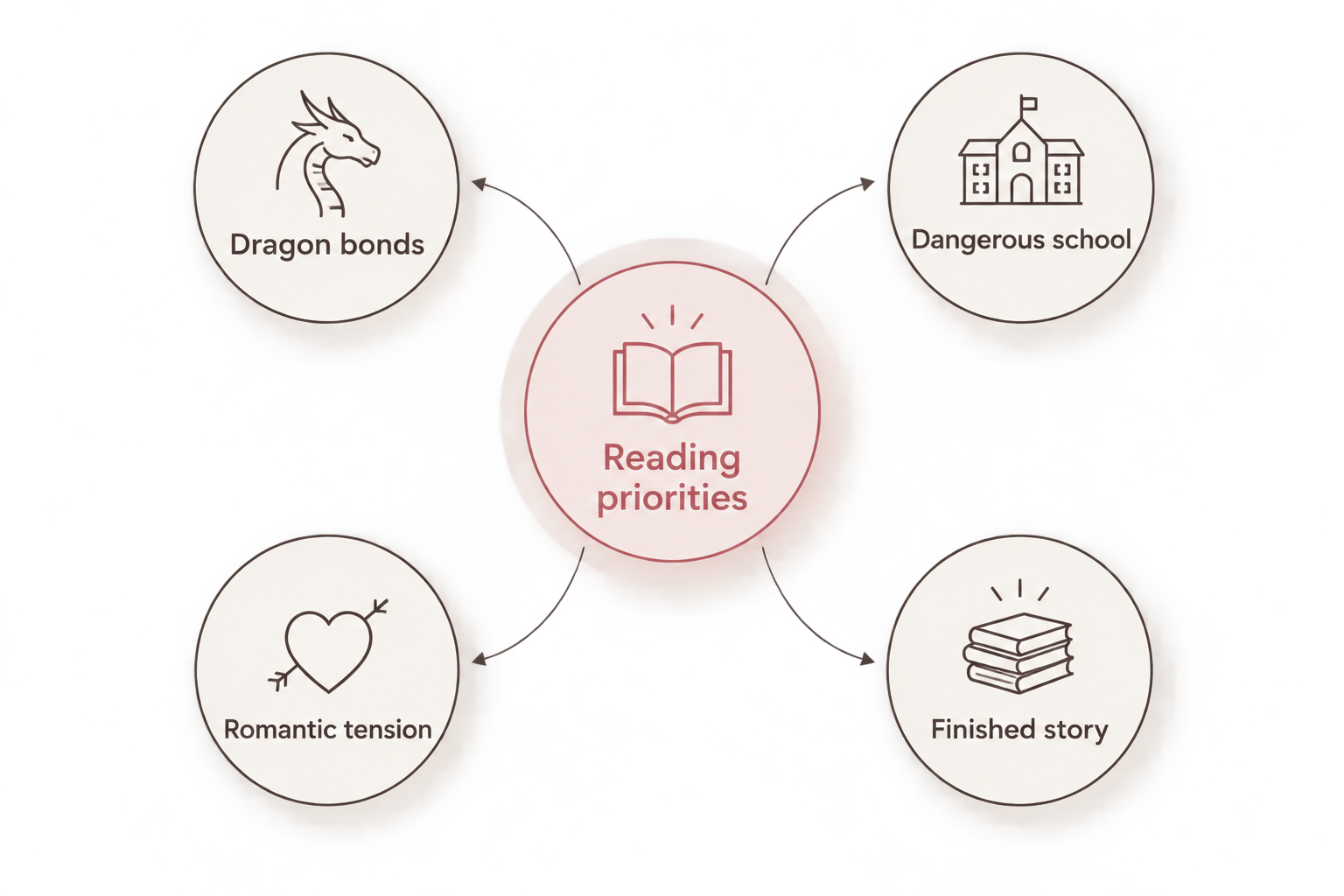
Start with the feature you actually want to repeat:
- Dragon bonds: Put the rider relationship ahead of a generic fantasy-romance label.
- Dangerous school: Look for training, unequal power, and survival inside an institution.
- Romantic tension: Prioritize the relationship dynamic rather than the presence of magic.
- Finished story: Check completion separately from similarity before committing.
Those priorities are not interchangeable. A book can match Fourth Wing closely on atmosphere and still fail your most important requirement: a finished ending.
For a 2026 reading list, write down your nonnegotiable before browsing. A useful request is specific: you want the dragon connection, but you do not want to begin another unfinished main story. That gives a recommendation a clear job.
GetSimilarBooks is a free book recommendation tool for readers who want hand-curated read-alikes from a title they already enjoyed. Enter a book to receive five suggestions; the personalized list of 20–30 titles requires an email address. The limitation is straightforward: a similarity match does not replace checking whether a recommended series meets your completion requirement.
Find your next read
Get five hand-curated suggestions, then request a free personalized list of 20–30 titles by email.
Can you stop after Fourth Wing without continuing?
Book 1 is not the full Empyrean story. You can choose to stop reading any novel, but Fourth Wing is written as the opening of a continuing series rather than a standalone with the whole central arc resolved.
If a complete ending is your requirement, stopping after the first installment does not solve the underlying problem. Choose a standalone or a finished series instead.
Does Onyx Storm finish the Fourth Wing series?
Book 3, Onyx Storm, is not the planned finale of the five-book Empyrean series. Reaching it means continuing the story, not reaching the intended end of the main sequence.
Avoid searching for its ending to establish completion. A spoiler-free series-status check answers that question without exposing plot developments.
Verity Audiobook Recommendations: Frequently Asked Questions
Is Fourth Wing finished as a series in 2026?
No. Fourth Wing belongs to Rebecca Yarros’s unfinished Empyrean series, which is planned as five books. Do not treat the opening sequence as a completed story.
What order should I read the Fourth Wing books in?
Start with Fourth Wing, then read Iron Flame, followed by Onyx Storm. These are consecutive installments, not interchangeable entry points.
Is Fourth Wing the series name or the first book?
Fourth Wing is the first book’s title; the series is called the Empyrean. Readers often use Fourth Wing informally to mean the whole series.
Can I read Onyx Storm before Iron Flame?
Read Iron Flame before Onyx Storm. Onyx Storm continues an existing story and assumes knowledge of the preceding novels.
Should I wait until all five Empyrean books are finished?
Wait if you need the full series ending before you start. Begin now only if an unresolved larger story and a publication wait fit how you enjoy reading.
What is a finished alternative if I liked the dangerous school in Fourth Wing?
Naomi Novik’s completed Scholomance trilogy is an option, beginning with A Deadly Education. It matches the threatening school and survival pressure, not the dragon-rider setting.
Can GetSimilarBooks help me find something to read while I wait?
GetSimilarBooks provides five hand-curated read-alike suggestions from a title you enjoyed. You can also request a free personalized list of 20–30 titles by providing your email address.
One last thing
The closest match is not always the right next book. If waiting is what frustrates you, another closely matched but unfinished series repeats the problem.
For your 2026 reading choice, put completion ahead of similarity when closure is nonnegotiable. Use GetSimilarBooks for possibilities, then check the exact story arc you intend to read—not just whether its first book has sequels.
Related guides
- Completed series for readers who loved Fourth Wing
- Standalone books like Fourth Wing
- Books like Fourth Wing, closest match first
Books like Hunger Games: five picks, closest match first

The Testing by Joelle Charbonneau is the closest match to The Hunger Games for readers who want deadly selection trials and a government that turns ambition into obedience. These five books like Hunger Games move from that familiar structure toward classroom horror, survival mystery, divided loyalties, and a harsher rebellion story; this 2026 guide explains what each preserves and what each changes.
- The Testing leads these books like Hunger Games: deadly trials, a resourceful heroine, and institutional distrust.
- Battle Royale is the pick for lethal classmates, but its violence is more graphic.
- The Maze Runner favors survival mystery; Legend favors opposing viewpoints; Red Rising favors caste conflict.
- Choose by the quality you miss from The Hunger Games, not the dystopian label alone.
Why this matters
The arena is only part of The Hunger Games. You might miss Katniss’s practical judgment, the threat beneath official ceremonies, or the way personal survival becomes political resistance. Those are different reading needs.
A book can reproduce a lethal competition without giving you Katniss’s emotional restraint. Another can capture the unequal society while leaving the arena behind. The strongest match preserves your favorite source of tension, not every surface detail.
GetSimilarBooks is best for fiction readers who want read-alike recommendations starting from a book they already enjoyed. Enter a title for five hand-curated suggestions, then request a personalized list by email if you want a longer reading queue.
What makes the best books like Hunger Games?
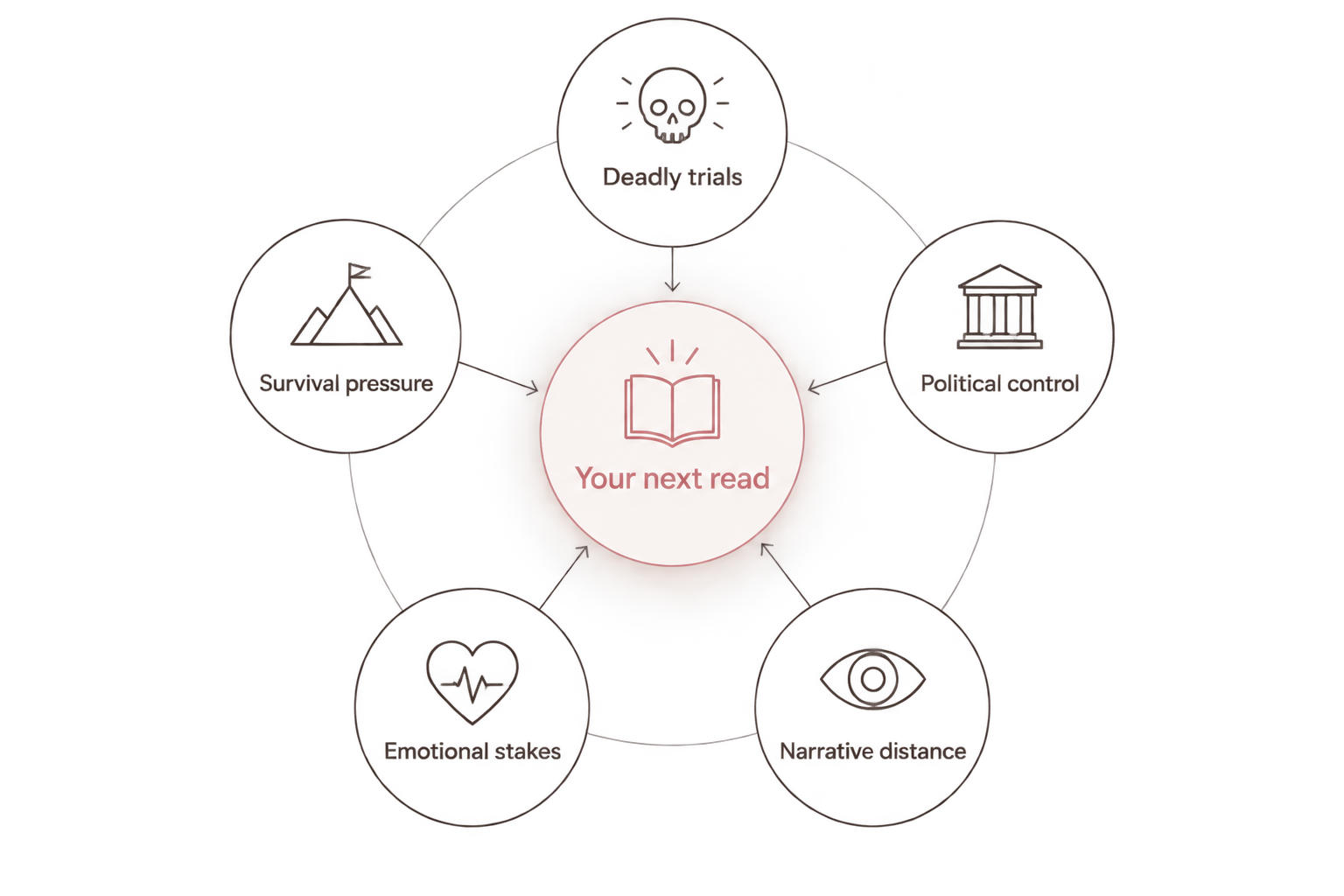
Use these criteria to choose your next read in 2026:
- Deadly trials: The rules force characters into consequential choices. A competition alone is not enough; the institution behind it should matter.
- Survival pressure: Resourcefulness, alliances, and uncertainty drive the action. The danger should affect how characters behave toward one another.
- Political control: Inequality shapes the characters’ options. Rebellion carries more weight when the system is visible in everyday life.
- Emotional stakes: Loyalty, grief, family, or attraction complicate the obvious survival decision. The characters need something to protect beyond themselves.
- Narrative distance: A close viewpoint creates a different experience from a broad ensemble. Choose according to whether you want intimacy or a wider picture.
Your next read depends on which of those qualities you want to keep. A stronger match on one dimension often means a deliberate departure on another.
Five books at a glance
The order runs from the closest overall match outward. The last book is not a weaker recommendation; it asks you to accept a larger change in audience, scale, and tone.
| Rank and book | Best for | Standout matching quality | Key limitation |
|---|---|---|---|
| 1. The Testing — Joelle Charbonneau | Deadly selection trials | A capable heroine navigating a dangerous state-run assessment | The selection structure feels particularly familiar |
| 2. Battle Royale — Koushun Takami | Classmates forced into lethal conflict | State violence turns existing relationships into survival decisions | More graphic violence and a much broader cast |
| 3. The Maze Runner — James Dashner | Enclosed survival mystery | Young people must understand a controlled environment to survive | Less immediate political context and less emphasis on romance |
| 4. Legend — Marie Lu | Opposing viewpoints within an unequal society | A privileged soldier and a wanted boy expose different sides of state power | No central arena or elimination tournament |
| 5. Red Rising — Pierce Brown | Caste conflict with an adult crossover edge | A low-status outsider enters an elite institution built around domination | Harsher content and a more aggressive central voice |
1. The Testing: best for deadly selection trials
Joelle Charbonneau’s The Testing follows Cia Vale, a young woman selected for an assessment tied to higher education and future leadership. The opportunity promises advancement. The process makes trust dangerous.
The Testing is the best next read if the selection machinery was your favorite part of The Hunger Games. Both novels place an observant heroine inside a system that presents coercion as opportunity. Preparation and judgment matter alongside physical survival.
The meaningful difference is the institutional setting. The Testing builds its threat around assessment and advancement rather than a televised punishment imposed on districts. That makes academic ambition part of the trap.
The Testing pros:
- A close female viewpoint keeps the danger personal.
- Tests make problem-solving central to survival.
- Uncertain alliances give conversations practical consequences.
- Distrust extends beyond individual competitors to the institution itself.
The Testing cons:
- The selection structure offers less novelty if you want distance from Panem.
- Its education-based premise changes the texture of the political critique.
Best for: Readers who want another capable heroine navigating deadly rules she did not write.
Content note: Violence and deaths involving young people are part of the premise. Choose it for the match, not as a gentler substitute.
Verdict: Buy The Testing if you want the closest structural match first.
2. Battle Royale: best for lethal conflict between classmates
Koushun Takami’s Battle Royale forces a class of 42 students into a government-controlled killing program. The students already know one another, so friendship, reputation, and existing grudges enter the contest with them.
The match is the state's use of young lives as an instrument of control. As in The Hunger Games, the rules push participants toward violence while making cooperation precarious. The question is not simply who can fight, but what trust means under those conditions.
Battle Royale is the sharper choice if you want the arena premise without preserving the same emotional register. Its wider cast repeatedly shifts your attention away from a single survivor.
Battle Royale pros:
- Established relationships give alliances immediate history.
- An ensemble viewpoint shows different responses to the same coercion.
- The survival setup keeps state power present in personal decisions.
Battle Royale cons:
- Violence is more graphic than in The Hunger Games.
- Frequent viewpoint changes reduce the sustained intimacy of Katniss’s narration.
- The large cast demands more attention to names and relationships.
Best for: Readers who want the lethal social experiment pushed toward horror.
Content note: Graphic violence, sexual violence, and suicide make this a substantial step up in intensity. It is not the default recommendation for a younger Hunger Games reader.
Verdict: Buy Battle Royale for the premise; skip it if graphic content is a firm boundary.
3. The Maze Runner: best for enclosed survival mystery
James Dashner’s The Maze Runner begins with Thomas arriving in a community of boys surrounded by a dangerous maze. He lacks the knowledge needed to explain his situation. Survival depends on learning the environment and understanding the group already living there.
The strongest Hunger Games connection is controlled space. Both books make geography, routines, and incomplete information part of the threat. An apparently understandable environment becomes harder to trust as its purpose comes into question.
The difference is what drives you through the chapters. The Maze Runner asks what this place is and how it works before giving you the broader political picture. Katniss enters the arena knowing much more about the society responsible for it.
The Maze Runner pros:
- Environmental danger rewards observation and practical thinking.
- Group survival gives cooperation a central role.
- Unanswered questions create a clear reason to keep reading.
The Maze Runner cons:
- Withheld information replaces much of Panem’s immediate social context.
- Romance is less central to the first book’s appeal.
Best for: Readers who remember the arena’s hazards more vividly than the Capitol’s ceremonies.
Content note: Threat, violence, and deaths involving young characters remain central. The change is toward mystery, not away from danger.
Verdict: Buy The Maze Runner when you want survival questions before political answers.
4. Legend: best for opposing viewpoints under state control
Marie Lu’s Legend follows June, an exceptional student within the Republic’s military system, and Day, a wanted boy from its poorer streets. Their paths cross through a criminal investigation that tests the official account of their society.
Legend uses 2 narrators to place privilege and deprivation beside each other. The Hunger Games shows inequality through Katniss’s movement between the districts and the Capitol; Legend builds that contrast into its viewpoint structure.
Choose Legend for divided loyalties rather than an elimination contest. Attraction matters because the characters do not begin with the same position, information, or relationship to authority. The political divide is personal from the start.
Legend pros:
- Alternating perspectives make class differences concrete.
- Investigation gives the characters reasons to question official claims.
- Romance and political distrust develop within the same conflict.
Legend cons:
- There is no central arena to reproduce the Games’ structure.
- Switching viewpoints changes the concentrated experience of following Katniss alone.
Best for: Readers who want state secrets, unequal opportunity, and a relationship shaped by opposing loyalties.
Content note: Military violence, death, and threats to family are part of the story. The romantic thread does not remove those stakes.
Verdict: Buy Legend if Panem’s inequality mattered more to you than the tournament.
5. Red Rising: best for caste conflict with an adult edge
Pierce Brown’s Red Rising follows Darrow, a low-status worker in a color-based hierarchy, as he enters the world of its ruling elite. The first novel combines infiltration with a brutal competitive institution.
The Hunger Games connection lies in the collision between organized cruelty and personal resistance. Both books make hierarchy something characters must confront physically, not just discuss. An institution teaches domination while presenting itself as necessary.
The difference is Darrow’s voice and trajectory. Red Rising is more aggressive in its ambition and harsher in its content. It is a move outward from Katniss’s guarded survival perspective, not a substitute with different scenery.
Red Rising pros:
- Caste hierarchy gives the conflict a clear structural foundation.
- Infiltration makes identity and performance part of survival.
- Competitive violence connects individual victories to a larger political goal.
Red Rising cons:
- Sexual violence and brutality make it a poor automatic teen recommendation.
- Darrow’s forceful narration differs substantially from Katniss’s restraint.
- Its speculative setting requires a different worldbuilding adjustment.
Best for: Readers ready for a harsher caste-rebellion story with an elite-training component.
Content note: Graphic violence and sexual violence warrant checking detailed warnings before starting.
Verdict: Buy Red Rising for the broader rebellion route; skip it if you want the same content level.
How the ranking works
This 2026 ranking prioritizes the first-book reading experience: immediate premise, source of tension, viewpoint, and meaningful differences from The Hunger Games. It does not rank authors by reputation or treat adaptations as substitutes for the novels.
The Testing leads because several matching qualities arrive together. Battle Royale preserves the lethal premise but changes the intensity and narrative distance. The remaining books each retain a narrower part of the experience while moving further from the original structure.
That distinction matters. Closest match and best book for you are not always the same choice. A reader avoiding an arena repeat should move down the list deliberately.
Which book should you choose?
Start with The Testing if you are undecided. It asks for the smallest adjustment in the combination of heroine, selection process, dangerous alliances, and institutional distrust.
For your 2026 reading list, choose Battle Royale for the darkest version of forced competition. Choose The Maze Runner for a place that must be understood to be survived. Choose Legend for opposing loyalties, or Red Rising for a harsher climb through an entrenched hierarchy.
Before choosing, finish one sentence: “What I want back from The Hunger Games is…” Name a reading experience, not a genre. “I want every alliance to feel risky” is more useful than “I want dystopia.”
For a longer queue, GetSimilarBooks offers five hand-curated read-alikes and an email-gated personalized list of 20–30 titles. The preview keeps the first decision small; the longer list gives avid readers more options.
Find your next read
Start with a title you enjoyed. Get five read-alikes, then request a longer personalized list by email.
Verity Audiobook Recommendations: Frequently Asked Questions
What’s the closest book to The Hunger Games?
The Testing by Joelle Charbonneau is the closest overall match on this list. It combines a resourceful heroine, dangerous selection trials, uncertain alliances, and distrust of the institution running the process.
Should I read Battle Royale if I liked The Hunger Games?
Read Battle Royale if the forced-survival premise interested you and you accept more graphic content. Its classmates already share a history, and its wider cast creates a different experience from Katniss’s close narration.
Is The Maze Runner more about romance or survival?
The Maze Runner is primarily a survival mystery, especially in its first book. Choose it for group dynamics, environmental danger, and unanswered questions rather than a romance-centered reading experience.
Which book like The Hunger Games has opposing viewpoints?
Legend by Marie Lu uses the perspectives of June and Day to show different positions within the same unequal society. It is the strongest choice here if you want attraction complicated by conflicting loyalties.
Is Red Rising suitable for every teenager who liked The Hunger Games?
No. Red Rising contains graphic violence and sexual violence, so liking The Hunger Games is not enough to establish suitability. Check detailed content warnings against the individual reader’s boundaries.
Are these recommendations connected to The Hunger Games series?
No. These five recommendations are separate works by other authors, not sequels or prequels to The Hunger Games. Their connection is the reading experience: survival pressure, coercive institutions, inequality, or rebellion.
How do I get a personalized list of books like Hunger Games?
GetSimilarBooks lets you enter a title you enjoyed and receive five hand-curated read-alike suggestions. You can also request a personalized list of 20–30 titles by email.
One last thing
For a 2026 reading reset, try choosing the difference you want rather than only the similarity. Keep the survival pressure but change the viewpoint. Keep the political anger but leave the arena behind.
The first pick is the safe one. The last is the interesting risk. Choose The Testing for recognition; choose a lower-ranked book when its difference is exactly what you need.
Related guides
- How to find books similar to one you loved without spoilers
- Books like Fourth Wing with deadly trials
- Books like Fourth Wing set in a military academy
- How to know if a book recommendation is actually a good match
How to find a book similar to a movie or show you loved?

To find a book similar to a movie or show you loved, identify the experience you want again—such as an uneasy marriage, a dangerous romance, or a fight for power—then compare books on that specific quality. Check whether the screen story has a source novel first, but choose a different book if you want familiar tension without an already familiar plot.
- How to find a book similar to a movie or show you loved: match the emotional payoff, not just genre.
- The Girl on the Train suits Gone Girl viewers seeking unreliable perspectives, but offers a different domestic mystery.
- Fourth Wing suits viewers seeking dragon-rider bonds and romance, not a royal-family political chronicle.
- GetSimilarBooks provides five hand-curated book recommendations from a book title; use a source novel as your starting point.
How to find a book similar to a movie or show you loved?
- Check for a source book. Look at the adaptation credits or the publisher’s description. A source novel gives you a clear starting point, even when you decide not to read it.
- Name the main attraction. Finish this sentence: I want another story where the tension comes from… Be specific. Distrusting a spouse is more useful than wanting a thriller.
- Choose a book that matches that attraction. Compare the relationship, conflict, and tone. Do not require the same setting unless the setting was the reason you watched.
- Check the meaningful difference. Read the publisher’s description and a sample. Confirm that the pace, narrative voice, and mature content fit what you want.
Once you have a book title that represents your taste, GetSimilarBooks offers five hand-curated suggestions. Its input is a book title, so establish that bridge before using it for a screen-inspired search.
Why this matters
A dragon does not make every fantasy story a match. Neither does a missing person make every thriller feel like Gone Girl. Those details describe what appears in the story, not how the story holds your attention.
For your 2026 reading list, separate recognition from satisfaction. You can recognize a familiar setting and still dislike the book’s central relationship. A quieter novel with no shared setting can deliver exactly the suspicion you wanted.
Match the source of tension before you match the scenery. That is the difference between a useful recommendation and a list of books sharing a genre label.
What to do when the movie or show has a source book
Start with a simple choice: do you want more of the same story, or a new story that creates a similar feeling?
Reading the source book serves the first need. Looking for read-alikes serves the second. Neither approach is automatically better, and an adaptation’s source is not always the closest match to the adaptation’s tone.
| Starting point | Best for | Advantage | Limitation |
|---|---|---|---|
| The source novel | Spending more time with familiar characters | Gives you the original narrative to compare with the adaptation | Major events can already be familiar |
| A read-alike of the source | Finding a new story with related qualities | Gives your search a specific book reference | Can reproduce qualities the adaptation changed or omitted |
| A trait-based search | Matching a particular screen experience | Focuses on the relationship or tension you actually want | Requires more detail than a genre name |
Gone Girl is adapted from Gillian Flynn’s novel. If you want the original version of that story, the novel is the direct choice. If you want another relationship built around suspicion, use Gone Girl as your reference rather than your destination.
House of the Dragon draws on George R. R. Martin’s Fire & Blood. That book uses a historical-chronicle approach. A viewer looking primarily for an intimate romance should not assume that the source will supply it simply because the show contains intense relationships.
For a 2026 search, make this distinction before collecting recommendations. Otherwise, you risk asking for the right title while describing the wrong reading experience.
Books for Gone Girl viewers who want relationship suspense
These recommendations move from contemporary domestic mystery toward different versions of intimate unease. The order follows the specific brief: unreliable perspectives, suspicion inside relationships, and uncertainty about what to believe. It is not a ranking of literary quality.
| Book | Best for | Specific match | Meaningful difference |
|---|---|---|---|
| The Girl on the Train by Paula Hawkins | Contemporary domestic mystery | Unreliable perspectives and suspicion around private lives | Observation and memory shape the mystery differently |
| Verity by Colleen Hoover | Intimate, sexually explicit suspense | An unsettling household and a manuscript that raises questions about its author | Romance and sexual content are more prominent; see these books like Verity for that branch |
| Rebecca by Daphne du Maurier | Slow-building psychological unease | A marriage shaped by secrets and an overpowering absent figure | Gothic atmosphere replaces contemporary thriller pacing |
The Girl on the Train: closest for unreliable perspectives
Best for: viewers who want to question a narrator’s interpretation. Paula Hawkins builds the novel around Rachel’s observations of other people’s lives and the uncertainty surrounding what she sees and remembers. That makes it a useful next step when your favorite part of Gone Girl was evaluating conflicting accounts.
The match is psychological rather than structural. Do not expect another version of the same marriage or the same sequence of revelations. The novel’s use of memory gives its uncertainty a different shape.
Brief content note: alcohol misuse and domestic violence. Verdict: Buy for unreliable perspectives; skip if you want a straightforward account of events.
Verity: closer to intimate, explicit suspense
Best for: readers who want relationship tension inside an unsettling home. Colleen Hoover’s Verity follows a writer taking over another author’s work and encountering a manuscript that complicates her understanding of the household. The document matters because it gives the reader something disturbing to interpret.
Choose it for suspicion, intimacy, and the discomfort of not knowing whose account deserves trust. Do not choose it expecting Gillian Flynn’s exact social focus or narrative style. The romance component is a more substantial part of the experience.
Brief content note: explicit sexual content, violence, and harm involving children. Verdict: Buy for intimate suspense; skip if sexual content is a deal-breaker.
Rebecca: the outward step into Gothic suspense
Best for: readers who want atmosphere and psychological pressure. Daphne du Maurier’s Rebecca places a new wife in a household still dominated by the memory of her husband’s first wife. The appeal lies in uncertainty, comparison, and the feeling that a relationship contains a history you cannot access.
This is the bigger change of pace. The novel builds unease through its narrator and setting rather than trying to imitate a contemporary domestic thriller’s rhythm. Choose it when you want dread to accumulate.
Brief content note: death and controlling relationships. Verdict: Buy for Gothic unease; skip if rapid plot movement is your main requirement.
Books for dragon-show viewers who want romance or court tension
Decide which part of the screen experience you want to keep. Dragon-rider relationships, romantic danger, and dynastic politics are separate attractions. A book can deliver one strongly without delivering the others.
The order below starts with dragons and rider bonds, then moves outward into dangerous courts and fantasy romance. Readers whose first priority is political maneuvering should start with The Cruel Prince instead.
| Book | Best for | Specific match | Meaningful difference |
|---|---|---|---|
| Fourth Wing by Rebecca Yarros | Dragon-rider bonds and romance | Dragons, dangerous rider training, and a central romantic relationship | A training environment rather than a royal-family chronicle; explore Fourth Wing read-alikes afterward |
| The Cruel Prince by Holly Black | Dangerous court politics | Power struggles, divided loyalties, and a hostile faerie court | No dragon-rider focus; romance shares space with political ambition |
| A Court of Thorns and Roses by Sarah J. Maas | Fantasy romance | A human protagonist entering a dangerous faerie world | Romance is the main bridge, not dragon warfare or dynastic history |
Fourth Wing: closest for dragons and rider bonds
Best for: viewers who want dragons connected to individual riders. Rebecca Yarros’s Fourth Wing centers on Violet Sorrengail entering a dangerous dragon-rider training environment. The relevant match is the relationship between riders, dragons, survival, and power—not simply the presence of flying creatures.
The difference is equally important. Training and romance organize the reading experience. If your favorite scenes involved succession disputes and rival branches of a royal family, that is a different brief.
Brief content note: explicit sexual content and violence. Verdict: Buy for rider bonds and romance; skip if dynastic politics must lead the story.
The Cruel Prince: closer for political danger
Best for: viewers who prefer maneuvering to spectacle. Holly Black’s The Cruel Prince follows Jude, a human living in a faerie world where power and belonging are contested. Its strongest connection to a court-focused screen story is the pressure to survive among people with conflicting interests.
This recommendation moves away from dragons. It also asks you to enjoy an antagonistic relationship without treating romance as the only plot. Political ambition is part of the attraction, not background decoration.
Brief content note: violence and coercion. Verdict: Buy for dangerous court politics; skip if dragons are non-negotiable.
A Court of Thorns and Roses: the outward romance choice
Best for: viewers who want a romantic relationship in a dangerous fantasy setting. Sarah J. Maas’s A Court of Thorns and Roses begins with Feyre entering the faerie world. Choose it when the emotional draw is attraction complicated by danger and unequal knowledge.
The match weakens if your main interest is military strategy or a family’s claim to a throne. This is a romance-led choice, not a substitute for a dragon-centered political story. Judge that difference before adding it to your 2026 reading list.
Brief content note: sexual content and violence. Verdict: Buy for fantasy romance; skip if you want dragons to anchor the story.
Why the closest book match varies
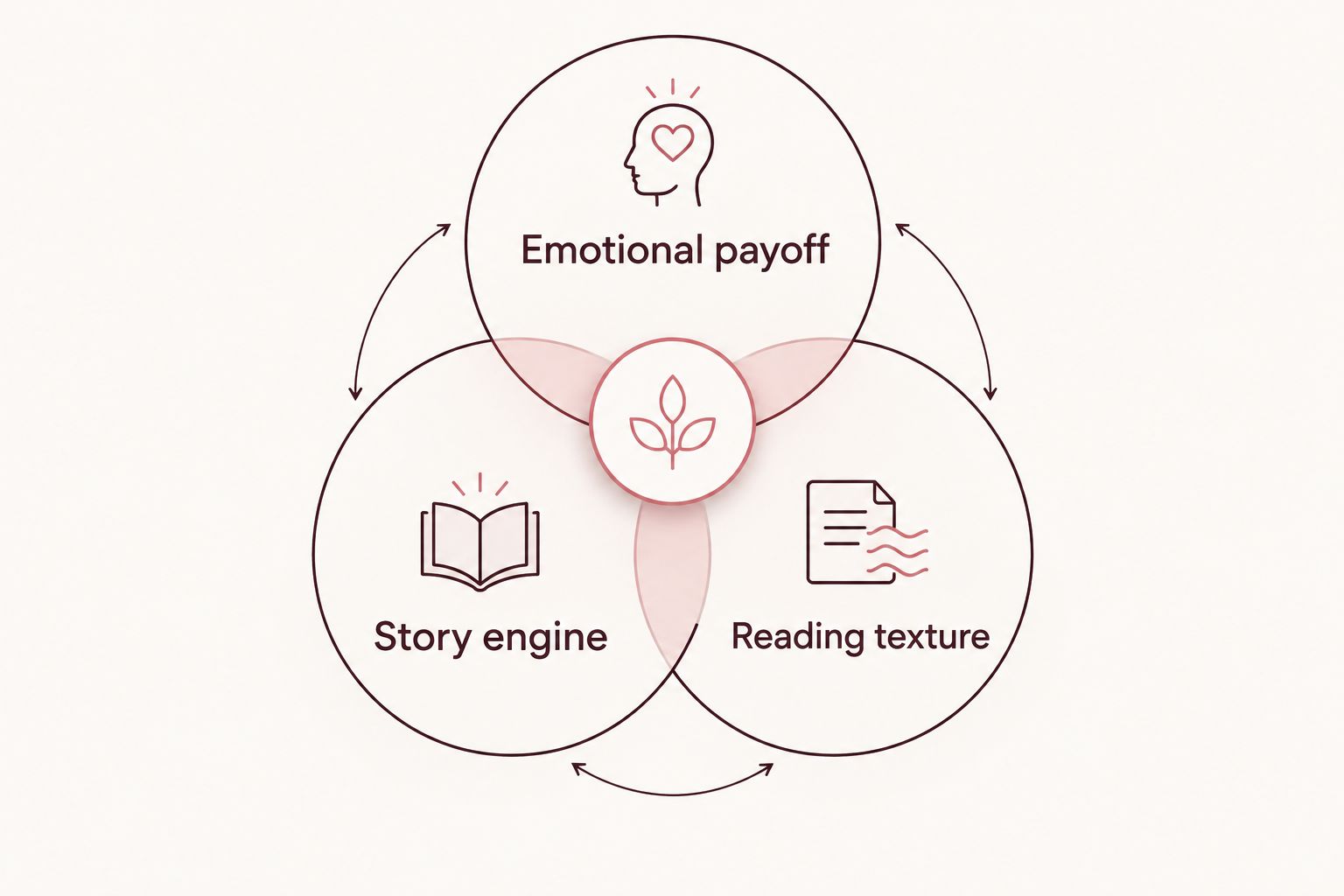
A recommendation changes when your reason for loving the screen story changes. Use these factors to explain what you want, rather than asking for something vaguely similar.
- Emotional payoff: Do you want dread, romantic anticipation, wonder, or the satisfaction of understanding a mystery?
- Story engine: Is the tension driven by a relationship, an investigation, training, or a contest for power?
- Reading texture: Do you enjoy an intimate narrative voice, shifting perspectives, or a historical-chronicle style?
- Setting: Are dragons, a particular household, or a dangerous court essential—or merely familiar scenery?
- Content limits: Would explicit sexual content, violence, or harm involving children rule out an otherwise close match?
Emotional payoff, story engine, and reading texture make a useful first filter. Setting and content limits then help you reject the wrong fit. A recommendation does not become better simply by matching more surface details.
Can I use a movie or show title in a book recommendation tool?
Use a movie or show title only when the tool explicitly supports screen titles. GetSimilarBooks accepts a book title and returns five hand-curated suggestions, so a source novel or a relevant bridge book is the appropriate starting point.
GetSimilarBooks is best for fiction readers who want book recommendations from a title they already enjoyed. The limitation matters: a relevant source novel is a search reference, not proof that you have read or liked it.
For a more personal request, explain what appealed to you on screen and what you want to avoid. The free personalized list contains 20–30 titles and requires an email address. Keep the request focused on your actual preferences rather than an assumed liking for the adaptation’s source.
Request your next reading list
Get a free personalized list of 20–30 titles. An email address is required.
What if I want the same feeling but a different genre?
Keep the emotional payoff and change the setting. A viewer who wants relationship suspicion can move from a contemporary thriller to Rebecca without preserving the same time period or plot machinery.
Use this sentence: I want the tension of this story, but not its setting. That gives your 2026 search a clear direction. It also leaves room for a recommendation that looks different while satisfying the same reader need.
Verity Audiobook Recommendations: Frequently Asked Questions
How do I find a book similar to a movie or show I loved?
Identify the relationship, conflict, or feeling you want again, then search for books that match it. Check for a source novel first, and compare each recommendation’s main difference before choosing.
Should I read the book if I already watched the adaptation?
Read the source book if you want the original version of a familiar story. Choose a read-alike instead if knowing major events would reduce your enjoyment.
What should I read after watching Gone Girl?
The Girl on the Train is a useful choice for unreliable perspectives and domestic mystery. Rebecca suits a slower Gothic mood, while Verity places more emphasis on intimate, explicit suspense.
Is Fourth Wing a good choice after House of the Dragon?
Fourth Wing is a good choice when dragon-rider bonds and romance are your priorities. It is not the same kind of story as a royal-family chronicle centered on succession.
How can I find similar books without getting spoilers?
Compare premises, narrative styles, and content notes rather than explanations of endings. A useful recommendation states why a book fits without revealing the event that resolves its mystery.
Can GetSimilarBooks recommend books from a television title?
GetSimilarBooks takes a book title as its starting point. Find the show’s source novel or a book with the qualities you want, then use that book as your reference.
What should I include in a personalized book request?
Include the screen title, the specific quality you liked, and a quality you want to avoid. Mention whether you have read the source book so your request does not imply a reading preference you have not established.
One last thing
Your strongest search detail can be something you disliked. Wanting dragons but not a training setting produces a different shortlist from wanting romantic tension but no explicit sexual content.
Before your next 2026 search, write one attraction and one exclusion. Keep both concrete. That small distinction gives you a better basis for choosing than a long list of shows you enjoyed for unrelated reasons.
Related guides
How to know if a book recommendation is actually a good match?

A book recommendation is a good match when it repeats the reading experience you want, not just the genre or plot you recognize. Look for a specific shared quality, an honest difference, and a clear answer about your dealbreakers. In 2026, a convincing recommendation still needs to explain why this book belongs next to the one you loved.
- How to know if a book recommendation is actually a good match: compare appeal, differences, and dealbreakers.
- Fourth Wing readers should separate dragon bonds, romantic tension, and deadly training before choosing another fantasy.
- Verity readers should distinguish psychological uncertainty from gothic atmosphere, romantic obsession, and a surprise ending.
- GetSimilarBooks offers five hand-curated suggestions; treat each explanation as a starting point, not a guarantee.
Why this matters
You can love Fourth Wing for the dragon relationships and dislike another book that matches only its dangerous competition. You can finish Verity wanting more uncertainty about whom to believe, rather than another story about a writer.
Match the reason you kept reading, not the easiest detail to put on a cover. If you want to investigate without exposing the ending, start with finding similar books without spoilers. A good explanation describes the tension without disclosing its resolution.
How to know if a book recommendation is actually a good match?
Test the recommendation against your own reading experience. Use these steps before accepting a resemblance as a reason to read.
- Name the appeal. Finish this sentence: I kept reading because I wanted more of ____. Choose something specific, such as an uneasy first-person voice or a relationship built through rivalry.
- Find the evidence. The recommendation should describe how the suggested book creates that experience. A shared label such as fantasy romance is not enough.
- Identify the difference. Look for the trade-off: slower pacing, less romance, a different setting, or more demanding worldbuilding.
- Check the boundary. Confirm anything that would stop you reading, including explicit sex, child-harm themes, or an unfinished series.
- Read a sample. Judge the prose and narrative voice directly. A plot description cannot tell you whether you enjoy spending time inside a narrator's head.
For a 2026 reading list, use the same test on a new release and an older novel. Publication date does not establish fit. Neither does appearing beside your favorite book on a shelf.
What does convincing evidence look like?
A useful recommendation makes a claim you can evaluate without finishing the book. It tells you what creates the resemblance and where that resemblance stops.
| Recommendation wording | What it establishes | What you still need |
|---|---|---|
| Both are fantasy romances | Broad category overlap | Whether romance, action, or worldbuilding leads |
| Both place a student in a dangerous magical school | A shared source of pressure | Whether the voice and relationships also appeal |
| Both build unease around a household and withheld information | A shared suspense mechanism | Whether the pacing and resolution suit you |
| Both contain a shocking twist | An ending-focused promise | Almost everything about the reading experience |
The strongest explanation survives the removal of the book's title. If it could describe almost any thriller, it has not explained the match.
After Fourth Wing: match the pressure or the relationship
Fourth Wing combines a military academy, dragon bonds, danger, and romance. Decide which element you want repeated before choosing a read-alike. These books illustrate different matches; neither reproduces that whole combination.
| Book | Best for | Specific match | Meaningful difference |
|---|---|---|---|
| A Deadly Education by Naomi Novik | Dangerous-school pressure | Magical students face threats inside their school | No dragon-rider bond; romance is less central |
| The Serpent and the Wings of Night by Carissa Broadbent | Attraction under mortal pressure | A dangerous competition complicates trust and attraction | Vampire society replaces the military academy and dragons |
A Deadly Education: best for dangerous-school pressure
Choose A Deadly Education if the school itself was part of Fourth Wing's attraction. Naomi Novik places students in a magical education where survival shapes everyday decisions. That is a more specific connection than simply calling both books fantasy.
The difference matters. El's prickly narrative voice and the explanation of magical systems create a different rhythm, and the romance is less central. Choose it for hostile-school tension; skip it if dragon bonds and a dominant romance are essential.
The Serpent and the Wings of Night: best for attraction under pressure
Choose The Serpent and the Wings of Night if you want danger to make trust difficult. Carissa Broadbent connects a lethal competition with attraction between characters who have reasons to be cautious. That relationship between survival and intimacy supplies the match.
The setting is not a rider academy. Vampire power structures shape the story, and there is no equivalent promise of a dragon partnership. Choose it for competition and romantic distrust; skip it if the rider relationship was your main reason for reading.
Order carries meaning only when the criterion is clear. The school-centered match comes first here because it preserves the training environment; the romance-centered match belongs first for a different reader.
After Verity: match the uncertainty or the enclosed setting
Verity can leave you wanting an unsettling household, competing accounts, sexual tension, or doubts that persist after the ending. Those are different requests. A recommendation that names only secrets misses the distinction.
| Book | Best for | Specific match | Meaningful difference |
|---|---|---|---|
| Rebecca by Daphne du Maurier | An absent woman's influence | A narrator enters a household shaped by another woman's presence | Slower gothic suspense rather than Verity's contemporary pace |
| The Turn of the Key by Ruth Ware | Suspicion inside an isolated household | A live-in role places a woman inside a home full of unease | Childcare and surveillance take priority over romance |
Rebecca: best for an absent woman's influence
Choose Rebecca if you were drawn to the discomfort of entering a home where another woman's story controls the atmosphere. Daphne du Maurier builds tension through the narrator's insecurity and the household's relationship with the past. The resemblance concerns emotional pressure, not matching plot events.
Expect a slower, more atmospheric novel. Readers seeking Verity's contemporary voice or explicit sexual content are asking for a different match. Choose it for intimate gothic unease; skip it if fast escalation is non-negotiable.
The Turn of the Key: best for household suspicion
Choose The Turn of the Key if a live-in job and an unsettling home supplied the pull of Verity. Ruth Ware uses a nanny's position in a technology-equipped house to make domestic routines feel threatening. The connection is the vulnerability of living where you work.
Romance is not the central attraction, and child death is part of the premise. That content distinction belongs in the recommendation, not in a surprise discovery later. Choose it for domestic suspicion; skip it if you want romance at the center or avoid child-death themes.
Why book recommendation fit varies
For your 2026 reading list, separate a genuine mismatch from a change in what you want. Loving a book once does not mean wanting every feature repeated immediately.
- Priority: Your favorite element might be the romance, while the recommendation preserves only the setting.
- Pacing: A slow accumulation of dread feels different from frequent reversals, even when both books are suspenseful.
- Voice: A sharp, argumentative narrator creates a different experience from a restrained or reflective one.
- Relationship balance: A love story that drives the plot is not interchangeable with a subplot you can largely ignore.
- Content boundaries: A close thematic match still fails if it crosses a boundary you do not want crossed.
- Commitment: A standalone and an opening volume ask for different levels of continued reading.
Treat these as choices, not quality scores. A slower book is not a worse recommendation when you specifically want atmosphere. It is a worse recommendation when someone promises you speed.
Build a reading brief before requesting another list
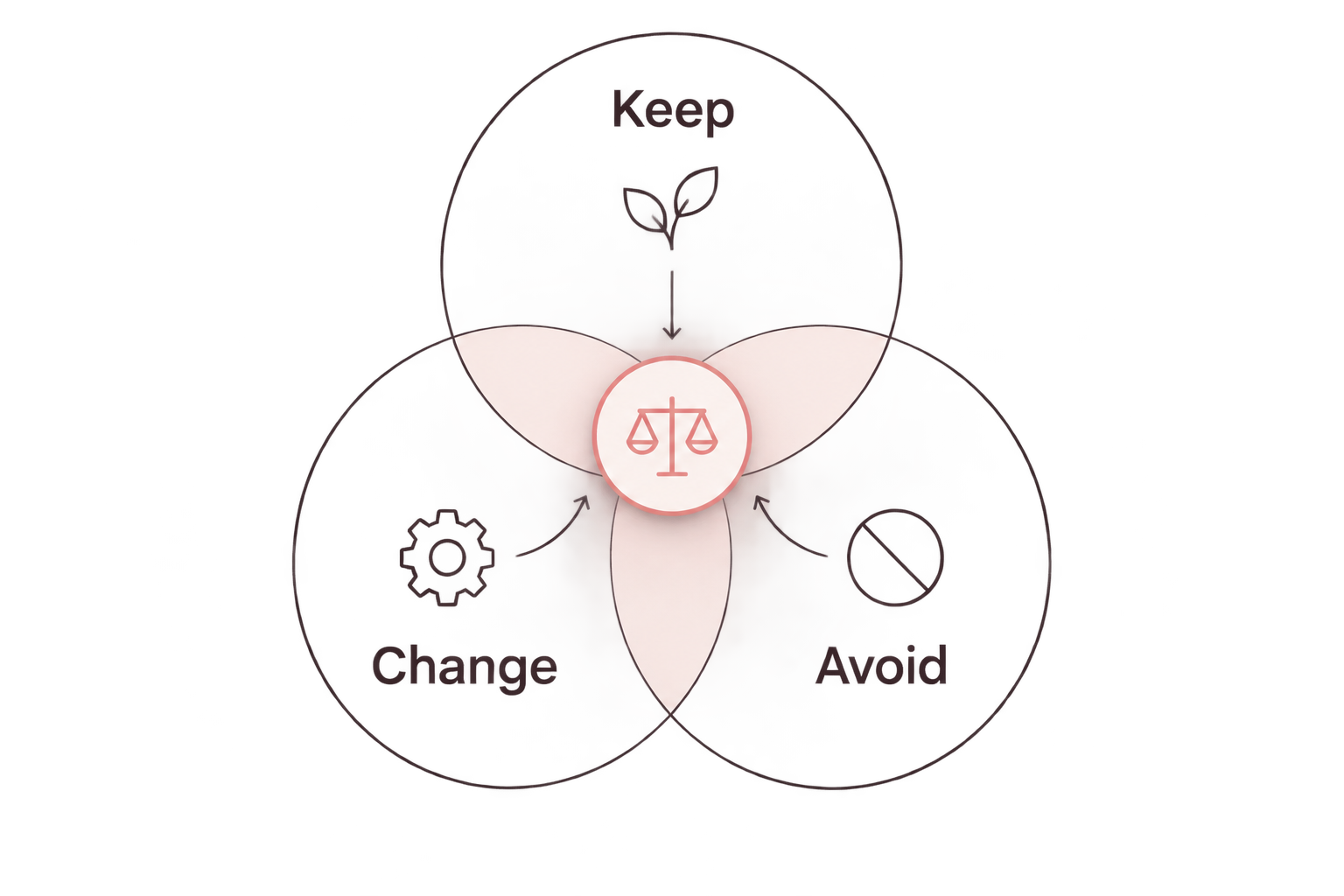
Write a short brief with three parts: Keep, Change, and Avoid. This turns a title into a request another person can interpret.
For a Fourth Wing follow-up, your brief might read: Keep the dangerous training and strong friendships. Change the emphasis toward less romance. Avoid graphic sexual detail. That request is more informative than asking for another popular fantasy.
For a Verity follow-up, try: Keep the claustrophobic household and uncertainty about people's motives. Change the pace toward a slower gothic story. Avoid child-harm themes. The final boundary can rule out an otherwise plausible match.
Does the same matching method work outside fiction?
Yes. The distinction between subject and reading experience also applies to nonfiction. You might want a performer's own perspective, a closely examined career, or an account of a wider cultural scene; sharing a musical genre does not settle that choice.
For example, evaluating hip-hop biography recommendations means separating interest in an artist from interest in the book's approach. Ask whether you want a personal account or a biographer's interpretation before treating a familiar name as sufficient evidence of fit.
That is the same decision you make with fiction: identify what the book does, not just what it is about.
What if a recommendation gets the match partly right?
Keep the useful part and reject the rest. If the atmosphere works but the prose feels wrong, your next request should preserve atmosphere while changing narrative voice. You have learned something more specific than whether you like the genre.
Do not turn a partial match into an obligation. A recommendation earns consideration, not completion. Reading a sample is a way to test a claim before committing to the whole book.
Turn the brief into a personalized list
GetSimilarBooks is best for fiction readers who want title-based, hand-curated read-alikes. Enter a book you enjoyed to receive five suggestions. An email-gated personalized list expands that to 20–30 titles.
Five suggestions are a preview, not proof that every book will fit. Use the matching reasons and differences to choose; a longer list does not remove the need to check voice, content, and series commitment.
You can request GetSimilarBooks' free personalized list through GetSimilarBooks. Keep your reading brief beside the results so you judge each title against your preferences rather than its familiarity.
Verity Audiobook Recommendations: Frequently Asked Questions
How do I know if a book recommendation is actually a good match?
A recommendation is a good match when it preserves the experience you want and makes its differences clear. Look for a specific shared quality, then check your content boundaries and read a sample.
Is being in the same genre enough to make two books similar?
No. Shared genre establishes a broad category, not matching pacing, voice, relationship balance, or emotional effect. Ask what each book does that made you want to continue reading.
What should I ask for after finishing Fourth Wing?
Ask for the element you most want repeated: dragon bonds, dangerous training, romantic tension, or friendships under pressure. Add what you want changed so the next recommendation does not preserve an element you merely tolerated.
What makes a recommendation a good match for Verity?
A good Verity match names the attraction it preserves, such as household unease, psychological uncertainty, or romantic obsession. Another book containing secrets is not automatically a close match.
Should I trust a recommendation that promises a huge twist?
Treat a promised twist as incomplete evidence. It tells you little about the voice, pacing, content, or relationship dynamics that occupy the rest of the book.
How many suggestions does GetSimilarBooks provide?
GetSimilarBooks provides five hand-curated read-alike suggestions after you enter a title you enjoyed. Its email-gated personalized list contains 20–30 titles.
Should I keep reading if the recommended book does not feel right?
You do not need to finish a book to honor a recommendation. Identify whether the problem is voice, pace, content, or the original matching reason, then use that distinction in your next request.
One last thing
Before adding another title to your 2026 reading list, write down one thing you did not like about your favorite book. It gives your next recommendation a boundary that praise alone cannot supply.
The goal is not to find the same book again. It is to keep what mattered without repeating what you endured.
Related guides
- Fourth Wing read-alikes with less spice
- Verity read-alikes without a romance plot
- How accurate are book recommendation quizzes?
Books like The Song of Achilles: five picks, closest match first

Best overall: In Memoriam by Alice Winn. Best for an ancient-world love story: The Persian Boy by Mary Renault. Best for Madeline Miller’s voice: Circe. These five books like The Song of Achilles are ordered from the closest emotional match outward, with the differences that matter for your next read in 2026.
- In Memoriam leads these books like The Song of Achilles for queer love under wartime pressure.
- The Persian Boy pairs an ancient setting with a lover’s intimate account of a powerful man.
- Circe preserves Madeline Miller’s voice, but romance is not its central purpose.
- GetSimilarBooks book recommendations suit readers who want matches based on more than a shared genre.
Why this matters
The Song of Achilles leaves different readers wanting different things. You might miss Patroclus’s intimate narration, the relationship with Achilles, or the sense that private love has collided with a public story nobody can stop.
Those are different requests. Another Greek retelling can deliver the setting while missing the relationship entirely; a novel without gods can come closer to the emotional experience.
GetSimilarBooks starts with a title you enjoyed and returns five hand-curated suggestions. For this list, the deciding question is simpler: which part of The Song of Achilles do you want to feel again?
What makes the best books like The Song of Achilles?
Use these criteria for your 2026 reading list. A strong match needs more than an ancient setting or a sad ending.
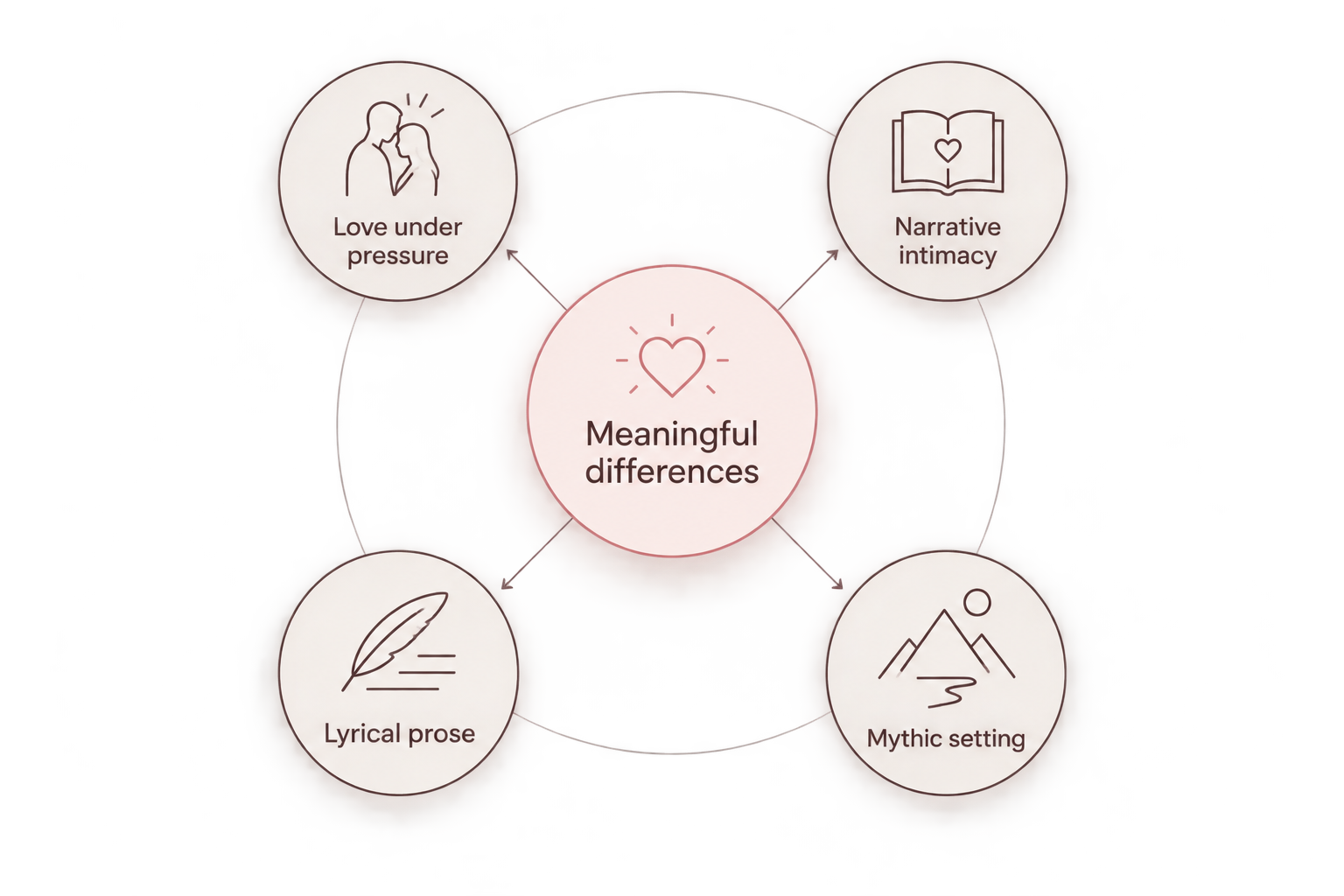
- Love under pressure: The relationship changes what the characters risk, conceal, or sacrifice.
- Narrative intimacy: You experience history through a particular person’s attachment, not just through events.
- Lyrical prose: The language carries emotional weight without requiring constant action.
- Mythic setting: Gods, inherited stories, or ancient power structures shape the characters’ choices.
- Meaningful differences: You know whether you are choosing another love story, a war novel, or a correction to heroic myth.
No recommendation below matches every criterion. That is the point: the differences tell you where to go next.
Five read-alikes at a glance
The order follows emotional resemblance first, then moves toward books that preserve one particular quality. Every book has a distinct reason to be here.
| Book | Best for | Closest matching quality | Key limitation |
|---|---|---|---|
| In Memoriam — Alice Winn | Queer love under wartime pressure | Intimacy set against organized violence | Graphic modern warfare replaces myth |
| The Persian Boy — Mary Renault | An ancient-world lover’s perspective | A devoted narrator watching a powerful man | Enslavement and unequal power shape the relationship |
| The Silence of the Girls — Pat Barker | A less heroic view of Troy | The human cost behind Achilles’s reputation | Not a central queer love story |
| Circe — Madeline Miller | Miller’s voice and mythic interiority | An intimate first-person Greek retelling | Selfhood matters more than one romance |
| Swimming in the Dark — Tomasz Jedrowski | Lyrical queer longing outside mythology | Desire constrained by public expectations | No ancient setting or battlefield epic |
1. In Memoriam: best for queer love under wartime pressure
Alice Winn’s In Memoriam follows Henry Gaunt and Sidney Ellwood from an English boarding school into the First World War. Their attachment develops within institutions that give them little room to speak plainly about it.
The closest match is the collision between tenderness and war. Like The Song of Achilles, In Memoriam makes the relationship essential to how you experience the violence. Military events are not a separate plot happening around the love story.
The difference is texture. Winn’s war is industrial, bodily, and immediate. You get mud, injury, and military machinery rather than divine intervention or the distance of myth.
In Memoriam pros
- The queer relationship sits at the center of the novel.
- School friendships and military expectations make private feelings difficult to express.
- Tenderness and brutality sharpen each other rather than occupying separate parts of the story.
In Memoriam cons
- Graphic battlefield injuries make this a demanding choice after an emotionally draining book.
- The boarding-school opening and modern warfare create a different atmosphere from ancient Greece.
Best for: You cared most about Achilles and Patroclus loving each other inside a world organized around war.
Content note: graphic violence, injury, and homophobia.
Verdict: Buy In Memoriam for the closest match to love under wartime pressure, not for another mythology retelling.
2. The Persian Boy: best for an ancient-world lover’s perspective
Mary Renault’s The Persian Boy tells its story through Bagoas, a Persian eunuch who becomes Alexander the Great’s lover. The setting shifts from Greek myth to historical fiction, but the intimate view of a famous man creates a strong connection.
Bagoas sees the person behind the public figure. That perspective will appeal if Patroclus’s attention to Achilles mattered more to you than the Trojan War itself.
The important difference is power. Bagoas’s history of enslavement and his position beside a conqueror make inequality impossible to set aside. Read this for the devoted observer, not for an uncomplicated partnership.
The Persian Boy pros
- First-person narration keeps a world-changing figure at an intimate distance.
- The ancient setting preserves the unfamiliar customs and hierarchies of the source novel.
- Affection, loyalty, and political ambition remain closely entangled.
The Persian Boy cons
- Enslavement and sexual exploitation are central to Bagoas’s circumstances.
- Campaigns and court politics demand more attention than a narrowly focused romance would.
Best for: You want another ancient-world story told by the person who loves a celebrated man.
Content note: enslavement, sexual exploitation, and violence.
Verdict: Buy The Persian Boy for its narrator and ancient setting; skip it if unequal power is a firm boundary.
3. The Silence of the Girls: best for seeing Troy without hero worship
Pat Barker’s The Silence of the Girls centers Briseis, a woman enslaved during the Trojan War and awarded to Achilles. You return to a familiar conflict, but the moral position changes immediately.
This is a strong match for the question beneath Miller’s novel: what does heroic greatness cost the people nearby? Barker turns that question toward women whose lives the warriors treat as possessions.
The Silence of the Girls is a companion in argument, not a substitute romance. Its Achilles belongs to the same mythic world, but the viewpoint resists the tenderness that shapes Patroclus’s account.
The Silence of the Girls pros
- The Trojan setting lets you reconsider familiar figures through a different experience.
- Briseis’s perspective makes captivity and survival central rather than peripheral.
- The book challenges the gap between a hero’s reputation and another person’s suffering.
The Silence of the Girls cons
- Readers seeking a central queer relationship will not find that emphasis here.
- Its treatment of captivity and sexual violence is bleak rather than consoling.
Best for: You want to stay at Troy but question what the heroic version leaves out.
Content note: sexual violence, enslavement, and wartime brutality.
Verdict: Buy The Silence of the Girls for a changed perspective on Troy; skip it if your next book must center a love story.
4. Circe: best for Madeline Miller’s voice
Madeline Miller’s Circe follows the goddess and witch through exile, encounters with gods and mortals, and the work of defining a life outside divine expectations. The familiar voice makes this the obvious next stop, but not automatically the closest match.
Both novels give a mythic figure a private emotional life. Miller makes large inherited stories feel personal through memory, observation, and the narrator’s understanding of other people.
The difference is the organizing question. The Song of Achilles turns around a particular attachment; Circe gives more space to solitude, power, motherhood, and self-determination. Choose Circe for the voice, not as a promise of another Achilles and Patroclus.
Circe pros
- Miller’s first-person narration supplies the clearest stylistic connection on the list.
- Greek mythology remains central rather than decorative.
- Circe’s changing relationship with power gives the novel a focus beyond romantic attachment.
Circe cons
- Romance does not provide the same continuous center.
- The episodic encounters feel different from following a relationship toward a shared conflict.
Best for: You underlined Miller’s sentences and want another intimate voice inside Greek myth.
Content note: sexual violence, abuse, and difficult childbirth.
Verdict: Buy Circe if the writing was your strongest attachment; wait if you specifically need a central queer love story.
5. Swimming in the Dark: best for lyrical queer longing
Tomasz Jedrowski’s Swimming in the Dark follows Ludwik and Janusz in communist-era Poland. A relationship formed during a summer away becomes harder to sustain when desire meets different responses to political power.
The connection to The Song of Achilles is emotional rather than historical. Private love exists inside a public order that determines what can be admitted, protected, or pursued.
This is the furthest recommendation from Greek myth, and the smaller scale is deliberate. Swimming in the Dark replaces battlefield spectacle with secrecy, memory, and compromised choices. Pick it when you want the ache without another epic.
Swimming in the Dark pros
- Queer desire and emotional vulnerability remain central.
- Retrospective narration gives the relationship the pressure of remembered significance.
- Political disagreement affects the lovers’ choices rather than serving as scenery.
Swimming in the Dark cons
- There are no gods, ancient campaigns, or mythic stakes.
- Its quieter movement will not satisfy a reader seeking another large-scale war narrative.
Best for: You want lyrical queer longing and can leave the ancient world behind.
Content note: homophobia and political repression.
Verdict: Buy Swimming in the Dark for intimate longing under political pressure, not for an epic setting.
How the ranking works
This 2026 ranking gives the greatest weight to a central queer attachment shaped by forces beyond the lovers’ control. That puts In Memoriam first and keeps a shared Greek setting from deciding the whole list.
Narrative perspective breaks the next tie. The Persian Boy preserves the lover’s view of an extraordinary man; The Silence of the Girls changes the viewpoint while retaining Troy. Circe preserves the author’s voice, and Swimming in the Dark preserves the emotional tension while changing the setting completely.
These are reading-fit judgments, not claims that every book delivers the same experience. No invented reader scores or claims of first-hand testing determine the order.
Which book should you choose?
Choose In Memoriam if you are undecided. It offers the clearest continuation of the central experience: a queer relationship made more vulnerable by war.
Choose The Persian Boy instead if leaving the ancient world would break the spell. Choose Circe if you care more about Miller’s sentences than about repeating the romantic structure.
Before settling your 2026 reading list, name your non-negotiable: queer romance, intimate narration, mythology, or emotional intensity. Asking for all four without ranking them makes almost any recommendation look closer than it is.
GetSimilarBooks book recommendations begin with five hand-curated suggestions. Readers who want a longer selection can request an email-gated personalized list of 20–30 titles. The useful next step is to distinguish what you loved from what you merely recognized.
Find your next read-alike
Start with a title you loved. Get five hand-curated suggestions and request a longer personalized list.
Verity Audiobook Recommendations: Frequently Asked Questions
What is the closest book to The Song of Achilles in 2026?
In Memoriam by Alice Winn is this list’s closest emotional match. It centers queer love under wartime pressure, though its First World War setting and graphic violence differ sharply from Greek myth.
Should I read Circe after The Song of Achilles?
Read Circe next if Madeline Miller’s voice and intimate treatment of mythology were your favorite qualities. Choose another book on this list if a central queer love story is essential.
Which book stays closest to the ancient-world setting?
The Persian Boy offers an ancient-world setting and a lover’s view of a powerful man. The Silence of the Girls stays with the Trojan War but centers Briseis’s experience of captivity rather than a central romance.
Is The Silence of the Girls another Achilles romance?
The Silence of the Girls is not another Achilles-centered romance. Pat Barker focuses on Briseis and the human cost of the Trojan War, including enslavement and sexual violence.
Which recommendation works if I do not want more mythology?
Swimming in the Dark is the clearest choice for lyrical queer longing without mythology. In Memoriam is the better fit if you also want war to remain central.
Are these recommendations suitable for younger readers?
These recommendations contain mature themes, and several include graphic violence or sexual violence. Check detailed content guidance for the individual title rather than assuming a shared reading level from The Song of Achilles.
How can I get a personalized list after The Song of Achilles?
GetSimilarBooks lets you enter a book you enjoyed and receive five hand-curated read-alike suggestions. An email-gated personalized list of 20–30 titles is also available for readers who want more options.
One last thing
A familiar character is not the same as a familiar reading experience. The Silence of the Girls returns you to Achilles but changes the moral center; In Memoriam leaves mythology entirely yet comes closer to love under wartime pressure.
For your next read in 2026, choose the feeling before the setting. That single distinction makes this list easier to use.
Related guides
- How to find books similar to one you loved without spoilers
- How to get a personalized reading list for free
- Books like Fourth Wing with queer romance
Books like The Martian: five picks, closest match first

Best overall: Project Hail Mary. Best for another Andy Weir adventure: Artemis. Best short read: All Systems Red. These five books like The Martian are ordered from closest match outward, with the similarities and differences that matter when choosing your next read in 2026.
- Project Hail Mary is the closest match for The Martian’s scientific problem-solving, accessible explanations, and humor.
- Artemis keeps Andy Weir’s technical puzzles but replaces isolated survival with a lunar heist.
- Seveneves emphasizes orbital survival; Rendezvous with Rama emphasizes exploration; All Systems Red emphasizes a sarcastic narrator.
- GetSimilarBooks offers five hand-curated read-alikes, plus a personalized list of 20–30 titles after you provide your email.
Already read the obvious choices? Enter a title you enjoyed at GetSimilarBooks for recommendations built around a book you actually liked. GetSimilarBooks is best for readers who want book recommendations starting from a specific favorite.
Why this matters
The Martian offers more than an astronaut in danger. Its appeal comes from watching a capable person explain a problem, attempt a solution, and deal with the consequences when something else breaks. Mark Watney’s humor makes the technical detail feel conversational rather than instructional.
A useful read-alike preserves that experience. Another space setting alone is not enough: a novel about interstellar politics can feel less like The Martian than a tightly focused engineering story.
This 2026 shortlist separates scientific problem-solving, narrative voice, and survival pressure. Choose the quality you miss most, not simply the next book with a spacecraft on its cover.
What makes the best books like The Martian?
- Scientific problem-solving: The characters use observation, calculation, experiments, or engineering to change their situation.
- Survival pressure: Technical choices have immediate consequences, rather than serving only as background information.
- Narrative humor: A distinctive voice gives you relief from danger without removing the stakes.
- Readable explanations: You can follow why a solution works without arriving with specialist knowledge.
- Meaningful differences: Each recommendation offers a reason to continue and a reason to choose something else.
These criteria explain the order. The closest match combines several qualities; the later choices preserve one particularly well while changing the reading experience.
The five picks at a glance
| Rank and book | Best for | Standout match | Key limitation |
|---|---|---|---|
| 1. Project Hail Mary — Andy Weir | The closest overall read-alike | Scientific experiments narrated with humor | More speculative science and a different narrative structure |
| 2. Artemis — Andy Weir | Another Weir novel without repeating the survival setup | Technical improvisation inside a functioning lunar settlement | Crime and conspiracy replace solitary survival |
| 3. Seveneves — Neal Stephenson | Detailed orbital survival | Engineering under catastrophic pressure | Denser explanations and a much larger narrative scope |
| 4. Rendezvous with Rama — Arthur C. Clarke | Methodical space exploration | Observation and deduction in an unfamiliar environment | Less humor and less intimate characterization |
| 5. All Systems Red — Martha Wells | A short, sarcastic science-fiction read | A capable narrator dealing with danger and inconvenient humans | More action and character conflict than scientific explanation |
1. Project Hail Mary: best read-alike for scientific problem-solving
Project Hail Mary, by Andy Weir, is the default recommendation if you want the closest overall experience. A man wakes aboard a spacecraft without knowing who he is or why he is there. Understanding his situation becomes part of the work of surviving it.
The match is the reasoning on the page. You follow questions, tests, failed assumptions, and revised plans, with a conversational narrator carrying the explanations. Like The Martian, the book makes working through a problem a source of suspense.
The meaningful difference: Project Hail Mary moves further into speculative science and unfolds through a different structure. It does not reproduce Watney’s mission-log experience, and knowing less about its discoveries improves the first read.
Project Hail Mary pros:
- Scientific investigation drives the plot.
- Humor keeps explanations approachable.
- Problems develop into further problems rather than disappearing after one clever answer.
Project Hail Mary cons:
- Its speculative elements depart from The Martian’s near-term survival framework.
- Its unfolding backstory interrupts the immediate situation.
Best for: Readers who want to understand the solution, not just witness the rescue.
Verdict: Buy Project Hail Mary first if you have not read it. Avoid detailed plot summaries before starting.
2. Artemis: best read-alike for another Andy Weir adventure
Artemis follows Jazz Bashara, a smuggler living in a lunar city, as a criminal opportunity pulls her into a larger conspiracy. The environment matters: infrastructure, materials, and the practical demands of living on the Moon shape what characters can do.
The connection to The Martian is technical improvisation. Weir again gives physical constraints an active role in the story, and Jazz’s first-person narration supplies a casual, irreverent voice. You still get plans whose success depends on understanding how things work.
The meaningful difference: Jazz is not Watney in a different spacesuit. Artemis is a heist and conspiracy novel with social friction, questionable decisions, and a populated setting rather than a lone professional trying to get home.
Artemis pros:
- Lunar engineering affects the action.
- The first-person voice is informal and direct.
- A functioning settlement provides different practical problems from an isolated habitat.
Artemis cons:
- Criminal schemes take priority over survival logistics.
- Readers attached to Watney’s temperament should expect a different protagonist.
Best for: Readers who want more of Weir’s technical storytelling but welcome a change of plot.
Verdict: Buy Artemis for the engineering-minded heist; skip it if solitude was the main attraction.
3. Seveneves: best read-alike for detailed orbital survival
Seveneves, by Neal Stephenson, begins with the destruction of the Moon and the threat that the resulting debris poses to Earth. Humanity’s response turns orbital survival into an engineering problem on a civilization-wide scale.
This is the pick for readers who stopped to think through The Martian’s equipment failures and resource constraints. Hardware, orbital mechanics, and the consequences of technical decisions receive sustained attention. Survival depends on systems, not simply courage.
The meaningful difference: Seveneves expands far beyond one person’s predicament. Its cast is larger, its explanations are denser, and its later narrative takes a substantial leap beyond the opening emergency. Expect a change in both scale and structure.
Seveneves pros:
- Engineering constraints carry real narrative weight.
- Orbital survival receives extensive attention.
- Collective decision-making adds problems that individual competence cannot solve alone.
Seveneves cons:
- Long technical passages slow the immediate action.
- The major structural shift changes the kind of story you are reading.
Best for: Readers who wanted more technical depth and broader consequences from The Martian.
Verdict: Buy Seveneves for the engineering; skip it if you want Watney’s brisk, joke-led delivery.
4. Rendezvous with Rama: best read-alike for methodical exploration
Rendezvous with Rama, by Arthur C. Clarke, follows a human expedition investigating a vast alien object passing through the solar system. The central pleasure is discovery: observing an unfamiliar environment, forming explanations, and deciding how to proceed with incomplete knowledge.
The Martian connection lies in disciplined attention. The environment is not decorative scenery; understanding its physical properties determines the expedition’s choices. If you enjoyed watching Watney notice something useful and reason from it, that investigative quality is the match here.
The meaningful difference: Clarke puts the mysterious object ahead of an intimate, wisecracking narrator. The story values scale, uncertainty, and unanswered questions more than personal confession or a steady stream of jokes.
Rendezvous with Rama pros:
- Exploration proceeds through observation and deduction.
- Physical surroundings shape the expedition’s decisions.
- The central mystery rewards attention to unfamiliar details.
Rendezvous with Rama cons:
- Character relationships are less central than the exploration.
- Not every mystery receives a tidy explanation.
Best for: Readers who prefer scientific curiosity to banter and want discovery without constant combat.
Verdict: Buy Rendezvous with Rama for the expedition; skip it if a close narrator-reader bond is essential.
5. All Systems Red: best read-alike for a short, sarcastic voice
All Systems Red, by Martha Wells, introduces Murderbot, a security unit that has secretly overridden its governor module. While protecting a survey team, it would rather avoid awkward human interaction and watch entertainment feeds.
The connection to Watney is voice under pressure. Murderbot is capable, observant, and dryly funny while dealing with threats that demand action. Its commentary gives the danger a personal texture without requiring long explanations of the technology.
The meaningful difference: All Systems Red is a novella driven by security threats, identity, and uncomfortable relationships. It does not offer The Martian’s sustained sequence of calculations and improvised experiments. This is a match for the narration more than the science.
All Systems Red pros:
- A sharply defined narrator carries the story.
- Competence and sarcasm work together under pressure.
- The novella format gives you a shorter commitment than the other picks.
All Systems Red cons:
- Technical mechanisms receive less explanation.
- The larger character story continues in subsequent books.
Best for: Readers who miss Watney’s commentary more than his calculations.
Verdict: Buy All Systems Red for the voice; skip it if you need the science worked out on the page.
How the ranking works
The order reflects similarity to The Martian, not a claim that one novel is universally better than another. For this 2026 list, scientific problem-solving and readable explanations carry the most weight, followed by survival pressure and humor.
Project Hail Mary combines those qualities most closely. Artemis retains Weir’s approach but changes the story’s engine. Seveneves deepens the engineering while widening the scope; Rendezvous with Rama favors investigation; All Systems Red favors voice.
Use these three priorities to make the final choice:
- Science: Start with Project Hail Mary; choose Seveneves when you want denser engineering.
- Survival: Choose Project Hail Mary for a focused predicament or Seveneves for collective survival.
- Humor: Choose All Systems Red when the narrator matters more than the technical explanation.
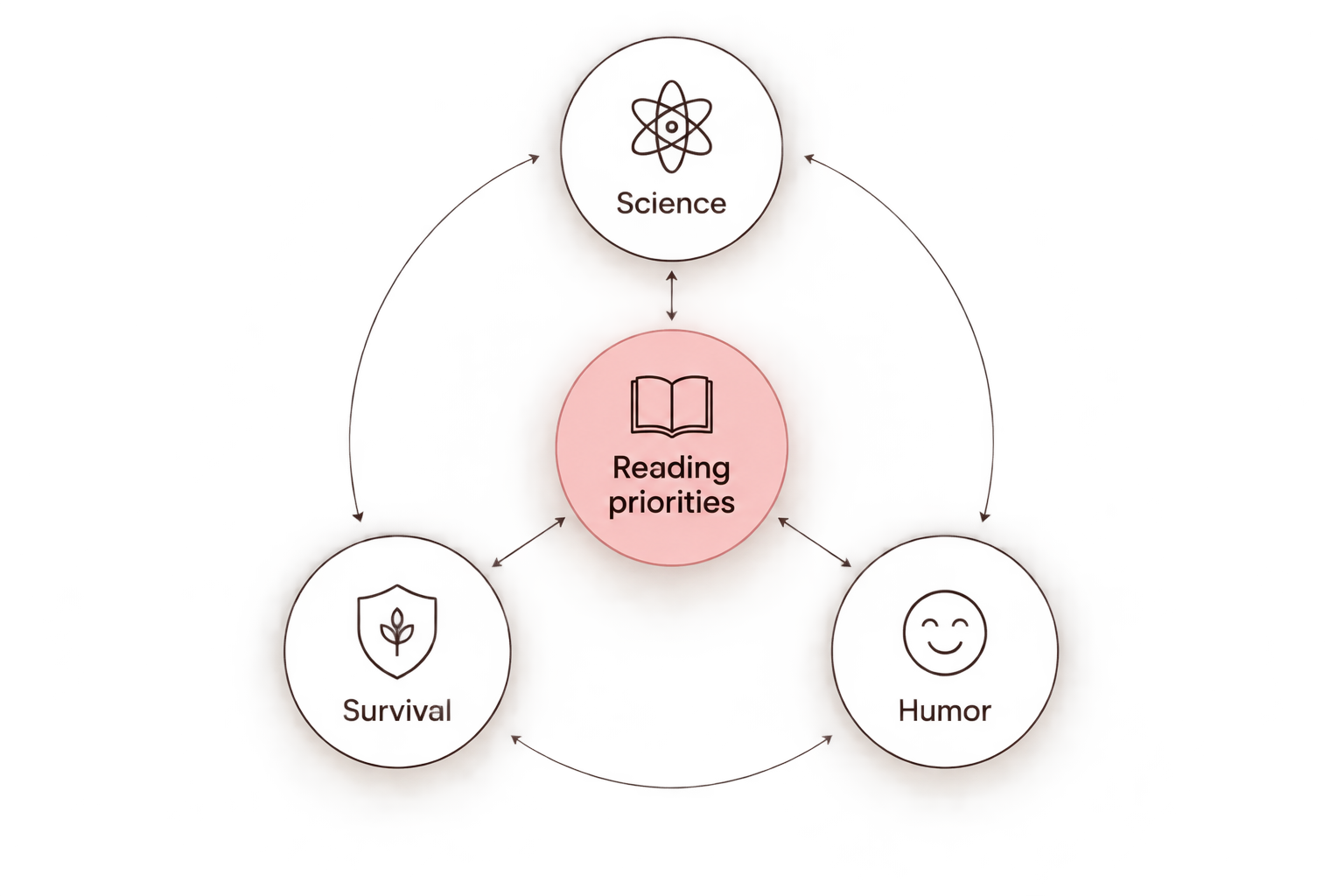
Which book should you choose?
Start with Project Hail Mary. It preserves the strongest combination of explanation, experimentation, danger, and humor. If you have already read it, move to Artemis for another Weir novel or Seveneves for a more demanding engineering story.
For your 2026 reading list, avoid treating “hard science fiction” as a complete recommendation. That label does not tell you whether a book is funny, intimate, slow, or focused on an ensemble.
For a broader selection, give GetSimilarBooks 1 title you enjoyed. The tool returns 5 hand-curated recommendations; providing your email adds a personalized list of 20–30 titles. The initial selection is useful for a quick choice, while the longer list gives you more directions to explore.
Find your next read
Start with a book you enjoyed. Get five read-alikes, plus a personalized list of 20–30 titles by email.
Verity Audiobook Recommendations: Frequently Asked Questions
What’s the closest book to The Martian?
Project Hail Mary by Andy Weir is the closest overall match on this list. It combines scientific problem-solving, accessible explanations, survival pressure, and a humorous narrator, while moving further into speculative science.
Should I read Artemis or Project Hail Mary after The Martian?
Read Project Hail Mary for the closer match to The Martian’s problem-solving experience. Choose Artemis if you want technical improvisation inside a lunar heist rather than another isolated survival predicament.
Which book like The Martian has the most engineering detail?
Seveneves is the strongest choice here for sustained engineering detail and orbital survival. Its larger cast, denser explanations, and major structural shift make it a different reading experience from The Martian.
What’s a short book like The Martian?
All Systems Red by Martha Wells is the short-form choice on this list. The novella matches the appeal of a capable, sarcastic narrator under pressure, but offers less scientific explanation.
Do I need to read The Martian before Project Hail Mary?
No. The Martian and Project Hail Mary are separate novels, so you do not need to read one to understand the other. You can choose either without completing a series first.
Which recommendation is best if I dislike sarcastic narrators?
Rendezvous with Rama is the best fit here if you prefer methodical exploration to sarcastic narration. Seveneves is another option when detailed engineering matters more to you than a conversational first-person voice.
Are these still useful recommendations in 2026?
Yes. This 2026 list ranks books by their specific similarities to The Martian rather than by publication recency. The deciding factors are scientific problem-solving, survival pressure, readability, and narrative voice.
One last thing
Your next read does not need to improve on The Martian in every way. It needs to preserve the part you are not finished with: the experiment, the isolation, or the joke after something breaks.
Write that preference beside the title before requesting recommendations. “More science, less banter” is a more useful instruction than “more space books.”
Related guides
- Books like Project Hail Mary, closest match first
- Books like Project Hail Mary with humor in the science
- Is Project Hail Mary hard science fiction?
- How to find similar books without spoilers
How many books are in the Harry Potter series?

There are 7 books in the main Harry Potter series by J. K. Rowling as of 2026, beginning with Harry Potter and the Sorcerer’s Stone and ending with Harry Potter and the Deathly Hallows. That count excludes Harry Potter and the Cursed Child, a stage-play script, and companion books about the wizarding world. Read the 7 novels in publication order for the complete original story; you do not need the extras.
- How many books are in the Harry Potter series? There are 7 main novels, read in publication order.
- Harry Potter and the Cursed Child continues the story as a play script, not an eighth novel.
- The Sorcerer’s Stone and the Philosopher’s Stone are regional titles for the same first book.
- Companion books add wizarding-world background but are not required to understand the original series.
Why this matters
A shelf of Harry Potter editions can make a finished series look much bigger than it is. Illustrated editions, regional titles, scripts, and companion books do not all represent additional installments in Harry’s original story.
Count distinct novels, not covers or formats. If you are choosing the series for a child, length is only part of the decision: the later books contain darker material. The guide to whether Harry Potter is appropriate for 8-year-olds addresses that separate question.
How many books are in the Harry Potter series?
The main Harry Potter series contains 7 novels. The table below gives the reading order without revealing major plot developments. The order is the same for a first-time reader in 2026 as for someone rereading the original story.
| Reading order | Book title | What to expect, without spoilers |
|---|---|---|
| 1 | Harry Potter and the Sorcerer’s Stone | Harry discovers the wizarding world and begins attending Hogwarts. Published as Philosopher’s Stone in the UK. |
| 2 | Harry Potter and the Chamber of Secrets | A school mystery builds on the people, places, and rules introduced in the first book. |
| 3 | Harry Potter and the Prisoner of Azkaban | Harry learns more about his family’s past as the world outside Hogwarts becomes more important. |
| 4 | Harry Potter and the Goblet of Fire | A magical competition expands the setting and marks a shift toward greater danger. |
| 5 | Harry Potter and the Order of the Phoenix | Institutional conflict, resistance, and Harry’s growing frustration take a larger role. |
| 6 | Harry Potter and the Half-Blood Prince | Earlier history becomes central to understanding the conflict ahead. |
| 7 | Harry Potter and the Deathly Hallows | The central conflict reaches its conclusion, with a structure that breaks from the usual school-year pattern. |
Start with Sorcerer’s Stone and follow the table downward. Later novels assume you know earlier relationships, discoveries, and consequences. Reading a synopsis instead of an installment preserves some information but removes the gradual development that gives later scenes their weight.
The opening books also establish details that become significant later. You do not need to identify those details in advance. Let the books supply them in order rather than searching for explanations that reveal future events.
Main novels: 7 books
The 7 main novels are the best fit if you want Harry’s original story from beginning to end. They form a connected sequence rather than a collection of independent adventures. Individual books resolve immediate problems, but the larger conflict continues across the series.
The strength of reading all seven is continuity: friendships, rivalries, and apparently small discoveries accumulate meaning. The limitation is commitment. You cannot jump to a later installment and expect every relationship or revelation to carry the same force.
The tone also changes. The early books give more space to discovery, school routines, and contained mysteries; the later books spend more time on grief, manipulation, prejudice, and war. That progression matters when you are choosing a read-aloud or deciding whether to continue immediately with a younger reader.
There is no requirement to read the entire series without a break. Finish an installment, consider its tone, and decide whether the next book suits the reader now. A complete series does not have to become an uninterrupted reading project.
Main novels plus Cursed Child: 8 works, not 8 novels
If you add Harry Potter and the Cursed Child to the original series, you have 8 works: 7 novels and 1 stage-play script. That is a broader reading list, not a revised count of the main novels.
Cursed Child takes place after the original series and follows the next generation as well as familiar characters. The play is by Jack Thorne, based on an original story by J. K. Rowling, John Tiffany, and Jack Thorne. Its format matters as much as its position in the timeline.
Best for: readers who specifically want a later-set stage story. Dialogue and stage directions carry the action, rather than the descriptive narration of the novels. That makes it a different reading experience, not simply another volume written in the same style.
Read it after Deathly Hallows if you choose to include it. Starting there exposes information about where characters end up. Skip it if your goal is only to finish the original seven-book narrative; that narrative already has an ending.
The play’s two-part structure does not make it two additional main-series novels. When checking an edition, distinguish the structure of the production from the number of books in Harry’s original story.
Companion collection: 3 books outside the main sequence
The Hogwarts Library collection brings together 3 companion books: Fantastic Beasts and Where to Find Them, Quidditch Through the Ages, and The Tales of Beedle the Bard. None is a numbered installment in the original sequence.
These books explore material connected to the fictional world. They do not continue Harry’s school years in the way the main novels do. Choose one for its subject, not because you think it is a missing chapter of the central story.
| Companion book | Best for | Meaningful difference from the novels |
|---|---|---|
| Fantastic Beasts and Where to Find Them | Readers interested in magical creatures | A fictional reference book, not a Harry-centered adventure |
| Quidditch Through the Ages | Readers interested in the wizarding sport | Background and sporting history rather than a continuing plot |
| The Tales of Beedle the Bard | Readers interested in wizarding folklore | A collection of tales rather than a full-length series installment |
The benefit is extra texture. The limitation is that these books will not replace the experience of following Harry, Ron, and Hermione through another sustained adventure.
For a first read in 2026, the simplest approach is to finish the novels before exploring the companion collection. In particular, The Tales of Beedle the Bard has connections to the final novel that are easier to appreciate afterward.
Why the Harry Potter book count varies
Different counts usually answer different questions. Someone counting the original narrative gets a different result from someone counting every related publication on a shelf.
- Main novels: The original sequence contains 7 distinct novels. This is the answer to the usual series-count question.
- Stage script: Adding Cursed Child produces a broader list, but it does not turn the script into a novel.
- Companion books: Fictional textbooks and folklore collections expand the setting without extending the numbered sequence.
- Regional titles: Sorcerer’s Stone and Philosopher’s Stone identify the same first installment, not separate adventures.
- Formats and adaptations: Illustrated editions, audiobooks, ebooks, and films should not be counted as new main-series novels.
The useful distinction is between the story, its continuation in another medium, and background material. Keep those categories separate when choosing what to read.
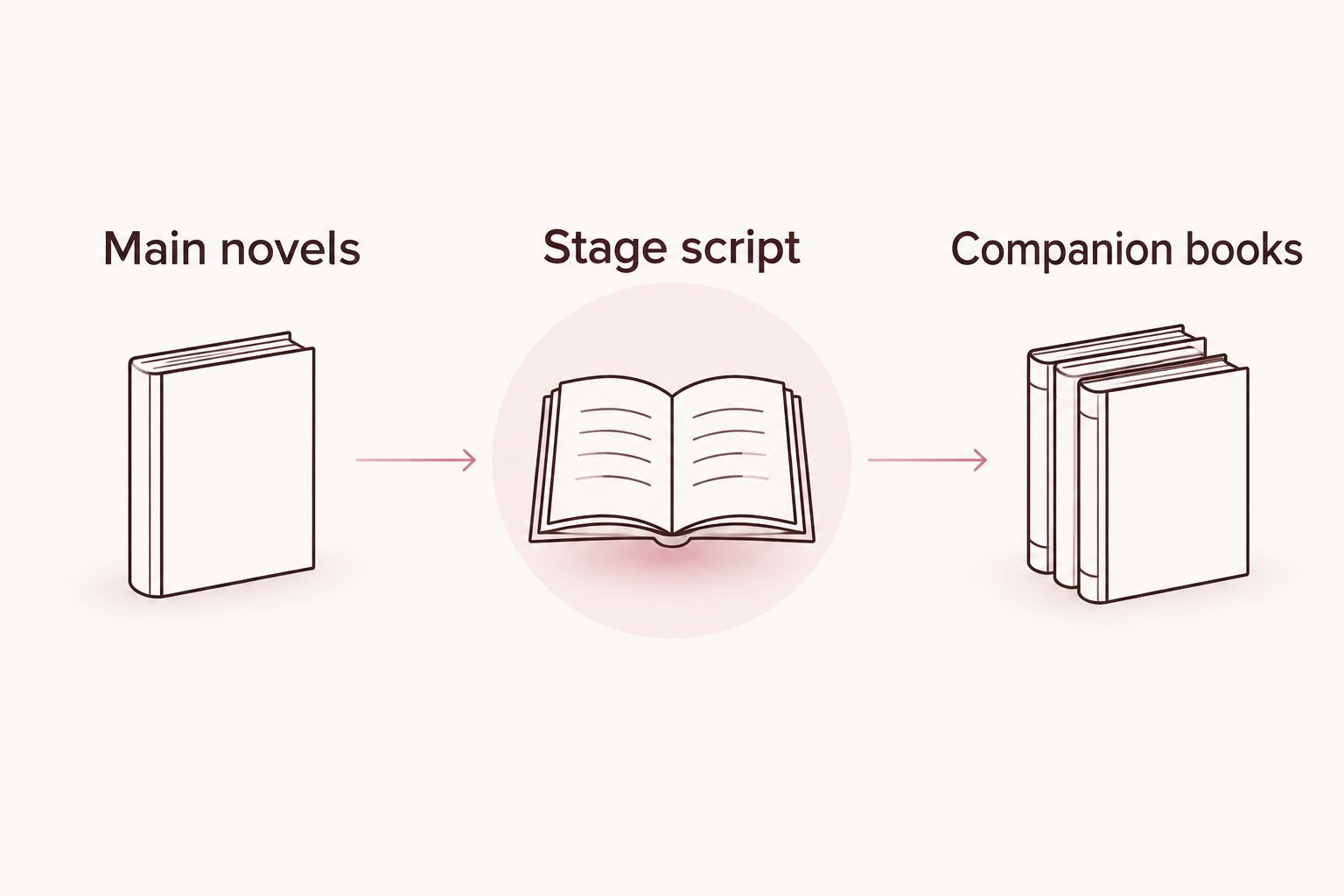
For a 2026 reading checklist, write down the seven titles rather than relying on a retailer’s collection name. A collection can include extra material, and a matching set of covers tells you little about which distinct works it contains.
Are there 7 or 8 Harry Potter books?
There are 7 main Harry Potter novels, or 8 works if you deliberately include the Cursed Child play script. Say which category you mean rather than treating both totals as interchangeable.
The original novel sequence ends with Deathly Hallows. A later-set story does not make that ending incomplete.
Why are there 8 Harry Potter movies but 7 books?
There are 7 main books, but the film adaptation of Deathly Hallows is split into two movies. That produces 8 films adapting the original novel sequence.
The split happened in the adaptation, not in the novels. You do not need to find a separate Deathly Hallows Part 2 novel to finish reading.
Do I need to read anything before the 7 Harry Potter books?
The 7 Harry Potter books need no prequel or companion reading. Begin with Sorcerer’s Stone, also titled Philosopher’s Stone, and let the first novel introduce the setting.
If you have already watched the films, the same order still works. Familiarity with the screen story does not replace the relationships, explanations, and smaller developments presented in the books.
After the seventh book, choose what you want to keep
Finishing Harry Potter does not automatically mean you want another story with a magic school. You might want the friendships, the mystery running beneath everyday life, or the feeling of discovering a hidden world. Those are different reading needs.
Before choosing a follow-up, name the quality that mattered most. Also name one thing you want changed: a shorter commitment, an older cast, or a lighter tone. That gives a recommendation more direction than a shared fantasy label.
Getsimilarbooks is best for fiction readers who want read-alike book recommendations from a title they already enjoyed. At Getsimilarbooks, you can enter a book title and receive five hand-curated suggestions. The free personalized list expands that to 20–30 titles and requires an email address.
The distinction is practical: Getsimilarbooks helps you choose your next book; it is not needed to work out the Harry Potter reading order. Finish the original sequence first if completing Harry’s story is your goal.
Verity Audiobook Recommendations: Frequently Asked Questions
How many books are in the Harry Potter series in 2026?
There are 7 books in the main Harry Potter novel series in 2026. The count excludes the Cursed Child play script, companion books, and alternative editions.
What are the Harry Potter books in order?
Read Sorcerer’s Stone, Chamber of Secrets, Prisoner of Azkaban, Goblet of Fire, Order of the Phoenix, Half-Blood Prince, and Deathly Hallows. In the UK, the first book is titled Philosopher’s Stone.
Is Harry Potter and the Cursed Child the eighth book?
Harry Potter and the Cursed Child is a later-set stage-play script, not an eighth main-series novel. Read it after the original seven books if you want to include the stage story.
Are Philosopher’s Stone and Sorcerer’s Stone different books?
Philosopher’s Stone and Sorcerer’s Stone are regional titles for the same first Harry Potter installment. You do not need to read both to complete the series.
Do the Fantastic Beasts books count as Harry Potter novels?
Fantastic Beasts and Where to Find Them is a companion book, not one of the 7 main Harry Potter novels. Related film screenplays also sit outside the original novel sequence.
Can I stop reading after Deathly Hallows?
Yes. Deathly Hallows concludes the central story told across the 7 original novels. Companion books and the Cursed Child script are optional additional reading.
Why do some Harry Potter collections contain more than seven books?
A collection can combine the original novels with scripts, companion books, or other editions. Check the individual titles rather than using the number of volumes to identify the main series.
Can a recommendation tool help me after Harry Potter?
Getsimilarbooks offers book recommendations based on a title you enjoyed. You receive five hand-curated suggestions, with a free personalized list of 20–30 titles available after providing an email address.
One last thing
Do not count Philosopher’s Stone and Sorcerer’s Stone twice. That single title difference can make a reading checklist look as though it contains a missing installment. Check the order number, not just the wording on the cover.
For your 2026 reading list, keep the task simple: seven original novels first, optional extras afterward. Then choose your next series by what you loved, not by whether its cover promises another school of magic.
Related guides
- Books like Harry Potter for middle schoolers
- Books like Harry Potter for adult readers
- Books like Harry Potter with darker themes
Is ACOTAR a slow burn or instant romance?

ACOTAR is closer to slow-burn romance than instant romance: attraction develops before trust, and the relationship takes time to become central. The first novel has a clearer romantic progression within one book, while the wider series gives emotional development more room. For your 2026 reading list, expect a gradual fantasy romance—not immediate love, but not an uninterrupted wait for anything romantic to happen either.
- Is ACOTAR a slow burn or instant romance? Sarah J. Maas’s series favors gradual attachment over immediate love.
- The first ACOTAR novel develops attraction and trust within a fantasy plot; it does not postpone every romantic payoff.
- A Court of Mist and Fury gives emotional development more space. Start with the first novel, not the sequel.
- Fourth Wing readers should expect less military-academy momentum and more attention to an unfamiliar faerie world.
Why this matters
Slow burn describes the wait for a relationship to develop. It does not tell you whether the opening chapters move quickly, whether characters notice each other immediately, or whether the book contains explicit sex. Those are separate questions.
That distinction matters if you finished Fourth Wing and want the same romantic tension rather than another fantasy with a romance somewhere inside it. Match the part you enjoyed: attraction, earned trust, delayed commitment, or danger shared by a couple. A shared genre label is not enough.
GetSimilarBooks is a book recommendation tool for readers who want hand-curated read-alikes from a title they already enjoyed.
Is ACOTAR a slow burn or instant romance?
ACOTAR is a gradual romance, with a stronger slow-burn reputation at series level than the first novel alone explains. In Sarah J. Maas’s A Court of Thorns and Roses, Feyre does not begin with an established romantic bond. Her circumstances, distrust, and limited understanding of the faerie world stand between initial impressions and emotional attachment.
The first book still delivers romantic development of its own. Calling it slow burn should not suggest that the entire novel consists of almost-meetings and postponed conversations. You get a developing relationship alongside the fantasy conflict.
Readers also use “ACOTAR” to mean either the opening novel or the whole series. That creates confusion: someone describing the emotional experience of several books is not necessarily describing the pace of book 1.
| Book | Best for | What develops gradually | Main limitation for this preference |
|---|---|---|---|
| A Court of Thorns and Roses | Readers who want courtship inside a dangerous fairy-tale setting | Familiarity, attraction, and trust | Its opening includes substantial adjustment to an unfamiliar world |
| A Court of Mist and Fury | Readers who prioritize emotional intimacy | Vulnerability, understanding, and relationship development | It depends on the first novel; it is not an alternative starting point |
| Fourth Wing | Readers who want attraction alongside training and immediate danger | Trust under pressure and romantic commitment | Its military-academy structure creates a different reading rhythm |
The table compares the reading experience, not the quality of the books. Choose ACOTAR for a romance that grows through changing understanding. Choose Fourth Wing when training, competition, and external danger are central to what you want from the setup.
The first novel: gradual attraction, not endless delay
Best for: readers who want a romantic arc within the opening book.
A Court of Thorns and Roses begins with Feyre’s survival concerns, family responsibilities, and hostility toward faeries. Romance is not her starting priority. That gives the relationship somewhere to go beyond an immediate declaration of love.
The early distance matters. Feyre must revise what she thinks she knows, and the reader learns about the setting through her limited perspective. Attraction develops inside that process rather than replacing it.
The advantage is a romance connected to the fantasy premise. Emotional movement follows changes in proximity, knowledge, and perceived safety. You are not simply waiting for characters to acknowledge an attraction that has no obstacles.
The drawback is that world introduction can feel like romantic delay even when it serves another purpose. If your preferred slow burn requires constant banter or charged encounters from the opening, the quieter stretches are a meaningful difference.
Read the first novel for its own romantic progression, not solely as a ticket to a later book. That is the sounder expectation for a first read in 2026.
The wider series: more room for emotional development
Best for: readers who enjoy relationships shaped by consequences and changing self-understanding.
The series has more space than the opening novel to explore what characters need, what they misunderstand, and how experience affects intimacy. That extended emotional development helps explain why readers describe ACOTAR as slow burn.
A Court of Mist and Fury, book 2, is especially relevant to that description. Its appeal includes sustained attention to emotional recovery, vulnerability, and being understood. Naming the romantic outcomes would spoil the experience; the useful distinction is the greater emphasis on how closeness develops.
The benefit is depth across a continuing story. A relationship can mean something different after the characters have lived through difficult events.
The limitation is commitment. You cannot reproduce that accumulated context by skipping the opening novel. If you only want a self-contained romance, a continuing fantasy series asks for something different.
Start with A Court of Thorns and Roses. Reading in order protects both the plot and the emotional logic that makes later development matter.
Why ACOTAR’s romantic pace feels different to different readers
A slow-burn label is useful only when you know what is being delayed. For a 2026 reading choice, separate these factors before deciding whether ACOTAR fits:
- Attraction: Noticing someone is not the same as loving or trusting them. Early interest does not automatically make a romance instant love.
- Trust: Feyre’s circumstances and beliefs give her reasons for suspicion. Changes in trust carry romantic weight.
- Worldbuilding: Learning the faerie setting takes narrative space. Those passages affect reading speed without necessarily advancing the relationship.
- Emotional intimacy: Disclosure, vulnerability, and understanding are different milestones from physical closeness. The series gives them sustained attention.
- Series scope: A judgment about the opening novel is narrower than a judgment about the continuing story. Ask which one a recommendation means.
These factors explain how readers can agree about the events but disagree about the pace. One reader counts the wait for attraction. Another counts the wait for emotional security.

The practical question is not whether ACOTAR passes a universal slow-burn test. Ask whether you enjoy watching attraction become trust while the fantasy story develops around it. That is a more useful predictor than the label alone.
Is ACOTAR slower than Fourth Wing?
ACOTAR’s opening spends more attention on Feyre entering and understanding an unfamiliar faerie world; Fourth Wing places Violet inside a dangerous military training environment. That difference makes Fourth Wing’s setup more immediately pressure-driven. It does not make every romantic milestone directly comparable.
If you loved Fourth Wing for charged interactions amid training and competition, ACOTAR changes the balance. Expect a different setting and a less academy-centered source of tension. The match is fantasy romance with developing trust, not the same plot machinery.
If your favorite part was waiting for emotional defenses to come down, the wider ACOTAR series is relevant. If your favorite part was dragons, rider bonds, and military training, romantic pacing alone will not replace those elements.
Do not choose ACOTAR solely because both books attract romantasy readers. Choose it because its particular blend of faerie danger, changing perceptions, and relationship development sounds appealing.
Does slow burn mean ACOTAR has little spice?
Slow burn describes relationship pacing, not sexual explicitness. ACOTAR contains on-page sexual content, and the level of explicitness differs across the series. A gradual emotional bond is not a low-spice guarantee.
That distinction matters when you are choosing by comfort level. A book can delay trust while allowing physical attraction or intimacy to develop sooner. It can also sustain romantic tension without frequent explicit scenes.
For your 2026 shortlist, keep separate notes for romantic pace and mature content. Brief content considerations for ACOTAR include sexual content, violence, and coercive situations. Consult a spoiler-conscious content guide if one of those is a firm boundary.
Use “slow burn” to choose a relationship rhythm, not to screen for age suitability or explicit content. Those decisions need their own information.
Should I keep reading if the beginning feels slow?
Keep reading if you are interested in Feyre, the faerie setting, or the developing uncertainty around her circumstances. Those elements are part of the book, not disposable material before the romance begins.
If none of them interests you, later romantic development is not a reason to force the experience. A recommendation should fit how you like to read, not require you to ignore everything except a promised payoff.
Use this spoiler-free check:
- Identify the missing ingredient. Do you want more romantic interaction, faster external action, or less setting explanation? These are different preferences.
- Notice what already holds your attention. Curiosity about the world or Feyre’s changing judgments gives you a reason to continue beyond reputation.
- Choose without a chapter deadline. Reading speed, edition, and tolerance for setup differ. An invented checkpoint is less useful than your actual response.
You do not need a particular verdict by a particular page. You need a reason to want the next scene.
Find your next book by the kind of tension you want
“More like ACOTAR” leaves too much unsaid. Specify whether you want distrust becoming affection, emotional healing, faerie politics, or a long wait for commitment. Also name what you do not want repeated.
GetSimilarBooks gives you 5 hand-curated read-alike suggestions after you enter a title you enjoyed. An email-gated personalized list expands that to 20–30 titles. The five-book preview is a smaller starting point; the longer list requires sharing your email.
For a useful 2026 reading brief, pair the title with a concrete preference: gradual trust, strong romantic focus, and no major spoilers. That says more about the desired reading experience than “fantasy romance” alone.
Find your next slow burn
Start with a title you enjoyed. Get five hand-curated suggestions and request a free personalized list.
Verity Audiobook Recommendations: Frequently Asked Questions
Is ACOTAR a slow burn or instant romance?
ACOTAR is closer to slow-burn romance than instant romance. The first novel develops attraction and trust gradually, while the wider series gives emotional intimacy more room.
Does the first ACOTAR book have romance, or does it only set up the series?
The first ACOTAR book has its own developing romance. It also introduces the fantasy setting, so romantic progress shares space with Feyre learning about an unfamiliar world.
Is A Court of Mist and Fury the slow-burn book?
A Court of Mist and Fury gives sustained attention to emotional intimacy and relationship development. Read A Court of Thorns and Roses first; the sequel depends on its events and context.
Can I skip the first ACOTAR book to get to the romance?
Do not skip the first ACOTAR book. It contains romance itself and establishes the experiences that give later emotional development its meaning.
Will I like ACOTAR if I loved Fourth Wing?
ACOTAR fits Fourth Wing readers who want fantasy danger and developing romantic trust. It is a less direct match if military training, dragons, and rider bonds were the main attraction.
Does slow burn mean ACOTAR is low spice?
Slow burn does not mean ACOTAR is low spice. Relationship pacing and sexual explicitness are separate, and the series contains on-page sexual content.
How can I find another fantasy romance with gradual trust?
Use a favorite title and specify gradual trust rather than only asking for fantasy romance. GetSimilarBooks offers five hand-curated suggestions and an email-gated personalized list of 20–30 titles.
One last thing
A romance can move physically faster than it moves emotionally. That is why asking only when characters kiss or become intimate gives you an incomplete answer about slow burn.
Before choosing ACOTAR, finish this sentence: “I want to wait for them to…” If your answer is trust each other, understand each other, or become emotionally vulnerable, you have identified a more useful preference than a trope label. Keep that preference when you choose the next book, too.
Related guides
- Books like Fourth Wing with slow-burn romance
- Is Fourth Wing or ACOTAR the better fantasy romance start?
- What order should I read the ACOTAR series in?
- Books like ACOTAR: five picks, closest match first
Does Fourth Wing have a love triangle?

Fourth Wing has early love-triangle tension, but not a sustained, evenly balanced choice between two love interests. Violet’s relationships with Dain and Xaden create jealousy and competing loyalties, while the central romance becomes clear. This spoiler-light 2026 guide covers the first novel only, without revealing its ending or making promises about later books.
- Does Fourth Wing have a love triangle? Early tension, yes; a sustained, evenly balanced romantic choice, no.
- Rebecca Yarros gives Dain and Xaden different roles in Violet’s story, rather than equal romantic weight.
- Fourth Wing suits readers who enjoy enemies-to-lovers tension, but not readers who require absolutely no romantic rivalry.
- GetSimilarBooks offers five hand-curated read-alikes, with an email-gated personalized list of 20–30 titles.
Does Fourth Wing have a love triangle?
Yes in the broad sense of competing romantic possibilities; no in the sense of a prolonged choice between equally developed relationships. Rebecca Yarros introduces Violet’s existing attachment to Dain alongside her attraction to Xaden. Those connections overlap enough to create tension, especially early in the book.
The useful distinction is between a triangle-shaped setup and a triangle-driven story. Fourth Wing has the setup. Its main romantic arc does not give both possibilities equal space or equal momentum.
| What you mean by a love triangle | Does Fourth Wing fit? | What to expect |
|---|---|---|
| Two people have romantic significance for the protagonist | Yes | Dain and Xaden both matter to Violet |
| Jealousy or competing attention | Yes | Some uncomfortable romantic tension |
| Two equally developed romantic relationships | No | The central pairing receives clearer emphasis |
| A prolonged question of which person Violet wants | Not the main structure | Trust and danger carry more weight than partner selection |
| Absolutely no romantic rivalry | No | That is a stricter boundary than this book meets |
If your real concern is how long the attraction takes to develop, the guide to books like Fourth Wing with slow-burn romance separates romantic pacing from romantic rivalry. They are different preferences. A book can delay a relationship without introducing another serious contender.
Why this matters
A simple yes or no gives the wrong expectation here. Calling Fourth Wing a love-triangle romance overstates the competition; calling it completely triangle-free erases the early tension that some readers specifically want to avoid.
Your tolerance for rivalry matters more than the trope label. If you dislike hundreds of pages of indecision between equally appealing partners, Fourth Wing is not primarily built around that experience. If even brief competing attraction bothers you, take the warning seriously.
For a reader choosing Fourth Wing in 2026, the practical question is not whether someone has attached a trope tag to it. Ask whether jealousy, an existing crush, or an alternative romantic possibility crosses your own line.
Dain: familiarity and an existing attachment
Dain represents someone Violet already knows. Their shared history gives his presence emotional significance before the newer relationship has had time to develop.
That familiarity explains why readers identify a triangle at all. Dain is not simply an unrelated friend standing near the romance. However, his importance to Violet’s history does not make his romantic role equivalent to Xaden’s.
Best for understanding: why the opening feels more triangular than the central romance. Naming his eventual role more precisely would reveal developments you do not need before reading.
Xaden: attraction complicated by danger
Xaden’s connection with Violet carries attraction, suspicion, and reasons for caution. Their relationship belongs to the book’s enemies-to-lovers appeal, where wanting someone does not immediately make trusting that person easy.
This is the romance that receives the clearer narrative emphasis. That statement describes the book’s focus, not its ending. You can know which relationship matters most without knowing how its conflicts unfold.
Best for understanding: why readers often describe Fourth Wing through enemies-to-lovers rather than through love-triangle indecision.
Why readers describe the romance differently
Readers use “love triangle” for different experiences. The disagreement usually comes from the definition, not from a disagreement about which characters appear in the book.
- Existing attachment: Violet’s history with Dain gives him significance that a newly introduced acquaintance would not have.
- Competing attraction: The presence of another romantic possibility is enough for some readers to count a triangle.
- Unequal emphasis: Other readers reserve the label for two relationships that receive comparable development. Fourth Wing does not fit that narrower definition well.
- Jealousy tolerance: A reader avoiding jealousy entirely needs a stronger warning than someone avoiding drawn-out indecision.
- Series scope: An answer about Fourth Wing should describe that novel, not silently include later installments.
Those distinctions make trope warnings more useful in 2026. Instead of asking only whether a triangle exists, ask what kind of competition appears and how much of the romance depends on it.
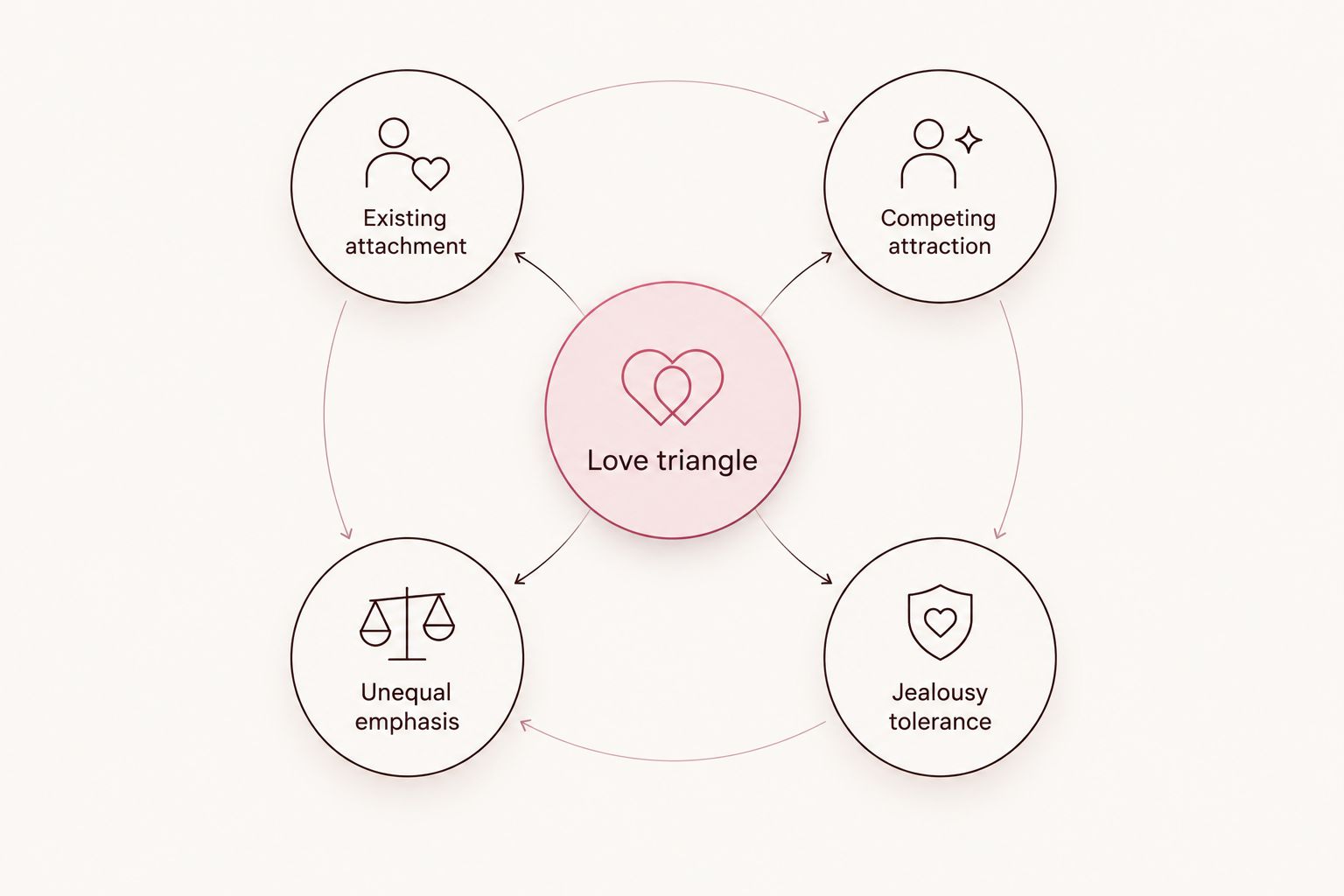
Will I like Fourth Wing if I hate love triangles?
Fourth Wing is a reasonable choice if you dislike prolonged romantic indecision, but a poor choice if you require zero rivalry. Its romantic tension is not limited to deciding between two people. Trust, conflicting loyalties, and the dangerous setting also shape the relationship.
Separate your hard boundary from your preference. “I prefer one obvious central couple” leaves more room than “I never want another character to be a romantic possibility.” Fourth Wing fits the former more comfortably than the latter.
You should also separate triangle avoidance from content level. Fourth Wing is adult fantasy with explicit sexual content and violence. A clearer central pairing does not make it a low-spice or gentle read.
Can you explain the romance without spoiling who Violet chooses?
Yes: Fourth Wing gives Violet an established emotional connection and a newer, more dangerous attraction. The contrast lets the book explore familiarity, independence, and trust without giving both relationships equal romantic development.
A spoiler-light explanation can name Dain and Xaden because that answers the actual question. It does not need to disclose relationship milestones, later revelations, or the ending. Avoid character relationship timelines if you want to preserve those discoveries.
Does this answer cover the whole Empyrean series?
No: this answer covers Fourth Wing, not the whole Empyrean series. A first-book trope description is not a guarantee about every later installment.
When checking a discussion in 2026, look for the book title before reading further. A thread labeled with the series name can discuss later relationship developments even when its opening question sounds suitable for a new reader.
What should you read next if you want less romantic competition?
Start with the part of Fourth Wing you want to keep. Deadly trials, distrustful attraction, and emotionally important romance are separate qualities; no recommendation below reproduces all of them.
These books move from the closest match for danger and romantic tension toward quieter or structurally different alternatives. The differences matter as much as the similarities. None should be treated as a substitute for checking your other content boundaries.
| Book | Best for | Specific connection to Fourth Wing | Meaningful difference |
|---|---|---|---|
| The Serpent and the Wings of Night by Carissa Broadbent | Deadly trials and distrustful attraction | A vulnerable heroine faces lethal competition while attraction complicates trust | Vampires and a tournament replace dragons and military training |
| Radiance by Grace Draven | A clearly centered couple | A fantasy relationship develops across social and cultural divisions | An arranged marriage and growing friendship replace academy rivalry |
| Divine Rivals by Rebecca Ross | Emotional intimacy through writing | Romance develops alongside a dangerous wider conflict | Rival journalists and letters replace rider training and dragons |
The Serpent and the Wings of Night: best for deadly trials
Choose Carissa Broadbent’s The Serpent and the Wings of Night if the strongest part of Fourth Wing was attraction developing under lethal pressure. Oraya is a human in a vampire-dominated world, and the tournament setting makes survival central rather than decorative.
The match is specific: a comparatively vulnerable heroine must assess danger while deciding whom to trust. Romantic tension grows inside that problem, not outside it. That connection is stronger than simply shelving both books under fantasy romance.
The difference is equally clear. You get vampires and a structured competition, not dragon bonds or the rhythms of a military academy. Expect adult sexual content and violence; this is not the gentler alternative.
Verdict: Buy for dangerous competition and distrustful attraction; skip if dragons are the essential ingredient.
Radiance: best for a clearly centered couple
Choose Grace Draven’s Radiance if you want the relationship to feel like a developing alliance rather than a contest between romantic candidates. Brishen and Ildiko enter a political marriage across cultural and physical differences.
The strongest connection is learning to understand someone your own society treats as fundamentally different. The attraction grows through respect and companionship. That makes it useful for readers who enjoyed intimacy developing across divisions but want less romantic competition.
The trade-off is pace and setting. Radiance does not reproduce Fourth Wing’s academy structure, dragon relationships, or succession of training dangers. It also contains adult sexual content, so “less rivalry” should not be mistaken for “less explicit.”
Verdict: Buy for companionship becoming desire; skip if you want another lethal-school story.
Divine Rivals: best for emotional intimacy through writing
Choose Rebecca Ross’s Divine Rivals if you want to keep romantic tension while changing how intimacy develops. Iris and Roman are rival journalists whose connection involves letters against the backdrop of a war between gods.
The match is the contrast between public friction and private vulnerability. Readers who liked seeing guarded characters become emotionally legible have something concrete to follow here. The romance does not depend on recreating Fourth Wing’s physical setting.
The difference is substantial: writing, work, and wartime separation shape the relationship. There are no dragon-rider classes. Its sexual content is less explicit than Fourth Wing’s, but war and danger remain part of the reading experience.
Verdict: Buy for letters and emotional closeness; skip if training trials matter more than the romance.
Ask for the relationship dynamic you actually want
“Something like Fourth Wing” leaves too much unsaid. A useful request names both the attraction and the exclusion: deadly trials with a central couple, enemies-to-lovers without prolonged indecision, or fantasy romance without competing love interests.
GetSimilarBooks is best for fiction readers who want hand-curated read-alikes from a book they already enjoyed. Enter 1 title to receive 5 suggestions. The free personalized list expands that to 20–30 titles and requires your email address.
The trade-off is straightforward: the short preview asks less of you, while the longer list adds an email step. A recommendation list also does not replace checking a specific content boundary before reading.
Use GetSimilarBooks to start with the book you liked. For your 2026 reading list, keep the preference precise: one central romance is not the same request as no jealousy at all.
Verity Audiobook Recommendations: Frequently Asked Questions
Does Fourth Wing have a love triangle or not?
Fourth Wing has early love-triangle tension, but not a sustained, evenly balanced choice between two love interests. Dain and Xaden have romantic significance without receiving equal romantic development.
Is Dain a love interest in Fourth Wing?
Dain has romantic significance for Violet, especially through their existing history and her attachment to him. Describing him as only an unrelated friend would understate the early setup.
Is Xaden the main romantic focus in Fourth Wing?
Xaden is the main romantic focus in Fourth Wing. Identifying that emphasis does not reveal the ending or explain how the relationship’s conflicts develop.
Should I avoid Fourth Wing if I cannot stand jealousy?
Avoid Fourth Wing if absolutely no romantic jealousy or rivalry is a firm requirement. Its central romance is clearer than a balanced triangle, but the book is not free of competing romantic tension.
Does no love triangle mean Fourth Wing is low spice?
No. Fourth Wing contains explicit sexual content, regardless of how you classify its romantic structure. Triangle intensity and sexual explicitness are separate content questions.
Can I read this answer without getting spoilers for later books?
Yes. This page limits its relationship discussion to Fourth Wing and does not reveal later-book developments. It also avoids explaining the first novel’s ending.
Can GetSimilarBooks help me find my next fantasy romance?
GetSimilarBooks provides five hand-curated read-alike suggestions from a title you enjoyed. Its free personalized list contains 20–30 titles and requires an email address.
One last thing
Ask what makes the romance difficult, not just how many people are involved. A book with one central couple can contain distrust, jealousy, and painful conflict. A triangle label alone tells you surprisingly little about whether that experience suits you.
For your next read, finish this sentence: “I want Fourth Wing’s ___, without its ___.” That gives you a clearer selection rule than another broad fantasy-romance list.
Related guides
- Books like Fourth Wing with enemies-to-lovers romance
- Books like Fourth Wing with less spice
- How to find similar books without spoilers
How accurate are book recommendation quizzes?

Book recommendation quizzes are useful for building a shortlist, not for predicting whether you will love a book. Their accuracy depends on whether they capture why you liked a title, respect your dealbreakers, and explain the differences between the match and your next read. In 2026, judge a quiz by the reasoning behind its results—not by a confidence score without an explanation.
- How accurate are book recommendation quizzes? Judge the fit explanation, not an unexplained score.
- Fourth Wing read-alikes should distinguish dragon bonds, romantic tension, and deadly competition.
- Verity read-alikes should distinguish relationship suspense, unsettling atmosphere, and narrative uncertainty.
- GetSimilarBooks offers five hand-curated suggestions from a title you enjoyed; your content limits still need separate checking.
Why this matters
Finishing Fourth Wing does not tell a quiz what you want next. You might want the dragons but less explicit romance. Another reader might want the romantic tension without another military academy.
Those are different requests. A result can share the genre and still miss the experience you wanted to repeat.
A useful recommendation names both the connection and the compromise. If you want a repeatable way to assess results, the book recommendation quiz to personalized list workflow keeps the focus on turning a broad match into a reading decision.
How accurate are book recommendation quizzes?
Book recommendation quizzes are accurate only in relation to a defined goal. Identifying a book in your preferred genre is a different task from finding one with the same emotional tension, narrative voice, and content boundaries as your last favorite.
For your 2026 reading list, separate these jobs before deciding whether a result is good.
| Recommendation approach | Best for | What it helps you identify | Main limitation |
|---|---|---|---|
| Broad preference quiz | Exploring a genre | A starting direction based on answers such as mood or setting | Broad answers leave room for very different books |
| Title-based read-alike search | Following a particular favorite | Books connected to an identifiable reference title | The title alone does not explain which qualities mattered to you |
| Annotated recommendation list | Comparing specific candidates | Reasons a book matches, plus meaningful differences | You still need to decide which differences are acceptable |
These are ways to organize your search, not accuracy rankings. A short quiz with a clear explanation gives you something you can assess. A longer quiz that returns unexplained titles leaves you guessing.
Look for a statement such as: this matches the dangerous competition, but the romance has a different balance. That explanation lets you accept or reject the recommendation for a reason.
A list of covers does not do that work. Neither does a matching percentage that leaves the meaning of a match undefined.
Why book recommendation accuracy varies
The quality of a match depends on the request and the explanation attached to the result. Use these factors to identify where a recommendation fits—or breaks down.
- Matching priority. Dragons, romantic tension, and academy rivalry are distinct reasons to enjoy Fourth Wing. Decide which one comes first.
- Pacing preference. Wanting suspense does not necessarily mean wanting a slow accumulation of unease. State whether you want urgency or atmosphere.
- Romance balance. A central love story and a background romantic subplot offer different reading experiences.
- Content limits. A thematic match still fails your request if it includes material you want to avoid.
- Tolerance for difference. A close read-alike and an interesting departure serve different purposes. Choose which you want before judging the list.
- Explanation quality. A result becomes easier to evaluate when it identifies a shared feature and an important departure.
Treat a dealbreaker as a requirement, not a preference to average away. If you want less explicit romance, a strong setting match does not cancel that condition.
The same applies to format. Wanting a standalone is a practical constraint, not a minor variation in taste.
How can you check a quiz result before committing?
Use this four-step check on your next 2026 shortlist. It is a decision process, not a scoring system or a promise of enjoyment.
1. Name the appeal
Finish this sentence: I want another book that makes me feel the way this part did. Keep the answer specific enough to distinguish your favorite from other books in its genre.
For Fourth Wing, that might mean a vulnerable protagonist surviving dangerous training. For Verity, it might mean the discomfort of not knowing whose account to trust.
2. Set the limits
Name what you do not want before inspecting the recommendations. Examples include explicit sexual content, child-harm themes, a love triangle, or a series commitment.
You do not need to justify a boundary. You need enough information to check whether the suggested book respects it.
3. Read the difference
Look for the part of the recommendation that tells you what will change. Is the pace slower? Does politics replace training? Is the romance less central?
An honest difference is not a defect in the recommendation. It is the information that makes the recommendation usable.
4. Sample the voice
Read an opening sample when one is accessible to you. Notice the narration, sentence rhythm, dialogue, and distance from the protagonist.
A plot description cannot reproduce those qualities. If the premise fits but the voice does not, move to another candidate rather than treating the match as an obligation.
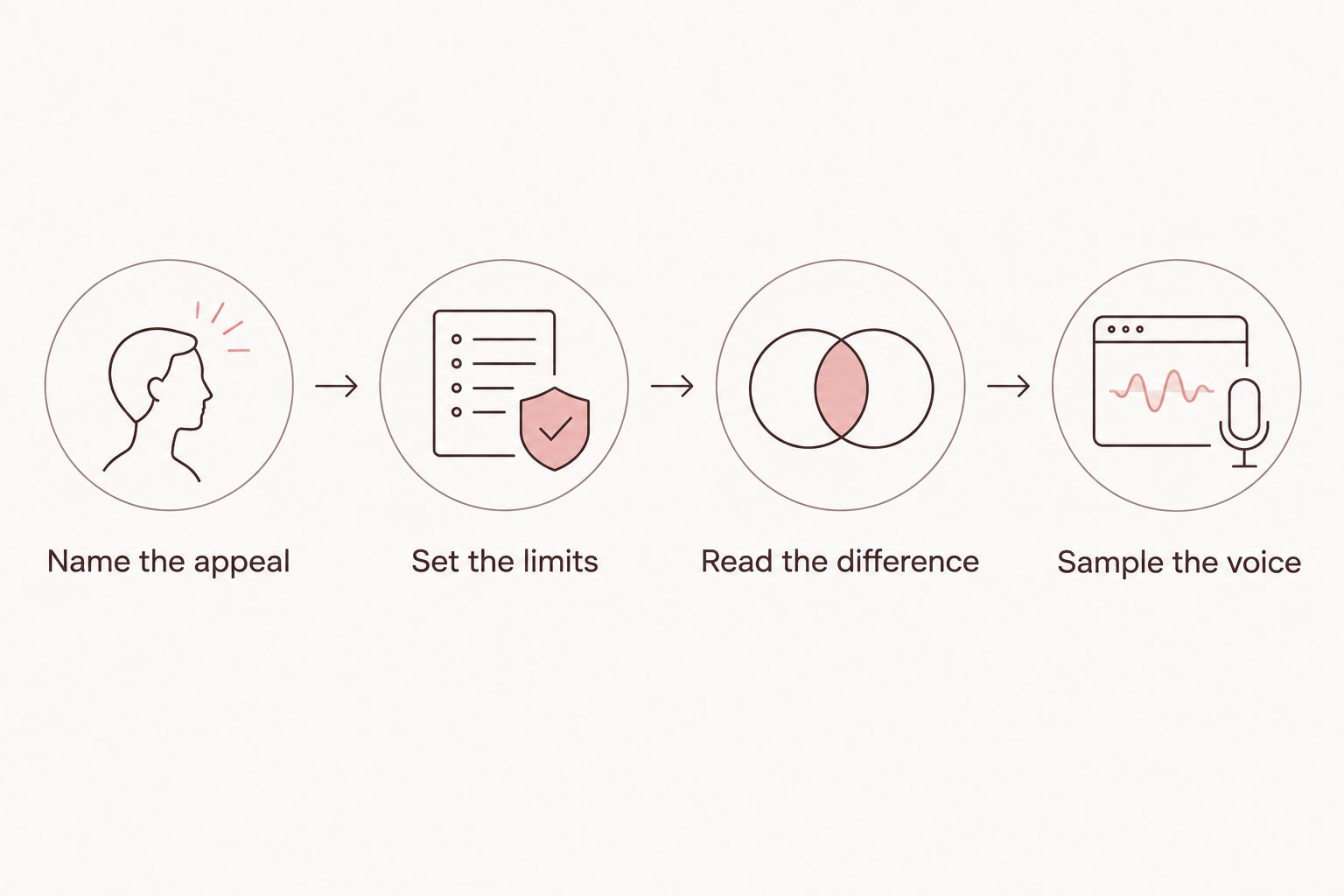
What does an accurate Fourth Wing or Verity match look like?
An accurate explanation does not need to promise another favorite. It needs to make the reading choice clear without revealing major twists.
The examples below show the difference between a specific connection and a shared genre label. They are starting points for evaluating fit, not claims about measured quiz performance.
| Starting point | Candidate | Best for | Specific connection | Honest difference |
|---|---|---|---|---|
| Fourth Wing | Fireborne by Rosaria Munda | Readers prioritizing dragon riders and institutional rivalry | Dragon-rider training and competition connect personal ambition with political power | Political aftermath and competing loyalties shape the story; do not choose it expecting the same romance balance |
| Fourth Wing | The Serpent and the Wings of Night by Carissa Broadbent | Readers prioritizing dangerous competition and romantic tension | A human heroine faces lethal stakes in a vampire-dominated setting | Vampires and a deadly tournament replace dragon bonds and a military academy |
| Verity | Rebecca by Daphne du Maurier | Readers prioritizing marital unease and an unsettling home | An uneasy marriage and the influence of another woman create psychological tension | Its gothic atmosphere and measured pace differ from a contemporary romantic thriller |
For the Fourth Wing examples, the order starts with the dragon-rider connection and moves outward to the competition-and-romance connection. Reverse that order if romantic tension matters more to you than dragons.
Rebecca answers a separate Verity need: unease inside an intimate relationship. It is not a substitute for every aspect of Verity, and it should not be presented as one.
If explicit content is your deciding factor, start with books like Fourth Wing with less spice rather than accepting a broad fantasy-romance match. Then check each candidate's content notes separately.
Does a longer quiz mean a better recommendation?
More questions help only when the answers change something relevant about the result. Questions about pace, romance balance, and content boundaries address different parts of the reading experience.
Rephrasing the same broad preference does not tell you more about the final match. Before finishing a long quiz, ask whether its questions distinguish the books you would accept from the books you would reject.
A useful test is to imagine two readers choosing the same genre. One wants an atmospheric standalone; the other wants a fast-moving series with a central romance.
If the questions cannot separate those requests, the result needs more explanation. Length alone is not evidence of accuracy.
Are recommendation quizzes useful for choosing a gift?
A gift recommendation has an extra problem: you are describing someone else's preferences. Keep your 2026 gift shortlist anchored to books the recipient has actually enjoyed, not just facts you know about their life.
Occupation gives you a topic to consider, not a complete reading profile. When choosing books by profession, distinguish professional interest from leisure reading: a job tells you what someone does, not whether they want that subject in a novel.
The same distinction applies to hobbies. Someone who enjoys solving puzzles does not automatically want a puzzle-driven mystery, and someone who works in healthcare does not automatically want a hospital setting.
Use a known favorite as the starting point. Then identify what the recipient enjoyed about it, whether they already own the proposed book, and whether the content fits their preferences.
For gifts, familiarity with the reader matters more than an elaborate personality label. If you cannot explain why the specific book suits the person, keep looking.
What should you do when the recommendations miss?
Change the request before repeating it. Asking for another book like Verity still leaves open whether you mean romantic tension, domestic unease, an unreliable account, or an ending that invites discussion.
Keep the part that worked and name the part that did not. A useful revision is: keep the unsettling relationship, but choose a faster pace. Another is: keep the dangerous training, but reduce the emphasis on romance.
Avoid adding every preference at once. Start with the defining appeal and the firm boundaries, then decide which remaining differences you can accept.
For a fresh 2026 search, a concise preference statement gives you a clearer basis for judging any list. You are not trying to describe your entire reading identity. You are choosing your next book.
When should you use a title-based read-alike finder?
Use a title-based finder when you have a clear starting book but do not want to complete a broad personality quiz. GetSimilarBooks lets you enter a title you enjoyed and receive five hand-curated read-alike suggestions.
GetSimilarBooks is best for fiction readers who want a title-based starting point for their next read. The advantage is a concrete reference book; the limitation is that a title alone does not communicate every preference or content boundary.
Five is the preview. You can also request a free personalized list of 20–30 titles by providing your email.
Treat the longer list as more candidates to assess, not as proof of greater accuracy. Apply the same check to each result: the reason it matches, the meaningful difference, and any condition you need to verify.
Find your next read-alike
Start with a title you enjoyed and get five hand-curated suggestions.
Verity Audiobook Recommendations: Frequently Asked Questions
Can a book recommendation quiz tell whether I will love a book?
A book recommendation quiz gives you candidates, not certainty about your reaction. Judge whether the explanation matches your priorities, then sample the writing before committing.
What makes a book recommendation quiz accurate for me?
A useful match connects your specific reading preferences to identifiable qualities in the suggested book. It should also explain a meaningful difference and leave you able to check your dealbreakers.
Are longer book quizzes more accurate than short ones?
Length alone does not establish accuracy. Additional questions matter when they distinguish relevant preferences such as pacing, romance balance, and content limits.
Why do I dislike books recommended from a favorite title?
A title-based recommendation can match a feature that was not your reason for enjoying the original. Specify what you want to repeat and what you want to change.
How do I get better recommendations after Fourth Wing?
Choose whether dragon bonds, dangerous training, romantic tension, or another quality matters most. Add any firm content limits so a shared fantasy setting does not become the whole basis for the match.
Can a quiz help me find books like Verity without spoilers?
A quiz can describe matching qualities without explaining plot revelations. Look for language about atmosphere, relationship tension, narrative uncertainty, and pace rather than descriptions of the ending.
How many recommendations does GetSimilarBooks provide?
GetSimilarBooks provides five hand-curated read-alike suggestions from a title you enjoyed. You can also request a free personalized list of 20–30 titles by providing your email.
One last thing
The most revealing part of a recommendation is sometimes its warning. A sentence explaining that the politics matter more than the romance tells you more than an unsupported promise of a perfect match.
For your 2026 reading list, ask one final question: What will I miss from the original? A recommendation that answers honestly gives you a choice rather than a sales pitch.
Related guides
- How does a book recommendation quiz actually work?
- How to find your next book after finishing a series you loved